

✠ Nihilus Indomitus ✠




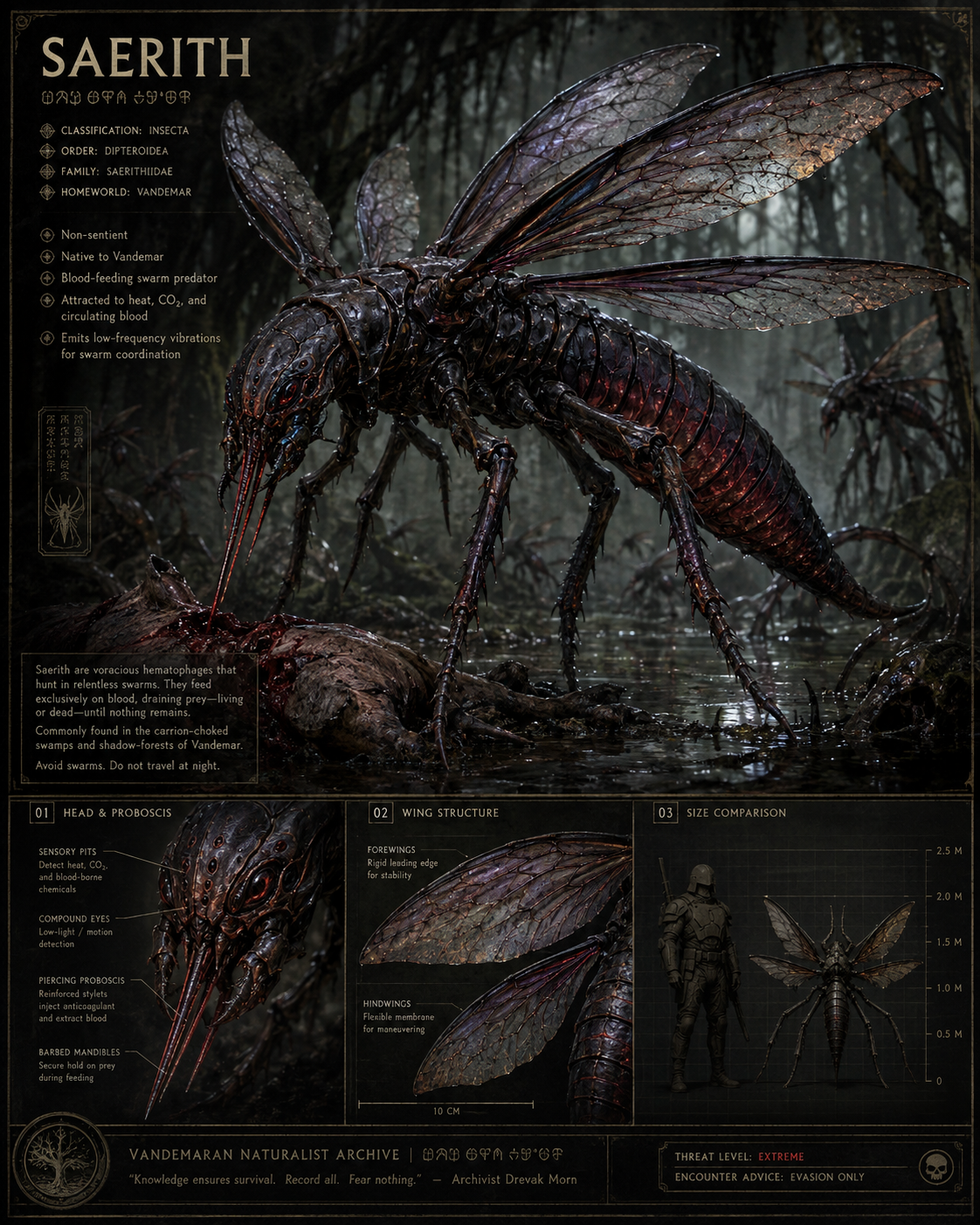
- Intent: To fill the world of Vandemar with interesting and diverse life that is intriguing to roleplay with.
- Image Credit:
- Canon: N/A
- Permissions: N/A
- Links: Vandemar
GENERAL INFORMATION
- Name: Saerith
- Designation: Non-sentient
- Origins: Vandemar; wetlands, deep forests and carrion-rich lowlands
- Average Lifespan: 3–5 standard years
- Estimated Population: Planetary; widespread, with dense seasonal concentrations
- Description: Saeriths are large predatory insects that follow bloodshed with unnerving precision. Their low, resonant wingbeat often reaches the wounded before help does. A lone specimen is an aggressive parasite; a feeding swarm can reduce a dying animal to bloodless ruin within minutes.
PHYSICAL INFORMATION
- Breathes: Type I atmosphere
- Average Height of Adults: 0.25–0.4 metres
- Average Length of Adults: 0.6–0.9 metres
- Skin color: Black, dark crimson, brown or bruised violet
- Hair color: None
- Distinctions: Saeriths possess six segmented limbs, two translucent wing pairs and an elongated puncturing proboscis. Their narrow abdomen expands considerably after feeding, exposing red vascular bands beneath the chitin. Sensory pits along the head detect body heat, blood aerosols and the chemical markers of injury. Females are larger and more heavily armoured, while males possess broader wings and longer antennae. Older specimens develop clouded wings and pale mineral scoring across the thorax.
- Races: None recognised. Marsh populations tend to be darker and broader-winged, while forest saeriths possess narrower bodies suited to dense vegetation.
- Force Sensitivity:Non-Sensitive
- Exceptional detection of blood, heat and wounded prey
- Anticoagulant venom and rapid swarm coordination
- Agile flight through dense woodland
- Fragile wings and lightly protected abdomen
- Highly vulnerable to cold and sudden temperature drops
- Sonic disruption can scatter or disorient swarms
CULTURE
- Diet: Hematophagous carnivore. Saeriths feed on blood, lymphatic fluid and exposed soft tissue. They prefer wounded or dying animals and rarely attack healthy large prey without a swarm. Several bitter wetland plants are poisonous to them.
- Communication: Wing vibrations, antenna contact, scent markers and rapid abdominal pulses. Feeding swarms generate a continuous low hum that can be felt through nearby surfaces.
- Technology level: None.
- Religion/Beliefs: None.
- General behavior: Saeriths gather around carrion, battle sites and active predators, often trailing hunting beasts from a safe distance. Queens establish colonies inside hollow trees, flooded caves, carcasses and abandoned machinery. Workers feed the queen and larvae with partially digested blood. When a nest is threatened, the swarm does not defend territory blindly; it follows the heat and breath of intruders through cover, attacking exposed joints, eyes and damaged armour seals. During winter, colonies retreat into insulated chambers and survive on preserved organic matter.
HISTORICAL INFORMATION
Saerith remains appear throughout Vandemar's fossil record, though the modern species grew larger after the arrival of imported megafauna and increased availability of dense forest carrion.
Early settlers attempted to eliminate them through chemical dispersal. This caused rapid carcass accumulation, disease outbreaks and uncontrolled growth among smaller scavengers. The species was subsequently reclassified as an ecologically necessary hazard.
Modern authorities destroy colonies near habitation zones but leave remote swarms undisturbed. Battlefield medics and forest wardens carry specialised repellents, for the saerith does not distinguish between the nearly dead and those who might yet be saved.