Star Wars Roleplay: Chaos

Register a free account today to become a member! Once signed in, you'll be able to participate on this site by adding your own topics and posts, as well as connect with other members through your own private inbox!

Private Resurgence of Wrath

Chapter 1 – Ashes in the Foundry

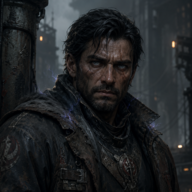
The air in the foundry was thick with iron and smoke, a living blackness that crept into the lungs like it had a memory of everyone who had ever breathed there. Honus Redtree worked with a rhythm that had become instinct, hammer striking molten steel, sparks flicking like tiny stars swallowed by the dark. He was a man whose name once stirred awe and fear, now reduced to calluses, soot, and the monotony of service.

He had saved a world once. The banners of victory still hung in dusty archives, but outside the walls of government, outside the gleaming spires of order, the people no longer remembered—or cared. Safety had become obedience, and obedience was rewarded with enough food and shelter to keep bodies alive while spirits rotted.

Mara appeared at the edge of his vision, moving with a grace that was cruel in its precision. She didn't speak; she didn't need to. The corners of her mouth hinted at amusement, a subtle twist that felt like a knife. She had always known how to cut deeper than the enemy ever could. Her presence was a reminder, a tether to a life Honus no longer controlled.

He glanced at her, feeling the years of erosion in himself. Honus remembered the battles, the victories, the faces of those who had fought beside him. They had faded, or worse, they had bent to the new order. And now he bent too, quietly, invisibly, hoping that surviving was enough.

The clang of metal against metal echoed through the cavernous hall, a heartbeat in the dark. Sparks flew, and for a moment, Honus let his mind drift—not to memories, but to the faint whisper of rebellion buried beneath the ash. Somewhere, buried beneath years of control and cruelty, there was still fire in him.

But to rise, he would have to first look at the world and ask if it was even worth saving.

And the answer… was not yet clear.

The bell sounded three times.

Not the shift bell. Not the meal bell. Not the dull iron clamor that told the foundry men when to lower their hammers and shuffle toward the ration troughs with their burnt hands and hollow eyes.

Three clean notes.

High. Silver. Official.

Every hammer stopped.

The foundry became a beast holding its breath.

Honus lowered his tongs slowly, letting the orange bar of heated steel rest inside the cradle. Around him, men and women stared at the floor. No one looked toward the western doors, though everyone knew what waited beyond them.

Mara did look.

She stood near the inspection rail above the work floor, hands folded before her, pale face untouched by soot. Somehow the smoke did not cling to her. It never had. Even in their little apartment, where rust bled down the pipes and the vents coughed black dust every morning, Mara remained clean, sharp, and preserved.

A woman made of glass and verdicts.

The western doors opened.

Cold air swept through the foundry, cutting the heat in half. It carried the sterile scent of the upper city: rainwater scrubbers, polished stone, electric ozone, and the faint chemical sweetness of the Ministry's uniforms.

Six Wardens entered first.

Their armor was smooth black ceramic, jointed at the elbows and knees, each chestplate marked with the white sigil of the Directorate: an open eye inside a gear. Their faces were hidden behind mirrored masks. They moved without hurry because everyone knew hurry belonged to people who could be stopped.

Behind them came a man in a dove-gray coat.

Auditor Caldus Venn.

Honus knew him. Not personally. Men like Venn did not know men like Honus personally. But he had seen him before, twice in the past year, walking the foundry floor with his ledger slate and soft smile, selecting names from the labor rolls. Those selected were always told they had been chosen for advancement.

No one ever returned advanced.

Foreman Pell stepped forward, removing his cap so quickly he nearly dropped it.

"Auditor Venn," Pell said, bowing his head. "Foundry Nine is honored by your presence."

Venn smiled. He was thin, neat, almost delicate, with silver hair combed flat against his skull. His eyes moved over the workers the way a butcher's thumb moved over meat.

"Honor is inefficient, Foreman," Venn said. "Compliance is preferred."

"Yes, Auditor. Of course."

Venn lifted his slate. Pale light washed his face from below.

"We are conducting an emergency requisition under the Safety Continuance Act. Industrial output in the northern defense sectors has fallen three percent below acceptable projections. The Directorate requires bodies."

No one breathed.

Bodies.

Not workers. Not citizens. Not souls.

Bodies.

Honus felt the old part of himself stir beneath the ash, that ancient inner thing with its scarred knuckles and bright teeth. He pushed it down. Hard.

Venn tapped his slate. "Names will be called. Those selected are to report immediately for transport. Refusal will be recorded as civic sabotage."

A woman three rows over began to shake. Her husband put one hand on her wrist, not to comfort her, but to stop her from making noise.

Venn read the first name.

"Arlen Vos."

A young man near Furnace Two went white. He could not have been more than nineteen. His arms were roped with new muscle, his face still soft in places the foundry had not yet burned away.

"No," someone whispered.

His mother.

Honus knew her by sight. Sella Vos. She cleaned slag drains on the lower level and sang old cradle hymns when she thought the vents were loud enough to hide her voice.

A Warden turned its mirrored face toward her.

The whisper died.

Arlen stepped out of line. His jaw trembled, but he walked.

Venn read another name.

Then another.

Each one struck the room like a hammer blow.

Honus kept his eyes lowered.

He had learned the geometry of survival: do not look too long, do not stand too straight, do not let pity become visible. Pity was heat. Heat drew instruments. Instruments drew blood.

"Lio Marrick."

This time, no one moved.

Venn glanced up.

"Lio Marrick," he repeated.

A small figure stood beside the coal lift, half-hidden behind a cart of scrap rivets. A boy. Fourteen, maybe fifteen, with a shaved head and hands too large for his wrists. His left sleeve was pinned empty at the elbow.

Honus knew him.

Everyone knew Lio.

The boy had lost the arm in a gear press six months before. The foundry had charged his mother for equipment disruption. When she couldn't pay, Lio's remaining service term had been doubled.

The boy stared at the Wardens.

"I can't go," Lio said.

His voice cracked in the middle.

The room seemed to shrink around him.

Venn's smile did not change. "You can walk, can't you?"

Lio swallowed. "My mother needs me."

"That is not relevant."

"She's sick."

"That is also not relevant."

"I only have one arm."

Venn looked down at his slate, then back at the boy. "The Directorate requires bodies, not excuses."

A Warden moved toward Lio.

The boy stepped back, knocking over the rivet cart. Metal scattered across the floor in a glittering spill. The sound was enormous.

The Warden reached for him.

And Honus moved.

Not far. Not dramatically. He did not roar. He did not leap into legend.

He simply stepped between the boy and the Warden.

The foundry changed.

Not in sound. There was no sound.

But in pressure.

Every worker felt it. Even the furnaces seemed to lower their flames.

The Warden stopped.

Honus stood with his hammer hanging at his side, shoulders bent from years of labor, beard threaded with gray, hair dark with sweat and soot. He looked like any other broken foundry man.

Almost.

Venn studied him.

Mara's eyes narrowed from the inspection rail.

"Worker," Venn said softly. "Move."

Honus did not.

He could feel Lio behind him, trembling like a wire in a storm.

The old heat rose again, spreading through Honus' chest, filling old cracks, touching scars that no doctor had ever seen. Once, that heat had answered prayers. Once, it had split the sky above the Black Fen and burned the wings from the god-engine called Vhor.

Once, men had screamed his name not in anger, but hope.

Redtree.

Redtree.

Redtree.

Now his name was a file sealed beneath six layers of Ministry denial.

Honus forced his fingers to relax around the hammer.

"He's damaged," Honus said.

His own voice startled him. Low. Rough. Unused to defiance.

Venn tilted his head. "A damaged tool may still be useful."

"He'll die in the northern works."

"Many do."

"He's a child."

Venn's smile thinned into something more honest. "There are no children under the Safety Continuance Act. Only dependents, contributors, and burdens."

The Warden took one step closer.

Honus looked into its mirrored mask and saw himself reflected there: old, soot-black, eyes sunken, spine bowed by invisible chains.

Then Mara spoke.

"Honus."

One word.

Not loud.

It cut through him all the same.

He turned his head slightly.

She had descended the iron stairs and now stood at the edge of the work floor. Her expression was calm, but her eyes carried the private venom she saved for closed doors.

"Don't embarrass yourself," she said.

A few workers glanced at Honus, then quickly away.

Mara walked toward him with measured grace. "You're tired. You're confused. You've been having spells again."

Honus felt the trap closing.

Spells.

That was what she called them. His moments of anger. His memories. His nightmares. His grief. Anything in him that had not yet been domesticated.

She turned to Venn. "My husband served during the old conflicts. His mind is unstable when provoked. I apologize for him."

The words landed soft as snow, cold as execution.

Venn's eyes sharpened.

"Your husband?" he asked.

Mara bowed her head slightly. "Honus Redtree."

There it was.

His name entered the room like a ghost with mud on its boots.

Foreman Pell flinched.

One of the older workers made a strangled sound and covered it with a cough.

Venn stared at Honus for a long moment.

Then he laughed.

Not loudly. That would have been less cruel.

"A relic," Venn said. "How quaint."

Honus said nothing.

Venn stepped closer, close enough that Honus could smell mint on his breath.

"I read your file when I was a student," the Auditor said. "Edited, of course. Sanitized. Full of patriotic exaggeration. The last hero of the old age. The man who broke the enemy at Aerrowdeep. The man who carried the Dawn Standard through the burning gate."

His smile returned.

"And here you are. Government property in a furnace room."

Honus' jaw tightened.

Mara touched his arm. To anyone watching, it might have looked gentle.

Her fingers dug into the tendon above his wrist.

"Come away," she whispered.

Only he could hear the rest.

"Or they will remember what you are."

The threat was not for him alone.

Honus knew that. He knew the machinery of punishment. The Directorate rarely struck the stone when the roots were easier to poison. If he resisted, they would not only take him. They would take Lio, Sella, Pell, half the row, anyone who had seen too much hope flicker and failed to report it.

That was how tyranny survived.

It made courage expensive for everyone nearby.

Honus looked back at Lio.

The boy's face was wet now, though he made no sound.

"Please," Lio mouthed.

Honus had once faced armies that blotted out valleys.

This was worse.

Slowly, Honus stepped aside.

Something inside him broke with a quiet, familiar sound.

The Warden seized Lio by the collar and dragged him forward. The boy stumbled, tried to keep his feet, failed, rose again. No one helped him.

No one could.

Venn tapped his slate. "Continue."

More names followed.

Honus heard none of them clearly. They reached him through water. Through years. Through the roar of a battlefield where better people had died believing the future would be clean.

At last, the requisition ended.

Fourteen workers taken.

Fourteen holes left in the foundry.

Venn turned before leaving. His gaze found Honus one final time.

"The Directorate honors your past service, Redtree," he said. "By allowing you to remain useful."

The Wardens marched out with the selected workers between them.

Lio looked back once.

Then the western doors closed.

The foundry stayed silent.

Foreman Pell cleared his throat, eyes fixed on nothing. "Back to work."

No one moved.

His voice cracked. "Back to work!"

The hammers rose.

The furnaces growled.

The world continued, obscene in its obedience.

Honus returned to his station. The steel bar he had left in the cradle had cooled too much. It was ruined now, dark and brittle at the edges.

He lifted it anyway.

Hammered it anyway.

Again.

Again.

Again.

Each strike rang wrong.

Mara remained beside him.

"You almost made a spectacle," she said.

Honus did not answer.

"You should be grateful I intervened."

The hammer fell.

"You're not built for noble gestures anymore."

The hammer fell.

"You're old, Honus."

The hammer fell.

"You're tired."

The hammer fell.

"And whatever you were, whatever songs they sang about you, that man is dead."

Honus stopped.

For one dangerous moment, he looked at her fully.

Mara's expression did not change, but something cautious moved behind her eyes.

There he was, beneath the soot and defeat.

Not dead.

Buried.

The difference mattered.

Honus leaned close enough that she could hear him over the furnace roar.

"Dead men don't dream," he said.

Mara's lips parted slightly.

Then the shift bell screamed.

Workers lowered their tools and began filing toward the ration hall, heads bowed, bodies bent. Honus hung his hammer on its hook and walked past Mara without waiting for permission.

Outside the foundry, evening had settled over the city of Vael Turog.

Once, it had been called Vael-Tura, the Valley of Lanterns. In Honus' youth, thousands of prayer lights floated above its river every dusk, each one carrying a wish, a grief, a promise, a blessing. The river had shone like a second sky.

Now the river was covered in steel grating.

The lanterns were illegal.

Above the foundry district, the upper city rose in tiers of white stone and black glass, its towers crowned with signal arrays and surveillance halos. Patrol lights drifted between buildings. Ministry announcements crawled across enormous screens in calm blue letters.

SECURITY IS MERCY.

SERVICE IS PEACE.

MEMORY IS A PRIVILEGE.

Honus stood in the street, soot cooling on his skin.

Far ahead, at the checkpoint where the Wardens had taken the requisitioned workers, someone began to sing.

A small voice.

Thin.

Defiant.

The words were old, older than the Directorate, older than the foundries, older even than the war that had made Honus into a weapon.

"Root below and star above…"

The song faltered as a Warden shouted.

Then another voice joined.

"Carry us through ash and blood…"

Honus closed his eyes.

A third voice rose.

Then a fourth.

The Wardens barked commands. There was the crackle of shock batons. A cry of pain.

Still, for a few breaths, the song lived.

Honus opened his eyes.

Across the street, beneath a broken drainage arch, someone watched him.

A woman in a hood the color of rainwater.

She was there for only a heartbeat. But before she vanished into the steam, she lifted two fingers to her brow, then touched them to her heart.

The old salute.

The salute of the Dawnbound.

Honus' breath caught.

They were dead.

They had to be dead.

He had buried them in his mind because the alternative was madness.

Mara appeared beside him, her voice low and polished.

"What are you looking at?"

Honus stared at the empty archway.

"Nothing," he said.

But beneath the city, beneath the iron, beneath the years of shame and silence, something had shifted.

A root had found water.

And far away, in some locked chamber of the world, the past opened one ember-bright eye.

Honus did not go home by the main stair.

Mara noticed.

Of course she noticed. Mara noticed the smallest rebellions. A cup set too sharply on a table. A silence held one breath too long. A glance toward a locked door. She collected such things the way old priests had once collected bone charms, turning them over in private, naming their sins.

"The south lift is faster," she said.

Honus kept walking.

"The south lift has light," she added.

Still, he walked.

The foundry district was a maze of brick corridors, steam gutters, ash alleys, and overhead pipes sweating black condensation. It had not been designed for beauty. It had been designed for output, containment, and easy surveillance. Yet there were corners where the cameras had gone blind from age and grime. Corners where old stone still showed through the poured concrete. Corners where the city remembered itself.

Honus knew them all.

Or he had once.

He turned into Cinder Lane, a narrow passage between the slag silos and the wall of Furnace House Three. The ground sloped downward. Water dripped from pipes overhead, hissing where it struck warm metal grates.

Mara followed him.

Her shoes clicked behind him with irritating precision.

"You saw someone," she said.

Honus said nothing.

"Under the arch."

Nothing.

"A woman?"

The word entered him like a needle, searching.

Honus stopped beneath a dead lamp. Its glass was cracked. Moths gathered inside it anyway, battering themselves against darkness with idiot devotion.

Mara smiled faintly.

"There it is."

He turned.

"What?"

"That look." She took one step closer. "You were always terrible at hiding hope."

Honus stared at her.

The foundry noise had faded behind them. Down here, the city sounded different. Pipes groaned in the walls. Somewhere far below, machinery churned with the slow appetite of an underground god. Above them, the patrol lights moved across the smog clouds in pale, searching sweeps.

"I saw a stranger," Honus said.

Mara's smile sharpened. "No. You saw a ghost, and you wanted it to be real."

He almost answered.

Almost.

That was the danger with Mara. She could make silence feel like surrender and speech feel like self-harm. Every conversation with her was a room with knives hidden in the furniture.

"You should be careful," she said. "The Directorate has been merciful with you."

Honus laughed once. It came out dry and ugly.

Mara's face hardened.

"Mercy," he said. "That's what we call cages now?"

"That is what we call restraint."

"Whose?"

"Harlon Pike raised his voice at a ration audit last month," Mara said. "His daughters were reassigned to ceramic processing by morning. Nessa Vey hid a banned hymn sheet under her mattress. Her husband lost his work allotment. You stood between a Warden and a requisitioned laborer today."

"A boy."

"A laborer." Her voice was flat now, stripped of perfume. "And you did it in front of witnesses."

Honus stepped toward her.

For a moment, Mara's eyes flicked to his hands.

Good, he thought.

Let her remember something too.

"I stepped aside," he said.

"Yes." Her mouth barely moved. "You did. And that is why we are walking home instead of being dragged to an extraction room."

He looked away first.

It tasted like rust.

Mara adjusted the cuff of her sleeve. "You think restraint makes you a coward. It does not. It makes you manageable."

There it was.

A word too cleanly chosen.

Honus looked at her again.

Mara realized the mistake a heartbeat too late.

"Manageable," he repeated.

Her expression softened at once, but the machine behind it had already shown through.

"You know what I mean."

"No," Honus said. "I don't think I do."

She came closer and touched his cheek. Her hand was cool. Her eyes were wet now, or pretending to be. She had many faces and kept them polished.

"I mean I worry for you," she said. "I mean I am tired of watching you bleed against walls you cannot break. I mean I have buried enough of you already."

A passing patrol light swept over the alley, painting them both in white.

Honus did not move until it passed.

Then he took her wrist and lowered her hand from his face.

Gently.

That gentleness angered her more than force would have.

They walked the rest of the way in silence.

Their apartment was on the twenty-third tier of Block Halberd, a workers' habitation stack bolted to the eastern side of the foundry hill. The building was a vertical bruise of concrete, iron balconies, laundry wires, and surveillance nodes. Every window was identical. Every door bore a number. Every number belonged to the state before it belonged to a person.

Their door read: H23-19.

Inside, the apartment smelled of boiled grain, sterilizing acid, and the faint lavender Mara rubbed into her wrists each morning. The rooms were small but orderly. Too orderly. There were no loose papers, no old photographs, no useless beloved objects. Mara disliked clutter, especially the kind that carried memory.

Honus removed his boots by the door.

Mara removed her gloves.

A domestic ceremony. Two prisoners pretending the ritual meant home.

On the wall above the cooking unit, the Ministry screen flickered awake. A woman with copper hair and dead blue eyes smiled down at them.

"Good evening, citizens. Today's Harmony Index has risen by point-four percent across the lower industrial sectors. Your obedience has saved lives."

Honus reached for the switch.

Mara spoke without looking at him. "Leave it."

His hand stopped.

The screen continued.

"Reminder: unauthorized songs, ancestral rites, pre-Directorate symbols, and unregistered gatherings remain punishable under civic destabilization statutes. Report irregular sentiment. Care is vigilance."

Mara set water to boil.

Honus stood in the middle of the room and watched the screen until the smiling woman's face blurred into light.

Unauthorized songs.

Root below and star above.

He remembered the rest.

Not because he wanted to.

Memory came anyway, dragging its chains.

Carry us through ash and blood,
Keep the names beneath the flood,
When the tyrant crowns the flame,
Wake the root and speak the name.

He had heard it first as a child in Redtree Hollow, sung by his grandmother while she carved prayer marks into bark. Back then, the world had still believed in small holy things. Bread left beneath stones for the burrowing spirits. Bells rung at dusk for the dead. Children taught that every river had a temper and every mountain a memory.

The Directorate called those beliefs primitive now.

Honus called them roots.

Mara set a bowl in front of him.

Gray mash. Protein oil. Salt if one felt decadent.

He sat.

She sat across from him, watching him eat before touching her own food. That too was ritual. She liked to see whether his hands shook.

They did not.

Not tonight.

That worried her.

"You should request a neural rest assessment," she said.

Honus swallowed. "No."

"You haven't been sleeping."

"No one in this building sleeps. The pipes scream."

"That is not what I mean."

"I know what you mean."

Her spoon clicked against the bowl.

"Do you?" she asked. "Because from where I sit, you seem determined to invite scrutiny."

Honus looked around their immaculate little room.

"No shrine," he said. "No books. No relics. No visitors. No missed shifts. No excess speech. I go to work. I come back. I eat what they give me. I sleep when I can. What more do they want?"

Mara's eyes did not blink.

"Your peace."

His laugh came again, quieter this time.

"They took that before they sent you."

The room changed.

Only slightly.

A tightening in Mara's jaw. A stillness in her shoulders. A thread pulled too hard through cloth.

"What did you say?"

Honus leaned back.

The chair creaked under him.

"I said they took my peace."

"No." Mara's voice dropped. "You said before they sent me."

The Ministry screen filled the silence with its gentle poison.

"Tomorrow begins Civic Gratitude Week. Citizens are encouraged to submit testimonies honoring the Directorate's protection."

Honus should have denied it.

He should have looked confused. Tired. Apologetic. Manageable.

Instead, he watched Mara watch him.

A strange calm entered him. Not courage exactly. Something older and less clean. The calm of a man finally hearing the floor crack beneath a house he already knew was rotten.

"How long?" he asked.

Mara stood.

The movement was too quick.

"You're unwell."

"How long, Mara?"

She took his bowl and carried it to the sink though he had not finished eating.

"You need sleep."

"Were you assigned before the wedding?"

Her hand tightened around the bowl.

"Stop."

"After Aerrowdeep?"

The bowl struck the counter. Mash slopped over the rim.

"Stop."

"After I refused the Directorate seat?"

That did it.

Her face lost every mask at once.

For a heartbeat, Honus saw the woman beneath: not wife, not caretaker, not wounded companion. An operative in a plain apartment, holding a life in both hands and squeezing until it stopped resisting.

Then she gathered herself.

But he had seen it.

And she knew he had.

"You think you refused power," she said softly. "That is the story you tell yourself because it lets you feel noble. You did not refuse power, Honus. You abandoned responsibility. Men like you break the world and then wander off when it needs governing."

Honus rose.

The chair scraped the floor.

"I saved it."

"You saved a battlefield." Her eyes flashed. "You did not save the future. Others had to do that. Others had to build systems, laws, walls, surveillance, punishments. Others had to keep frightened people from tearing each other apart while you hid inside your grief."

He stared at her.

There was conviction in her voice.

That was the worst of it.

Not all monsters know they are monsters. Some sleep beautifully because they call the cage a cradle.

"You believe them," he said.

Mara lifted her chin.

"I believe order is kinder than chaos."

"You believe chains are kinder than choice."

"I believe most people do not know what to do with choice."

"Then you never knew my people."

"Your people are gone."

The words hit harder than he expected.

Mara saw it and pressed.

"The old world is gone. The valley rites, the wandering councils, the Dawnbound, the little songs sung to trees and stones. Gone. And perhaps they deserved to go, because when the iron came down from the north and the sky opened, all their lovely beliefs could not save them."

Honus crossed the room so fast she stepped back.

The old heat flared in him. The light above them buzzed. The Ministry screen stuttered.

For one moment, the apartment smelled not of grain and acid, but of storm rain on split cedar.

Mara went pale.

Honus stopped himself inches from her.

His hands were open.

His voice, when it came, was barely human.

"They saved me."

The screen crackled.

The smiling announcer's face warped, dissolved, returned.

Mara looked at the light. Then at him.

Fear moved through her.

Not fear of a husband.

Fear of a file coming alive.

Honus felt it then. Beneath his ribs. Beneath scars and age and all the careful ruin. A pulse.

Small.

Furious.

Impossible.

He stepped back, breathing hard.

Mara's fear vanished behind calculation.

"Do you know what happens," she whispered, "if they detect a resurgence?"

He said nothing.

"They will not send Wardens next time. They will send a Saint Engine."

Honus' blood cooled.

The words had weight. Old weight. War weight.

Saint Engine.

He had not heard that term in twenty years.

The original Saint Engines had been built during the Last War, when desperation gave engineers permission to commit theology with tools. Machines wrapped around harvested relics. Steel bodies powered by murdered miracles. They had fought for the old coalition at first.

Then the Directorate inherited them.

Then they improved them.

Mara watched recognition pass across his face.

"Yes," she said. "You remember. So remember this too: you are not what you were. You cannot stand against one now."

"Why?" Honus asked.

Her brow tightened. "Why what?"

"Why warn me?"

She did not answer.

"Is that in your assignment too?"

The slap came hard enough to turn his head.

Silence followed.

The Ministry screen continued smiling.

Honus slowly faced her again.

Mara's hand trembled at her side.

Not from remorse.

From anger that she had lost control of the room.

"You will go to bed," she said.

"No."

"You will go to bed, and tomorrow you will go to the foundry, and you will forget whatever you think you saw under that arch."

"No."

A muscle jumped in her cheek.

"Honus."

He walked past her into the smaller room.

Their sleeping quarters contained one bed, two metal lockers, and a narrow window looking out over the lower city. Honus opened his locker.

Inside were folded work clothes, two spare shirts, a shaving blade, and nothing else.

At least, nothing visible.

He knelt and pressed his thumb against a small dent near the back corner.

The locker's false bottom clicked.

Behind him, Mara entered the doorway.

"What are you doing?"

Honus lifted the panel.

Beneath it lay a strip of red cloth, faded almost brown with age.

Mara inhaled sharply.

Not because it was a weapon.

Because it was worse.

A memory.

Honus lifted the cloth with both hands.

It had once been tied around the haft of the Dawn Standard. Not the banner itself, not anything grand enough for archives, just a torn binding strip he had taken from the battlefield after Aerrowdeep. Red for the valley clay. Red for the tree sap that bled when cut. Red for the dead who had bought morning with their bodies.

Mara stared at it.

"You told me you burned everything."

"I lied."

Her face twisted. "You kept contraband in our home?"

"Our home?" he asked.

That landed.

She looked away.

He stood and wrapped the cloth once around his wrist.

It barely fit. His hands had grown thicker with labor, knuckles swollen from years of hammer work. The cloth was old and weak, but when it touched his skin, the pulse beneath his ribs answered.

Not loudly.

Not yet.

But enough.

From somewhere outside came a distant sound.

A shout.

Then another.

Honus turned to the window.

Down below, in the street near the checkpoint, people were gathering. Not many. A dozen, perhaps. Maybe less. Shadows in work coats. Heads bowed. One held a lantern cupped in both hands, its light hidden beneath cloth.

Illegal.

Beautiful.

Madness.

Mara moved beside him and looked down.

"No," she said.

The word had no command in it now.

Only dread.

The gathered figures began to sing.

Softly at first.

Root below and star above.

Honus closed his eyes.

Carry us through ash and blood.

More voices joined from nearby windows. One from the stack across the alley. Another from the walkway above. A woman's voice. An old man's. A child's.

Keep the names beneath the flood.

The Ministry screen in the other room shrieked.

"Unauthorized civic gathering detected. Remain indoors. Remain peaceful. Report participants. Security response is mercy."

Mara seized Honus' arm.

"Do not move."

He looked at her hand.

Then at her.

For years, that grip had been enough.

Not tonight.

He removed her fingers one by one.

She backed away as though he had burned her.

"Honus," she whispered, and for the first time in years, his name sounded less like a leash and more like a plea.

He opened the apartment door.

The hall outside was full of faces.

Workers stood half in shadow, doors cracked open behind them. No one spoke. No one dared. But they saw the red cloth on his wrist.

An old woman across the hall covered her mouth.

A man with a scarred scalp began to weep without sound.

Honus walked past them toward the stairwell.

Mara followed only as far as the threshold.

"Saint Engines," she called after him.

He paused.

"They will send Saint Engines."

Honus looked back.

The hall light flickered over his soot-dark face.

"Then they should send more than one."

He descended.

Each step downward felt impossible, then less impossible, then inevitable.

By the time he reached the street, the patrol sirens had begun.

The singers did not scatter.

They should have.

Any sensible person would have run. Any living person with a taste for remaining living would have vanished into alleys and doorways and vents.

But grief had fermented into something stronger than sense.

Fourteen workers had been taken.

A boy with one arm had been taken.

And perhaps, Honus thought, there are numbers tyranny cannot count because they do not fit inside a ledger.

He stepped into the street.

The song faltered.

People turned.

The lantern bearer lowered her cloth.

Warm gold light spilled over the wet stones.

The hooded woman from the arch stood at the center of the gathering.

Now Honus saw her clearly.

She was older than he had first thought, perhaps fifty, with dark skin lined by weather and worry, her hair braided close to her scalp and threaded with bits of copper wire. One side of her face bore a burn scar shaped like a wing. Her eyes were bright, merciless, alive.

She looked at the cloth on his wrist.

Then she dropped to one knee.

Honus froze.

One by one, the others knelt.

Not in submission.

In recognition.

The hooded woman spoke the words forbidden by law, erased from schoolbooks, buried in sealed records and old blood.

"Dawn returns to root."

Honus' throat closed.

He knew the response.

Of course he knew it.

Twenty years of silence had not killed it.

He looked at the kneeling workers, the illegal lantern, the patrol lights converging through the smog.

Then he answered.

"Root remembers dawn."

The city seemed to hear him.

Somewhere high above, alarms changed pitch.

The hooded woman rose.

"My name is Edda Vale," she said. "Dawnbound, last cell of the eastern quarter."

Honus could barely breathe.

"How many?"

Her smile was grim.

"Enough to die badly."

"That's not enough."

"No," Edda said. "But it is enough to begin."

A patrol skimmer swept around the corner, lights blazing white. Wardens spilled from its open sides before it fully stopped, batons alive with blue current.

A command voice thundered through the street.

"Disperse immediately. This gathering is unlawful. Kneel and place your hands behind your heads."

A few singers flinched.

None moved.

Honus turned toward the Wardens.

There were eight of them.

Mara had been right.

He was old.

He was tired.

He was not what he had been.

But the first Warden came too close.

It reached for Edda.

Honus caught its wrist.

The armor was cold and smooth beneath his fingers. Stronger than bone. Stronger than flesh.

The Warden's head snapped toward him.

"Release."

Honus tightened his grip.

Something inside the armor began to grind.

The Warden swung its baton.

Honus moved before thought could catch him.

His shoulder dipped. His left foot slid. The old forms rose through his body, not graceful, not untouched by age, but present. He drove his palm into the Warden's chestplate.

The impact cracked ceramic.

The Warden flew backward into the skimmer hard enough to dent its side.

For one bright, stunned second, no one moved.

Honus stared at his hand.

Pain bloomed through his wrist.

Real pain.

Human pain.

He almost laughed.

Then the remaining Wardens charged.

The street erupted.

Edda threw the lantern.

It shattered at the feet of the second Warden, and fire rushed outward in a golden sheet. Someone screamed. Someone else swung a length of pipe. A woman leapt from a stair rail onto a Warden's back and drove a mining pick into the joint below its helmet.

Honus took the next baton strike across his ribs.

Agony flashed white.

He staggered.

The Warden raised its weapon again.

Honus caught the second blow on his forearm, stepped in, and slammed his forehead into the mirrored mask.

The mask cracked.

Behind it, something wet gasped.

Not machine.

A person.

The realization sickened him, but he did not have room for sickness.

He hooked his hand behind the Warden's neck and drove it down into his rising knee. Armor buckled. The body fell.

Another baton struck his back.

He dropped to one knee.

Old injuries opened their mouths. His spine screamed. His lungs forgot their task.

Too slow, he thought.

Too old.

A Warden aimed its baton at Edda's skull.

Honus reached for heat.

Nothing came.

Only pain.

Only breath.

Only the terrible distance between legend and man.

Then the singers rose behind him.

Root below and star above.

The words struck the street like rain on buried seed.

Carry us through ash and blood.

Honus felt the pulse again.

Small.

Furious.

Not in him alone.

In the stones.

In the people.

In the forbidden song passing from mouth to mouth like fire learning to walk.

The red cloth on his wrist tightened.

No, not tightened.

Rooted.

Fine red fibers sank into the cracks of his skin. Not cutting. Remembering.

Honus stood.

The Warden turned.

The baton came down.

Honus caught it barehanded.

Blue current crawled over his arm, burning through sleeve and skin.

He did not let go.

The Warden tried to pull back.

Honus pulled harder.

The baton snapped in half.

The street went quiet around the broken sound.

Honus drove the shattered end through the Warden's knee joint. It collapsed. He struck again, crushing the baton housing against the pavement until sparks died like insects under glass.

The last three Wardens hesitated.

That saved them.

A siren wailed from the upper road.

Heavier.

Deeper.

Edda's face changed.

"Saint," she said.

Honus looked toward the rise.

At the top of Cinder Lane, something vast stepped through the steam.

It was shaped like a man only in the way a gallows is shaped like a tree. Nine feet tall. White armor plated over black synthetic muscle. Its shoulders bore scripture etched in machine-cut lines. Its head was smooth, featureless, crowned by a halo of rotating brass blades.

In the center of its chest, behind glass, something glowed.

Not a reactor.

Not a battery.

A relic.

A caged holy thing.

The Saint Engine lifted one hand.

The air filled with pressure.

Windows cracked along the habitation stack. The illegal lantern fire guttered flat. People cried out and dropped to the ground.

A voice emerged from the Saint Engine, layered and calm.

"Honus Redtree."

His name rolled through the street with cathedral weight.

"By authority of the Directorate, you are recalled for containment."

Honus felt every year of his life settle onto his bones.

Behind him, Edda whispered, "Can you fight it?"

He looked at the Saint Engine.

At the caged glow in its chest.

At the people huddled behind him.

At the upper windows where hundreds of faces now watched from darkness.

Mara stood on the balcony twenty-three stories above, one hand at her throat.

Honus raised his right hand.

The red cloth fluttered though there was no wind.

"No," he said.

Edda's face fell.

Then Honus smiled, and it was a grim old thing with blood in its teeth.

"But I can make it remember me."

The Saint Engine charged.

And Honus Redtree, last hero of a world that had forgotten how to kneel to anything but fear, stepped forward to meet it.
 
Chapter 2

The Saint Engine

The Saint Engine came down Cinder Lane like judgment taught to walk.

Every step cracked stone. Every motion sang with gears, hidden pistons, and old sanctity forced through wires. The rotating brass halo above its smooth white head carved the steam into ribbons. Its chest burned with imprisoned light, pale gold behind glass, pulsing in time with something that might once have been a heart.

Honus remembered when relics had been kept in cedar boxes and wrapped in rivercloth.

He remembered old priests washing their hands before touching them.

He remembered children leaving flowers at roadside shrines, not because anyone commanded them to, but because gratitude had once been ordinary.

Now a miracle was locked inside a war machine.

That, more than the armor, more than the blades, more than the voice that had spoken his name, filled him with rage.

Not the hot rage of youth. That had been bright and wasteful. This was older. Darker. A coal buried deep under mountain stone.

The Saint Engine struck first.

Its arm blurred.

Honus barely moved in time. The fist passed where his ribs had been and punched into the wall of the habitation stack. Concrete burst outward. People screamed from the floors above as the whole building shuddered.

Honus drove his shoulder into the Saint Engine’s side.

It did not move.

Pain detonated through him.

He staggered back, teeth clenched, breath broken in his throat. The old songs had made him stronger, yes. The red cloth had woken something, yes. But strength was not youth. Strength was not magic enough to make bones forget their history.

The Saint Engine turned its blank face toward him.

“Combat capacity diminished,” it said.

Honus spat blood onto the street.

“Yours or mine?”

The halo blades accelerated.

Edda Vale shouted from behind him. “Move!”

Honus dropped.

A blade of light snapped from the Saint Engine’s palm and cut through the air above him. It sliced the iron balcony supports on the opposite building. Metal screamed. A section of balcony sagged, tearing loose from the wall.

Three people clung to the railing as it fell.

Honus moved without thinking.

The old forms returned in fragments. Foot. Breath. Hand. Weight. He crossed the street in four strides, leapt through falling sparks, and caught the broken balcony’s lower strut with both hands.

The weight hit him like a collapsing bridge.

His knees buckled.

A woman screamed above him. A child sobbed. Someone shouted his name, not as legend, not as prayer, but as raw animal terror.

Honus planted his boots.

Stone cracked beneath them.

The balcony slowed.

Stopped.

For one heartbeat, the whole street stared.

Then Edda barked, “Get them down!”

Workers surged forward. Hands reached up. The three trapped people were pulled from the twisted railing and dragged into the alley.

Honus released the strut and let the balcony crash.

Too late, he sensed the Saint Engine behind him.

A white hand closed around his throat.

The world lifted.

Honus struck the machine’s wrist. Once. Twice. His blows rang uselessly against armor. The Saint Engine raised him until his boots kicked above the street. Its featureless face leaned close.

“Honus Redtree,” it said. “Former Dawnbound commander. Former bearer of the Dawn Standard. Former strategic asset of the free valley coalition. You are required for containment, examination, and historical correction.”

Honus clawed at the fingers around his throat.

Historical correction.

That was what they called murder when the corpse was famous.

The glow in the machine’s chest brightened.

Through the glass, he saw movement.

Not flame.

Not electricity.

A small shape curled in light.

A hand.

A child’s hand.

No.

Honus stopped struggling.

The Saint Engine misread it as surrender.

“Compliance preserves civic stability.”

Honus stared into the chest chamber.

The hand moved again, pressing against the inside of the glass.

He remembered the war laboratories after the fall of Aerrowdeep. He remembered rumors. Children born under shrine signs. Infants who could hear the old rivers. Orphans with impossible blood. The Directorate had promised protection.

Protection.

That word again, robed and perfumed, hiding its teeth.

“You put a child in there,” Honus rasped.

The Saint Engine did not answer.

It did not need to.

Honus wrapped both hands around the machine’s wrist. The red cloth on his own wrist tightened, fibers glowing dull crimson.

Below him, Edda saw.

Her face changed from fear to horror to understanding.

“Sing!” she shouted.

No one moved.

Edda turned on the gathered workers with the fury of a struck bell.

“Sing, damn you! Sing or watch him die!”

A trembling voice rose from the street.

“Root below and star above…”

Another joined.

Then another.

The song climbed the walls.

The Saint Engine’s halo stuttered.

Honus felt the pulse answer beneath the stones. Not strong. Not clean. The city had been paved, bolted, surveilled, and poisoned. But beneath all that, under concrete and pipes and law, the valley was still there.

Root below.

Star above.

Honus pulled.

The Saint Engine’s grip tightened. His vision filled with black sparks.

He pulled harder.

The armor around its wrist groaned.

The machine drove him into the pavement.

Stone burst beneath his back.

Air fled his lungs. The world went silent. He saw the sky between buildings: smog, patrol lights, one pale star fighting through the industrial murk.

The Saint Engine lifted its foot over his chest.

“Asset resistance exceeds acceptable threshold.”

Honus could not move.

His body had become a country after invasion. Broken roads. Burning farms. Bells ringing in drowned churches.

The foot descended.

Then Edda slammed a mining charge against the Saint Engine’s knee.

She had crossed the street under its shadow, mad woman, magnificent fool, carrying death in both hands.

“Dawnbound sends regards,” she said.

The charge blew.

The explosion folded the Saint Engine’s leg sideways. White armor cracked. Black synthetic muscle snapped and whipped through the smoke. The machine staggered, foot missing Honus by inches.

Edda was thrown back. She struck the ground hard and rolled, one arm bent wrong beneath her.

Honus forced himself up.

Everything hurt.

Good.

Pain meant he remained inside his body.

The Saint Engine tried to stand, its damaged leg shrieking as internal mechanisms corrected the break. The relic-child inside its chest glowed brighter, feeding repair systems with stolen wonder.

Honus stepped close.

The machine raised its arm.

He caught it.

This time, he did not strike the armor.

He placed his palm flat against the glass chamber in its chest.

The Saint Engine froze.

Honus closed his eyes.

“Little root,” he whispered.

The words came from nowhere and everywhere. Some old valley blessing. Some grandmother’s breath. Some buried grammar of mercy.

Inside the chamber, the small hand pressed against his.

Light flooded his bones.

The street vanished.

For a moment, Honus stood in a forest that no longer existed.

Redtree Hollow.

Tall black trunks. Leaves like copper coins. Mist between roots. Prayer knots tied in branches. His grandmother kneeling beside a spring, washing blood from his boyhood hands after he had killed a rabbit and wept over it.

“Life answers life,” she had told him. “Power answers hunger. Learn the difference, Honus.”

The vision shattered.

He was back in Cinder Lane, palm burning against the Saint Engine’s chest.

The relic-child was not speaking with words.

It was afraid.

It was tired.

It was old and young at once.

Honus opened his eyes.

“I know,” he said.

The Saint Engine’s free hand closed around his shoulder and began to squeeze.

Bone creaked.

Honus did not move his palm from the glass.

“I know,” he said again.

Then he drove his fist into the chamber.

The glass did not break.

A shockwave threw him backward. He crashed into the street and skidded through ash water. The Saint Engine staggered too, chest flashing with warning light.

Its voice warped.

“Relic integrity threatened. Containment priority elevated.”

Honus rose to one knee.

The patrol sirens changed again.

More lights appeared at the top of the lane.

Edda crawled toward him, face slick with blood.

“Honus,” she gasped. “We have to go.”

He looked at the Saint Engine.

Its damaged leg had nearly repaired itself.

The child’s hand was gone from the glass.

“We can’t leave it,” he said.

“We can’t save it dead.”

The words struck true.

Honus hated them.

More Wardens appeared through the steam. A second skimmer descended overhead, its searchlight sweeping across the street. From the habitation blocks, the singers began to vanish back into windows and doorways. Courage could burn bright, but bodies were still bodies, and batons still broke them.

The Saint Engine straightened.

Its halo resumed full speed.

Edda grabbed Honus’ arm with her good hand.

“Now!”

A smoke canister burst against the street between them and the Saint Engine. Thick black vapor erupted upward, swallowing light. Another canister landed. Then another.

Figures moved through the smoke.

Not Wardens.

Workers.

Dawnbound.

A man with a red scarf pulled Edda to her feet. A young woman with cropped silver hair threw Honus’ arm over her shoulder, though he nearly crushed her under his weight.

“I can walk,” he growled.

“Then start proving it,” she snapped.

He liked her immediately.

They ran.

Not gracefully. Not heroically. They fled through alleys slick with oil and rain, down rust ladders, under steam conduits, through a maintenance gate that should have been locked but opened at Edda’s bloodied touch.

Behind them, the Saint Engine’s voice rolled through the district.

“Honus Redtree. Return to containment.”

Honus looked back once.

Through the thinning smoke, he saw it standing in the street, white armor cracked, halo spinning, chest glowing like a stolen dawn.

Then the gate slammed shut.

Darkness took them.

For several minutes, the world became tunnels.

Honus moved by memory and pain. The silver-haired woman stayed under his arm, muttering insults every time he stumbled.

“You’re heavier than the songs implied.”

“The songs were written by friends.”

“They were generous.”

“Friends usually are.”

She glanced up at him, surprised, then gave a sharp laugh.

Edda limped ahead, supported by the man in the red scarf. Her injured arm hung uselessly. She should have been screaming. Instead she gritted her teeth and led them through a passage so narrow Honus had to turn sideways.

At last they reached a round metal door set into old stone.

Not concrete.

Stone.

Ancient blocks, damp with groundwater, marked by carvings the Directorate had failed to sand away. Roots. Stars. Open hands. Birds with human eyes. The old valley script curled around the doorway, half-hidden beneath mineral stains.

Honus touched the nearest mark.

It warmed beneath his fingers.

A lock clicked.

The door opened inward.

Warm air breathed out.

Not foundry heat. Not machine heat.

Living heat.

They entered a chamber beneath the city.

Honus stopped.

For the first time in twenty years, he saw a shrine.

Not a grand one. Not like the river temples of Vael-Tura or the cedar halls of Redtree Hollow. This was a hidden thing, built from salvage and devotion. Candles burned in broken engine housings. Prayer ribbons hung from pipes. Bowls of clean water rested on crate altars. A sapling grew from a crack in the stone floor, thin and pale, its leaves red as fresh wounds.

People filled the chamber.

Dozens.

Some wounded. Some old. Some barely more than children. Foundry workers, pipe runners, ration clerks, teachers, sweepers, mothers with infants tucked under coats. Ordinary people with frightened eyes and stubborn mouths.

When Honus entered, every voice died.

He hated it at once.

The silence of expectation was another kind of chain.

Edda lowered herself onto a crate with a grunt. “Don’t stare at him like he’s a statue. He bleeds. I saw plenty.”

That broke the spell.

A few people looked away. Someone fetched bandages. Someone else brought water. The silver-haired woman helped Honus sit on a stone bench near the sapling.

He sank down heavily.

His body began reporting damages with bureaucratic enthusiasm.

Cracked ribs, likely. Torn shoulder. Burned palm. Bruised spine. Split lip. Old knee furious. Pride unstable.

The silver-haired woman crouched in front of him and examined his pupils.

“I’m Tavi,” she said.

“Honus.”

She snorted. “Yes, that part made it through the riot.”

“You’re a healer?”

“I’m a mechanic.”

“Then why are you looking at my eyes?”

“Checking whether the relic cooked your brain.” She lifted one eyelid with no tenderness whatsoever. “Hard to tell. You already have the stare of a man who argues with ghosts.”

Honus glanced toward Edda. “Is she always like this?”

“Worse when she likes someone,” Edda said through clenched teeth as another Dawnbound wrapped her arm.

Tavi gave a knife-thin smile. “You’ll know when I don’t.”

Honus looked at the hidden shrine again.

“How many cells?”

Edda’s humor faded.

“Three in the eastern quarter. Maybe two in the northern stacks, though we lost contact after the textile raids. One beneath the river grates. Small. Poorly armed. Half-starved.” She swallowed as the bandage tightened around her arm. “Alive.”

Honus looked at the sapling.

Its red leaves trembled though there was no wind.

“Why reveal yourselves now?”

Edda stared at him.

“They took Lio.”

Honus felt the boy’s name settle in the room.

“He’s yours?”

“No.” Her mouth tightened. “He is ours. That used to mean something.”

Yes, Honus thought.

It had.

Tavi stood and wiped blood from her hands onto her trousers.

“The requisition convoy will take the selected workers to Northgate Processing first,” she said. “After that, they’ll be split. Mines. defense works, organ debt, Saint candidate screening if anyone lights up pretty under the knives.”

Honus looked at her.

Saint candidate screening.

The chamber seemed to tilt.

“How do you know that?”

Tavi’s eyes hardened.

“My brother was selected three years ago. We got his hand back in a sealed apology box.”

No one spoke.

The candles bent in the stale air.

Honus looked down at his own burned palm. The skin was blistered where it had touched the Saint Engine’s chest.

Inside that armor, a child had pressed back.

“How many Saint Engines does the Directorate have?” he asked.

Edda and Tavi exchanged a look.

“Officially?” Tavi said. “None. They’re propaganda myths from the war, according to the schools.”

“And unofficially?”

“We know of seven active in Vael Turog,” Edda said. “Maybe more. One stationed in each major district. One at the Ministry Citadel. One mobile unit assigned to special containment.”

“The one tonight.”

Edda nodded.

Honus breathed slowly.

Seven.

Twenty years ago, he had destroyed two Saint Engines with a company of Dawnbound, three shrine-bearers, artillery support, and a sky full of desperate gods.

He had been younger then.

The gods had been louder.

“Can they track me here?” he asked.

Tavi shook her head. “Not easily. These tunnels predate the surveillance grid. Old waterworks, shrine roads, smuggler cuts. Half the city sits on bones it doesn’t remember.”

Edda leaned forward. Sweat shone on her brow.

“But they will search. Block by block. Door by door. Mara will report everything she knows.”

Honus looked up.

The name struck something tender and infected.

“Mara already has.”

Edda’s eyes narrowed.

“You knew?”

“I suspected.”

“And you stayed with her?”

Honus said nothing.

Tavi’s voice softened slightly. Only slightly.

“Handlers don’t just watch people. They build rooms inside their heads.”

Honus looked at her.

There was knowledge there. Personal. Scar-deep.

Before he could answer, the round door groaned open again.

A scout stumbled in, breathless and soaked with rain.

“Wardens sealed Cinder Lane,” he said. “They’re pulling people from Block Halberd. Floor by floor.”

Honus stood too fast.

Pain flashed. Tavi shoved him back with one hand.

“Sit down, mountain.”

“They’re taking the residents because of me.”

“They were taking them before you stood up,” Edda said. “That is the trick of it. Tyranny makes you believe every cruelty is your fault for resisting, instead of theirs for committing it.”

Honus looked at her.

Edda’s face was gray with pain, but her eyes did not waver.

“The question is not whether they will punish us,” she said. “They already do. The question is whether we make their punishment expensive.”

The scout swallowed.

“There’s more.”

The chamber tightened around his voice.

“What?” Tavi asked.

The scout looked at Honus.

“They arrested Mara Redtree.”

Honus went still.

Tavi muttered something under her breath.

Edda watched him carefully.

“Alive?” Honus asked.

The scout nodded. “Wardens took her from the balcony. She was shouting at them. Said she was Directorate assigned. Said she had clearance.”

Honus closed his eyes.

For one cruel second, part of him was glad.

A small part. A human part. A wounded animal in a locked cellar.

Then it was gone.

No, not gone.

Contained.

He opened his eyes.

“Where?”

“Citadel intake, likely.”

Tavi stared at him. “Don’t.”

Honus looked at her.

“Whatever thought just lit itself behind your eyes,” she said, “smother it.”

“She knows my habits. My injuries. My history.”

“She also spent years helping them bury you.”

“Yes.”

“And?”

“And the Directorate does not forgive failed handlers.”

Edda leaned back, studying him.

“You want to rescue her.”

“I want to know what she knows before they cut it out of her.”

Tavi gave him a flat look. “That is the least convincing lie I’ve heard all week, and I spent yesterday listening to a ration officer explain flour shortages.”

Honus said nothing.

The hidden chamber murmured around them. People whispered. Some angry. Some afraid. Some staring at the red cloth on his wrist as though it might bloom into a banner if enough desperate eyes fed it.

Edda raised her good hand.

The murmurs faded.

“No one storms the Citadel,” she said. “Not tonight. Not with a Saint Engine awake and every Warden in the eastern quarter hunting blood.”

Honus’ jaw tightened.

“I didn’t say storm.”

Tavi folded her arms. “Good. Because I was about to hit your cracked ribs for morale.”

Edda’s gaze remained fixed on him.

“What are you saying?”

Honus looked around the chamber.

At the shrine.

At the sapling.

At the people who had kept the old songs alive in sewer dark and machine shadow.

At the impossible fact of them.

For twenty years, he had believed himself the last ember of a dead fire. It had been easier that way. Loneliness hurt, but it demanded nothing. Hope demanded everything.

He drew a slow breath.

“I’m saying the Directorate took fourteen workers tonight,” he said. “One of them is a boy named Lio. They took Mara. They woke a Saint Engine with a child trapped inside it. By morning, they’ll turn this district inside out to prove no one can defy them.”

He looked at Edda.

“So we don’t wait for morning.”

Tavi’s eyes sharpened despite herself.

Honus stepped toward the sapling and touched one red leaf.

It curled around his finger.

“We need maps of Northgate Processing. Patrol schedules. Service tunnels. False papers. Something loud enough to pull Wardens away from the convoy route. Something quiet enough to get prisoners out before the alarm eats us alive.”

Edda’s mouth slowly curved.

“Listen to him,” she said to the room. “The old bear remembers how to bite.”

Honus ignored that.

“We do not fight the Saint Engine again unless we must. Not yet. If it comes, we run. If we can’t run, we blind it. If we can’t blind it, we bring the ceiling down and pray the old stones still hate machines.”

A murmur moved through the Dawnbound.

Not fear this time.

Focus.

A dangerous tool.

Tavi stepped beside him.

“I can get us into Northgate,” she said. “Maybe. There’s an exhaust artery under the processing yard. Automated grates, heat sensors, two drone nests. Ugly, but not impossible.”

“Good.”

Edda nodded to the scout. “Wake the river cell. Tell them the root has broken stone.”

The scout’s eyes widened.

“That phrase?”

“That phrase.”

He ran.

Honus turned back to Edda.

“And Mara?”

Edda’s expression cooled.

“We cannot spare people for the Citadel.”

“I know.”

“Do you?”

He did.

That was the blade of command. Not fighting. Not dying. Deciding who had to wait in darkness because the living mission came first.

He had hated it in the war.

He hated it now.

“Northgate first,” he said.

Tavi watched him closely.

“And after?”

Honus did not answer at once.

Above them, faint through stone and pipe and concrete, the city sirens wailed like iron birds.

He thought of Lio’s face as the Wardens dragged him away.

He thought of Mara’s hand on his cheek, pretending tenderness so well it had almost become indistinguishable from the real thing.

He thought of the child inside the Saint Engine.

He thought of the old song climbing the walls of Vael Turog.

Then Honus Redtree, who had once saved a world and lived long enough to watch it rot, spoke to the hidden remnant of the Dawnbound.

“After,” he said, “we remind the Directorate that history has teeth.”

.................

Plans made in secret do not feel like plans.

They feel like prayers with knives hidden in them.

The hidden chamber became motion. People who had seemed moments ago like frightened refugees now moved with brutal purpose. Crates opened. False panels lifted. Maps appeared from beneath altar cloths and inside hollow pipe casings. Weapons were counted with the grim embarrassment of poverty: three mining charges, two coil pistols with failing capacitors, a dozen shock knives, crowbars, cutters, smoke canisters, homemade flash bells, and one pre-Directorate hunting rifle wrapped in oilcloth like a saint’s fingerbone.

Honus watched them work and felt the old ache of command settle across his shoulders.

Not pride.

Never pride.

Command was a room where other people’s deaths waited for your signature.

Tavi unrolled a map across a steel worktable. It showed the lower eastern quarter, the old waterworks, Northgate Processing, and the convoy arteries leading toward the industrial rail spine.

The map was hand-corrected in red ink. Patrol routes. Dead cameras. Sensor nests. Drainage tunnels. Bribe points. Execution corners.

Honus placed both hands on the table and leaned over it.

His ribs protested.

He ignored them.

“Convoy leaves when?” he asked.

“Before dawn,” Tavi said. “Directorate likes transfers while the district is still under curfew. Less witness clutter.”

“Route?”

“Officially?” She tapped the map. “Here. West along Ironwake, north through Halberd Gate, then over the rail bridge to Processing.”

“And actually?”

Edda limped closer, arm bound tight to her chest. “They’ll change it after tonight. Too much unrest. Too many eyes. They’ll avoid the main road.”

Honus nodded. “So they’ll use the underpass.”

Tavi glanced at him.

He pointed to a narrow channel beneath the old viaduct. “Crown Drain.”

“That tunnel’s sealed.”

“It was sealed twenty years ago too.”

“You’ve used it?”

“I escaped through it with half a battalion and a mule carrying artillery powder.”

Tavi blinked.

Honus looked at her.

“The mule complained less than you.”

A few nearby Dawnbound went very still, then one of them laughed. Not loudly. Laughter was contraband down here too, apparently.

Tavi’s mouth twitched despite herself.

Edda studied the map. “Crown Drain floods during rain.”

Honus listened.

Above them, through layers of city, water whispered in pipes.

“It rained tonight,” he said.

“Exactly.”

“That helps us.”

Tavi made a small disgusted noise. “Of course it does.”

Honus tapped Crown Drain. “Wardens in armor don’t like uneven footing. Skimmers can’t follow underground. Sensors hate water scatter. If they take the convoy through there, they’ll move slow.”

“And if they don’t?”

“Then we lose them.”

The bluntness chilled the table.

Honus did not soften it. False certainty had killed more soldiers than fear ever had.

Edda looked at the gathered cell leaders. “We need two teams. One to strike the convoy. One to draw pursuit.”

“No,” Honus said.

Every face turned to him.

Edda’s eyes narrowed. “No?”

“Three teams. Convoy strike. Pursuit draw. Prisoner shelter.”

Tavi nodded slowly. “He’s right. Getting them loose is the easy nightmare. Keeping them hidden afterward is the harder one.”

“Can the river cell take them?” Honus asked.

Edda’s mouth tightened. “Maybe twenty. Maybe more if no one breathes too loudly.”

“Fourteen prisoners,” Tavi said. “Plus whoever they grabbed from Block Halberd.”

Honus looked at the map.

“How many were taken from the block?”

The scout who had reported Mara’s arrest stood near the door, still catching his breath.

“Hard to say. Wardens were clearing floors when I left. Maybe thirty. Maybe fifty.”

Honus closed his eyes.

Fifty.

Because he had stepped forward.

No.

Because the Directorate had chosen cruelty before he had chosen breath.

Edda’s words returned to him: That is the trick of it.

He opened his eyes. “Then we assume sixty.”

Tavi rubbed both hands over her face. “Wonderful. We’ll rescue a crowd with a basket and three spoons.”

“We don’t need comfort,” Honus said. “We need movement. Crowds are hard to hide but easy to scatter. Give them routes, not rooms.”

Edda nodded. “Old shrine paths.”

“Which ones still run north?”

A very old man stepped forward from the candlelight.

He had been sitting near the sapling, so quiet Honus had mistaken him for part of the shrine. His back was bent, his beard yellow-white, his eyes filmed with age but not weakness. Around his neck hung a string of tiny clay bells, each packed with wax so they could not ring.

“My grandmother walked the northern shrine path,” the old man said. “Before the Directorate. Before the war.”

Honus looked at him.

“What’s your name?”

“Bram.”

“Do you know the path?”

Bram smiled without showing teeth. “My bones do.”

Honus nodded once. “You lead shelter.”

Tavi frowned. “He can barely stand.”

Bram’s smile vanished. “Little gearling, I was crawling through holy drains before your mother learned to spit.”

Tavi looked offended, then impressed, then more offended.

Honus pointed to a chain of old marks on the map. “Take them from Crown Drain into the north shrine path. Split them at each branch. No group larger than six. Children with fastest adults. Injured with anyone who can carry weight.”

Edda watched him, and her expression had grown quiet.

“You’ve done this before,” she said.

Honus did not look up.

“Yes.”

“How many did you save?”

His finger stopped on the map.

Outside the chamber, water dripped steadily from stone.

“Not enough.”

No one asked again.

They worked faster after that.

The plan took shape in broken pieces.

A false maintenance failure at Soot Pump Twelve would pull Wardens east. Two young pipe runners would set flash bells along Ironwake to mimic a larger uprising. The river cell would block three surveillance veins by dumping magnetized slag into relay wells. Tavi would open the grates below Crown Drain. Edda would command the extraction team despite her broken arm, because no one could talk her out of it and several people wisely chose life.

Honus would strike the convoy.

No one argued.

That troubled him.

“You should argue,” he said.

The room paused.

Tavi looked up from rewiring a charge. “What?”

“With me. All of you.” Honus scanned the chamber. “Never trust a man because songs survived him.”

Edda’s expression softened by a knife’s width. “We don’t.”

“Good.”

“We trust you because tonight, when the Saint Engine came, you stood between it and us.”

“That may only prove I’m tired of living.”

Bram chuckled. “Most useful heroes are.”

Honus did not smile.

A young woman near the weapons crate raised her hand as though she were in a classroom that no longer existed.

Honus looked at her. “Speak.”

Her voice shook, but she held his gaze. “What if the Saint Engine comes to the convoy?”

“Then the strike fails.”

The room tightened.

Honus continued. “If it comes before prisoners are loose, we scatter. If it comes after, I delay it.”

“For how long?” she asked.

“As long as I can.”

“That means you die.”

Honus leaned on the table. “Probably.”

The word dropped like a stone into water.

Tavi stared at him with open irritation. “That’s not a plan. That’s a funeral wearing boots.”

“It’s a boundary,” Honus said. “Plans need those.”

Edda stepped closer. “No martyrdom unless it buys something real. I won’t waste people on symbols.”

“Nor will I.”

“Yourself included.”

Honus met her eyes.

That was harder.

At last he nodded.

“Good,” Edda said. “I’d hate to drag the last hero of the valley out of a death spiral by his remaining hair.”

“I have plenty.”

“Not after tonight.”

Tavi snorted.

The room breathed again.

For a while, Honus let himself become useful.

He marked ambush points. Adjusted routes. Asked names and remembered them. Jor, who had once loaded ore carts and now carried explosives. Senn, a former school archivist who could forge Directorate transit seals because she had spent fifteen years filing them. Halvek, whose left eye was artificial and could detect live current. Mina and Cor, twins who could climb anything with cracks in it. Bram, old as buried wood, humming forbidden hymns under his breath as he traced shrine paths.

Names mattered.

The Directorate used numbers because numbers were easier to erase.

Honus used names because the dead deserved weight.

At last Tavi shoved a bundle into his arms.

“Put this on.”

He unfolded it.

A coat. Dark gray. Heavy. Reinforced at the ribs with flexible plates. A hood deep enough to hide most of his face.

“Looks like Warden lining,” he said.

“It was Warden lining.”

“Did the Warden object?”

“Briefly.”

He put it on. It was too tight across the shoulders.

Tavi circled him, squinting critically. “You’re built inconveniently.”

“So I’ve been told.”

She took his burned hand and wrapped it in a strip of treated cloth. This time, her touch was careful.

Honus watched her work.

“How old was your brother?”

Her hands slowed.

“Seventeen.”

“What was his name?”

Tavi tied the bandage too tightly.

Honus did not flinch.

“Ren,” she said.

“What did he like?”

She looked up sharply.

People always expected questions about how the dead died. Few knew what to do when asked how they lived.

Tavi looked back down at his hand.

“He liked broken radios,” she said. “Said the old frequencies were haunted. He’d sit up all night turning the dial, listening through static for voices. He once swore he heard a woman singing from before the war.”

“Maybe he did.”

“Maybe.” Her jaw tightened. “He also stole sweet paste from ration stores and blamed rats.”

“Were there rats?”

“Yes.”

“Then his logic was sound.”

A reluctant smile touched her face and vanished.

“They sent us his hand because my mother kept submitting inquiry forms,” Tavi said. “It arrived in a white box with a letter thanking us for our patience.”

Honus felt the coal of rage shift deeper inside him.

“I’m sorry.”

“I don’t want sorry.”

“No.”

“I want the machine opened.”

Honus looked toward the chamber door, as though he could see through tunnels, streets, armor, glass.

“So do I.”

Tavi finished the bandage.

“Then don’t die in Crown Drain.”

“I’ll try to disappoint everyone less.”

“Start there.”

Edda called from the table. “We move.”

The chamber changed again.

Candles were pinched out one by one. The shrine dimmed but did not disappear. In the lower light, the red-leafed sapling seemed brighter, its thin trunk trembling with a life that had no business surviving underground.

Honus approached it before leaving.

He did not kneel.

He had knelt enough in life, to grief, to guilt, to men with clean hands and dirty laws.

Instead he placed two fingers against the bark.

For a moment, he heard wind in leaves that were not there.

Redtree Hollow.

His grandmother’s voice.

Life answers life.

He withdrew his hand.

A single red leaf had fallen onto the stone at his feet.

Bram saw and went pale.

Edda saw too.

“What?” Tavi asked, looking between them.

Bram bent slowly, picked up the leaf, and held it out to Honus with both hands.

“Root-gift,” the old man whispered. “Haven’t seen one since I was a boy.”

Honus took it.

The leaf was warm.

“What does it mean?” Tavi asked.

Bram’s old eyes shone in the dark. “It means the valley is listening.”

Honus closed his hand around the leaf.

“Then let’s give it something worth hearing.”

They left the shrine in three groups.

No farewells. Farewells tempted fate and gave fear time to put on its boots.

Honus followed Edda and Tavi through a tunnel that sloped downward into colder dark. The walls narrowed. Pipes ran overhead, some new, some ancient, some patched with materials from eras that had hated each other. Water moved beneath the grating underfoot.

For a while, no one spoke.

Then Edda said, “You asked how many cells.”

“Yes.”

“I lied.”

Honus glanced at her.

“There are more,” she said. “Not just in Vael Turog. Across the valley cities. In the quarry towns. Under the western rails. Even inside one Ministry archive, unless they’ve been caught.”

“Why hide that?”

“Because I needed to know whether you were still capable of hope without becoming stupid.”

“And?”

“The night is young.”

Tavi laughed under her breath.

Honus absorbed the information.

More cells.

More embers under ash.

For twenty years, the Directorate had not killed the old world. It had only driven it underground, where roots did their patient, dangerous work.

“Who leads them?” he asked.

“No one.”

“That’s a weakness.”

“That’s survival. Leaders can be captured.”

“Movements without leaders fracture.”

“Movements with leaders get beheaded.”

He could not argue.

The tunnel opened into a maintenance bay lit by a single red bulb. Mina and Cor waited there with packs on their shoulders and climbing hooks at their waists. They were young, perhaps sixteen, identical except Cor had a split eyebrow and Mina wore three steel rings through one ear.

“Relay wells are fouled,” Mina said.

“Flash bells set,” Cor added.

“River cell confirms shelter path,” Mina said.

“Soot Pump Twelve goes loud in six minutes,” Cor said.

They spoke in turns so smoothly Honus wondered whether they had trained it or simply arrived in the world as a duet.

Edda nodded. “Good. Get above Crown Drain. Eyes only. No heroics.”

Both twins looked at Honus.

He frowned. “What?”

Mina shrugged. “That word seems flexible tonight.”

“Unflex it,” Edda snapped.

They vanished up a ladder.

Tavi checked the charge strapped to her belt. “We should go.”

The next passage descended steeply. The air grew wet and foul. The walls sweated mineral slime. Honus had to duck beneath old support beams carved with valley script.

At the bottom, they reached Crown Drain.

It was larger than Tavi had implied, a brick-lined artery running beneath the old city, half-filled with black rainwater moving sluggishly north. Rusted walkways clung to either side. Above, through sewer grates and broken street vents, thin bars of city light fell into the dark.

Honus remembered it instantly.

Not as it was now, but as it had been during the war. Flooded with smoke. Men coughing. A mule screaming. Enemy machines hammering overhead. A young soldier named Pel Aric laughing because the artillery powder had gotten wet and they were all going to die smelling like sewage.

Pel had died six days later at the Dawn Gate.

Honus gripped the railing.

Memory was not a river. Rivers flowed somewhere. Memory was a hook.

Edda noticed. “You good?”

“No.”

“Can you move?”

“Yes.”

“Then be not good while moving.”

They took positions near a bend where Crown Drain narrowed beneath three intersecting roads. The convoy, if it came this way, would be forced into single file along the raised service shelf. The water below was waist-deep, maybe deeper in places, and cold enough to steal breath.

Tavi set charges along the first support arch.

“Not enough to collapse the tunnel,” she said. “Enough to scare masonry and ruin everyone’s posture.”

“Scare masonry?” Honus asked.

“I have a relationship with stone. Don’t pry.”

Edda placed shooters behind broken pipe columns. Jor and Halvek rigged a cable snare across the walkway. Senn distributed forged emergency clearance tags to those who would guide prisoners out.

Honus stood in the shadows near the bend.

Waiting.

Waiting had always been worse than fighting. Fighting reduced the world to shape and motion. Waiting let conscience speak.

Above, sirens wailed.

Far away, something exploded.

Soot Pump Twelve.

Dust drifted from the tunnel ceiling.

A minute passed.

Then another.

A low hum entered the drain.

Engines.

Not skimmers. Ground haulers.

Tavi looked at Honus from across the water and raised two fingers.

Two vehicles.

Honus lifted one hand.

Hold.

The hum grew louder. Lights appeared at the far end of Crown Drain, pale beams cutting through mist. The first hauler rolled into view on thick magnetic treads. Its front armor bore the Directorate eye-in-gear. Two Wardens walked ahead of it, batons ready. Four more rode the sides.

Behind it came a prison carriage.

Caged sides. Reinforced roof. Bodies packed within.

Honus’ breath caught.

Faces behind bars.

Workers.

Block residents.

And there, near the front, Lio Marrick, one arm wrapped around a younger child to keep her upright.

Alive.

The second vehicle followed close behind, carrying more prisoners.

No Saint Engine.

Yet.

Honus lowered his hand.

The cable snare snapped tight.

The lead Wardens hit it at knee height and went down hard. Before the hauler could stop, Tavi triggered the first charge.

The arch screamed.

Brick dust and sparks burst from the ceiling. The hauler lurched sideways as rubble slammed onto its hood. Its lights shattered. In the sudden dark, flash bells detonated along the tunnel walls.

White fire.

Noise.

Confusion.

Edda shouted, “Now!”

The Dawnbound struck.

Coil shots cracked from the shadows. A Warden pitched backward into the water, armor sparking. Jor swung a sledge into another’s knee. Halvek drove a shock knife beneath a helmet seal and twisted until the mirrored mask went black.

Honus moved through the chaos toward the prison carriage.

A Warden stepped in front of him, baton raised.

Honus did not slow.

He caught the baton arm, turned under it, and drove the Warden face-first into the carriage bars. Metal rang. The prisoners recoiled. Honus stripped the baton from the Warden’s hand and crushed the control node.

The cage door had an electronic lock.

Tavi appeared beside him. “Move.”

She slapped a device onto the panel.

Nothing happened.

She cursed.

“What?” Honus asked.

“Military encryption.”

“Can you open it?”

“Can you stop breathing down my neck?”

He turned.

Three Wardens had regrouped near the first hauler.

Honus lifted the dead baton.

It fizzed weakly in his hand.

One Warden charged.

Honus threw the baton into its faceplate, then met it shoulder-first. The impact drove fire through his ribs. He used the pain. Turned it. Let it sharpen him. His elbow found the throat seam. His knee found the hip joint. His fist found the crack in the mask.

The Warden fell.

The second came in low.

Honus stepped onto the cable snare, kicked upward, and sent the Warden tumbling over the railing into black water.

The third drew a pistol.

A shot cracked.

Honus twisted too late.

The round struck his side armor and punched him backward. The plate held, barely. Breath left him.

The Warden aimed again.

A small figure slammed into it from behind.

Lio.

The boy had somehow reached through the carriage bars with his one arm and caught the Warden’s collar. He pulled with all his weight, dragging the aim off line.

The pistol fired into the ceiling.

Honus surged forward and broke the Warden’s wrist against the bars. The pistol clattered down. Honus kicked it into the water, then struck the Warden once beneath the jaw.

It dropped.

Lio stared through the bars at him.

“Are you real?” the boy whispered.

Honus almost had no answer.

Then the lock sparked.

Tavi grinned. “I am.”

The cage door opened.

Prisoners spilled out in terror and disbelief.

Edda was already there, shoving clearance tags into hands.

“Follow the red marks. Groups of six. No screaming unless something is chewing you. Move!”

Bram appeared from a side passage like an old ghost summoned by logistics.

“This way,” he called. “Little ones first. Injured with me.”

Honus grabbed Lio by the shoulder.

“Can you run?”

The boy nodded too quickly.

“Can you follow orders?”

Another nod.

“Good. Help Bram with the children.”

Lio’s face changed. Fear remained, but something else entered. Usefulness. Dignity. A match flame in a cold room.

“Yes, sir.”

Honus squeezed once and let him go.

The second carriage was harder.

Its guards had locked down from inside. The prisoners were screaming now, pressed against the bars as smoke thickened and the hauler engine whined into overload.

Tavi reached the lock.

“Same encryption,” she said.

“How long?”

“Longer than we have.”

Honus looked through the bars.

Sella Vos was inside.

Lio’s mother.

She gripped the cage with both hands, face gaunt, eyes enormous.

“Honus,” she said, as though naming a dead man.

Then, from the far end of Crown Drain, a sound rolled toward them.

Not engine.

Not siren.

A bell.

Deep, slow, merciless.

Edda turned pale.

Tavi’s hands froze on the lock.

The prisoners began to sob.

The Saint Engine stepped into Crown Drain.

Its white armor was still cracked from Cinder Lane. One leg moved with a slight hitch where Edda’s charge had wounded it. Its halo spun above its blank head, cutting mist into shining threads. The relic chamber in its chest glowed brighter than before.

It had followed.

Of course it had.

The machine’s voice filled the tunnel.

“Unauthorized extraction in progress. Return stolen citizens to lawful custody.”

Tavi whispered, “I hate that thing.”

Honus stepped away from the carriage.

Edda grabbed him. “No martyrdom.”

“Open the cage.”

“You can’t hold it.”

“Open the cage.”

Her grip tightened.

He looked at her.

“Edda.”

She released him with visible hatred.

Tavi snarled at the lock and worked faster.

Honus walked toward the Saint Engine.

The water below reflected its glow, turning the drain into a river of trapped dawn.

The machine stopped twenty paces away.

“Honus Redtree,” it said. “Your resistance has expanded criminal liability to all present.”

Honus kept walking.

“Tell your masters I’m done being liable for their crimes.”

The Saint Engine lifted its hand.

Pressure filled the tunnel.

Honus felt it press against his skull, his lungs, his old scars. Behind him, people cried out and fell. Dust rained from the ceiling. The water flattened under invisible force.

He took another step.

Then another.

The red cloth on his wrist began to glow.

Not bright.

Not enough.

He reached into his coat and drew out the red leaf from the shrine.

The Saint Engine paused.

Inside its chest, the relic-child’s light flickered.

Honus held the leaf up between two fingers.

“Little root,” he said.

The machine’s halo stuttered.

Tavi shouted behind him, “Almost!”

The Saint Engine lunged.

Honus had expected speed.

He had not expected grief.

The relic inside it cried out without sound, and that cry struck him in the heart before the machine’s fist struck his body.

He flew backward, crashed through a rust railing, and plunged into Crown Drain.

Cold swallowed him.

For one black moment, there was no war. No Directorate. No song. Only water, darkness, and the ancient animal panic of drowning.

Then something grabbed his coat.

Not a hand.

A root.

Impossible red fibers, thin as veins, wound around his wrist from the cloth and pulled.

Honus broke the surface, gasping.

Above him, the Saint Engine advanced on the second carriage.

Tavi was still at the lock.

Edda stood between her and the machine with one working arm and a pistol that looked absurdly small.

Honus reached for the walkway.

His body refused.

The water dragged at him. His coat weighed a hundred pounds. His ribs screamed. His burned hand had gone numb.

The Saint Engine raised its palm toward Edda.

Honus saw, with terrible clarity, the next few seconds.

Edda would fire.

The shot would do nothing.

The Saint Engine would cut her in half.

Tavi might open the cage before dying.

The prisoners would scatter into slaughter.

Not enough.

Never enough.

Honus looked down into the black water.

Beneath the surface, something red moved.

Not blood.

Roots.

They crawled along the drain floor, pushing through cracks in brick, through rusted pipe, through mortar laid by dead hands. They had been there all along, starved thin under the city, waiting for a name, a song, a wound, a reason.

Honus opened his burned hand.

The red leaf dissolved against his palm.

The water warmed.

He heard the old song, not from the Dawnbound, not from the prisoners, but from the stone beneath the city.

Root below.

Star above.

The roots wrapped around his arm.

Honus whispered, “I remember.”

The drain erupted.

Red roots burst from the water in a twisting mass, slamming into the Saint Engine’s legs. The machine staggered. More roots exploded from the walls, cracking brick, tearing through old mortar, coiling around white armor.

Tavi screamed something triumphant and obscene.

The cage lock snapped open.

Edda grabbed her and hauled her back as prisoners spilled out.

The Saint Engine tore through the first roots with brutal strength, but more came, wet and red and shining faintly from within. They wrapped around its wrists. Its torso. Its halo.

The brass blades screamed as roots jammed between them.

Honus climbed from the water, every breath a broken stair.

The Saint Engine turned toward him, dragging half the tunnel with it.

“Anomalous valley manifestation detected.”

Honus limped closer.

“No,” he said. “Old valley manifestation.”

The machine pulled one arm free and struck.

Honus ducked beneath the blow, stepped inside its reach, and slammed both hands against the relic chamber.

This time, he did not punch.

He listened.

The child inside was crying.

Not with lungs. With light.

Honus pressed his forehead to the glass.

“I can’t free you yet,” he whispered. “But I found you.”

The Saint Engine convulsed.

The roots tightened.

Behind him, Edda shouted, “All clear!”

Honus did not turn.

“Go!”

“Honus!”

“Go!”

Tavi appeared at his side anyway, because apparently the woman had been born allergic to survival.

She slapped a mining charge against the Saint Engine’s damaged knee.

“What are you doing?” Honus snarled.

“Improving your bad plan.”

“Leave.”

“After this.”

She armed the charge.

The Saint Engine’s arm broke free.

Honus shoved Tavi away.

The machine’s backhand caught him across the chest.

He hit the wall hard enough to break stone.

The charge blew.

The Saint Engine’s damaged leg shattered at the joint. It fell to one knee, roots swarming over it again, halo grinding to a halt with a final metallic shriek.

Tavi crawled to Honus, grabbed his coat, and slapped his face.

“Still in there?”

Honus coughed blood.

“Regrettably.”

“Good. Move.”

They ran.

Behind them, the Saint Engine began tearing itself loose from the roots.

It would not hold forever.

Nothing held forever.

But prisoners were moving through the side passages. Bram’s voice echoed somewhere ahead, sharp and old, guiding them by forbidden marks. Lio shouted encouragement to the younger children. Edda cursed people into formation with the elegance of a battlefield saint who had misplaced her patience.

Honus and Tavi reached the shrine path last.

A narrow doorway in the drain wall opened into darkness veined with red rootlight. One by one, the Dawnbound vanished through it.

Honus paused at the threshold.

The Saint Engine had freed one arm. Its chest glowed violently. Through the cracked armor and root-tangle, he saw the small hand press against the glass again.

Honus raised his burned hand.

The child’s light flickered once.

An answer.

Then he stepped into the shrine path.

The door closed behind him.

Darkness folded over the passage, but it was not empty darkness. Roots threaded the ceiling. Old carvings glimmered faintly along the walls. The air smelled of wet stone, leaf mold, and something Honus had not smelled since childhood.

Cedar smoke.

People moved ahead in terrified silence.

Some wept.

Some prayed.

Some carried others.

No one sang now. They needed breath for escape.

Honus walked until his knees nearly failed. Tavi stayed beside him, not touching unless he stumbled. That small mercy was almost too much.

After what felt like miles, the passage widened into a cistern chamber where three shrine roads branched north, west, and down.

Bram began dividing the rescued.

“You six, north. Follow the bird marks. You five, west until the stone mouth, then down. Mothers with infants, with me. No lights unless I say. No names spoken above whispers.”

Sella Vos found Lio in the confusion.

The sound she made when she saw him was not a word. It was older than language.

Lio tried to stand straight, tried to be brave, but when she reached him, he folded into her one-armed and shaking. She kissed his shaved head again and again, murmuring his name like she was stitching him back into the world.

Honus looked away.

Some victories deserved privacy.

Edda came to him, pale but upright through sheer contempt for weakness.

“We got forty-seven out,” she said. “Lost Jor. Halvek too, I think. Three prisoners didn’t make it past the carriage.”

Forty-seven.

Not enough.

More than none.

Honus bowed his head.

Edda’s voice softened. “You opened the roots.”

“They opened themselves.”

“Don’t get mystical at me. I’m injured.”

He looked at her.

She gave him a tired, crooked smile. “But yes. They opened themselves.”

Tavi joined them, wiping grease and blood from her chin. “The Saint Engine won’t stay trapped. We maybe bought an hour before it crawls back into command range and screams our location into every Directorate receiver.”

“Then we split now,” Honus said.

Edda nodded. “Shelter teams proceed. Strike team returns to the eastern shrine chamber by lower route.”

Tavi stared at Honus. “You’re not walking back anywhere.”

“I am.”

“You have cracked ribs, burns, probable internal bleeding, and the general structural integrity of a condemned bridge.”

“Then don’t jump on me.”

“I’m serious.”

“So am I.”

They glared at each other.

Edda sighed. “I can feel my arm trying to leave my body and even I find this exhausting.”

Before Tavi could answer, a low chime sounded through the cistern.

Everyone froze.

Bram’s face went white.

The old clay bells around his neck trembled.

One rang.

A tiny, muffled note.

Then another.

Honus turned slowly.

At the far end of the cistern, where the downward path vanished into black, a figure stood.

Not Warden.

Not Dawnbound.

A woman in a long coat of black Ministry fabric, soaked from the hem upward. Her hair had come loose from its pins. One cheek was bruised. Her wrists were bound in front of her with restraint wire.

Mara.

For a moment, no one moved.

Tavi lifted her pistol.

Edda did the same.

Mara looked past them all.

At Honus.

Her face was pale, stripped raw of its usual control. Yet her chin remained high. Even ruined, Mara wore pride like armor.

Honus stepped forward.

“How did you find this path?”

Mara raised her bound hands.

Blood ran from beneath the wire.

“I didn’t,” she said.

Her voice shook.

Not much.

Enough.

“I was sent.”

Edda’s pistol did not waver. “By whom?”

Mara swallowed.

Then, from the darkness behind her, something moved.

A second figure emerged.

Tall. Thin. Wrapped in a cloak of gray feathers and wire. Its face was hidden by a bronze mask shaped like an owl, old valley craftwork fused with Ministry circuitry. In one hand, it carried a staff capped with a dead surveillance eye.

Bram dropped to his knees.

Not in fear.

In recognition.

Edda whispered a name like it hurt her mouth.

“Veyr.”

Honus stared.

The figure removed the mask.

Beneath it was a man Honus knew.

Older now. Gaunt. One eye clouded white. Half his scalp scarred by burns. But alive.

Impossible.

Unforgivable.

Alive.

“Hello, Honus,” said Cael Orison, last priest-engineer of the Dawnbound, who had supposedly died closing the Dawn Gate twenty years before.

His smile was a broken thing.

“You look terrible.”

Honus could not breathe.

Cael leaned on his staff.

“Good. That means we still have time.”
 
Chapter 2 Cont...

The Saint Engine

No one spoke.

The cistern held its breath around them.

Water dripped from the ceiling into black pools. Roots glowed faintly along the stone ribs of the chamber. The rescued prisoners stood frozen in their little groups, children pressed against parents, old workers clutching forged tags like paper shields against a steel world.

Honus stared at Cael Orison.

The dead man.

The living betrayal.

Twenty years ago, Cael had stood at the Dawn Gate with both hands sunk into the control altar, blood running from his nose, eyes bright with relic fire. He had laughed then. Honus remembered that most clearly. Not the enemy machines screaming across the valley. Not the sky split open like a wound. Not the Dawn Standard burning in his hands.

Cael laughing.

“Go,” he had said. “Someone has to tell the trees we won.”

Then the gate had closed.

Then the mountain had swallowed him.

Then Honus had spent two decades carrying another ghost.

Now the ghost stood in front of him wearing feathers and wires.

Honus crossed the cistern in four strides.

Tavi said, “Honus.”

Edda said, “Wait.”

Mara said nothing.

Cael did not step back.

Honus hit him.

Not with the full old strength. Not with the rootfire. Not with anything holy.

Just his fist.

Cael went down hard, staff clattering across the stone. The bronze owl mask bounced once and spun into a puddle.

A few prisoners gasped.

Tavi lowered her pistol slightly. “I am revising several assumptions.”

Cael lay on his side, one hand over his mouth. Blood slipped between his fingers. Then he laughed.

That same laugh.

Older. Wetter. Ruined around the edges.

Honus stood over him, shaking.

“You were dead.”

Cael rolled onto his back and looked up at him with one clear eye and one clouded moon.

“Yes,” he said. “Briefly.”

Honus grabbed him by the front of his coat and hauled him upright.

“You let me bury you.”

Cael winced. “Technically, you buried a door.”

“You let me mourn you.”

“Yes.”

“You let them take everything.”

Cael’s expression changed.

The laughter drained out of him.

“No,” he said softly. “Not everything.”

Honus almost struck him again.

Edda stepped between them despite her broken arm, pistol still in her good hand.

“Enough. We do not have the luxury of old grief throwing punches in a drainage cathedral.”

Honus did not take his eyes off Cael.

Cael wiped blood from his mouth with the back of his hand.

“I deserved that,” he said.

“You deserve worse.”

“Yes.”

That answer, plain and unguarded, stole some force from Honus’ anger. Not enough to spare Cael. Enough to delay him.

Mara stood apart from them, wrists bound, coat torn, eyes fixed on the roots along the wall. She looked like someone trying not to touch a dream because it might bite.

Tavi lifted her pistol again and aimed it at Mara.

“We should discuss why the handler is here before the corpse-priest gets sentimental.”

Mara’s gaze cut to her.

“I am not your enemy.”

Tavi gave a humorless smile. “That sentence has worn many uniforms.”

Mara raised her bound hands slightly. “I can help.”

“You helped plenty already.”

“Tavi,” Edda said.

“No.” Tavi did not lower the gun. “She put chains inside his house and called them curtains. She fed the Directorate his weakness. She watched them requisition children. Now she arrives tied up and trembling, and we’re supposed to pass her tea?”

Mara’s face tightened, but she did not look away.

“I was assigned to keep him dormant,” she said.

The cistern chilled.

Even the children seemed to understand the shape of it.

Honus looked at her.

There it was. The word stripped naked at last.

Dormant.

Not safe. Not stable. Not managed.

Dormant.

A weapon stored in a human life.

Edda’s voice was low. “Say the rest.”

Mara swallowed.

“My instructions were to isolate him from sympathetic networks, suppress memory triggers, report signs of relic resurgence, and prevent contact with surviving Dawnbound elements.”

Tavi’s pistol clicked as her finger tightened.

Mara continued quickly. “But I was not sent alone.”

Honus narrowed his eyes.

“What does that mean?”

Mara looked at Cael.

Cael closed his eyes for half a breath.

Edda turned slowly toward him. “You knew.”

Cael picked up his staff and leaned on it. “I suspected.”

“Suspected what?” Honus asked.

Cael looked at him.

“That Mara’s assignment was real, but incomplete. She was never the lock. She was the bell.”

The words moved through the chamber like cold smoke.

Honus felt his anger shift into something sharper.

“Explain.”

Cael nodded toward Mara’s wrists. “The Directorate embedded failsafe codes in her reports. Linguistic triggers. Emotional stress markers. Domestic proximity readings. Every time Honus showed signs of waking, she reported it, and those reports trained the system watching him.”

Mara’s lips parted.

“No.”

Cael’s face held no pity, which was perhaps the only mercy he had left.

“Yes.”

Mara shook her head once. “I sent behavioral summaries. Compliance assessments. Nothing more.”

“You sent the map of his ruins,” Cael said. “They built the cage from it.”

Mara looked at Honus.

For the first time since he had known her, she seemed truly young. Not innocent. Never that. But young in the way people become when the story they built themselves out of collapses and leaves them standing in dust.

“I didn’t know,” she said.

Honus wanted to believe her.

That made him hate her more for a moment.

He looked away.

Edda’s pistol moved from Mara to Cael.

“And you,” she said. “You knew this and left him there?”

Cael accepted the aim without flinching.

“I watched from far away. Too far, maybe. But if I had gone to him before the roots stirred, the Directorate would have activated the Saint Engine sooner. He would have been taken. The eastern cells would have been exposed. The valley network would have burned before it had teeth.”

Honus laughed quietly.

It was a dangerous sound.

“How noble of you to let me rot for strategy.”

Cael’s clear eye shone.

“You think I did not rot too?”

“No,” Honus said. “I think you learned to call it useful.”

Cael took that like another punch.

Good, Honus thought.

Let him bleed inside the words.

Bram, still kneeling, finally rose with difficulty. His old bells trembled at his throat.

“Veyr,” he said. “If you came now, it means the old count has ended.”

Cael turned to him.

“Yes.”

Edda’s face went still. “What old count?”

Cael looked around the cistern, measuring faces, fear, wounds, hunger. His gaze paused on Lio and Sella. On Tavi. On Mara. Finally on Honus.

“The Directorate is moving the Saint Engines to full synchronization,” Cael said. “Seven in Vael Turog. Thirty-two across the valley cities. More in the border keeps. At dawn three days from now, they will initiate the Quiet Mercy Protocol.”

Tavi stared. “That sounds like a lullaby written by a knife.”

“It is worse.”

Mara whispered, “No. That protocol was theoretical.”

Cael looked at her. “It was approved two months ago.”

Her face drained of color.

Honus stepped closer. “What does it do?”

Cael’s fingers tightened around his staff.

“The Saint Engines are not only weapons. They are transmitters. Each relic-child inside them is linked to old valley lines beneath the cities. Roots. Rivers. buried shrines. Bones of the land itself. The Directorate cannot destroy the old power, so they intend to invert it.”

“Invert how?” Edda asked.

“Turn memory into obedience.”

No one moved.

Cael’s voice lowered.

“When the protocol begins, every citizen within the grid will be exposed to a continuous harmonics field. Not pain. Not persuasion. Something deeper. It will dull grief, sever ancestral memory, suppress defiance, and make disobedience feel like self-mutilation.”

Tavi’s lips curled. “They’re going to domesticate the soul.”

“Yes,” Cael said.

Honus thought of the Ministry screen smiling in his apartment.

Memory is a privilege.

He had thought it propaganda.

It had been a warning label.

Mara leaned against the cistern wall as if her legs had become water.

“They said it would reduce unrest,” she said. “Trauma. Civic panic. Violent nostalgia.”

“Nostalgia,” Edda said bitterly. “That’s what they call wanting your child back from a cage.”

Mara closed her eyes.

Honus watched her. A terrible understanding moved through him.

Mara had believed in order because she feared chaos. The Directorate had known that. They had not needed to lie to her entirely. They had only fed her truths cut into obedient shapes.

That did not absolve her.

Nothing absolved cleanly.

But it made the wound more complicated.

Honus turned to Cael. “Why come through Mara?”

“Because the Citadel intake flagged her as compromised after your resurgence. She was scheduled for extraction. I intercepted the transfer.”

Mara looked at him sharply. “You were the power failure.”

Cael shrugged faintly. “Among other inconveniences.”

Tavi looked unimpressed. “And you brought her here because?”

“Because she carries access.”

Mara went very still.

Cael pointed at her bound wrists. “Under her left palm is a Ministry authentication lattice. Handler class. It can open several low Citadel gates and one Saint Engine service vault.”

Tavi lowered her pistol by half an inch.

“Now she’s interesting.”

Mara drew her hands close to her body. “I am not a key.”

“No,” Cael said. “You are a person they made into one.”

That landed somewhere deep in the cistern.

Honus saw Mara flinch. Not dramatically. Mara did little dramatically unless it served her. But her mouth trembled once before she tightened it.

Edda turned to Honus. “Three days.”

Honus nodded.

Three days to stop a regime that had spent twenty years building a cage around a civilization.

Three days with half-starved rebels, broken weapons, wounded leaders, rescued prisoners, one dead man returned wrong, one handler turned liability, and a hero whose bones had begun making formal complaints.

He almost smiled.

The world had always been generous with impossible tasks.

Tavi tucked her pistol away. “We can’t fight thirty-two Saint Engines.”

“No,” Honus said. “We don’t.”

Cael watched him closely.

Honus looked at the rootlit walls.

“They’re linked.”

“Yes,” Cael said.

“Through the old valley lines.”

“Yes.”

“Then we don’t break every machine. We break the song they’re forcing the valley to sing.”

Bram’s wax-stuffed bells trembled.

Cael’s mouth curved in bleak approval. “There he is.”

Honus shot him a look. “Don’t.”

The smile vanished.

Edda leaned over the map Bram had unrolled from a waterproof tube. “Where is synchronization controlled?”

Cael tapped the center of Vael Turog.

“The Ministry Citadel. Beneath it, actually. The old River Temple. They built the Citadel over it after the war.”

Honus felt the floor vanish beneath memory.

The River Temple.

Once, every council in Vael-Tura had begun there. Farmers, smiths, teachers, shrine-keepers, soldiers, doctors, fools with loud voices and good hearts. They had argued for days under lanternlight while the river ran open beneath glass floors.

No king. No throne.

Just people, flawed and loud and alive, trying to govern without becoming gods.

Of course the Directorate had buried it.

“They put the control heart in the temple?” Honus asked.

Cael nodded. “The Confluence Chamber.”

Edda exhaled through her teeth. “That’s under the highest security district in the city.”

“Correct.”

“Protected by Wardens, surveillance grids, aerial skimmers, sealed lifts, Ministry troops, and at least one Saint Engine.”

“Two,” Mara said.

Everyone looked at her.

She straightened, drawing herself back together shard by shard.

“Two Saint Engines guard the Citadel. One public. One beneath. The lower unit is bound directly to the Confluence Chamber.”

Cael’s face darkened. “Name?”

“Mercy-of-Law.”

Bram made a sign over his heart.

Tavi grimaced. “They name them?”

Mara nodded. “The eastern mobile unit is Mercy-of-Ash. Northern is Mercy-of-Iron. River district is Mercy-of-Silence.”

“Mercy,” Edda said. “They keep using that word. I’m going to bite someone.”

Honus looked at Mara. “How do we get below the Citadel?”

Mara met his eyes.

There was fear there.

Good. Fear meant she understood the price of speech.

“There is no direct way from outside,” she said. “But during Civic Gratitude Week, the Directorate opens the outer hall for testimony ceremonies. Approved citizens, selected labor representatives, Ministry families. Security is heavy, but not sealed. Beneath the hall is a service descent used by choir technicians, broadcast staff, and relic engineers.”

Tavi blinked. “Choir technicians?”

Cael answered. “Harmonic arrays need human calibration. Voices stabilize old power better than machines.”

Honus remembered the illegal song rising through Cinder Lane.

Voices.

The Directorate had not killed music.

It had conscripted it.

Edda looked toward the rescued prisoners, most of whom were still waiting to be moved into the shrine paths.

“We cannot plan a Citadel breach while dragging forty-seven fugitives behind us.”

“No,” Honus said. “First we hide them.”

“Then gather cells,” Edda said.

“Then strike before dawn in three days.”

Cael shook his head. “Not dawn.”

Honus turned.

“What?”

“The protocol begins at dawn. By then, the Saint Engines will already be harmonically aligned. We strike during the first public testimony broadcast tomorrow night.”

Mara frowned. “That’s too soon.”

“That is why it may work,” Cael said.

Tavi barked a laugh. “Wonderful. Suicide, but rude.”

Cael looked at Honus. “The broadcast uses a temporary open signal between the Citadel choir system and every district screen. If we enter the Confluence Chamber during the ceremony, we can send a counter-harmonic through the same channel.”

“A song,” Bram whispered.

Cael nodded. “An old one.”

Honus felt every eye turn toward him.

He understood before anyone said it.

“No,” he said.

Cael’s face did not change.

Edda’s did.

Tavi looked between them. “What am I missing?”

Bram answered softly. “The Dawn Standard was not just a banner.”

Honus closed his hand around the red cloth on his wrist.

Cael said, “It was a carrier relic. A living weave. It could bind thousands of voices into one harmonic force.”

“It burned,” Honus said.

“Most of it.”

Honus’ voice dropped. “No.”

Cael pointed to his wrist. “That strip is enough.”

Tavi stared at the faded cloth. “That ratty thing?”

“It carried the Dawn through Aerrowdeep,” Cael said. “It drank blood from half the valley. It remembers every voice that ever rose beneath it.”

Honus felt sick.

Not afraid of power.

Afraid of memory.

“The last time we used it,” he said, “three hundred Dawnbound died.”

Cael’s expression became iron grief.

“The last time we used it, the valley survived.”

“Do not polish it.”

“I am not.”

“You always did.” Honus stepped toward him. “That was your gift. You could make slaughter sound ceremonial.”

Cael’s own anger finally sparked.

“And you could make guilt sound like wisdom.”

The words struck.

Tavi whispered, “Lovely. The ghosts are dueling.”

Edda silenced her with a look, though not quickly enough to hide agreement.

Cael lowered his voice.

“I know what it cost. I counted bodies too, Honus. I carried names until they scraped my skull raw. But we do not get to refuse the knife because it once cut us.”

Honus said nothing.

The red cloth felt heavier than iron.

Mara watched him from beside the wall. Her voice came quiet.

“What happens to him if he uses it?”

Cael did not answer.

That was answer enough.

Mara stepped forward. “What happens?”

Cael looked at her, then at Honus.

“The Standard remnant will need an anchor. A living one. It will pull through him. Every voice, every memory, every old line beneath the city. If he holds, the counter-harmonic could shatter the synchronization. If he fails, it burns him hollow.”

Mara’s face changed.

Tavi turned to Honus. “And by hollow, we mean dead?”

Cael’s mouth tightened. “Death would be the tidy outcome.”

Honus looked away.

He saw again the child’s hand inside the Saint Engine. Lio dragged from the foundry. Sella’s face behind bars. The illegal lantern spilling gold across wet stone. The root pushing through concrete because someone had finally remembered its name.

“What other anchors are there?” Edda asked.

Cael was silent.

“What other anchors?” she repeated.

“None that I know.”

“Convenient,” Tavi snapped.

“It is not convenient,” Cael said. “It is monstrous. But it is true.”

Mara laughed suddenly.

A small, broken sound.

Everyone turned.

She looked at Honus with something like disbelief. “This is what they feared.”

He did not answer.

“All these years,” she said. “They told me you were dangerous because you could destroy order. Because men would follow you into violence. Because your name was an infection. But it wasn’t that.”

Her eyes shone, furious and wet.

“They were afraid you would remember how to make people sing.”

Honus looked at her then.

For once, Mara had no mask ready.

That did not make her trustworthy.

It made her visible.

The cistern bell chimed again, louder this time.

Bram stiffened.

“Saint Engine,” he said. “Close.”

Edda snapped into motion. “Shelter teams move now.”

The chamber burst back into urgency.

Bram led the first groups down the north path. Sella and Lio went with him, though Lio looked back at Honus before disappearing.

“Sir,” the boy called softly.

Honus turned.

Lio lifted his one hand to brow, then heart.

The old salute.

Honus returned it.

The boy vanished into rootlit dark.

Tavi began checking charges again. “If Mercy-of-Ash found the drain trail, it’ll reach this cistern eventually.”

Cael shook his head. “Not if I close the lower marks.”

Edda stared at him. “That seals us off from the eastern chamber.”

“Yes.”

“That chamber is our main refuge.”

“It is compromised now. Everything east is compromised.”

Tavi cursed under her breath.

Edda looked like she wanted to argue, but the distant bell sounded a third time. Closer. Heavy enough to ripple water.

Honus turned to Mara. “Can you walk?”

She lifted her bound wrists. “Better if I can use my hands.”

Tavi pulled a cutter from her belt. “I vote no.”

Honus held out his hand.

Tavi stared at him.

He did not move.

She muttered, then tossed him the cutter.

Mara watched as he stepped close. For a moment, the old apartment existed between them: gray mash, lavender oil, Ministry screens, her fingers digging into his wrist.

He cut the restraint wire.

Blood welled where it had bitten her skin.

Mara rubbed her wrists and looked at him with an expression too tangled to name.

“You should hate me,” she said.

“I do.”

She absorbed it.

He added, “Not cleanly.”

That seemed to hurt more.

Good, he thought again, though less fiercely now.

Edda called, “We move west. Cael, seal the marks. Tavi, rear charges. Honus, with me.”

Cael lifted his staff and struck the stone floor once.

The roots along the cistern walls flared red.

He began to chant.

Not the old song. Something older. A priest-engineer’s command language, half prayer, half mechanism. The carvings in the walls answered. Stone seams glowed. Water reversed direction in the channels, flowing uphill in thin silver lines.

The downward passage behind Mara darkened.

From far away came the metallic shriek of something forcing its way through old doors.

Mercy-of-Ash.

The Saint Engine had found them.

Tavi planted two charges at the mouth of the passage and backed away. “Cael?”

“Almost.”

The shriek came again.

Closer.

A white hand punched through the darkness at the end of the passage, fingers tearing stone.

Mara gasped.

Honus stepped in front of her without thinking.

He hated that too.

The Saint Engine’s cracked head emerged, halo broken on one side, brass blades dragging sparks from stone. Roots still clung to its armor, torn and burning. Its chest chamber flickered violently.

Inside, the child’s hand pressed against the glass.

Honus froze.

Cael shouted, “Now!”

Tavi triggered the charges.

The passage exploded.

Stone collapsed in a roaring curtain between them and the Saint Engine. Dust slammed through the cistern. People stumbled. Water leapt from pools. The roots flared bright enough to show every face as a mask of red fire.

For a heartbeat, there was silence.

Then from behind the rubble, the Saint Engine spoke.

Muffled.

Calm.

Inevitable.

“Honus Redtree.”

The rubble shifted.

A fist struck from the other side.

Cracks raced across the fallen stone.

Tavi’s eyes widened. “I hate being right about things.”

Cael slammed his staff down again. The carvings along the passage turned from red to white.

The cracks sealed.

Not perfectly.

But enough.

The Saint Engine struck again.

This time the wall held.

Cael sagged, nearly falling. Edda caught him with her good arm and immediately regretted it from the look on her face.

“Move,” he rasped. “That will not hold long.”

They fled west through the shrine road.

Behind them, the Saint Engine hammered the sealed passage with slow, patient blows.

Each impact followed them through the dark.

Boom.

Boom.

Boom.

Like a giant heart beating under the city.

The western shrine road was narrower than the others. Its ceiling forced them to hunch. Roots formed natural ribs overhead, glowing faintly when Honus passed, dimming behind him. Mara walked near the middle, watched by Tavi with a pistol drawn and very little forgiveness loaded behind her eyes.

Cael limped beside Honus.

For several minutes, neither spoke.

At last Cael said, “I am sorry.”

Honus kept walking. “For which part?”

“All of it.”

“That’s too large to be useful.”

“Yes.”

The passage sloped upward. Old air brushed Honus’ face. Somewhere ahead, he smelled rain.

Cael leaned more heavily on his staff.

“I wanted to come back after the gate closed.”

“Then why didn’t you?”

“Because the gate did not close cleanly. Something followed me halfway through. Not a creature. Not exactly. A logic. A hunger. Directorate engineers found me before the Dawnbound did.”

Honus glanced at him.

Cael tapped the scarred side of his head. “They took what they could. I escaped with help, but not before they learned enough to begin the Saint Engine revisions.”

Honus slowed.

Cael looked at him.

“Yes,” he said. “Some of this is mine.”

There it was.

Not strategy. Not mysticism. Not prophecy.

Guilt.

Honus knew that country.

He had built a house there.

“And you became Veyr,” Honus said.

Cael nodded. “A dead watcher. A rumor in the wires. I kept cells apart so no single betrayal could kill the root. I stole children from screening lists when I could. I failed more than I succeeded.”

Honus thought of the relic-child in Mercy-of-Ash.

“Who is inside it?”

Cael’s face tightened.

“I don’t know.”

“Find out.”

“I will.”

“No,” Honus said. “You will find out before tomorrow night.”

Cael met his gaze, then nodded.

Ahead, the passage widened into an old station beneath a collapsed market district. Rain fell through cracks in the ceiling far above, silver threads in darkness. The station platforms were covered in moss and old tile. Faded murals lined the walls: river boats, red trees, people dancing with lanterns in their hands.

The rescued fugitives had already begun splitting into smaller groups. Bram stood beneath a broken mural, directing them toward hidden exits with the authority of a man who had outlived every fool who underestimated him.

Edda gathered Honus, Cael, Tavi, and Mara near a cracked ticket booth.

“We have maybe fifteen minutes before the eastern seals fail and less before patrols sweep surface exits,” she said. “We need a place to plan.”

Cael pointed upward. “Old observatory. Three levels above. The Directorate sealed it after they outlawed public star rites. I reopened it years ago.”

Tavi stared. “Of course you have a secret star room.”

Cael smiled faintly. “Several.”

Mara spoke for the first time since the cistern. “The Directorate will monitor all known associates and labor blocks. They will expect Honus to run outward. Beyond the city. The Citadel may actually be less guarded against infiltration while they search the districts.”

Edda studied her. “That helpfulness better not have a hook in it.”

Mara’s jaw tightened. “Everything has a hook. I am telling you where this one is.”

Honus looked at her.

She continued. “If I access the handler lattice, I can also retrieve tomorrow’s ceremony roster. We’ll need identities to enter the outer hall.”

Tavi crossed her arms. “You can do that from a sealed observatory?”

“No. But there is a Ministry relay shrine beneath the old market.”

Cael frowned. “You know about the relay shrine?”

Mara looked at him coldly. “I was good at my job.”

Tavi muttered, “And there’s the hook.”

Edda looked at Honus. “Decision?”

Honus felt the old weight again.

Every face waited.

Cael with his guilt.

Tavi with her rage.

Edda with her pain.

Mara with her fractured allegiance.

Above them, rain fell through the buried market like the city had begun to leak sky.

“Cael and Edda go to the observatory,” Honus said. “Wake whoever can still fight. Send word to every cell: tomorrow night, Citadel outer hall, during the testimony broadcast.”

Edda nodded.

“Tavi and I take Mara to the relay shrine,” he continued. “We get the roster and any access routes she can pull.”

Tavi made a face. “I was afraid you’d say something organized.”

Mara stared at Honus. “You trust me with access?”

“No.”

“Then why bring me?”

“Because I trust what they built you to open.”

Her face went still.

He did not soften it.

“You wanted truth,” he said. “There it is.”

Mara looked down at her bloodied wrists.

Then she nodded once.

Edda stepped close to Honus. “You are in no shape for another fight.”

“None of us are.”

“Not inspiring.”

“I’m finished inspiring people for free.”

She almost smiled.

Then her expression hardened. “If she betrays you?”

Honus looked at Mara.

Mara looked back.

Tavi patted her pistol. “I’ll provide punctuation.”

Honus said nothing.

The group split.

Edda and Cael climbed toward the observatory, two wounded relics of different wars. Bram led the last fugitives into the northern cracks. The old station emptied until only Honus, Tavi, and Mara remained beneath the rain-threaded ceiling.

For a moment, the three of them stood in the dim mural light.

A hero.

A mechanic.

A handler.

None clean.

All necessary.

Tavi broke the silence. “Right. Take us to your creepy Ministry shrine.”

Mara turned toward a service corridor half-hidden behind a mural of lantern dancers.

“This way.”

They followed.

The corridor descended sharply. The air changed from moss and rain to dust and copper. After several turns, the walls became smoother, newer, lined with black cables that pulsed faintly beneath their insulation.

Mara stopped before a plain metal door with no handle.

She placed her left palm against a dark glass panel.

For a second, nothing happened.

Then the skin beneath her palm lit with thin blue lines.

The authentication lattice.

A circuit tattoo buried under flesh.

Honus saw her jaw tighten from pain.

The door opened.

Beyond it lay a chamber that made his stomach turn.

It had once been a shrine.

The old bones remained: circular floor, central altar, niches for candles, a ceiling carved with stars. But the Directorate had gutted it and filled it with machinery. Black server columns stood where prayer bowls should have rested. Cables ran through carved roots. The altar had been replaced by a Ministry console, polished white and humming softly.

Tavi stepped in and whispered, “They really can ruin anything.”

Mara approached the console.

Honus watched the shadows.

“Work fast,” he said.

Mara placed both hands on the interface. Blue light climbed her wrists. Her face tightened.

The console recognized her.

Screens unfolded from the air, thin panes of pale text and diagrams.

Mara began sorting through them with practiced speed.

“Ceremony roster,” she said. “Outer hall staff. Choir technicians. Broadcast engineers. Labor representatives.”

Tavi leaned over her shoulder. “Can you print identities?”

“This is not a ration kiosk.”

“Can you steal them elegantly, then?”

Mara gave her a look, then flicked two panes aside.

“I can assign three emergency credentials to maintenance overflow.”

“Only three?” Honus asked.

“Without triggering review, yes.”

“Do it.”

Mara worked.

Her hands shook once.

Honus noticed.

So did Tavi.

“What?” Tavi asked.

Mara’s eyes fixed on a newly opened file.

“Citadel intake records.”

Honus stepped closer.

Mara’s voice thinned. “My extraction order.”

She read silently.

The blue light from the console made her face look carved from ice.

Then she laughed.

Not like before.

This sound had no disbelief in it.

Only ruin.

“What?” Honus asked.

Mara swallowed.

“I was not marked for interrogation.”

Tavi frowned. “Then what?”

Mara turned the screen so they could see.

Honus did not understand the codes.

Tavi did.

Her face darkened.

“Candidate transfer,” she said.

Mara nodded.

Honus looked between them. “Candidate for what?”

Mara’s eyes lifted to his.

“Saint Engine integration.”

The chamber hummed around them.

Honus felt something cold crawl up his spine.

Tavi read the file again, jaw clenched. “They weren’t going to question you. They were going to put you inside one.”

Mara looked back at the screen.

“Mercy-of-Ash requires replacement relic support. Current child-core unstable after contact with Redtree anomaly.”

Current child-core.

Honus’ vision darkened at the edges.

The child in the glass was dying.

And the Directorate had chosen Mara as the next holy battery because years near Honus had awakened something in her blood.

Mara whispered, “I don’t have power.”

Cael’s words echoed in Honus’ mind.

Voices stabilize old power better than machines.

Honus looked at the gutted shrine around them.

“Maybe everyone does,” he said. “Maybe they just taught us not to notice.”

A sound came from the corridor outside.

Metal on stone.

Tavi killed the nearest light with the butt of her pistol.

The chamber plunged into blue gloom.

Another sound.

A boot.

Then a voice, smooth and familiar, floated through the open door.

“Handler Redtree.”

Auditor Caldus Venn stepped into the relay shrine.

He wore no armor. His dove-gray coat was spotless despite the wet city above. Two Wardens flanked him, pistols raised. Behind them stood a thin Ministry technician carrying a restraint case.

Venn smiled at Mara.

“There you are.”

His gaze moved to Honus.

The smile deepened.

“And there you are.”

Tavi lifted her pistol.

The Wardens aimed faster.

Venn raised one hand lazily.

“Let us not turn this sacred vandalism into noise. The district has had such a tiring evening.”

Honus stepped in front of Mara.

Venn noticed.

His brows rose with delicate amusement.

“How touching. The asset protects the instrument.”

Mara’s voice shook with anger. “You marked me for integration.”

“Yes,” Venn said. “Your service has been exemplary. Advancement was inevitable.”

“You were going to put me in that thing.”

Venn looked almost offended.

“Not that thing. Mercy-of-Ash is a damaged chassis. You were approved for a newer vessel.”

Tavi whispered, “I am definitely shooting him.”

Venn ignored her.

He looked at Honus the way a collector might look at an antique blade.

“You must understand, Redtree. We did try kindness. We gave you a home. Work. A wife. Structure. We allowed your name to fade instead of hanging it from the Citadel as a warning.”

Honus’ voice was quiet. “You sent a jailer to my bed.”

“We sent containment to your life.” Venn smiled. “And for many years, it worked.”

Mara flinched.

Honus did not.

The old heat inside him had gone still.

Still was worse.

Venn continued, “Now the situation has evolved. The Directorate is willing to offer terms.”

Edda would have laughed.

Tavi looked ready to bite through metal.

Honus said, “No.”

Venn blinked. “You haven’t heard them.”

“I heard enough when you took Lio.”

Venn sighed. “The boy again. Sentiment is such a persistent infection.”

Honus took one step forward.

Both Wardens tightened their aim.

Venn smiled.

“The terms are simple. You return to custody. Handler Redtree proceeds to integration. The mechanic is processed for insurgency, sadly unavoidable. In exchange, the Directorate will suspend punitive sweeps in the eastern quarter.”

Tavi stared at him. “That’s your offer?”

“A generous one.”

“No,” she said. “I mean it’s structurally embarrassing. You should feel bad as a negotiator.”

Venn’s eyes chilled. “Shoot her knee.”

The left Warden shifted aim.

Honus moved.

Not toward the Warden.

Toward the shrine altar.

He slammed his burned hand onto the console where Mara’s authentication still glowed.

The red cloth on his wrist flared.

The gutted shrine screamed.

Every server column burst alive with red light. The old carvings beneath the cables ignited. Roots that had been carved in stone became roots of light, racing across the floor, up the walls, through the ceiling stars.

Venn stumbled back.

“What is this?”

Honus did not know.

He only knew the shrine remembered being holy and was furious about what had been done to it.

Tavi fired.

Her shot struck the nearest Warden’s pistol, knocking it aside. Mara seized the restraint case from the technician and smashed it into his face. The second Warden fired at Honus.

The bullet stopped in midair.

Not completely.

It crawled forward through the red light, slow as an insect in sap.

Honus stared at it.

So did everyone else.

Then Tavi grabbed his coat. “Admire miracles later.”

The bullet dropped.

Chaos returned.

The first Warden charged. Honus met it with both hands, drove it backward into a server column, and the awakened shrine did the rest. Red light wrapped the armor. The Warden convulsed and fell.

Mara ducked under the second Warden’s arm and drove the restraint wire into the joint beneath its helmet. Not enough to kill. Enough to blind its sensors. Tavi finished it with two shots and an insult.

Venn backed toward the door, all polish gone.

“You have no idea what you are disrupting.”

Honus turned on him.

“No,” he said. “I’m starting to.”

Venn drew a small black device from his coat.

Mara shouted, “Signal trigger!”

Tavi fired.

Too late.

Venn pressed the device.

The relay shrine’s screens snapped open all at once.

Across every pane, one image appeared.

The Saint Engine Mercy-of-Ash.

Still trapped behind sealed stone. Still damaged. Still glowing.

Its chest chamber filled the screens.

Inside, the relic-child opened their eyes.

Honus stopped breathing.

A little girl.

Maybe nine.

Hair floating in pale light. Skin translucent with exhaustion. One hand pressed to the glass.

Her mouth moved.

No sound came through.

But Honus understood.

Help me.

Then the image changed.

A countdown appeared across every screen.

Tavi read it aloud, voice suddenly small.

“Emergency core purge.”

Mara went white. “They’re going to kill her.”

Venn straightened, regaining his smile in pieces.

“Compromised assets must be retired.”

Honus grabbed him by the throat and lifted him off the floor.

The Auditor’s feet kicked once, then dangled.

“Stop it.”

Venn choked, but his eyes shone with triumph.

“I can’t.”

“Stop it.”

“It is automatic now.”

Mara was already at the console, hands flying through screens.

“I need command clearance.”

Tavi shoved beside her. “Fake it.”

“I can’t fake Saint security.”

Honus tightened his grip.

Venn’s face darkened.

“How long?” Honus asked.

Tavi looked at the countdown.

“Six minutes.”

The gutted shrine pulsed red around them.

Six minutes until the child inside Mercy-of-Ash was murdered and replaced.

Six minutes until the Directorate erased one more inconvenient soul.

Honus looked at Venn.

The old Honus, the battlefield Honus, would have crushed his throat.

The tired Honus wanted to.

The root waking in him wanted something worse.

Instead, he lowered Venn enough to look him in the eye.

“You called her an asset.”

Venn gasped for air.

Honus leaned close.

“Her name is the first thing I’m taking from you.”

Venn smiled through pain.

“You don’t know it.”

Honus looked toward the screens.

At the girl in the glass.

At Mara trying to break a system she had served.

At Tavi rewiring a console with shaking fury.

At the red shrine light crawling into the dead machines.

He pressed his burned palm flat against Venn’s forehead.

Venn’s eyes widened.

“What are you doing?”

Honus answered honestly.

“I don’t know.”

The red cloth blazed.

The relay shrine went silent.

Then every screen filled with names.

Thousands.

Children screened. Children taken. Children integrated. Children failed. Children disposed. Names the Directorate had reduced to codes, buried under clearance walls, hidden beneath mercy and law.

They poured through the air in red letters.

Mara covered her mouth.

Tavi stopped working.

Honus searched without knowing how he searched. The rootlight moved through him, into Venn, through the authentication lattice of the relay shrine, down into the machine catacombs where cruelty kept its ledgers.

A name rose brighter than the rest.

ILA VOS.

Honus’ heart clenched.

Vos.

Sella’s family.

Lio’s sister.

He looked at Mara.

She understood at once.

“Lio said his sister died in fever camps,” she whispered.

Venn began to laugh, strangled by Honus’ grip.

“Many families prefer the simpler story.”

Honus threw him into the altar hard enough to crack the white casing.

“Tavi,” he said.

“I’m trying!”

Mara seized one of the red-lit screens. “Ila Vos. Core designation in Mercy-of-Ash. If we anchor her identity, the purge may pause.”

“May?” Tavi snapped.

“It needs to verify disposal authority against a named civic dependent.”

“Say that in human.”

“We make the system remember she is a person.”

Honus looked at the screen.

The girl’s face flickered.

“Ila,” he said.

Nothing.

He stepped closer.

“Ila Vos.”

The countdown stuttered.

Tavi inhaled sharply. “Again.”

Honus placed both hands against the console.

“Ila Vos,” he said, louder.

The red light surged.

Mara joined him, voice trembling.

“Ila Vos.”

Tavi understood.

Her expression changed, and when she spoke, her voice was rough as broken stone.

“Ila Vos.”

The countdown slowed.

Outside the chamber, from somewhere in the walls, another voice echoed.

Cael.

“Ila Vos.”

Then Edda, distant through the relay.

“Ila Vos.”

Then more.

Bram. Sella. Lio.

Lio’s voice broke on the name.

“Ila Vos.”

The shrine took the name and carried it.

Through roots.

Through wires.

Through old stone.

Through the stolen harmonic channels of the Directorate.

The countdown froze at nine seconds.

On the screen, the girl’s eyes opened wider.

She heard them.

Venn lay against the altar, bleeding from his scalp, staring in horror.

“No,” he whispered.

Honus turned to him.

“Yes.”

The relay shrine erupted in sound.

Not the old song yet.

A name.

One name becoming many.

Ila Vos.

Ila Vos.

Ila Vos.

Across the screens, emergency locks failed one by one. The purge order collapsed under a flood of identity markers, family records, birth rites, suppressed shrine registrations, hidden medical notes, school fragments, contraband photographs, every stolen proof that Ila Vos had been alive before she had been useful.

Tavi whooped. “That did it!”

Mara sagged against the console.

Honus stared at the screen.

Inside Mercy-of-Ash, Ila placed both hands against the glass.

For one second, the Saint Engine was not a weapon.

It was a prison with a child inside.

Then the feed cut.

The relay shrine dimmed, exhausted.

Silence returned.

Venn laughed once, weak and poisonous.

“You saved her purge,” he rasped. “Not her life. The chassis will recover. Command will isolate the breach. Tomorrow night, Quiet Mercy proceeds. And now they know exactly what you intend.”

Honus walked to him.

Venn looked up, still smiling.

“You need me.”

Honus crouched.

“No.”

Venn’s smile faltered.

Mara stepped forward. “He has Citadel clearance.”

Honus did not look away from Venn.

“So do you.”

“They will revoke mine.”

“Not if we move faster than their fear.”

Tavi raised her pistol toward Venn. “I vote we don’t drag him along.”

Edda’s voice crackled suddenly from a damaged speaker in the shrine wall.

“Do not kill Venn.”

Tavi groaned. “Why does everyone keep ruining my civic engagement?”

Edda continued, strained but clear. “He knows Directorate response patterns. Bring him. Bound. Bleeding is fine.”

Venn’s eyes flashed.

Honus stood.

“Mara.”

She looked at him.

“Can you bind him?”

Something cold moved across her face.

“Yes.”

She took the restraint wire from the floor and wrapped Venn’s wrists with efficient brutality. He hissed in pain.

“Careful,” he said. “You are still Directorate property.”

Mara pulled the wire tighter.

“No,” she said. “I have been advanced.”

Tavi stared at her for half a second.

Then she laughed despite herself.

Honus almost did too.

Almost.

The speaker crackled again. Cael’s voice followed, faint and urgent.

“Honus. The name breach did more than halt the purge. It opened a channel into the Saint network. Every cell heard. Maybe half the city heard.”

Honus looked at the red-lit shrine.

“What did they hear?”

Cael answered after a pause.

“Us saying Ila Vos.”

In the distance above, through stone and market and rain, a sound began.

A voice.

Then another.

Faint at first.

Then growing.

Not the old song.

Not yet.

A name.

“Ila Vos.”

From somewhere in the buried city.

“Ila Vos.”

From the pipes.

“Ila Vos.”

From illegal radios, hacked Ministry speakers, apartment screens, Warden channels, broken public address towers, every place the relay shrine’s stolen roots had reached.

“Ila Vos.”

Honus closed his eyes.

The Directorate had built a machine to erase memory.

Instead, for one dangerous breath, the whole city remembered a child.

When he opened his eyes, the path ahead had changed.

Not easier.

Never easier.

But clearer.

He looked at Tavi.

“Get Venn moving.”

He looked at Mara.

“Download what you can.”

Then he turned toward the open door, toward the tunnels, toward the Citadel waiting above the buried River Temple.

“Tomorrow night,” Honus said, “we give them every name.”
 
Chapter 3

Every Name

By the time Honus reached the old observatory, the city had begun to speak in stolen voices.

Not loudly.

Not yet.

Vael Turog did not know how to be loud anymore. The Directorate had spent twenty years teaching the people that volume was a confession. Joy was monitored. Grief was indexed. Anger was redirected into work quotas, ration queues, civic testimony forms, and the dull little cruelties people performed upon themselves when no Warden was near enough to blame.

So the city whispered.

Through cracked apartment screens.

Through illegal radios hidden beneath floorboards.

Through factory address horns that coughed awake without permission.

Through the gutted relay shrines buried under markets and transit stations and Ministry schools.

One name.

Ila Vos.

It traveled through the district like a match passed from hand to hand in a rainstorm.

Ila Vos.

A child the Directorate had stolen, erased, renamed, and sealed inside a Saint Engine.

Ila Vos.

A person.

That was all.

That was enough.

Honus heard it rising from the streets below as he climbed the final stair to the observatory. Each step hurt. His ribs had become a parliament of knives. His burned hand throbbed beneath Tavi’s bandage. His shoulder felt poorly attached to the rest of him. Somewhere along the way, his left knee had developed a theological objection to stairs.

Tavi climbed behind him with Auditor Venn bound and stumbling between them.

Mara followed last.

No one trusted her at their backs.

Honus did not either.

Trust was too large a word for what held them together now. Necessity was closer. Necessity had a meaner face and better posture.

The old observatory door stood open above them, its bronze rim scarred where Ministry crews had once tried to seal it with molten locks. Cael’s work had undone them. Of course it had. The man had always treated locks as an insult from an inferior mind.

Honus stepped through.

The observatory had been built before the Directorate, before the Last War, before Vael-Tura had become Vael Turog and traded lanterns for searchlights.

Its dome was cracked but standing. Rain slipped through narrow breaks in the ceiling and fell in silver threads to the circular floor. The old star glass remained overhead, cloudy with grime, but through it a few stubborn points of light burned in the night. Around the chamber, brass instruments stood beneath sheets of dust: sky wheels, lunar measures, old telescopes, constellation frames, all designed for a people who once believed looking upward was a public right.

Now the stars were considered destabilizing.

Too vast.

Too suggestive.

Too difficult to fit inside policy.

Edda stood at the center of the chamber beside a map table, arm bound, face gray with pain, eyes alive with command. Cael leaned near a console assembled from observatory mechanisms and stolen Ministry parts. His staff rested against the table. Red rootlight crawled faintly through cables connected to a cracked viewing lens.

Half a dozen Dawnbound surrounded them.

Mina and Cor sat on the floor, both bleeding from small cuts, eating ration wafers with the solemn ferocity of wolves.

Bram was not there.

Good, Honus thought. That meant the rescued had moved on.

Edda looked up as Honus entered.

“You’re late.”

“I brought a guest.”

Tavi shoved Venn forward.

The Auditor nearly fell, caught himself, and straightened with as much dignity as a bound man could manufacture. Blood had dried along his temple. His dove-gray coat was torn at one sleeve. He still wore superiority like perfume, faint but persistent.

“How charming,” Venn said, glancing around the observatory. “A museum of obsolete superstitions.”

Tavi pressed the pistol to the back of his neck.

“Keep talking. I’m collecting reasons.”

Edda ignored him and looked to Mara.

“You got the credentials?”

Mara lifted a data wafer between two fingers. “Three maintenance overflow identities. Outer hall access only. I also copied choir technician routes, lower lift codes, and a partial ceremony schedule.”

“Partial?” Edda asked.

“Citadel security was already sealing after the name breach.”

Cael looked up sharply. “Already?”

Mara nodded. “They are faster than I expected.”

Venn smiled. “We are always faster than traitors expect.”

Tavi struck him behind the knee. He dropped with a sharp breath and hit the floor.

“Sit,” she said.

Venn glared up at her.

She smiled. “Look at that. We’re both learning.”

Honus crossed to the map table.

Spread across it was the Citadel district, drawn in layers: surface avenues, public halls, service corridors, old temple substructures, relic vaults, power conduits, Warden barracks, drone nests, choir platforms, and the Confluence Chamber buried beneath everything like a heart under armor.

It was worse than he had feared.

It always was.

The Ministry Citadel rose above the old River Temple in seven white towers connected by black glass bridges. Aerial skimmers circled the upper levels. Saint Engine Mercy-of-Law guarded the public court. The second, Mercy-of-Order, waited below near the Confluence Chamber, bound directly into the synchronization system.

Two Saint Engines.

A city full of Wardens.

A broadcast watched by every obedient citizen and every frightened rebel.

Three forged credentials.

One wounded hero.

A mechanic with too much anger and not enough ammunition.

A broken handler.

A dead priest-engineer.

And a name loose in the wires.

Honus leaned over the map.

“All right,” he said. “Show me where we die.”

Tavi folded her arms. “Finally, a practical question.”

Cael tapped the outer hall. “We enter here, during the testimony ceremony. Civic Gratitude Week requires live attendance from selected labor representatives. Security will scan for weapons, contraband symbols, relic resonance, and unauthorized emotional agitation.”

Tavi stared at him. “Unauthorized emotional agitation?”

Mara answered. “Pulse irregularity. stress pheromones. pupil response. vocal tremor. The Citadel uses behavioral gates.”

Honus looked at her.

“How did anyone ever walk in there?”

“Most citizens are terrified all the time,” she said. “The system reads that as normal.”

No one answered that.

Rain ticked softly through the broken dome.

Cael continued. “Our credentials get three of us inside as emergency maintenance overflow assigned to broadcast infrastructure. From there, we reach the lower service descent.”

“Three,” Edda said.

Honus nodded. “Me, Mara, Tavi.”

“No,” Cael said.

Honus looked at him.

Cael’s clear eye held steady. “You need me in the Confluence Chamber.”

“I need you alive outside it.”

“You need someone who can read the temple mechanisms.”

“Mara has the routes.”

“Mara can open doors,” Cael said. “She cannot speak to the old altar.”

Mara did not object.

That told Honus enough.

Edda said, “The credentials cover three.”

Cael reached into his coat and withdrew something small wrapped in gray cloth. He unfolded it.

A Ministry faceplate.

Thin. Flexible. Pale as dead skin.

Tavi grimaced. “That’s foul.”

“Identity veil,” Cael said. “Single use. It will fool basic Citadel scans for perhaps ten minutes.”

“Perhaps?” Tavi asked.

“Likely eight.”

“Comfort continues to evade us.”

Cael looked to Honus. “I go in as Venn.”

Venn, still kneeling on the floor, laughed.

Every head turned toward him.

“You cannot impersonate me,” he said. “My gait is indexed. My voice is keyed. My clearance requires live biometric confirmation.”

Cael smiled faintly.

“Yes.”

Venn’s smile faded.

Cael stepped toward him.

“I’ll need your right eye.”

Tavi brightened. “This meeting has improved.”

Venn’s face went slack for one precious second before his arrogance returned in armor.

“You wouldn’t dare.”

Cael crouched before him, weary and cold.

“Auditor, I have spent twenty years living under floors while your Directorate put children into engines. Do not mistake my exhaustion for restraint.”

Mara looked away.

Honus did not.

He did not like the thing they were becoming in that room. He liked less the thing they fought. War was always a butcher selling rotten choices by weight.

Venn swallowed.

“My eye alone won’t give you access.”

“No,” Cael said. “But fear will fill the gaps.”

“What does that mean?”

“It means you are going to record a message authorizing your own temporary movement through security.”

Venn laughed again, though weaker this time. “Never.”

Tavi rested the pistol lightly against his temple.

“Never is such an ambitious word.”

Edda raised a hand. “Enough. We are not torturing him unless there is no other way.”

Tavi did not lower the pistol. “Define other way.”

Honus looked at Venn.

The Auditor stared back, lips pressed tight.

Honus crouched in front of him. Pain snarled through his ribs. He let it.

“You are thinking they will rescue you,” Honus said.

Venn’s eyes flickered.

“They won’t. Not because they don’t want you. Because by now they have marked you compromised. You saw the relay breach. You heard the names. You know we have the ceremony schedule. If they find you, they will extract what you know and call it retirement.”

Mara’s voice came quietly from behind him.

“He’s right.”

Venn’s mouth twisted. “You would know.”

Mara stepped closer.

“Yes.”

The word was not defensive.

That made Venn blink.

Mara lowered herself to one knee in front of him. For years she must have used that calm face to soothe, threaten, steer, and report. Now it had changed. Not softer. Sharper. A blade that had discovered who forged it and decided to cut backward.

“You know the Directorate’s first rule,” she said. “Contamination is not forgiven. It is harvested.”

Venn looked at her, and for the first time, fear showed through the polish.

Mara leaned closer.

“They marked me for integration within minutes of suspected compromise. What do you think they have marked you for?”

Venn said nothing.

The observatory listened.

Below, distant through stone and rain, the city whispered.

Ila Vos.

Ila Vos.

Venn’s face tightened.

“What do you want me to say?”

Cael produced a small recorder.

Mara told him.

Her voice was precise. Cold. Ministry-perfect.

“Priority relic response authorization. Auditor Caldus Venn proceeding to outer hall and lower choir service levels with emergency technical escort. Behavioral irregularities are to be disregarded under Continuance Act override. Confirmation phrase: Mercy preserves the useful.”

Venn stared at her.

“That override is restricted.”

Mara’s eyes did not move.

“Yes.”

“You always paid attention.”

“Yes.”

He looked almost impressed.

Then Honus saw the realization strike him. Mara had belonged to the machine, but she had studied its seams. Perhaps every captive does, even before they know they are captive.

Venn recorded the message.

Cael took his right eye after.

Not the whole eye. Tavi had been disappointed to learn that phrase meant a biometric contact lens copied with a brutal little Ministry scanner from Venn’s retinal surface. Venn screamed anyway. Tavi told him his commitment to theater was noted.

Afterward, they bound him to an iron ring beneath the old star glass.

“You’re leaving me here?” Venn demanded.

Edda checked the knot one-handed. “No. We’re gifting you solitude.”

“When the Directorate finds me, I’ll tell them everything.”

Honus looked down at him.

“When the Directorate finds you, pray they believe you were brave.”

That silenced him.

For a while.

Plans hardened.

Edda would remain aboveground with the outer cells, turning the city’s whisper into a roar at the right moment. Mina and Cor would climb broadcast towers and plant signal thorns, little devices of Tavi’s design meant to split the Ministry feed and keep channels open. Bram would move the rescued through shrine paths and spread Ila’s name. The river cell would prepare boats beneath the grates in case the Citadel strike failed and survivors needed to vanish into the old waterways.

No one said if.

Everyone breathed it.

Honus, Mara, Tavi, and Cael would enter the Citadel during the testimony ceremony, reach the lower service descent, enter the old River Temple, and use the remnant of the Dawn Standard to force a counter-harmonic through the broadcast array.

A song made of names.

A weapon made of memory.

A funeral turned inside out.

When the plan was done, silence settled.

Not peace.

Just the absence of new disasters for one thin minute.

Honus walked away from the table and stood beneath the cracked dome. Through the dirty star glass, he could see a narrow piece of sky. One star burned there, pale and stubborn.

Cael joined him.

For once, the dead man said nothing.

Honus appreciated that so much he almost forgave him.

Almost.

After a while, Cael held out a small metal flask.

Honus took it, sniffed, and frowned.

“Is this medicine?”

“Technically.”

He drank.

It burned like a torch dropped down a well.

Honus coughed hard enough to regret having lungs.

Cael took the flask back. “Also technically liquor.”

“You always were a criminal priest.”

“Only after certification.”

The old rhythm almost returned.

That made it hurt worse.

Honus looked at him. “Tomorrow night, if the Standard burns through me, can you stop it?”

Cael did not answer quickly.

“No.”

Honus nodded.

“Can you make it hurt less?”

“No.”

“Can you keep the others safe if I fail?”

Cael’s face folded inward, old grief making new shapes.

“I will try.”

Honus looked back at the star.

“That is the smallest honest prayer.”

Cael’s voice lowered. “Honus.”

“No.”

“I need to say it.”

“No, you need me to absolve you before we walk into death together.”

Cael flinched.

Honus turned to him.

“I can’t. Not tonight. Maybe not ever.”

Cael’s clear eye shone.

“I know.”

“But you can stand where I need you.”

“Yes.”

“Then stand there.”

Cael bowed his head.

Not deeply.

Enough.

Across the room, Tavi was teaching Mina and Cor how not to explode themselves with signal thorns, a lesson they seemed determined to make interactive. Edda watched over the map with her jaw clenched against pain. Mara stood alone near an old brass telescope, rubbing the raw marks around her wrists.

Honus crossed to her.

She noticed him before he reached her.

Mara always noticed.

For a moment, neither spoke.

Then she said, “I don’t know what I am without them.”

Honus looked at the old telescope.

Dust covered the lens. He wiped it with his sleeve, accomplishing little.

“Most people don’t,” he said.

She gave a faint, bitter smile. “Is that comfort?”

“No.”

“Good. You’re terrible at comfort.”

“I’m out of practice.”

Her smile died.

“I thought I was protecting civilization,” she said. “That sounds obscene now. But I did. I believed restraint was mercy. I believed memory could become violence. I believed you were dangerous.”

“I am.”

“Yes,” she said. “But not the way they told me.”

Honus looked at her then.

The woman before him was not the woman from the apartment. Not exactly. That woman had been polished to a killing shine. This one was cracked, and through the cracks, something human looked out, frightened and furious.

“You hurt me,” he said.

She closed her eyes.

“I know.”

“No. You don’t. You know the shape of it. Not the weight.”

Mara opened her eyes again. She did not argue.

That was new.

“I isolated you,” she said. “I reported you. I corrected you when you drifted toward yourself. I made your grief sound like illness. I made your silence sound like stability. I used tenderness when it worked and shame when it didn’t.”

Each sentence landed in the space between them like a stone.

Honus let them.

She deserved to hear them fall.

“So yes,” she said. “I hurt you.”

His voice was quiet. “Why?”

Mara looked past him, toward the map, the rebels, the rain, the old machines made for stars.

“Because I was afraid of what people become when no one holds the leash.”

“And now?”

She looked back at him.

“Now I am more afraid of those who build leashes.”

That answer did not heal anything.

But truth rarely healed at first. Mostly it cleaned the wound and made the room smell of blood.

Honus nodded once.

Mara’s voice thinned. “Will you ever forgive me?”

He almost lied.

“No.”

She took that without blinking, though her face paled.

“Not because I know I won’t,” he said. “Because forgiveness is not a coin I can promise before I have earned enough breath to spend it.”

She looked down.

“I understand.”

“Good.”

He turned to leave.

Her voice stopped him.

“Honus.”

He paused.

“If the Standard burns you hollow tomorrow, what should I do?”

“Stop it.”

“How?”

“Any way you can.”

Her breath caught.

“You mean kill you.”

He looked back.

“I mean stop it.”

Mara’s face went still. A familiar mask tried to return, but it no longer fit.

At last she nodded.

“All right.”

Honus walked away, leaving her with the weight of that mercy.

The hours before dawn broke apart into tasks.

Tavi repaired gear with savage affection, cursing each component as though insult improved conductivity. Cael calibrated the identity veil and taught Mara the old temple descent signs. Edda sent runners into the city through roof cracks and shrine shafts. Mina and Cor vanished into the rain with packs full of signal thorns and the confidence of the young, which was to say both beautiful and unacceptable.

Honus slept for seventeen minutes.

He dreamed of Redtree Hollow.

Not burning. Not dead.

Alive.

Children ran between black trunks. Prayer ribbons snapped in clean wind. His grandmother sat beside the spring, carving marks into bark with her little moon knife.

“You came late,” she said.

“I was delayed.”

“By grief?”

“Mostly.”

She nodded as if this were reasonable. “Grief is a road that pretends to be a house.”

He sat beside her.

In the dream, he was young and old at once. His hands were callused and small. His body hurt and did not hurt. Above them, the leaves whispered with voices he almost knew.

“I don’t want to be used again,” he said.

His grandmother kept carving.

“Then don’t be used.”

“The valley needs an anchor.”

“Anchors drown if no one pulls them up.”

He looked at her.

She smiled without looking away from the bark.

“Life answers life, Honus. Not symbols. Not guilt. Not dead men’s songs. Life.”

“I don’t know how to carry them all.”

“Then don’t carry them.”

The forest darkened.

Her knife stopped.

“Wake them.”

He opened his eyes.

Tavi was standing over him.

“Get up,” she said. “You were muttering at furniture.”

Honus sat up with a groan. “What did I say?”

“Something about anchors.”

He rubbed his face. “Anything embarrassing?”

“You exist in a heroic resistance cell wearing half-broken Warden lining and smelling like sewer water. We’ve moved beyond embarrassment.”

Fair.

Dawn came gray.

The city screens declared order restored.

They lied badly.

All morning, the Directorate broadcast calm faces and clean phrases. Illegal gatherings had been dispersed. A terrorist relic event had been contained. Citizens were reminded that rumors of abducted children were enemy fabrications. The name Ila Vos was classified as destabilizing misinformation. Repetition of the name would be treated as civic sabotage.

By noon, half the lower city was whispering it.

By afternoon, someone painted it across the side of Foundry Nine in red slag.

By evening, Wardens had scrubbed it away.

By dusk, it appeared again on every Ministry screen in the eastern quarter for exactly seven seconds.

ILA VOS.

Then beneath it:

WHO ELSE?

The city held its breath.

That was the moment Honus understood.

The plan had already begun without him.

Not the Citadel strike. Not the counter-harmonic.

The real thing.

The thing no map table could command.

People were remembering that fear had neighbors.

Night fell.

Civic Gratitude Week opened under floodlights.

The Ministry Citadel shone above Vael Turog like a white knife planted in the corpse of a temple. Citizens gathered in the outer plaza under Warden watch, arranged by class, function, clearance, and usefulness. Labor representatives stood in gray lines. Ministry families stood beneath heated awnings. Choir technicians in pale robes moved along the upper platforms. Drones hovered like patient insects.

Above the entrance, an enormous screen displayed the Directorate sigil.

An open eye inside a gear.

SECURITY IS MERCY.

SERVICE IS PEACE.

MEMORY IS A PRIVILEGE.

Honus stood in the maintenance queue with his hood low, false credentials warming against his palm.

Tavi stood beside him in a grease-stained technician coat, jaw tight, eyes bright.

Mara stood on his other side, dressed once more in Ministry gray.

Seeing her in it did something ugly to him.

Then she slipped her left hand into her sleeve and tore out the inner lining where the Directorate sigil had been sewn.

Small gesture.

Sharp little knife.

Cael waited twenty paces ahead wearing Venn’s face.

The identity veil was unsettlingly good. Not perfect. The posture was wrong. The soul was wrong. But at a distance, under rain and floodlight, he looked enough like the Auditor to offend the truth.

The queue moved forward.

Behavioral gates scanned each entrant.

One by one, citizens passed beneath pale arches. Some flinched. Some whispered gratitude prayers to the Directorate because fear had eaten all other gods. A child began crying and was hushed so quickly the sound barely existed.

Honus stepped closer to the gate.

His ribs hurt.

His hand burned.

The red cloth was hidden beneath his sleeve, wrapped tight around his wrist.

Beyond the gate waited the outer hall.

Beyond the outer hall, the service descent.

Beyond that, the buried River Temple.

Beyond that, Mercy-of-Order and the Confluence Chamber.

Beyond that, perhaps the end of the Directorate’s quiet little apocalypse.

Or simply death with better lighting.

Tavi leaned slightly toward him.

“Last chance to say something inspiring.”

Honus looked at the gate.

At the Wardens.

At the screen.

At the people standing in perfect frightened lines.

Then, somewhere far back in the plaza, a voice whispered.

“Ila Vos.”

A Warden turned.

Too late.

Another voice answered from the opposite side.

“Ila Vos.”

Then another.

Not loud.

Not yet.

But enough to move through the crowd like wind finding dry leaves.

Mara’s eyes widened.

Cael, wearing Venn’s stolen face, smiled faintly.

Tavi exhaled. “That’ll do.”

The gate scanned Honus.

For one endless second, pale light crawled over him.

The arch chimed.

Green.

ACCESS GRANTED.

Honus stepped into the Ministry Citadel.

The old temple beneath his feet woke enough to hate him.

And beneath his sleeve, the torn red remnant of the Dawn Standard began to beat like a second heart.
 
Chapter 4

The Confluence Chamber

The Ministry Citadel did not smell like power.

That was the first thing Honus noticed.

Power, real power, had a smell. Blood warming on stone. Rain striking burned metal. Cedar smoke in a shrine. Sweat under armor. Soil broken open by roots. Fear in a room where no one admitted to being afraid.

The Citadel smelled like polish.

Polished floors. Polished walls. Polished lies.

The outer hall rose around him in white marble and black glass, vast enough to make every citizen feel small by design. Pillars climbed toward a ceiling painted with the Directorate’s founding myth: faceless workers lifting gears into the sky while Wardens stood behind them like guardian angels with batons.

At the far end of the hall stood a stage.

A line of selected citizens waited beside it, each holding a prepared testimony on pale paper. Their faces were gray with obedience. Above them, choir technicians adjusted harmonic arrays built into the balcony rails. The devices looked almost beautiful, silver ribs and glass throats arranged like instruments.

Honus knew better.

Beautiful things could be made to serve ugly mouths.

The crowd filed into assigned sections beneath the watch of Wardens. Drones drifted overhead, silent and black. Ministry officials moved through the hall in clean uniforms, smiling with the exhausted warmth of people trained to perform humanity for broadcast.

Tavi leaned close without looking at him.

“I hate this room.”

Honus kept his eyes forward. “Get in line.”

“I am in line.”

“Emotionally.”

“Emotionally, I’m setting fire to the curtains.”

Mara walked beside them, face composed beneath the hood of her technician coat. She belonged here too well. The Citadel lights liked her. They touched her cheekbones and collar and made her look official again, as though the building itself was trying to reclaim her.

Honus did not miss the way her hands shook inside her sleeves.

Ahead, Cael moved with Venn’s stolen face and stolen clearance, his posture just arrogant enough to be convincing. A Warden at the inner checkpoint turned toward him.

“Auditor Venn.”

Cael did not slow. “Emergency technical override. Outer hall broadcast irregularities.”

The Warden’s mirrored mask tilted. “No irregularities logged.”

Cael looked at him with Venn’s face.

“Then your log is behind.”

A pause.

A dangerous one.

Honus felt the red cloth stir beneath his sleeve.

The Warden stepped aside.

“Proceed.”

Cael did.

Honus followed with Tavi and Mara through the technician lane toward the choir platforms. The false credential in his palm warmed as they passed the next scanner.

Green.

ACCESS GRANTED.

Tavi exhaled through her nose.

Mara did not.

They reached a service alcove behind the west balcony, hidden from the public hall by a curtain of black soundproof fabric. Beyond it, a narrow corridor ran along the spine of the building, lit by floor strips and watched by small glass eyes set into the ceiling.

Cael waited beside a maintenance hatch.

The Venn face had begun to peel slightly at one edge.

“Eight minutes,” Tavi whispered. “You said ten.”

“I said perhaps ten.”

“I’m going to start charging you for perhaps.”

Mara knelt at the hatch and placed her left palm against the lock.

Blue lines lit beneath her skin.

The hatch clicked open.

Honus heard distant applause from the hall.

The ceremony had begun.

A woman’s voice rose through the broadcast speakers, smooth as poisoned cream.

“Citizens of Vael Turog, welcome to Civic Gratitude Week. Tonight, we gather beneath the sheltering eye of the Directorate to honor the peace purchased by vigilance, the safety preserved by service, and the mercy made possible through order.”

Tavi made a quiet gagging noise.

Mara climbed into the hatch first. Tavi followed. Then Cael. Honus took one last look through the curtain gap.

On stage, a young foundry worker stood before the crowd reading from a paper with trembling hands.

“I am grateful for the Directorate because freedom without structure is only fear…”

Honus looked away.

Some wounds had uniforms.

He entered the service hatch.

The descent was steep.

Metal rungs dropped through a vertical shaft behind the walls. Warm air rose from below, carrying the hum of machines and something deeper: water. Not the dead water of drains or pipes. Living water. River water, buried but not silenced.

The old River Temple was beneath them.

Honus felt it before he saw it.

Every rung downward tightened the red cloth around his wrist. His burned palm tingled. The old valley marks beneath his skin, the ones he had pretended were scars and age and damage, began waking one by one.

Root below.

Star above.

He could hear the city whispering through the walls.

Ila Vos.

Ila Vos.

Then other names began to appear between the echoes.

Ren Tallow.

Arlen Vos.

Jor Mavik.

Halvek Dorn.

Names from the rescue. Names from the dead. Names passed through hidden radios, shrine paths, towers, kitchen vents, and cracked screens.

The Directorate’s broadcast continued above, but beneath it the city had found a second frequency.

Cael looked down from the ladder below him.

“You feel it?”

Honus’ jaw tightened. “Yes.”

“Good.”

“No,” Honus said. “Not good. Large.”

Cael gave a humorless little nod. “Large, then.”

They reached the bottom of the shaft and stepped into a service corridor carved through old stone.

The Citadel had tried to cover the temple with steel plating and Ministry panels, but the old work showed through in places. River script curled beneath cables. Fish and roots and open hands emerged from behind security boxes. Here and there, a carved lantern still watched from the wall, its stone flame worn smooth by generations of touching fingers.

Mara paused beside one of them.

Her hand rose, almost touched it, then stopped.

Honus saw.

So did Tavi.

Mara lowered her hand.

“Which way?” Honus asked.

Mara swallowed and pointed left. “Choir service route. It leads to the lower lift.”

They moved.

Cael’s Venn-face peeled more with every step. By the time they reached the lift, the illusion had begun to sag around his mouth, making him look like a corpse impersonating a bureaucrat, which, in Honus’ opinion, was not far from the truth.

The lift doors were black iron, old temple metal overwritten by Ministry locks.

Mara pressed her palm to the reader.

Red light.

ACCESS DENIED.

Tavi stiffened.

Mara tried again.

Red.

ACCESS DENIED.

Above them, the broadcast voice swelled through the walls.

“Tonight’s testimonies remind us that memory ungoverned becomes resentment, and resentment becomes violence.”

Honus turned toward the corridor behind them.

Footsteps.

Armored.

Cael ripped the identity veil from his face and stuffed it into his coat. “They revoked her clearance.”

Tavi pulled her pistol. “How many?”

Honus listened.

“Four. Maybe six.”

Mara stared at the lock, breathing hard.

“I had access.”

Tavi snapped, “Past tense is trying to kill us. Fix it.”

Mara pressed both hands to the panel. The blue lattice beneath her skin flared, then guttered.

The lock remained red.

The footsteps came closer.

Cael raised his staff. “I can force it, but the old door will scream.”

“It screaming is better than us dying politely,” Tavi said.

Honus looked at the old carvings around the lift.

A river. A lantern. Two hands cupping water.

“Wait.”

He stepped to the door and placed his bandaged palm against the carved river beneath the Ministry lock.

Nothing happened.

The footsteps rounded the corner.

Wardens appeared, rifles raised.

“Hands visible. Kneel immediately.”

Tavi fired first.

Her shot struck the lead Warden’s faceplate, cracking the mirror but not dropping him. The Wardens answered with blue-white muzzle flashes. Honus shoved Mara down as rounds tore into the wall above her head. Cael struck his staff against the floor and sparks leapt from old script to new circuitry.

The lift door groaned.

Still locked.

Honus pressed harder against the carving.

The red cloth blazed beneath his sleeve.

“Open,” he growled.

The temple did not answer.

A rifle round struck his shoulder plate and spun him sideways. Pain exploded through him. He slammed into the door, teeth clenched, breath gone.

Mara crawled toward the panel again.

“No,” Honus barked.

She ignored him.

Another shot burned across the wall near her head. Stone dust burst over her hair. Tavi dropped one Warden with two shots to the knee joint, then cursed as her pistol clicked empty.

Cael stood in the open, staff raised, old words pouring from his mouth. The corridor lights flickered. The Ministry lock sparked.

The lift remained shut.

Mara placed her bleeding wrist against the reader.

Not her palm.

Her blood.

The blue lattice beneath her skin flashed through red.

The lock paused.

PROCESSING.

Mara looked at Honus.

“They made me a key,” she said. “Let me be one.”

Honus did not like it.

There was no time to dislike it properly.

The reader turned green.

The lift doors opened.

Tavi grabbed Cael and shoved him inside. Honus seized Mara by the back of her coat and hauled her after him as rifle fire chewed the stone where she had been kneeling.

The doors closed on sparks and shouting.

The lift dropped.

Fast.

Too fast.

Honus’ stomach rose into his throat. Mara hit the wall and slid down, clutching her wrist. Tavi slammed a fresh capacitor into her pistol with shaking fingers. Cael leaned on his staff, pale and sweating.

For three seconds, no one spoke.

Then Tavi looked at Mara.

“That was stupid.”

Mara pressed her bleeding wrist against her coat.

“Yes.”

“Useful too.”

“Yes.”

Tavi looked deeply annoyed by this moral inconvenience.

The lift continued downward.

The walls beyond the iron cage changed.

At first they were Ministry concrete.

Then old stone.

Then glass.

Through the glass, Honus saw the buried river.

It flowed beneath the Citadel in darkness, wide and black and shining with reflected machine light. Once, the temple had been built around it, not over it. Once, citizens had walked above the water on clear floors and dropped lanterns through open circles, watching them drift away with wishes tied to their little paper ribs.

Now the river ran caged between steel banks.

Cables pierced it.

Machines drank from it.

And still it moved.

That hurt him more than he expected.

Mara followed his gaze. “I never knew it was still here.”

Honus said, “They couldn’t kill everything.”

Cael’s voice was soft. “Not for lack of effort.”

The lift slowed.

A chime sounded.

LOWER CHOIR SERVICE.

The doors opened.

A cathedral of machines waited beyond.

They had entered the under-temple.

The old River Temple had been hollowed into a control complex. Its ancient columns still stood, carved with roots, stars, fish, birds, and human hands, but Ministry machinery had grown between them like black fungus. Cables hung from the ceiling in thick bundles. Harmonic arrays curved around the central floor. Screens floated above consoles. Glass tubes carried pale light through the walls.

And at the far end, beneath a dome of ancient stone, stood the first Saint Engine.

Mercy-of-Order.

It knelt in a circular basin where the river had once surfaced for public rites. Its armor was black, unlike Mercy-of-Ash’s white plating, and etched with thousands of tiny legal phrases. Its halo was not brass but silver, a ring of interlocking blades turning slowly around a faceless head.

In its chest glowed a relic chamber.

Honus forced himself to look.

Inside was not a child.

It was worse.

A woman, thin and ageless, suspended in amber light, her hair floating around her skull. Her mouth was open in a silent note that never ended. Wires entered her spine, throat, wrists, and heart.

Cael whispered, “Mercy-of-Order.”

Mara’s face went ashen. “I’ve seen her file.”

Honus did not look away from the chamber. “Name.”

Mara swallowed. “I don’t know.”

“Find it.”

The Saint Engine’s head turned toward them.

Its voice filled the under-temple, low and layered.

“Unauthorized descent confirmed.”

Tavi raised her pistol.

Honus lifted one hand. “No.”

The machine stood.

Water drained from its armor in black streams. It was larger than Mercy-of-Ash. Older, perhaps. Or simply less damaged. The legal script on its armor lit line by line.

Behind it, the Confluence Chamber waited.

Honus saw it through the machinery.

A circular platform above the buried river. At its center stood the old altar of Vael-Tura, a broad stone table carved from a single river boulder. The Directorate had bolted a harmonic crown above it, a metal framework connected to every Saint Engine in the city.

The heart of Quiet Mercy.

The knife inside the lullaby.

Cael’s hand tightened on his staff. “We need the altar.”

Mercy-of-Order took one step.

“Relic disturbance will be neutralized.”

Tavi muttered, “I’m getting tired of being neutralized.”

Mara moved to a console near the wall. “I can search integration records.”

“Fast,” Honus said.

“I know.”

Mercy-of-Order raised its hand.

The air compressed.

Honus’ bones vibrated. Tavi cried out and dropped to one knee. Cael’s staff cracked down the middle. Mara slammed against the console but kept her hands on the interface.

The Saint Engine’s pressure was different from Mercy-of-Ash.

Cleaner.

Colder.

Mercy-of-Ash had been rage and panic around a child’s prison.

Mercy-of-Order was obedience refined into physics.

Honus stepped forward.

The pressure deepened. Blood ran from his nose. The red cloth burned against his wrist.

“Honus,” Cael warned.

“I know.”

“No, you don’t.”

“I never do.”

He walked toward the Saint Engine.

The machine tilted its faceless head.

“Former asset displays degraded combat posture.”

Tavi wheezed from the floor. “Even the death machine thinks you need a chair.”

Honus almost smiled.

Mercy-of-Order moved.

Its fist struck like falling law.

Honus crossed his arms and took the blow.

The impact drove him backward across the floor, boots carving lines in the old stone. Pain flared in every injury he owned and several he had just acquired. He nearly fell.

Nearly.

The machine advanced.

Honus spat blood.

“Name,” he called.

Mara’s hands flew through records. “Searching.”

Cael staggered toward the altar, using the broken staff as a crutch.

Mercy-of-Order turned toward him.

Honus grabbed a hanging cable bundle and ripped it from the ceiling. Sparks rained down. He swung it around the Saint Engine’s arm, pulled with everything he had, and dragged its aim aside as a blade of pressure carved through three columns where Cael had been.

The columns collapsed.

The under-temple shook.

Above, through the broadcast system, applause thundered from the outer hall.

The testimony ceremony continued.

A man’s voice spoke through the speakers.

“Before the Directorate, my family suffered under uncertainty. Now, through service, we have peace.”

Honus wrapped the cable tighter and pulled.

Mercy-of-Order turned back to him.

“Interference noted.”

It seized the cable and yanked.

Honus flew toward it.

Too fast.

He released at the last instant, dropped under its swinging arm, and slammed both hands into its chest chamber.

The amber glass burned cold.

Inside, the suspended woman’s eyes opened.

Honus saw the note she was trapped in.

Not heard.

Saw.

A continuous scream shaped into harmony. Her identity stretched thin across circuits, protocols, legal seals, and machine prayers. She had been singing obedience into the Citadel for years.

He pressed his forehead to the glass.

“Who are you?” he whispered.

Her eyes moved.

Mara shouted from the console.

“Anwen Sol.”

The name struck the chamber.

Mercy-of-Order froze.

Mara shouted again, stronger. “Anwen Sol. Former river cantor. Arrested seventeen years ago for unauthorized mourning rites.”

Cael reached the altar and turned.

His face twisted.

“I knew her.”

The suspended woman’s eyes shifted toward him.

Cael whispered, “Anwen.”

Mercy-of-Order convulsed.

The machine’s hand closed around Honus and threw him.

He crashed into a harmonic array. Glass ribs shattered around him. A tone screamed loose into the air, high and wrong.

Tavi was already moving.

She sprinted low across the chamber, slid behind a console, and jammed one of her signal thorns into the base of the array.

“What are you doing?” Mara shouted.

“Making the bad music worse.”

The thorn sparked.

The under-temple speakers shrieked.

Up in the outer hall, the broadcast faltered. The prepared testimony became static, then a burst of feedback, then a single voice from somewhere in the crowd.

“Ila Vos!”

The hall erupted.

Not fully.

Not yet.

But enough.

Edda’s timing.

Good old Edda, wounded and furious, turning the plaza into a lit match.

Mercy-of-Order’s halo accelerated.

“Broadcast contamination detected.”

It turned toward the Confluence altar.

Cael climbed onto the platform, dragging the broken staff behind him.

“Honus!” he shouted. “Now!”

Honus forced himself upright.

His vision blurred.

The chamber doubled, then steadied.

Mara was still at the console, searching, opening records, throwing names into the system like stones through windows.

“Anwen Sol,” she said into the broadcast channel.

The speakers carried it.

“Anwen Sol.”

Tavi understood and joined.

“Anwen Sol!”

Cael, standing at the altar, raised both hands.

“Anwen Sol, river cantor of Vael-Tura, daughter of Pellin Sol, keeper of the ninth lantern rite.”

The Saint Engine staggered.

Inside the chest chamber, Anwen’s mouth moved.

For the first time, sound came out.

Not through the machine.

Through the room.

A single cracked note.

The old temple answered.

The buried river surged beneath the glass floor.

Mercy-of-Order slammed one fist into the platform, cracking the edge. Cael fell hard but clung to the altar.

Honus ran.

Every step was an argument with collapse.

He reached the machine as it raised its fist to crush Cael and drove his shoulder into the damaged joint beneath its arm. The blow did little. His body did less. But the red cloth flared, and roots burst from the old stone beneath Mercy-of-Order’s feet.

They were thinner here.

The Citadel had starved them.

Still, they came.

Red roots coiled around the Saint Engine’s legs and waist, slowing it, angering it, making obedience stumble.

Mara shouted, “The outer hall is splitting. Directorate feed is losing priority.”

Tavi looked up from the array, eyes wild. “Mina and Cor got the towers.”

Honus gripped the Saint Engine’s arm with both hands.

“Cael!”

Cael pulled himself upright over the altar.

The harmonic crown above it began to descend.

Metal ribs unfolded, each tipped with a needle of white light.

Honus knew what it wanted.

An anchor.

Him.

The red cloth on his wrist tightened until he felt blood bead beneath it.

Mara saw.

“No.”

Honus looked at her.

She understood too.

He gave one small shake of his head.

Do not stop this yet.

Her face hardened with grief and fury.

The harmonic crown lowered over the altar.

Cael placed the torn remnant of the Dawn Standard into the center groove.

Honus felt it leave his wrist before he saw it.

The cloth unwound itself, sliding from beneath his sleeve, red and faded and suddenly impossibly long, as though twenty years of hidden memory had been folded inside it. It crossed the air in a slow ribbon and settled onto the altar.

The Confluence Chamber woke.

Not the machines.

The chamber.

Old stones lit beneath Ministry plating. River script flared through black cables. The glass floor turned clear, revealing the buried river rushing below. Thousands of tiny lantern shapes appeared in the water, not real, not unreal, memories of every rite ever performed there.

Above, the broadcast speakers cracked open.

The whole city heard the river.

For one breath, Vael Turog remembered Vael-Tura.

Mercy-of-Order roared.

Not with a voice.

With command.

The legal script across its armor ignited. The roots around it burned. Honus was thrown back, struck the altar platform, and landed at Cael’s feet.

Cael grabbed him.

“It needs you standing.”

“Then help.”

Cael did.

Together, the two old ghosts rose beside the altar.

The harmonic crown hung above them, needles pointed downward. The red cloth lay in the groove, pulsing like a vein.

Mara left the console and ran toward them.

Tavi shouted, “Bad idea!”

Mara did not stop.

Mercy-of-Order broke one leg free from the roots.

Honus placed both hands on the altar.

The stone was warm.

Cael took his place opposite him.

“No,” Honus said.

Cael looked up.

“You said it needed one anchor,” Honus said.

Cael’s face went still.

“I lied,” Cael said.

Honus stared at him.

“There can be more than one.”

The old anger flashed, bright and brutal. “You were going to let me think I had to carry it alone.”

“I thought you would refuse otherwise.”

“I might have.”

“Yes.”

Honus wanted to hate him for it.

Later.

If later existed.

Mara stepped to the third side of the altar.

Honus turned sharply. “No.”

She placed her bleeding left hand on the stone.

“They made me a key,” she said. “Let me open something worth opening.”

Tavi reached the platform, breathing hard, pistol in one hand, tool knife in the other.

“This is clearly the worst place in the room, so apparently it’s where everyone’s meeting.”

She slapped her palm onto the altar.

Honus looked at her.

Tavi shrugged. “Ren Tallow.”

The name entered the altar.

The red cloth brightened.

Cael closed his eyes and spoke.

“Anwen Sol.”

Mara whispered, “Ila Vos.”

Honus gripped the stone.

The harmonic crown pierced downward.

White needles entered flesh.

Honus felt one slide into his burned palm.

Another into his wrist.

Another into the scar beneath his collarbone where the war had left shrapnel too near his heart to remove.

Pain opened like a black flower.

He heard Tavi curse.

Mara gasped.

Cael began to chant.

The chamber vanished.

No, not vanished.

Expanded.

Honus felt the city.

Every street. Every factory. Every ration line. Every apartment where citizens stood frozen before screens. Every hidden radio. Every Warden channel. Every child pretending not to listen. Every old person clutching forbidden memory behind their teeth.

He felt Saint Engines across the city.

Mercy-of-Ash, damaged and trapped, with Ila Vos glowing inside it like a candle under water.

Mercy-of-Iron in the northern stacks.

Mercy-of-Silence beneath the river district.

Mercy-of-Law above the Citadel court.

Mercy-of-Order before him, Anwen Sol screaming through obedience.

Thirty-two more across the valley cities, each containing someone stolen.

Not assets.

Not cores.

People.

Names.

The Directorate’s Quiet Mercy Protocol rose around them, a vast machine-song preparing to fall over the population like snow that would never melt.

Honus felt its shape.

It was beautiful in the way a guillotine blade is beautiful.

Precise.

Cold.

Certain.

Then the Dawn Standard remnant opened.

Every voice it had ever carried came through.

Soldiers at Aerrowdeep.

Shrine-keepers at Redtree Hollow.

Children singing by the river.

Dead Dawnbound.

Old councils arguing under lanternlight.

Honus’ grandmother.

Jor.

Halvek.

Ren Tallow.

Anwen Sol.

Ila Vos.

Thousands.

Then more.

The city joined.

Not in song yet.

In names.

Ila Vos.

Ren Tallow.

Anwen Sol.

Arlen Vos.

Lio Marrick.

Sella Vos.

Jor Mavik.

Halvek Dorn.

Names poured into the Confluence.

The Ministry broadcast tried to drown them.

Edda’s voice cut through instead, ragged and magnificent.

“Say them!”

The city answered.

Names became rain.

Names became stones.

Names became roots under doors.

Mercy-of-Order struck the platform.

The altar cracked.

Tavi screamed but kept her hand down.

Mara’s knees buckled. Honus shifted, bracing her with his shoulder without removing his palms from the stone.

Cael’s eyes bled light.

“Hold,” he gasped.

Honus felt himself thinning.

The Standard wanted to make him symbol again. Banner. Weapon. Anchor. Dead man polished into useful legend.

No.

His grandmother’s voice moved through him.

Life answers life.

Not symbols.

Not guilt.

Wake them.

Honus stopped trying to carry the city.

Instead, he let the city carry itself.

He spoke into the Confluence, not as commander, not as hero, not as the last anything.

As a man.

“My name is Honus Redtree,” he said.

The chamber shook.

“I was broken.”

The broadcast carried him.

Across Vael Turog, screens flickered.

“I was afraid.”

The names quieted, listening.

“I let them teach me silence because silence looked like survival.”

Mara sobbed once beside him.

Honus kept going.

“They told us memory was dangerous. They were right.”

Mercy-of-Order tore another root free.

“Memory is dangerous to cages.”

The buried river rose.

“They told us service was peace. They lied.”

The outer hall crowd roared above them, no longer whispering.

“They told us mercy wore armor.”

He looked at Mercy-of-Order. At Anwen trapped inside. At every stolen relic-core burning in the network.

“Mercy remembers your name.”

The Confluence erupted.

Not with light.

With voices.

The old song began, not from Honus, not from Cael, not from the rebels alone, but from thousands of throats across the city.

Root below and star above,
Carry us through ash and blood,
Keep the names beneath the flood,
When the tyrant crowns the flame,
Wake the root and speak the name.

The Saint Engines screamed.

Quiet Mercy tried to initiate.

The counter-song struck it.

The first synchronization tower shattered somewhere above the eastern quarter, raining sparks over the foundry roofs. Then another in the river district. Then a third near the northern stacks.

Mercy-of-Order staggered backward.

The glass chamber in its chest cracked.

Anwen Sol opened her eyes fully.

Cael saw.

“Anwen,” he whispered.

She sang.

One note.

Human.

Broken.

Free enough to hurt.

Mercy-of-Order’s halo exploded.

Silver blades tore into the ceiling. The machine collapsed to one knee, armor splitting along lines of old legal text. Black fluid poured from its joints into the temple basin.

The harmonic crown above the altar overloaded.

Tavi looked up.

“That’s bad.”

Cael’s voice cracked. “Release!”

Honus tried to pull his hands free.

The needles held.

The Standard was not done with him.

Pain became a room with no door.

Mara saw and reached for the needles in his wrist.

“No,” he snarled.

She ignored him and grabbed the white metal with both hands.

It burned her palms.

She screamed and pulled.

Tavi did the same on Honus’ other side.

Cael broke his own needle first, then slammed his cracked staff across the crown’s central joint.

The crown split.

Honus ripped free.

The backlash threw them all from the altar.

For a moment there was only darkness and the roar of water.

Then Honus opened his eyes.

He lay on the glass floor, staring down into the buried river. Lantern memories drifted beneath him, gold and red and blue, carrying wishes from people long dead and not done speaking.

Tavi groaned nearby. “I have decided against dying. Too much paperwork.”

Mara lay curled on her side, palms burned, breathing.

Cael was on his knees near the altar, one hand pressed to his chest, staring at Mercy-of-Order.

The Saint Engine had fallen.

Its armor was split open.

The relic chamber was cracked but intact.

Inside, Anwen Sol moved one hand.

Cael crawled toward her.

Then the under-temple alarms began.

Not one.

All.

A Ministry voice thundered through every speaker.

“CONFLUENCE BREACH. PROTOCOL FAILURE. INSURGENCY EVENT. DEPLOYING FINAL MERCY.”

Mara lifted her head, face pale with horror.

Honus forced himself onto one elbow.

“What is Final Mercy?”

Cael did not answer.

Tavi did.

She had found the active command screen in the wreckage of the altar array.

Her face had gone empty.

“Citadel purge,” she said. “They’re going to collapse the under-temple.”

Mara staggered to her feet. “No. The outer hall is full.”

Tavi looked up.

“Yes.”

Above them, thousands of citizens crowded inside the Citadel.

Rebels. Workers. Ministry families. Children.

Witnesses.

The Directorate would bury them all and call it containment.

Honus stood.

Somehow.

Mercy-of-Order twitched on the floor. Anwen’s cracked chamber glowed weakly.

Cael looked at him.

“We can’t leave her.”

Honus looked toward the exit corridors.

Wardens were coming. He could hear them. Boots, drones, command units, maybe Mercy-of-Law descending from above.

The old altar was cracked.

The Standard remnant lay smoking in its groove.

The counter-song had broken Quiet Mercy, but not the Directorate.

Not yet.

Honus bent and lifted the red cloth.

It was hot enough to blister.

He wrapped it around his burned wrist anyway.

“Then we don’t leave her.”

Tavi stared. “I need you to understand how many bad options are breeding in this room.”

Honus looked at Mercy-of-Order.

Then at Mara.

Then Cael.

Then the ceiling, where dust drifted down from the outer hall as the first demolition charges armed somewhere in the bones of the Citadel.

“Cael, get Anwen out.”

Cael nodded once.

“Tavi, find the collapse sequence and make it regret existing.”

“Finally, a romance I understand.”

“Mara.”

She stood straighter despite the burns on her hands.

“With me.”

Her eyes flicked toward the corridors.

“Where?”

Honus turned toward the rising sound of armored footsteps.

Above them, the city was still singing.

Below them, the river was awake.

Ahead of them, the Directorate sent everything it had left.

Honus Redtree smiled, and this time there was nothing dead in it.

“We hold the door.”
 
Chapter 5

The Waking Root

“We hold the door,” Honus said.

The words had barely left his mouth before the first Warden came through the smoke.

It moved fast, rifle raised, mirrored mask reflecting the ruined under-temple in broken pieces: shattered harmonic ribs, black water, red rootlight, the fallen bulk of Mercy-of-Order, Cael crawling toward Anwen Sol’s cracked chamber, Tavi half-buried in sparking consoles, Mara standing beside Honus with burned hands and a face like she had swallowed fear and found iron underneath.

The Warden fired.

Honus lifted his hand.

He did not think.

That was the first mistake.

The air between him and the bullet thickened red.

Not light. Not flame. Not any clean thing a Ministry physicist could name and imprison in a diagram.

Rootfire.

The bullet slowed, turning end over end in the air. Its casing split. Powder hissed out in glittering grains. The slug dropped to the glass floor and rolled once against Honus’ boot.

The Warden stopped.

So did Honus.

His hand remained raised. Thin red lines glowed beneath his skin, running from the cloth around his wrist up his forearm, across the old scars at his elbow, into the black veins standing at his throat.

He could feel the bullet.

Not the metal.

The intention.

The command that had sent it forward. The fear inside the soldier who had pulled the trigger. The system behind the soldier. The hand behind the system. A thousand leashes all tied to one small violent act.

Honus stared at his palm.

Mara whispered, “Honus.”

More Wardens entered the corridor.

Four.

Eight.

Twelve.

Behind them came heavier steps.

Something larger.

Mercy-of-Law was descending.

Tavi shouted from the wreckage, “I’m going to need fewer people trying to kill us!”

Honus closed his fist.

The dropped bullet crumpled like soft clay.

The Wardens opened fire.

This time Honus did think.

He thought of the old temple beneath his boots.

He thought of the buried river.

He thought of his grandmother’s knife moving through bark.

He thought of every door he had failed to hold.

“Root below,” he said.

The floor answered.

Red roots burst through the glass.

They did not grow politely. They came like old anger given teeth, punching through Ministry panels, splitting polished stone, throwing shards in every direction. They rose in a thick twisting wall between the Wardens and the Confluence platform.

Bullets tore into them.

The roots bled sap the color of fresh wounds.

Honus felt each impact in his own ribs.

He staggered.

Mara caught his arm.

The contact shocked them both.

Her lattice flared blue beneath her skin. His rootfire flared red. For a heartbeat, their lights tangled, ugly and beautiful, leash and root, machine and valley, wound and answer.

Honus nearly pulled away.

Mara held tighter.

“Don’t command it,” she said.

He turned on her. “What?”

“The power.” Her face was pale, but her voice held. “You’re pushing it like a weapon.”

“It is a weapon right now.”

“No,” she said. “That’s what they would make it.”

A rifle shot tore through the root wall and grazed Honus’ cheek.

Mara flinched but did not release him.

Behind them, Cael shouted, “She’s alive!”

Honus looked back.

Cael had reached Mercy-of-Order’s relic chamber. The cracked glass glowed amber around Anwen Sol’s suspended body. Her eyes were open. Not clear. Not free. But open.

Cael’s hands moved over the seals with shaking reverence.

“Anwen,” he whispered. “Stay with me.”

Anwen’s lips parted.

No sound came out.

The machine around her twitched.

Mercy-of-Order was not dead. Not yet. Saint Engines did not die easily. The Directorate had built them to endure mercy, rebellion, weather, fire, grief, and everything else people mistakenly believed would stop a monster.

Tavi yanked a sparking cable from the console and jammed it into another port.

“Collapse sequence is buried under three command locks, two deadman triggers, and something I can only describe as spite with architecture!”

“Can you stop it?” Honus called.

“I can insult it into confusion!”

“How long?”

“Stop asking me for numbers during miracles!”

The roots shook as the Wardens advanced behind them.

Boots slammed against glass.

Rifle muzzles flashed.

The roots thickened, then thinned.

Honus tasted blood.

Not from his mouth.

From the floor.

From the ancient living veins beneath the Citadel as they tore themselves open for him.

He understood then, and the understanding sickened him.

This power did not come from nowhere.

Nothing did.

Every root he raised drank from the valley. Every shield he made borrowed from the buried river, from the singers above, from the people whose voices still fed the counter-song across Vael Turog. If he pulled too hard, he would not merely burn himself hollow.

He would burn them too.

The Directorate had used relic-children as engines.

Honus could become the same crime with better intentions.

He lowered his hand.

The root wall shuddered.

Mara stared at him. “What are you doing?”

“Not that.”

The next volley punched through.

Honus seized Mara by the shoulder and dragged her down as bullets screamed over them. A Warden pushed through the torn root wall, baton bright, mask cracked with red sap.

Mara moved before Honus did.

She stepped inside the Warden’s reach, caught its wrist with both burned hands, and pressed her left palm against the armor seam beneath its gauntlet.

Blue light flashed.

The armor locked.

The Warden grunted.

Mara twisted, using the body’s own momentum, and drove the baton back into its chestplate. Electricity crawled over ceramic. The Warden collapsed, twitching.

Honus looked at her.

Mara breathed hard. “I was trained.”

“I noticed.”

“You weren’t supposed to.”

Another Warden came through.

Honus did not raise roots.

He raised his hammer hand.

There was no hammer in it.

For a moment, that almost made him laugh.

Then the old fighting forms returned, but changed. His body moved with memory, yes, but the temple moved with him. When his boot slid, the glass beneath it softened for grip. When his shoulder turned, a root rose behind his heel and braced him. When the Warden swung, Honus saw not only the blow but the fear behind it, the drilled obedience, the small human hesitation buried under armor.

He stepped past the baton and struck once.

Not hard.

Precise.

His palm landed on the Warden’s chestplate.

“Who are you?” Honus asked.

The Warden froze.

The mirrored mask flickered.

A voice came from behind it, young and terrified.

“Davin.”

The armor seized around him.

Honus saw it then: the suit punishing him for answering.

He snarled and drove rootfire into the chestplate.

Not into Davin.

Into the lock.

The armor split open with a wet metallic crack. The Warden stumbled backward, helmet releasing with a hiss. A boy fell out of the black ceramic shell, no older than twenty, face slick with sweat, eyes wide with horror.

Mara stared.

So did the other Wardens.

Honus pointed at the fallen boy.

“Run.”

Davin crawled backward, then scrambled to his feet and fled into the smoke.

The remaining Wardens hesitated.

That hesitation was a door.

Honus stepped through it.

“Names,” he said.

The word rolled across the under-temple.

The roots did not rise this time.

The people did.

Above them, in the outer hall, the crowd was still singing. But now individual voices broke through the broadcast static.

“Ila Vos!”

“Anwen Sol!”

“Ren Tallow!”

“Jor Mavik!”

“Davin Pell!”

The last name struck the corridor like a thrown stone.

The young Warden who had fled screamed somewhere in the smoke.

His own name had found him.

The Wardens began to shake.

Not all. Not enough. But some.

A woman behind a mask lowered her rifle by an inch.

The armor corrected her.

Her arm jerked back into firing position.

Honus saw it.

The suits were not merely armor. They were cages too.

“Cael!” he shouted.

Cael looked up from Anwen’s chamber.

“The Warden armor. Is it keyed to obedience harmonics?”

Cael’s face sharpened. “Yes.”

“Can the Confluence break it?”

“Maybe.”

“Do it.”

“I’m opening a Saint Engine with half a staff and a prayer that hates me!”

“Then multitask.”

Tavi barked a laugh from the console. “That’s my favorite kind of leadership. Cruel, impossible, stupidly necessary.”

The corridor darkened.

The Wardens parted.

Mercy-of-Law entered.

It was taller than Mercy-of-Order.

Where Order had been black and legal, Law was white and gold, plated like a cathedral knight from a religion that had executed all its saints. Its halo was a perfect ring of flat golden blades, each engraved with Directorate statutes. Its face was smooth except for a single vertical line where a mouth should have been.

In its chest chamber burned a white relic so bright Honus could not see the person inside.

The pressure of it hit the room.

Everyone fell except Honus.

No.

That was not true.

Honus nearly fell.

The only reason he did not was that the roots beneath the glass held his bones upright.

Mercy-of-Law spoke.

Its voice was not layered like the others.

It was singular.

Male.

Old.

“Honus Redtree.”

Honus’ stomach tightened.

He knew that voice.

Not well. Not intimately. But he had heard it once, decades ago, in a war room beneath Aerrowdeep. A young officer with clean gloves and clever eyes, explaining that the free valley coalition could survive only if it became more disciplined, more centralized, more willing to do terrible things quickly.

Honus had hated him on sight.

“Director Alren Vale,” Honus said.

Mara went rigid.

Tavi looked up from the console. “Director?”

Mercy-of-Law’s halo turned slowly.

“Founder Emeritus,” Mara whispered. “The Directorate said he died fifteen years ago.”

“He improved himself,” Cael said darkly.

Honus stared into the impossible white glow.

Alren Vale.

Not a child. Not a stolen cantor. Not a victim twisted into service.

A ruler who had climbed willingly into a holy machine.

That was worse in an entirely new direction.

Mercy-of-Law lifted one hand.

“Final Mercy is authorized. Confluence contamination will be buried. Witness populations will be recorded as heroic losses.”

Mara stepped beside Honus.

“You would kill Ministry families too.”

“Continuity requires sacrifice.”

“There are children above us.”

“Children become citizens. Citizens become instability. Stability must be preserved at source.”

Tavi whispered, “I’m going to make his skeleton illegal.”

Mercy-of-Law turned its featureless face toward her.

“You are irrelevant.”

Tavi grinned without warmth. “That’s what the locks keep saying.”

She slammed both hands onto the console.

The entire under-temple convulsed.

Somewhere above, a demolition charge misfired. Instead of exploding, it vented a column of foam into a Citadel wall. Tavi’s laugh rang out, sharp and delighted.

“One spine of the collapse sequence is dead,” she called. “The rest are angry.”

Mercy-of-Law moved toward her.

Honus stepped into its path.

The Saint Engine did not slow.

It struck.

Honus caught the blow with both hands.

The impact drove him down to one knee. The glass floor cracked under him. His arms screamed. His old war wounds opened like awakened mouths.

Mercy-of-Law leaned closer.

“You were always strongest when pointed.”

Honus looked up into the white glare.

“I’m done being pointed.”

He pushed.

Nothing happened.

Mercy-of-Law’s hand descended, forcing him lower.

“You are a relic with delusions of agency.”

Honus smiled through blood.

“Funny. I was about to say the same.”

He stopped pushing.

He listened.

Not to the roots.

Not to the river.

To the white light inside Mercy-of-Law.

There was a person in there. There had to be. Even if Alren Vale had chosen this, even if he had fed himself to law and called it ascension, somewhere beneath the machine was a name. A first name. A child name. A memory before doctrine.

Honus reached for it.

The backlash nearly killed him.

Mercy-of-Law’s mind was not like Ila’s terror or Anwen’s endless song. It was a fortress built inside a furnace. Statutes, doctrines, emergency powers, command hierarchies, war memories, casualty projections, maps, maps, maps, all of it arranged around a central conviction so dense it had become a star.

People cannot be trusted.

Honus saw Alren Vale as a boy standing in a burning town during the Last War, watching neighbors tear one another apart over food, medicine, shelter, blame. He saw a mother dead in a doorway. A father hanged by frightened men who had once shared his table. He saw a child swear that no crowd would ever be allowed to become a beast again.

Then he saw the oath rot.

He saw safety become control.

Control become hunger.

Hunger become theology.

Mercy.

Law.

Order.

Quiet.

Honus withdrew with a gasp.

Mercy-of-Law struck him across the chamber.

He crashed through a fallen pillar and rolled over broken glass.

Mara screamed his name.

Honus could not move.

For a moment, the world narrowed to breath and pain.

Then the river spoke.

Not in words.

In weight.

In motion.

It had been buried for twenty years and had not stopped moving. It had been caged, pierced, drained, made useful, made obedient, and still it moved.

That was power.

Not domination.

Continuance.

Honus pressed one bloodied hand to the floor.

He did not command.

He asked.

The river rose.

Glass shattered across the Confluence Chamber as black water erupted upward, not in a flood but in columns, twisting around roots of red light. It struck Mercy-of-Law from the side and drove it three steps back.

Three steps.

Not victory.

Enough.

Mara ran to Honus and hauled him up with a strength that surprised them both.

“You’re getting heavier,” she said.

“Everyone keeps saying that.”

“Maybe listen.”

He leaned on her for one breath.

Only one.

Then he stood.

Something had changed inside him.

He could feel it.

Before now the old power had been an ember under ash. During the Confluence, it had become a storm passing through him. Now it was neither.

It was a forest waking root by root.

He could sense openings in stone. Old shrine paths beneath concrete. Hidden water under steel. The names of the stolen burning in distant engines. The fear of the crowd above. The rage of Edda in the plaza. The stubborn sparks of Mina and Cor in the broadcast towers. Lio’s voice somewhere in the north tunnels, repeating his sister’s name until it became both prayer and weapon.

It was too much.

No man could hold it.

So Honus did not hold it.

He let it pass through.

The pain lessened.

Not gone.

Never gone.

But it changed texture. Less knife. More weather.

Mercy-of-Law straightened.

“Unacceptable anomaly.”

Honus laughed.

It startled everyone, including him.

Tavi shouted from the console, “Second collapse spine dead! Third is thinking about its choices!”

Cael called, “Anwen’s chamber is open, but the feed lines are grown into her spine. I need time.”

Mercy-of-Law turned toward Cael.

Honus stepped again into its path.

This time, roots rose behind him. Not a wall. A grove.

Red trunks of living light pushed through the shattered temple floor, thin at first, then thickening, branching overhead. Leaves unfolded, dark red and shining like wet copper. The under-temple filled with the scent of rain on cedar.

Mara stared upward.

Tavi stopped cursing.

Even Cael went silent.

For a heartbeat, the Confluence Chamber was no longer a machine cathedral.

It was Redtree Hollow.

Not truly.

Not fully.

But enough for memory to put on bark and stand.

Mercy-of-Law halted.

Honus felt its calculation shift.

A weapon could be measured.

A man could be killed.

A forest was a different argument.

Honus lifted his burned hand.

“Davin,” he said.

The fallen Warden boy, somewhere in the smoke, answered with a sob.

“Anwen Sol,” Honus said.

The woman in Mercy-of-Order’s cracked chamber stirred.

“Ila Vos,” Honus said.

Far away, Mercy-of-Ash screamed through the Saint network.

“Alren Vale,” Honus said.

Mercy-of-Law’s halo stuttered.

Honus stepped closer.

“You were afraid,” he said.

The Saint Engine’s voice became thunder.

“Silence.”

“You saw people become cruel when the world broke.”

“Silence.”

“So you built a world where cruelty wore uniforms.”

Mercy-of-Law charged.

Honus did not meet it with force.

He placed one hand on the nearest red trunk.

The grove moved.

Roots opened beneath Mercy-of-Law’s feet, not grabbing, not crushing, but sinking. The glass floor softened into river mud remembered from centuries before the Citadel. The Saint Engine’s foot plunged ankle-deep.

Then knee-deep.

It roared and tore itself free, but slowly.

Slower.

Honus turned his head.

“Tavi.”

“I’m busy seducing a murder building!”

“Tavi.”

She glanced back.

He pointed to the sinking Saint Engine.

Her eyes widened. “That’s rude. I love it.”

She ripped a charge from her belt and threw it across the chamber.

Honus caught it with rootfire, guided it through the air, and planted it against Mercy-of-Law’s trapped knee.

Tavi blinked.

“You can do that now?”

“Apparently.”

“Try not to enjoy it.”

“I’m failing.”

She grinned, then triggered the charge.

The explosion tore gold plating from Mercy-of-Law’s leg. The Saint Engine staggered, one knee buckling into the red-root mud.

Mara moved beside Honus again.

“I can reach the outer hall alarms from the service panel.”

“Do it.”

“It will expose my lattice.”

“They already know.”

“It may burn out what’s left of my access.”

Honus looked at her.

Mara gave a small, bitter smile.

“Yes. I heard myself.”

She ran.

A Warden emerged from the smoke and aimed at her back.

Honus turned.

Too slow.

Davin tackled the Warden from the side.

The two crashed into a broken harmonic array. Davin screamed as his half-locked armor shocked him. Honus reached toward him, but Mercy-of-Law struck again, driving him back with a blast of pressure.

Mara reached the panel.

Her burned hands shook as she pressed them to the interface.

Blue light flared.

Red rootlight answered.

The outer hall speakers shrieked.

Then Mara’s voice filled the Citadel.

“Evacuate the outer hall. The Directorate has armed demolition charges beneath you. This is not an insurgent attack. This is a purge.”

For one second, silence.

Then panic.

Thousands of feet thundered above.

Wardens shouted.

Drones screamed directives.

Edda’s voice cut through the chaos.

“You heard her! Move! Children first! Break the lines!”

The Citadel began to lose its shape.

Not physically.

Worse for the Directorate.

Socially.

Lines dissolved. Assigned sections broke. Ministry families shoved through labor ranks. Laborers pulled children from beneath barricades. Choir technicians tore off their pale robes and used them as ropes. Someone struck a Warden with a testimony stand. Someone else opened an emergency gate from the wrong side.

Order became people.

Messy, terrified, alive.

Mercy-of-Law turned its head toward the ceiling.

“Civic structure failure.”

Honus spat blood onto the roots.

“No,” he said. “Civic structure beginning.”

The Saint Engine ripped free from the mud.

Its damaged knee sparked. Its halo accelerated until the gold blades became a burning ring.

“Final Mercy will proceed manually.”

It raised both hands.

The under-temple trembled.

Every remaining demolition charge armed at once.

Tavi’s console flashed red.

Her face went still.

“Bad.”

“How bad?” Honus asked.

“Remember all those bad options breeding?”

“Yes.”

“They’ve had children.”

Cael shouted, “I have Anwen!”

Honus looked back.

Cael had opened Mercy-of-Order’s relic chamber. Anwen Sol sagged in his arms, thin as a winter branch, wires still trailing from her spine and throat. She was alive.

Barely.

The fallen Saint Engine twitched behind them.

Mara pulled away from the panel, hands smoking.

“Outer hall gates are open,” she said. “But not enough people will clear before detonation.”

Honus looked at the ceiling.

He could feel the charges.

Little suns of violence packed into the Citadel bones.

He could feel the people above.

Too many.

Too close.

He could feel the buried river below.

Waiting.

Moving.

He understood.

The realization came quiet.

That made it worse.

“We lower the Citadel,” he said.

Tavi stared at him. “That is not a sequence of words I like.”

“Not collapse. Lower.”

Cael looked at the river through the shattered floor.

His face tightened with awe and horror.

“You want to sink the under-temple into the riverbed.”

“Can it be done?”

“Yes,” Cael said. “By the old rites, with the Confluence awake. The temple was designed to open to flood during drought years.”

Tavi threw both hands up. “Of course the ancient civic building has a holy flood mode.”

“It will drown the charges,” Honus said.

“It will drown us,” Mara said.

“Not if the river carries us.”

Tavi looked at him with deep offense. “You are trusting water now?”

Honus touched a red trunk.

“I’m asking it.”

Mercy-of-Law advanced, damaged and blazing.

“Unauthorized environmental manipulation will be prevented.”

Mara stepped beside Honus.

“So we hold the door?”

Honus looked at her.

At the burns on her hands.

At the fear in her eyes.

At the woman who had once been his cage, now standing at the threshold of one.

“No,” he said.

The grove trembled around them.

“We open it.”

Honus placed both palms on the broken glass floor.

He felt Mara place her burned hands beside his.

Then Tavi, cursing softly.

Then Cael, one arm still around Anwen, reached with his broken staff and touched the altar stone.

Davin crawled toward them, dragging his half-dead armor, and laid one shaking hand against a red root.

Above them, the city roared.

Below them, the river rose.

Honus closed his eyes.

He did not command.

He did not carry.

He did not become the weapon.

He asked.

“Vael-Tura,” he whispered, using the old name.

The under-temple answered.

The river broke its chains.
 
The river broke its chains.

Not with a sound.

That was the strange part.

The machines screamed. The glass floor shattered. The demolition charges shrieked through their arming cycles. Wardens shouted orders into comms already drowning in static. Mercy-of-Law roared with the voice of a dead founder who had mistaken control for salvation.

But the river itself made no sound at first.

It simply rose.

Black water pushed upward through every crack in the under-temple, clear at its edges and dark at its heart, carrying silt, lantern ghosts, red leaves, old coins, prayer knots, rusted keys, bones of fish, and memory older than the Citadel's first lie.

It did not burst.

It entered.

Like a citizen returning to a house stolen in war.

Water climbed over Honus' hands.

Cold.

Then warm.

Then neither.

It passed through his fingers and under his skin and behind his eyes. He saw Vael-Tura as it had been: open river, lantern bridges, council circles, quarrels in the public square, lovers carving initials into railings, children daring one another to touch the temple water during winter rites. He saw the first Directorate engineers arriving with survey tools. He saw the temple closed for "structural preservation." He saw the river grates installed. The altar wired. The first harmonic crown lowered into place.

He saw the river endure all of it.

Beside him, Mara gasped.

Her lattice flared blue beneath the water, lines of Ministry design burning under her skin. For a heartbeat, Honus felt the architecture of her captivity: reports, obedience cues, clearance gates, handler commands, years of rewarded cruelty and punished doubt. The river touched those lines.

It did not erase them.

It loosened them.

Mara cried out, not from pain alone, but from the terror of feeling a cage unlock from the inside.

Tavi shouted something obscene and joyous as the console in front of her sparked and died.

Cael's voice rose behind them, chanting old temple words with broken breath.

Davin sobbed.

Anwen Sol sang one note.

The Confluence answered.

Stone groaned beneath the Citadel.

The old flood channels opened.

For twenty years, the Directorate had paved over them, welded them shut, poured concrete into their mouths, and written maintenance reports declaring them obsolete.

The river did not care about reports.

Water hammered through hidden sluices. Roots tore open buried gates. The under-temple dropped three feet with a sound like a mountain clearing its throat.

Everyone fell.

Mercy-of-Law staggered, one golden hand clawing for balance.

Honus hit the flooded floor hard, water closing over his face.

For one suspended second he saw the chamber from below: red roots twisting through black water, broken machines shedding sparks, the shattered halo of Mercy-of-Order spinning slowly downward, Mara's hair floating around her like ink, Tavi kicking toward a fallen cable, Cael holding Anwen above the rising flood with one arm, Davin trapped in the remains of his armor, and Mercy-of-Law standing above them all like a burning idol refusing to drown.

Then Honus breathed water.

He did not choke.

The river entered his lungs and became air.

His eyes flew open.

No.

Not air.

Memory.

Breath borrowed from every living thing that had ever touched the river and left some part of itself behind. Fish. Roots. Children. Dead soldiers. Lantern makers. Mothers washing cloth. Old men spitting into the current for luck. The river had kept everything.

And now, impossibly, it kept him.

Honus pushed himself upright through the flood.

Water streamed from his mouth, his nose, his beard. His chest burned but did not fail. The red cloth on his wrist had fused tighter, no longer merely wrapped around him. It had grown into the scars of his arm in thin crimson strands.

He stared at it.

The cloth had roots.

Not metaphor.

Not memory.

Actual roots, red and hair-fine, sinking into his skin.

Tavi broke the surface nearby, coughing violently. "I hate holy plumbing!"

Honus caught her by the collar before the current pulled her toward an open channel.

"You breathing?"

"Against my better judgment."

Mara surfaced beside a broken column, gasping. The blue lines beneath her skin flickered wildly, then dimmed. She looked at her hands.

The burns remained.

The lattice did not.

She stared as if someone had cut away a limb she had not known was artificial.

"My access," she whispered.

Honus pulled her toward him with his free hand. "Gone?"

She flexed her fingers. No blue light answered.

Mara's face trembled once.

"Yes."

Grief and relief moved through her together, an ugly twin-birth.

"Good," Tavi snapped, coughing. "Now you can open doors the old-fashioned way. Explosives and spite."

The under-temple dropped again.

This time ten feet.

The flooded chamber lurched. Machinery tore loose from walls. Harmonic arrays snapped and vanished into the rising black water. The remaining demolition charges, buried in the Citadel's bones, hissed as flood channels swallowed them one by one.

Above, the outer hall thundered with panic and escape.

Honus could feel the people running.

Not as a mass.

As sparks.

A child with one shoe. A Ministry woman carrying a laborer's baby because the mother had fallen and a stranger had shoved the infant into her arms. A choir technician tearing open a side gate with bloody fingers. Edda standing atop a toppled barricade, screaming directions until her voice tore. Mina and Cor swinging from broadcast cables, laughing like feral bells as drones crashed around them.

Alive.

So many still alive.

Not all.

Never all.

The thought almost dragged him under.

Mercy-of-Law moved.

The Saint Engine waded through the flood as if the river were no more than inconvenience. Gold blades spun above its head. White light poured from its chest chamber, so bright the water around it boiled.

"Flood rite unauthorized," it said.

Honus laughed once, breathless.

"Still filing complaints?"

Mercy-of-Law raised one hand.

The water between them flattened.

A blade of pressure cut across the chamber.

Honus shoved Tavi and Mara down. The invisible force tore through the red grove behind them, slicing trunks of light. Sap burst into the flood. Honus felt every severed root like a finger cut from his hand.

He screamed.

Not from pain alone.

From warning.

The river surged around him, trying to answer with fury.

Honus caught it.

Not with strength.

With refusal.

"No," he rasped.

The current battered at his ribs from inside and out.

Mercy-of-Law advanced.

Tavi grabbed Honus' shoulder. "What are you doing now?"

"Stopping it from killing everyone for me."

She stared at him.

The answer was clear on her face: terrible, good, inconvenient.

Cael shouted from across the chamber. "Honus! I can't carry Anwen and Davin both!"

Davin was trapped beneath half a collapsed array, his Warden armor locked around his lower body. The boy clawed at the flooded floor, panic breaking him open.

Mercy-of-Law turned toward Cael.

"Defective personnel and compromised relics will be retired."

Honus moved.

The water moved with him.

No, not with him.

Around him.

He did not run across the flooded floor. The current lifted him, bore him forward, and set him down between Mercy-of-Law and Cael.

The Saint Engine struck.

Honus caught the blow with one arm.

The impact should have shattered him.

Instead, red roots burst from the water and wrapped around his bones from the inside. They braced his shoulder, spine, knees, wrists. Not armor. Something stranger. A living scaffold.

Pain flared.

Then steadied.

Honus looked down at his arm, locked against Mercy-of-Law's golden fist.

He was stronger.

Not young again.

Not healed.

Strength had not returned as the old war-songs had promised in memory. It had grown wrong and wild through the cracks of him. His wounds had become doors. His scars had become rootbeds. His pain had become a language the valley understood.

Mercy-of-Law tilted its head.

"Biological structure altered."

Honus bared his teeth.

"You noticed."

He twisted.

The roots inside him moved.

He drove Mercy-of-Law's fist aside, stepped into the flood, and struck the Saint Engine's chest with his open palm.

The white light inside flared.

For one instant, Honus saw Alren Vale again.

Not as a machine.

As a boy.

A frightened boy standing in ash, making a promise too large for a child: Never again. Never chaos. Never hunger. Never crowds. Never pleading. Never helplessness.

Honus almost pitied him.

Almost.

Then he saw what the boy became.

The files. The requisitions. The erased names. The Saint candidates. The quiet rooms where children were measured for holiness like metal stock. The handlers assigned to broken heroes. The laws written to make cruelty automatic.

Pity died.

Not loudly.

It simply found the door and left.

"You were hurt," Honus said. "And you made the world pay interest."

Mercy-of-Law seized his throat.

"Your empathy is inefficient."

Honus wrapped both hands around the golden wrist.

"No," he said. "It's expensive."

He pulled.

The river pulled with him.

Mercy-of-Law slid one step.

Then another.

Toward the opened flood channel.

The Saint Engine drove its other fist into Honus' ribs.

Bone cracked.

Honus' vision flashed black.

The living scaffold inside him buckled.

He nearly fell.

Mara struck Mercy-of-Law from the side with a broken length of harmonic rail.

It did almost nothing.

But almost nothing had become the currency of rebellion.

The blow turned the machine's head.

Mara stood waist-deep in water, rail raised, burned hands bleeding.

"I am done being useful," she said.

Mercy-of-Law backhanded her.

Honus saw it coming.

He reached.

A root burst from the water and wrapped around Mara's waist, yanking her backward. The strike missed by inches, cutting through the air where her skull had been.

She splashed down hard beside Tavi.

Tavi grabbed her coat. "Try not to declare personal liberation directly in front of the murder statue."

Mara coughed water. "Noted."

Tavi looked at Honus. "Can you drown him?"

"Trying."

"Try rudely."

Mercy-of-Law fired a blast of pressure into the flood.

The water split.

Honus was thrown back, tumbling beneath the surface. Red rootlight flickered around him. The current spun him toward a broken altar shard.

A hand caught him.

Davin.

The boy had dragged himself free from the armor wreckage. His legs hung uselessly in the water, but one hand gripped Honus' coat with desperate strength.

"I've got you," Davin gasped.

Honus surfaced beside him.

Davin's face twisted with terror. "I don't know why."

Honus coughed river water and blood. "You don't need to."

"I was shooting at you."

"You stopped."

"I was going to shoot again."

"But you didn't."

Davin shook his head, crying now. "The armor made me. It made my arm move. It made me sleep standing. It made me dream orders."

Honus looked at the broken Warden shell clinging to the boy's legs.

Another cage.

Always another cage.

He placed his hand on the armor.

"Name?"

"Davin Pell."

The name struck Honus harder than expected.

"Pell?"

"My father is Foreman Pell. Foundry Nine." Davin swallowed. "He thinks I volunteered."

Honus thought of the foreman bowing to Venn. Cap in hand. Voice cracking. Back to work.

"No," Honus said. "He doesn't."

Rootfire moved through his palm into the armor.

The ceramic shell split.

Davin cried out as the suit released his legs. Honus caught him before he sank.

Across the chamber, Mercy-of-Law turned toward them.

"Warden defection confirmed."

Tavi shouted, "Third collapse spine dead! Fourth is hidden under the river controls and I would like to file a complaint with history!"

Cael called back, "Use the west sluice!"

"What does a west sluice look like?"

"Old fish mark!"

"There are old fish marks everywhere!"

"The angry fish!"

Tavi stared around the drowning temple. "Why does the civic flood room have emotional fish?"

Honus passed Davin to Mara, who grabbed him under the arms.

"Can you swim?" she asked.

"No."

"Wonderful," she said. "Neither can my conscience."

She dragged him toward a floating slab of broken paneling.

Honus faced Mercy-of-Law again.

The Saint Engine was no longer advancing.

It was anchoring itself.

Golden spikes drove from its feet into the temple floor. Its halo widened, blades separating into a radiant crown. White light poured from its chest and spread through the flood in thin luminous veins.

The water nearest it stopped moving.

Then began to sink.

Honus felt the river recoil.

Mercy-of-Law was imposing order on the flood itself.

"Continuity restored," it said.

The river around Honus dragged downward as if pulled through hidden drains. Red roots blackened where white light touched them. The grove shivered, leaves falling into the water and turning gray.

Honus reached for the river.

The river answered weakly.

Too much.

The city above. The broken Confluence. The shattered Saint network. The damaged temple. The wounded people. The stolen relics. The old roots awakening too quickly after years of starvation.

He could not overpower Mercy-of-Law.

That truth arrived clean and unwelcome.

Honus had grown stronger, yes.

Strong enough to hold a bullet.

Strong enough to open roots.

Strong enough to ask a river to rise.

Not strong enough to defeat a man who had spent fifteen years turning himself into law.

Good, Honus thought.

Useful to know.

Mercy-of-Law raised both hands.

The white veins in the flood brightened.

"River correction initiated."

The water began to boil.

Mara screamed as steam rose around her. Tavi scrambled onto a console, cursing. Cael shielded Anwen with his body. Davin curled against the floating slab, eyes wide.

Honus sank to one knee.

The river was being cooked alive.

Rage took him.

The bad kind.

The easy kind.

The kind that wanted to command.

He could do it.

He knew he could.

He could rip every root under the Citadel upward. He could burst the river through every wall. He could drown the Saint Engine, the Wardens, the wounded, the rebels, the fleeing citizens, the Ministry families, everyone. He could make the Directorate pay in one red, holy flood.

The power opened inside him like a mouth.

For one heartbeat, he wanted to feed it.

Then he heard his grandmother.

Power answers hunger.

Learn the difference.

Honus closed his eyes.

His rage did not vanish.

He did not forgive.

He did not become gentle.

Instead, he gave the rage a name.

"Alren Vale," he said.

Mercy-of-Law paused.

Honus opened his eyes.

"You are not law."

The boiling slowed.

"You are one frightened man who found machinery large enough to hide inside."

Mercy-of-Law's halo screamed faster.

"Silence."

"No."

Honus stood.

He did not reach for the whole river.

He reached for one memory.

The boy in the ash.

Alren Vale before the Directorate.

Before the doctrine.

Before mercy became a uniform.

Honus held that memory, not tenderly. Honestly.

Then he pushed it into the Confluence.

The old altar caught it.

The river carried it.

The broadcast, half-dead and still bleeding signal through Tavi's thorns, carried it upward.

Across the Citadel screens, across the plaza, across half-broken apartment monitors and illegal radios, the people saw what Honus had seen.

A child in ruins.

A promise made in terror.

A wound turned into government.

For one stunned breath, Vael Turog saw its ruler not as symbol, founder, or machine.

As a boy.

Then Edda's voice tore through the feed.

"This is what they do with pain! They crown it! They arm it! They make you kneel to it!"

The crowd above roared.

Not in sympathy.

In recognition.

Everyone had pain.

The Directorate had taught them pain required obedience.

Honus showed them pain could become a door.

Mercy-of-Law staggered.

Its white light flickered.

"You violate sovereign memory."

Honus stepped forward through steaming floodwater.

"No," he said. "I returned stolen property."

Mercy-of-Law struck.

Honus did not block.

He opened the roots beneath his feet and sank.

The golden fist passed over him.

The river pulled Honus down and forward beneath the surface. He moved under the Saint Engine, through black water and red rootlight, and rose behind it.

Tavi saw first.

Her eyes widened. "That is profoundly unfair. Do it again later."

Honus placed both hands against Mercy-of-Law's back.

He asked the river for weight.

Not violence.

Weight.

The river gave him centuries.

Every flood. Every winter swell. Every stone rolled along the riverbed. Every drowned machine. Every bridge foot worn smooth. Every patient force that did not need hate because persistence had better teeth.

Honus pushed.

Mercy-of-Law slid.

One foot tore loose from its anchor.

Then the other.

The Saint Engine drove its spikes down again, but the glass beneath it had softened into riverbed. Its anchors sank too deep.

Tavi found the angry fish.

She whooped.

"There you are, you sulking little fossil."

She slammed her tool knife into the carved mark and twisted.

A sluice gate opened behind Mercy-of-Law.

The flood current changed direction.

Violently.

Everything loose in the chamber surged toward the western channel.

Mercy-of-Law turned.

Too late.

Honus drove his shoulder into its back.

Mara, dragging Davin with one hand, used the harmonic rail to hook a root around the Saint Engine's damaged knee.

Cael, still holding Anwen, spoke a word that cracked his voice and made the old altar flash.

Tavi fired her last charge into the floor beneath Mercy-of-Law's feet.

The explosion broke the riverbed open.

Mercy-of-Law fell backward into the western sluice.

Its golden hand shot out and caught Honus by the wrist.

The red cloth flared.

Mara screamed his name.

The current seized them both.

For one instant Honus hung between temple and torrent, Mercy-of-Law dragging him into the flooded dark. The Saint Engine's white chest blazed inches from him.

Alren Vale's voice came not through speakers now, but through the contact of machine, water, root, and bone.

You cannot govern what wakes.

Honus gripped the golden wrist.

"No," he said. "But I can greet it."

He tore the red cloth free from the Saint Engine's grasp.

The current took Mercy-of-Law.

The founder vanished into the western sluice, halo spinning like a drowning sun.

The flood swallowed him.

The under-temple shook.

Then dropped again.

The last demolition charges drowned.

The Citadel did not explode.

It sank.

Not all at once. Not catastrophically. The old temple knew its work. The Confluence floor lowered by measured violence, flood channels opening, pressure releasing, ancient civic engineering and old rites performing together after twenty years of forced silence.

Above, the outer hall tilted but held.

Walls cracked.

Marble split.

The great Directorate screen crashed from its mount and shattered across the emptying stage.

Citizens poured into the plaza under rain and alarm light.

Alive.

Not all.

Never all.

But thousands.

Alive.

In the under-temple, the flood began to settle.

Water remained chest-deep, black and red-lit, carrying debris in slow circles.

Honus clung to a broken column, shaking.

The living scaffold inside him withdrew, root by root, leaving his bones to remember their age all at once.

He nearly went under.

Mara reached him first.

She hooked one arm around his chest and dragged his head above water.

"Breathe," she said.

"I am."

"Better."

He tried.

It sounded like gravel being argued through a pipe.

Tavi swam badly toward them, one hand clutching a waterproof tool pouch above her head. "I killed the building. Or saved it. The line is wet."

Cael stood waist-deep near Mercy-of-Order's wreckage, holding Anwen Sol.

She was free of the chamber, but not free of damage. Wires still hung from her back like dead vines. Her eyes were open. Her lips moved soundlessly.

Davin floated nearby on the paneling, pale and shivering.

The remains of Mercy-of-Order lay half-submerged, black armor split like a husk.

The red grove had become a few trembling trunks.

Leaves drifted on the water.

Honus looked toward the western sluice.

No white light.

No golden halo.

"Is he dead?" Tavi asked.

Cael followed Honus' gaze.

"No," Cael said.

Honus nodded slowly.

He had felt it too.

Mercy-of-Law had not died.

It had gone deeper.

That was worse.

Mara tightened her grip around Honus when he swayed.

"You're burning up."

He looked at his wrist.

The red cloth had changed.

Once faded, nearly brown, it now glowed dark crimson. Fine roots threaded from it into his skin, but more than that, new symbols had appeared along the fabric: tiny river marks, old names, fragments of song, and one shape he did not recognize.

A black gate beneath a red tree.

Cael saw it from across the water.

His face went very still.

Honus noticed.

"What?"

Cael did not answer.

"Cael."

The priest-engineer swallowed.

"That mark," he said. "It was on the Dawn Gate."

The chamber seemed to grow colder.

Honus looked again at the cloth.

Black gate.

Red tree.

"What does it mean?"

Cael's voice was quiet.

"It means something on the other side heard you."

No one spoke.

Above them, the city roared in riot and evacuation and song.

Below them, the river moved through old channels newly opened.

Far away, somewhere deep in the flooded dark beneath the Citadel, a golden halo turned once.

And beneath Honus' skin, the waking root curled tighter around his bones, no longer sleeping, no longer merely remembering.

Growing.

Mara stared at his wrist.

"Honus," she whispered.

He looked at her.

For the first time since the foundry, she looked afraid not of what he had been, but of what he might become.

He understood.

He was afraid too.

Tavi dragged herself onto a half-submerged console and coughed up water.

"So," she said hoarsely, "did we win?"

Honus looked at the shattered temple, the freed cantor, the half-drowned boy, the broken machines, the sinking Citadel, the red leaves floating in black water, the cloth rooted into his flesh, and the strange gate-mark burned into its weave.

"No," he said.

The answer tasted like iron and river silt.

"But we survived the opening move."

Cael bowed his head over Anwen.

Mara closed her eyes.

Tavi groaned. "I hate long games."

From above, through cracked stone and broken speakers, the city began to sing again.

Not perfectly.
Not together.
Not safely.
But loudly now.
Root below and star above.

Honus listened, trembling, as thousands of voices carried the old song into the rain. And somewhere beneath the song, threaded through the river, roots, and ruined Saint network, another sound answered.

Low.
Vast.
Patient.

A knock from the far side of the Dawn Gate.
 

Chapter 6

The City That Remembered

The city did not wake.

It convulsed.

Vael Turog had forgotten how to rise cleanly. Too many years of curfew had bent its spine. Too many screens had taught it to ask permission from walls. Too many Wardens had made fear into a second weather.

So when memory returned, it came back wrong.

It came back as broken glass.

As smoke.

As crowds running through Ministry plazas with children under their arms and forbidden names in their mouths.

As old women tearing Directorate sigils from public kiosks and stuffing them into drainage fires.

As laborers standing in the middle of ration avenues, refusing to move when patrol skimmers screamed down from above.

As the Citadel, white and perfect and hateful, sinking twelve feet into the old riverbed with a groan so deep half the city mistook it for thunder.

Rain fell through everything.

It washed marble dust from the Citadel steps. It ran red over foundry slag where someone had painted ILA VOS again and again until the wall looked wounded. It beat against the surveillance halos, turning their lights into smears. It filled the open mouths of citizens who looked up and sang as if they had just remembered they owned throats.

Root below and star above.

The song did not belong to the Dawnbound anymore.

That was the problem.

That was the miracle.

That was the beginning of all the trouble.

Beneath the ruined Citadel, Honus Redtree floated in black water and tried not to become a forest.

His body was no longer simply pain.

Pain had been honest. Pain had limits. Pain said here is the cut, here is the break, here is the place where the body ends.

This was different.

Roots threaded beneath his skin. Not everywhere. Not yet. But enough. Fine crimson lines ran from the Dawn Standard remnant fused around his wrist, branching under his forearm, crossing his elbow, climbing toward the old shrapnel scar near his heart. They pulsed in time with things that were not his heartbeat.

The buried river.

The crowd above.

The red grove dying slowly in the drowned Confluence Chamber.

The old valley lines humming under streets, towers, foundries, prisons, schools, and graves.

And beneath all of that, far below, beyond stone and river and memory, the knock from the other side of the Dawn Gate.

Low.

Patient.

Again.

Honus flinched.

Mara felt it. She had one arm hooked under his, keeping his head above the water as the current dragged them through a half-collapsed sluice tunnel. Her other hand clung to Davin Pell, who coughed and shivered on a floating panel.

"What?" she asked.

Honus swallowed river water and blood. "Nothing."

Tavi, swimming ahead with a tool pouch clenched in her teeth, twisted around and glared at him. She spat the pouch into one hand.

"If the nothing has teeth, claws, explosives, or religious significance, say so now."

Honus looked at the tunnel walls.

Old carvings slid past in the dark. Fish. Lanterns. Hands. Stars. Red roots glowed faintly between the stones, guiding them downstream. Behind them, somewhere in the drowned under-temple, Cael carried Anwen Sol through chest-deep water and old wreckage, muttering prayers that sounded more like apologies.

Another knock moved through the current.

Not sound.

Pressure.

Honus felt it in his teeth.

He said, "The gate mark. It's not quiet."

Tavi stared at him. "Of course it isn't."

Mara's grip tightened. "Can it reach us?"

"I don't know."

"Can you stop it?"

"No."

Tavi shook her head and resumed swimming. "Wonderful. The holy door has opinions and our tree-man can't stop it. Lovely little evening we've built."

Davin coughed. "Tree-man?"

"Don't encourage her," Honus said.

The boy looked at Honus' arm, at the red roots beneath the skin, and went silent.

That silence hurt worse than the question.

The sluice narrowed.

The current quickened.

Ahead, Tavi vanished over a drop with a sharp, furious yelp.

Mara dragged Davin close. "Tavi?"

A splash answered.

Then Tavi's voice echoed from below.

"Still alive! Deeply irritated!"

Honus almost laughed.

Almost.

The current took them.

They dropped into darkness.

For one breath, there was no city. No war. No Directorate. Only falling water and the black animal certainty that stone waited below.

Then the river caught them.

Not gently.

But intentionally.

The current curved under Honus like a living arm and hurled him sideways instead of downward. He slammed into a pool of foaming water, rolled beneath the surface, and rose gasping beside Tavi in a round chamber lit by red roots.

Mara surfaced next, dragging Davin. The boy was pale, lips blue, eyes huge.

Cael emerged last with Anwen Sol held against his chest.

The river cantor looked less like a woman than a song that had been starved nearly to death. Her skin was translucent. Her hair clung in silver-black ropes to her face. Her throat bore scars where feed lines had been removed. Wet wires still trailed from her spine, dead and black.

Her eyes, though, were awake.

Too awake.

She looked at Honus as if she could see the roots inside him.

Perhaps she could.

Cael lowered her onto a flat stone ledge and checked the wound at her throat with shaking hands.

"Anwen," he said. "Can you hear me?"

Her lips moved.

No sound came.

Cael bent closer.

She tried again.

A whisper emerged, torn thin as paper.

"Too loud."

Cael's face cracked.

"I know."

"No," Anwen breathed. Her gaze remained on Honus. "Him."

Everyone looked at him.

Honus stood waist-deep in the pool, river water running from his beard. The red cloth around his wrist glowed under the surface. He could feel every stare and wished, absurdly, for the soot and obscurity of Foundry Nine.

"What does that mean?" Mara asked.

Anwen swallowed with pain.

"He is too loud."

Tavi frowned. "He barely talks. It's one of his better features."

Anwen's eyes fluttered. "Roots. Names. Gate. River. Dead. Living. All through him. All open."

Honus felt the roots beneath his skin tighten.

Cael looked at him sharply. "Honus, listen to me. Do not reach for anything."

"I'm not."

"Yes, you are."

Honus wanted to argue.

Then he realized Cael was right.

Without meaning to, he had been listening outward. To the city. To the riot. To the fleeing citizens. To the old river paths. To the Saint network flickering like a wounded constellation across the valley. He had been listening to everything because everything had begun listening back.

He closed his eyes.

The world grew louder.

He heard Edda above, somewhere near the Citadel plaza, ordering people into alley routes. He heard Mina and Cor arguing atop a broadcast tower while prying a drone wing out of a signal mast. He heard Sella Vos sobbing into Lio's hair in a shrine tunnel miles away. He heard Foreman Pell standing in Foundry Nine, staring at the painted name of Ila Vos, while workers waited for him to speak.

He heard Mercy-of-Ash.

Ila.

The little girl inside the damaged Saint Engine was not crying now.

She was singing.

Not with words.

With recognition.

Honus staggered.

Mara caught him. "Honus."

He opened his eyes.

The chamber had changed.

Not physically.

But every red root along the walls now leaned toward him.

Tavi saw it and went very still. "That seems unhealthy."

Cael rose slowly. "He's becoming a confluence."

Mara looked at him. "Meaning?"

Cael's expression was grim. "Meaning the old valley lines are using him as a meeting point."

Honus snapped, "Not using."

The word struck harder than he intended. The roots flashed bright. Water rippled outward from him.

Mara stepped back.

Davin whimpered.

Honus saw their faces and hated himself for it.

Cael did not move.

"Then choose a better word," the priest-engineer said.

Honus breathed.

The chamber waited.

"Gathering," he said at last. "They're gathering."

Anwen's cracked voice answered from the ledge.

"So is what followed."

The chamber turned colder.

Tavi looked between them. "I miss when my biggest concern was being shot."

Cael knelt beside Anwen again. "What did you hear?"

Anwen closed her eyes.

Her throat worked.

"When the Confluence opened. When the Standard sang. Something answered from beyond the old wound. Not the machines. Not the Directorate."

"The hunger," Honus said.

Cael flinched.

Mara noticed. "What hunger?"

Cael did not answer quickly enough.

Tavi pointed at him. "No. Absolutely not. We are not doing another dead-priest secret while soaked in conspiracy water."

Cael exhaled.

"During the Last War, the enemy opened the Dawn Gate beneath Aerrowdeep. It was meant to draw power from beyond the valley lines. Instead, something looked back."

Honus remembered.

Not clearly. He had spent years making sure of that.

A sky split black over the battlefield. Soldiers dropping their weapons and weeping blood. Machines growing antlers of bone. Trees bending away from a wind that came from nowhere. Cael at the altar. The Dawn Standard burning in Honus' hands. Three hundred Dawnbound singing until their hearts burst to close the gate.

"And now it heard us," Mara said.

Anwen whispered, "It heard him."

Honus looked at his wrist.

The black gate mark seemed darker than before.

Davin's voice came small from the floating panel. "What happens if it comes through?"

No one answered.

That was answer enough.

Then the chamber shook.

Dust rained from the ceiling.

A Directorate announcement blared faintly through broken pipes somewhere above.

"Citizens are ordered to return to assigned residences. Unlawful assembly will be treated as insurgent collaboration. Repetition of terrorist names is prohibited. Curfew is now total. Compliance is mercy."

Tavi looked up. "They still have the nerve to use that word."

Mara's face hardened.

"They'll seal the lower city," she said. "They'll isolate districts. Cut food, power, med lines. Then sweeps. Arrests. Public corrections."

"Corrections?" Davin asked.

Mara looked at him.

The boy understood and went paler.

Honus turned toward a half-submerged stairway on the far side of the chamber.

"We need to reach Edda."

Cael shook his head. "You need to stop bleeding rootlight first."

Honus looked down.

Red light curled from the cracks in his skin where the cloth had rooted into him. It drifted into the water like smoke.

"I'm fine."

Tavi barked a laugh. "You are currently redefining fine in ways that should frighten dictionaries."

"I can move."

"You can also apparently breathe river and insult ancient doors. That doesn't mean you should."

Mara stepped closer.

Her hands were shaking again, but not from fear alone. The blue lattice was gone. Without it, she looked somehow less finished, less polished, more human and less certain what to do with her edges.

"She's right," Mara said. "If the Directorate sees you like this, they won't just hunt you. They'll make the entire city afraid of you."

Honus looked toward the stair.

"They already are."

"No," Mara said. "They were afraid of your name. That's different. This…"

She glanced at his arm.

"This they can use."

He wanted to argue.

Couldn't.

Above, Vael Turog was singing and burning. Citizens had seen Alren Vale's childhood wound broadcast through the Confluence. They had heard Honus speak. They had seen the Citadel sink. That would become ten thousand stories by morning.

Some would be true.

Most would be useful to someone.

The Directorate would not need to invent much. Honus Redtree had opened roots under the Citadel and dragged a river through stone. He had touched a Saint Engine and exposed the founder's memory to the city. He had come back from obscurity with old power under his skin.

People would fear that without help.

With help, they would fear it enough to beg for chains again.

Honus sank onto the stone ledge beside Anwen.

Not because he agreed.

Because his knees stopped asking permission.

Tavi climbed from the water and wrung out her coat. "Right. We need shelter, medicine, dry explosives, and perhaps a priest who doesn't have secret apocalypse crumbs in his pockets."

Cael looked exhausted. "I deserve that."

"You deserve worse, but I'm rationing."

Mara crouched beside Davin, checking the raw bruises where the Warden armor had locked around his legs.

The boy flinched.

She withdrew her hands.

"I'm not going to hurt you."

Davin laughed once. It sounded like it escaped by accident.

"You were Ministry."

"Yes."

"I was Warden."

Mara looked at him.

The two of them sat in the wet red light, both newly stripped of machinery, both unsure whether they had been freed or merely exposed.

Finally Mara said, "Then perhaps neither of us should make promises yet."

Davin nodded.

Honus watched them and felt something inside him loosen.

Not forgiveness.

Not absolution.

A recognition, maybe.

Cages had different shapes. Some were worn. Some were married. Some were believed in. Some were inherited. Some were called duty until the lock clicked from inside.

A distant explosion rolled through the chamber.

Then another.

Not from the Citadel.

Farther east.

Foundry district.

Honus stood too fast and nearly fell.

"Foundry Nine."

Mara looked up. "You don't know that."

He did.

The old valley lines carried more than sound. He could feel iron heat. Smoke. Panic. The great furnaces roaring too hot. People gathered in the work hall. Wardens breaching the west doors.

Foreman Pell's voice.

Back to work.

No.

Different now.

Not this time.

Honus gripped the red cloth, eyes shut.

He saw it.

Pell standing before a line of Wardens, cap in hand, shoulders bent. Behind him, the workers of Foundry Nine held hammers, hooks, lengths of chain, furnace rakes.

Auditor Venn had returned.

No, not Venn.

A recording of Venn, projected from a Warden slate. His voice crisp, smug, immortal in the way bureaucrats always tried to be.

"Foundry Nine is charged with harboring insurgent sentiment. All workers will submit to loyalty inspection. Names associated with civic sabotage will be removed."

Pell lowered his cap.

For twenty years, he had bowed.

For twenty years, he had said back to work because work kept mouths fed and children unnoticed.

His son Davin's name had gone through the Confluence.

Now everyone knew the Wardens had not only recruited.

They had caged.

Foreman Pell lifted his head.

"No," he said.

Honus opened his eyes.

The chamber snapped back around him.

Mara was staring. "What did you see?"

"Foundry Nine is rising."

Tavi's expression sharpened. "On purpose or panic?"

"Both."

"Best kind. Worst kind."

Cael helped Anwen sit upright. "If the foundries rise, the Directorate will crush them first. The city runs on industrial output. They cannot allow labor revolt."

Honus looked at the stairway.

Mara stood. "You can't go there like this."

"I have to."

"No," she said. "You want to. There's a difference."

His anger flared.

The roots along the wall flashed.

Mara did not step back this time.

Good, he thought.

Bad, he thought.

Both.

"You think I should let them die?" he asked.

"I think you are not the only person allowed to save someone."

That stopped him.

Mara continued, voice steady though her burned hands shook.

"If you run to every fire, the Directorate will herd you with matches. They know that shape of you. I know that shape of you."

Honus stared at her.

The words cut because they were true.

Tavi pointed toward the ceiling. "I hate agreeing with her. It makes my teeth feel supervised. But she's right. You charge into Foundry Nine glowing like a folk disaster and they'll broadcast it by morning: Redtree corrupts workers, Redtree causes riots, Redtree drowns the Citadel, Redtree is why your ration line is empty."

Cael said, "The city needs to act without you."

Honus laughed bitterly. "Convenient advice from a man who hid for twenty years."

Cael absorbed it.

"Yes," he said. "And learned the cost of making one man the hinge of history."

The chamber fell quiet.

The foundry burned in Honus' mind.

Pell stood before Wardens.

Workers lifted hammers.

The old part of Honus wanted to go.

The new part listened.

Not to the river. Not to the roots.

To the people.

Foundry Nine was not waiting for him.

That realization struck like grief.

Then like pride.

He closed his eyes and reached, carefully, not commanding, not seizing, not becoming the flood again.

He touched the iron heat beneath Foundry Nine.

The furnaces answered.

He did not raise roots.

He did not break walls.

He whispered one name through the old stones.

"Davin Pell."

In the foundry, every Ministry speaker sparked.

The Warden slate stuttered.

Venn's recording died.

Then Davin's voice, thin and frightened in the lower chamber beside Honus, somehow carried through the foundry walls.

"I didn't volunteer," the boy said.

Davin looked up, horrified. "What?"

Honus opened his eyes. "Speak."

"I can't."

"You already are."

"No."

Mara moved beside the boy. "Tell him."

Davin stared at her.

"Tell your father," Mara said.

Davin trembled.

Then he looked toward the water, toward the roots, toward a distance only Honus could feel.

"Father?"

In Foundry Nine, Foreman Pell dropped his cap.

The workers froze.

Davin's voice broke.

"They put me in armor. They made me dream orders. They made my arm move. I tried to stop. I tried. I'm sorry."

Honus felt the foundry change.

Not explode.

Not yet.

Something better.

Something deeper.

The workers understood.

Their sons. Their daughters. Their nephews. Their neighbors. The Wardens behind the masks were not faceless monsters. They were stolen people in black shells.

The Directorate had not only sent Wardens against citizens.

It had made citizens into Wardens and sent them against themselves.

Foreman Pell bent slowly and picked up his cap.

Then he placed it back on his head.

"No inspections," he said.

The lead Warden lifted its rifle.

The workers moved.

They did not charge blindly. They were foundry people. They understood heat, timing, pressure, leverage. Furnace doors opened. Steam vents turned. Chains snapped around Warden legs. Molten slag spilled in a controlled sheet across the west aisle, cutting the Wardens off from the exit.

Pell did not swing a hammer.

He pulled a fire lever.

The overhead quench tanks opened.

A flood of cold industrial water crashed down onto the Warden squad. Their armor sparked, seized, and locked. Workers swarmed them with pry bars.

Not killing.

Opening.

One helmet came off.

Then another.

A woman fell out of the armor, coughing and screaming.

Someone shouted her name.

Someone else began to cry.

Foundry Nine did not become a battlefield.

It became a birth ward with weapons.

Honus withdrew from the connection, shaking.

Davin was sobbing.

Mara held one of his hands.

The boy did not pull away.

Tavi looked at Honus differently now.

Not softer.

More carefully.

"You just turned a foundry revolt without leaving the room."

Honus stared at his wrist.

"I used Davin."

Davin wiped his face with the back of his hand. "No."

Honus looked at him.

The boy's voice trembled, but he forced it out.

"You let me tell him."

Honus wanted that to absolve the act.

It did not.

But it kept it from becoming unforgivable.

Cael watched the red roots along Honus' arm.

"You must learn boundaries quickly."

Honus gave a tired, ugly smile. "Now you tell me there are lessons."

"There are always lessons."

"And teachers?"

Cael looked toward Anwen.

"Maybe."

Anwen's eyes were open again. She seemed to be listening to something far beyond the chamber.

"Redtree Hollow," she whispered.

Honus went still.

Mara looked at him. "What about it?"

Anwen's fingers twitched against the stone.

"The root began there. Before the war. Before the Standard. Before the gate. If he does not go there, the roots will keep choosing for him."

Honus felt the words sink into him.

Redtree Hollow.

He had not seen it in twenty years except in dreams, and dreams had been cruel enough.

"It's gone," he said.

Anwen's cracked gaze fixed on him.

"No."

Cael lowered his head.

Honus turned on him. "You knew?"

Cael's silence answered.

Tavi groaned. "I'm going to throw him back into the river."

"Cael," Honus said.

The priest-engineer looked up.

"Redtree Hollow burned," Honus said. "I saw the smoke from Aerrowdeep."

"The outer village burned," Cael said quietly. "The shrine grove did not."

Honus stepped toward him.

The roots brightened.

Cael did not retreat.

"The Directorate sealed the valley after the war," he continued. "Declared it contaminated. Built a perimeter. No roads in. No maps. No public record. I tried to reach it twice. Failed once. Nearly died the second time."

"And you didn't tell me."

"You were under watch."

"Do not use Mara as your excuse."

"I'm not." Cael's voice cracked. "I was afraid what you would do if you knew."

Honus stared at him.

"What I would do?"

"You would go there. Alone if you had to. And if the Directorate caught you before the roots woke, they would have cut you open and called it recovery."

Mara's face tightened.

Tavi's expression darkened.

Honus wanted to strike Cael again.

Instead, he turned away.

That restraint frightened him more than rage.

Redtree Hollow lived.

Some piece of it.

Some impossible root of his childhood, sealed behind Directorate lines, waiting.

The knock from the Dawn Gate moved through his wrist again.

This time, it felt closer.

Anwen whispered, "The gate mark will grow."

Honus looked at her.

"What happens when it finishes?"

Her mouth trembled.

"The thing outside will know where you are."

Tavi rubbed both hands over her wet face.

"Then we're going to Redtree Hollow."

Mara looked at her. "That is not your decision."

"No, but it's clearly the correct bad idea." Tavi began checking her pouch. "The city is on fire, the Directorate is blaming Honus, dead founder law-machine is swimming around somewhere, child engines are still trapped, and now an interdimensional knock-knock horror has his scent. We need answers before his arm becomes a doorway."

Davin whispered, "Can I come?"

Everyone looked at him.

The boy straightened as much as his shaking body allowed.

"My father heard me. Foundry Nine is opening armor." He swallowed. "There are more Wardens like me. I can tell people. I can help."

Mara said, "You need medicine."

"So does everyone."

Tavi pointed at him. "Uncomfortably fair."

Honus crouched before Davin.

It hurt. Everything did.

"You don't owe anyone more pain."

Davin's eyes filled, but he held Honus' gaze.

"Neither do you."

The boy had no right to say something that true.

Honus almost resented him for it.

Instead, he nodded once.

A horn sounded above.

Deep.

Repeating.

Mara went pale.

Tavi noticed. "What now?"

Mara stood slowly.

"That's not curfew."

Cael listened, then closed his eyes. "District severance."

Mara nodded.

"The Directorate is cutting Vael Turog into containment zones," she said. "Bridges raised. Rail locks sealed. Food distribution halted. Medical permits revoked. Any district with confirmed name-singing gets isolated."

"How long before people starve?" Tavi asked.

"Days," Mara said. "Some sectors, less."

Honus closed his eyes and reached toward the city.

He felt barriers closing.

Iron gates. Shock fences. Patrol corridors. Drone swarms. Transit tunnels flooded with suppressant gas. The lower city was being divided cell by cell, artery by artery.

Foundry Nine was bright with revolt.

The eastern quarter burned.

The river district sang.

The northern stacks were silent.

Too silent.

Mercy-of-Iron stood there.

Honus felt it like a nail in the skull.

Within it, someone was awake.

Someone old.

Someone angry.

Then the Saint network snapped shut.

Honus recoiled as if struck.

The red roots under his skin flared black at the edges.

Mara caught him.

"Honus?"

He gripped her wrist.

Not hard.

Hard enough.

"The Directorate just sealed the Saint network."

Cael cursed softly.

Anwen's eyes filled with tears.

"They heard him," she whispered.

"Who?" Tavi asked.

Anwen looked toward Honus' wrist.

"The other side."

Another horn rolled through the city.

Then the public screens flickered back to life.

Even down in the flood chamber, broken monitors along the wall sparked and glowed. One by one, they displayed the Directorate sigil.

The open eye inside the gear.

Then a woman appeared.

Not the copper-haired announcer.

Not Venn.

Not Alren Vale.

This woman was old, broad-shouldered, and severe, with iron-gray hair braided tight against her skull. She wore a black Directorate uniform without ornament. Her eyes were dark and steady, and unlike the others, she did not smile.

Mara inhaled sharply.

Honus glanced at her. "Who?"

"Marshal Ivara Senn."

Cael's face darkened. "She commands internal security."

Mara shook her head. "No. She commands wartime continuity."

The woman on the screen spoke.

"Citizens of Vael Turog. Tonight, a relic insurgency attacked the Ministry Citadel, sabotaged civic infrastructure, murdered lawful personnel, and weaponized prohibited memory against the public mind."

Tavi muttered, "She says it so neatly."

Marshal Senn continued.

"Director Alren Vale has entered emergency command seclusion to preserve continuity of government."

Honus looked toward the western sluice.

So they knew Mercy-of-Law survived.

"The terrorist Honus Redtree, formerly classified as a dormant war asset, is hereby declared an existential civic hazard."

Mara's grip tightened.

Honus felt nothing.

That worried him.

"Any citizen aiding Redtree, repeating names distributed by insurgent channels, sheltering Dawnbound remnants, damaging Warden recovery units, or participating in unauthorized song will be treated as an accomplice to mass destabilization."

The screen changed.

Images appeared.

Honus in the Confluence Chamber, roots rising around him.

The Citadel sinking.

Crowds screaming.

Wardens being pried open in Foundry Nine.

Carefully cut. Carefully arranged. Truth butchered into obedience-sized strips.

Then came the worst image.

Mara beside him.

Her face froze.

Marshal Senn's voice remained flat.

"Former Handler Mara Redtree is confirmed contaminated and no longer legally human under Continuance statutes."

Mara went utterly still.

"Recovery is authorized. Termination is authorized if recovery fails."

Honus turned toward her.

She was not breathing.

The screen changed again.

Tavi appeared, grainy, laughing beside a sabotaged console.

"Mechanic Tavi Tallow, known insurgent engineer. Termination authorized."

Tavi gave the screen a rude gesture.

Cael appeared next.

No name.

Only the bronze owl mask.

"Veyr-class saboteur. Capture priority."

Then the screen cut to a live feed from the Citadel plaza.

Wardens lined the steps.

Behind them stood civilians on their knees.

Hostages.

Edda stood among them.

Blood ran down one side of her face.

Her broken arm hung uselessly.

A Warden gripped the back of her coat, forcing her upright.

Marshal Senn's voice sharpened for the first time.

"Return the stolen relic Anwen Sol. Surrender Redtree. Surrender the corrupted handler. Surrender the saboteur Tallow. You have until dawn."

Edda lifted her head.

Even through the screen, Honus saw her smile.

Not bravely.

Meanly.

Good old Edda.

The Warden struck her.

She spat blood onto the Citadel steps.

The screen went black.

Silence filled the chamber.

Tavi's face had gone white.

Cael whispered, "Edda."

Mara looked at Honus.

Davin looked at the water.

Anwen began to weep without sound.

Honus stared at the dead screen.

The old Honus would have gone at once.

The newly waking Honus could feel every gate, every patrol, every hostage route, every trap blooming around Edda like a steel flower.

Marshal Senn wanted him to run at the knife.

She understood him already.

Or thought she did.

Honus closed his eyes.

The city roared inside him.

Foundry Nine. The river district. The eastern quarter. The silent northern stacks. Edda in chains. Ila inside Mercy-of-Ash. Alren Vale beneath the drowned Citadel. Redtree Hollow waiting beyond sealed roads.

And the knock.

Again.

Closer.

Honus opened his eyes.

"We don't surrender."

Tavi's mouth twisted. "Comforting."

"We don't storm the plaza either."

Cael looked at him sharply.

Honus turned toward the old stair.

"We split."

Mara stared. "Now?"

"Now."

He pointed to Cael. "You take Anwen and Davin to Foundry Nine. Pell is opening Warden armor. He'll shelter them."

Cael nodded slowly.

"Tavi," Honus said.

"No."

"You haven't heard the assignment."

"I know the shape of your voice when you're about to irritate me."

"You go with Cael."

"No."

"You're the only one who can help Pell disable the armor without killing the people inside."

Tavi opened her mouth.

Closed it.

Hated him for being right.

"Fine," she said. "But I'll complain in ways history remembers."

"Good."

He looked at Mara.

"With me."

Her eyes narrowed. "Where?"

Honus looked toward the west, though stone and water and city lay between him and the sealed valley beyond.

"Redtree Hollow."

Cael took one step forward. "Honus, Edda is alive."

"I know."

"The hostages."

"I know."

"You're leaving them?"

Honus turned on him, and the roots under his skin burned bright enough to paint the chamber red.

"No."

His voice lowered.

"I am trusting the city to save its own."

No one spoke.

Honus looked at the dead screen where Edda had been.

"She told me no martyrdom unless it buys something real. A rescue now buys Senn exactly what she wants. We need the root before dawn. We need to know what's happening to me before the gate mark opens further. We need answers from the place this began."

Mara watched him with something like awe and fear braided together.

"You are choosing not to charge."

"I hate it."

"I know."

Tavi slung her wet tool pouch over her shoulder.

"Damn. He's learning. Terrible development."

Cael approached Honus.

For a moment, the old priest-engineer looked impossibly tired.

"There's a shrine road beneath the western sluice," Cael said. "It leads toward the sealed perimeter, but it ends before Redtree Hollow. Directorate fences cut through the old paths."

"Can we pass them?"

"Not easily."

Honus looked at Mara.

She lifted her burned, lattice-less hands.

"I can't open Ministry gates anymore."

"No," Honus said. "But you know how they close."

Mara looked down at her hands.

Then slowly nodded.

"Yes."

Davin called from the floating panel.

"Honus."

He turned.

The boy swallowed hard.

"My father will ask what to do."

Honus looked toward the city above.

"Tell him to open every suit he can. Tell him not to kill the ones inside unless there's no choice. Tell him names first."

"Names first," Davin repeated.

Anwen lifted one trembling hand.

Honus went to her.

She touched the red cloth rooted into his wrist. Her fingers were cold as moonlit water.

"Do not let the Hollow crown you," she whispered.

Honus frowned. "What does that mean?"

Her eyes closed.

"Roots remember kings too."

Then she went limp against Cael's arm.

Mara stared at Honus' wrist.

Tavi muttered, "That was ominous in a very expensive way."

Above them, another horn sounded.

Dawn was still hours away.

Not enough hours.

Never enough.

The group moved.

Cael lifted Anwen. Tavi helped Davin onto her back with a grunt and immediate verbal abuse about his knees. Mara checked the stairwell, then the old sluice gate markings. Honus stood for one moment in the red-lit flood chamber and listened.

The city was no longer whispering.

It was arguing with itself.

Singing in one street.

Screaming in another.

Opening armor in the foundry.

Kneeling in the plaza.

Running.

Fighting.

Remembering.

Afraid.

Alive.

Honus touched the wall.

The stone warmed.

"Hold," he whispered.

Not a command.

A request.

The roots answered faintly.

Not yes.

Not no.

Something older.

Try.

He turned away.

At the passage mouth, Mara waited.

For years, she had stood between him and the world as a lock.

Now she stood beside him as a blade whose handle no one trusted yet.

"You know," she said quietly, "Senn will kill Edda if you don't come."

"Yes."

"And if you do, she'll kill more."

"Yes."

Mara studied him.

"This is what command feels like?"

Honus looked back once at the flooded chamber.

"No," he said. "This is what it costs."

They entered the western shrine road.

Behind them, Cael and Tavi moved east toward Foundry Nine, carrying the freed, the wounded, and the first proof that Saint Engines could be opened.

Ahead, Honus and Mara moved west beneath the wounded city, toward the sealed valley of Redtree Hollow.

Above, Marshal Ivara Senn prepared executions at dawn.

Below, Mercy-of-Law drifted somewhere in the drowned dark, not dead, not idle.

And beyond the old gate scar, something vast placed its hand against the world and knocked again.

This time, Honus heard words inside it.

Not many.

Not yet.

But enough.

Root.

Open.

Come.
 
Chapter 7

Redtree Hollow


The western shrine road did not welcome them.

It recognized Honus.

That was worse.

The passage narrowed after the flood chamber, bending away from the drowned Citadel and into the old bones beneath Vael Turog. The roots along the ceiling glowed when Honus passed, but not warmly. They lit in pulses, red then dark, red then dark, like a creature opening one eye at a time.

Mara walked behind him with a scavenged shock knife in one hand and a dead Warden pistol in the other. The pistol had three shots left. She had counted them twice, then once more after that, because Mara trusted numbers more than hope.

Honus did not blame her.

Hope had no ammunition.

The shrine road sloped upward through stone, brick, old cedar beams turned black with age, and stretches of Directorate concrete where the government had tried to fill the passage and failed. Water ran down the walls. Somewhere overhead, heavy machines moved through the city, sealing roads, raising barricades, dividing Vael Turog into obedient wounds.

Behind them, Cael and Tavi were taking Anwen and Davin toward Foundry Nine.

Ahead, Redtree Hollow waited.

Alive.

Impossible word.

Honus had spent twenty years believing the place burned. Not merely damaged. Not sealed. Burned. Gone the way childhood goes, first into memory, then into myth, then into a pain so familiar it stops wearing a name.

Now the name had teeth again.

Mara’s voice broke the dark.

“How far?”

Honus did not turn. “The old roads? Six miles.”

“And these roads?”

“These roads were not built for distance.”

“That is not an answer.”

“No.”

They walked another hundred paces.

The roots brightened, then dimmed.

Mara said, “Are they watching us?”

“Yes.”

“All of them?”

“Yes.”

She was silent for a while.

Then, quieter, “Do they hate me?”

Honus stopped.

The passage listened.

Mara stood half in red light, hair wet, face pale, burned hands wrapped in strips torn from her Ministry coat. Without the handler lattice glowing under her skin, she looked strangely diminished, but not weaker. Less like a blade in a display case. More like one pulled from a wound.

Honus looked at the roots.

“They remember what you were part of.”

Her jaw tightened. “That wasn’t what I asked.”

“No,” he said. “I don’t know if they hate you.”

“Do you?”

The question was too small for the dark it opened.

Honus turned away and kept walking.

Mara followed.

“That also wasn’t an answer,” she said.

“I know.”

“You keep doing that.”

“I know.”

Her boots scraped over wet stone behind him. “I used to think your silences meant weakness.”

“They did sometimes.”

“And now?”

“Now I’m trying not to let every wound speak at once.”

That quieted her.

Good.

Not kind, maybe.

But true.

They reached a fork where the passage split around a buried column carved with birds. One path angled upward, its ceiling fractured by newer concrete pylons. The other descended into black water.

Honus turned left.

Mara looked down the flooded way. “How do you know?”

He touched the carved birds.

Their stone eyes lit red.

“I don’t.”

“Comforting.”

“Tavi is contagious.”

For one strange second, Mara almost smiled.

Then the passage trembled.

The knock came again.

Not from behind.

Not from ahead.

From everywhere the roots touched.

Root.

Open.

Come.

Honus pressed one hand against the wall, breathing hard.

The red threads beneath his skin tightened. The black gate mark on the Dawn Standard remnant darkened, its little arch seeming to deepen, as if the cloth no longer bore an image but a hole.

Mara stepped close but did not touch him.

“What is it saying?”

He opened his eyes.

“It wants me to open.”

“The gate?”

“Me.”

Mara swallowed.

“Can you refuse?”

He looked at the roots in his arm.

“I think I already am.”

The passage groaned.

Dust fell.

Somewhere far above, a horn sounded. Then another. The city’s severance barriers were still closing. Vael Turog was being chopped into cages, and every cage would soon have a hunger schedule, a punishment schedule, and a grave schedule.

Honus pushed away from the wall.

They walked.

For a long time, there was only dark, breath, water, and old stone.

Then the shrine road ended.

Not dramatically. It simply stopped at a wall of Directorate steel.

The barrier cut across the tunnel from floor to ceiling, a slab of black metal reinforced with pale ceramic ribs and crowned by three surveillance eyes. No handle. No hinges. No mercy in its design.

Mara exhaled slowly.

“Perimeter seal.”

Honus stepped close.

The roots along the tunnel recoiled from the metal.

He placed his hand against the barrier.

Cold bit into his palm.

The steel did not remember river, root, or song. It remembered manufacture. Orders. Heat treatment. Factory stamping. Ministry inventory codes. It had been made to be forgetful.

Honus pushed.

Nothing.

Mara moved beside him and studied the ribs.

“This is inner perimeter grade. Built after the war to isolate contaminated zones.”

“Can you open it?”

“No.”

He glanced at her.

She held up one burned hand. “No lattice. No clearance. No access. I am tragically decorative.”

“You know how they close.”

“Yes.” Mara crouched near the lower seam and ran her fingers over the ceramic rib. “Three systems. Mechanical locks. Current mesh. Behavioral sentinel.”

“Meaning?”

“If we cut the wrong part, it screams. If we force it, it seals every side passage for a mile. If we stand here too long, it asks why.”

One of the surveillance eyes clicked.

Mara froze.

A pale line scanned over them.

Honus lowered his head, but too late.

The eye focused.

A Ministry voice whispered from the wall.

“Identity confirmation required.”

Mara’s face went blank.

Not frightened.

Working.

She stepped in front of Honus and lifted her chin.

“Handler Redtree, Mara. Continuance clearance four. Transporting dormant asset under emergency contamination protocol.”

The eye clicked again.

“Handler Redtree is legally contaminated.”

Mara’s expression did not change.

“Correction. Contamination designation issued without handler confirmation. Under Continuance Statute Eight, a field handler may dispute designation when asset retrieval is active.”

Honus stared at her.

The eye hummed.

“Asset identification.”

Mara turned and looked at Honus.

For one heartbeat, the old apartment stood between them. Gray mash. Ministry screen. Her voice saying manageable. Her hand digging into his wrist. His life folded smaller and smaller until it fit inside her reports.

Then she said, “Honus Redtree. Former Dawnbound commander. Active relic hazard. Status, restrained.”

The word struck him.

Restrained.

The roots under his skin recoiled.

Mara’s eyes flashed warning.

Play dead.

No.

Worse.

Play caged.

The eye scanned him again.

“Restraints not detected.”

Mara stepped close, gripped Honus’ wrist, and squeezed directly over the red cloth.

Pain shot through him.

The roots flared.

Honus nearly snarled.

Mara’s voice sharpened. “Asset restraint is organic. Rootbinding visible. Confirm.”

The eye tilted.

A thin needle extended from the wall, touched Honus’ wrist, and withdrew.

“Anomalous binding confirmed.”

Mara did not breathe.

The wall hummed.

“Destination?”

“Redtree Hollow containment grove.”

“Purpose?”

“Re-stabilization before transfer to Marshal Senn.”

Honus felt her grip tighten again.

Trust me, it said.

He hated that he understood.

The eye clicked.

“Marshal Senn has authorized termination.”

“Marshal Senn authorized termination upon failed recovery,” Mara said. “Not before strategic extraction. Redtree’s connection to the Saint network may expose remaining insurgent relays. Destruction now wastes intelligence.”

The eye went still.

Honus felt the cold mind inside the barrier weighing cruelty against usefulness.

Cruelty wanted them dead.

Usefulness wanted one more bite.

Usefulness won.

“Limited passage granted. Report to Hollow Gate for secondary inspection.”

The steel wall split open.

Beyond it waited moonlight.

Mara exhaled.

Honus looked at her.

“You called me an asset.”

“Yes.”

“That came easily.”

Her face tightened. “Yes.”

He wanted to wound her with it.

The words gathered.

Then he looked past her, through the opening, at the night beyond the city.

For the first time in twenty years, there was no ceiling over him.

He stepped through.

The world opened.

Not fully. Not kindly.

They emerged onto the western service cut above Vael Turog, where the city’s last industrial tiers clawed at the hills. Behind them, the capital burned in pieces. Signal towers spat sparks into rain. Searchlights combed lower districts. The Citadel leaned at the center, no longer a white knife but a broken tooth driven into the riverbed.

Beyond the city walls, the land rose.

Dark hills. Old roads. Black forests. Perimeter towers burning cold blue along the ridges. The sealed valley lay farther west, hidden behind fences, mines, old warding pylons, and twenty years of government lies.

Honus breathed.

Rain. Wet stone. Moss. Smoke behind him. Cedar ahead.

His knees nearly failed.

Mara saw but said nothing.

Good.

The silence was almost mercy.

A narrow maintenance track wound down from the service cut toward an abandoned road. Directorate floodlamps watched the slopes from tall pylons. Patrol drones moved in lazy grids overhead.

Honus pulled his hood low.

Mara caught his sleeve.

“Not that way.”

He followed her gaze.

The track looked empty.

Too empty.

She picked up a stone and tossed it onto the path.

The stone bounced once.

A shimmer of blue light snapped across the road.

The stone turned to white dust.

Honus stared.

“Current mesh?”

“Disintegration screen,” Mara said. “Perimeter-grade.”

“They put that around a dead village?”

“They put it around what they feared people would remember.”

They left the track and climbed through drainage brush slick with rain. Mara moved with care, scanning the ground, the trees, the tower sightlines. Honus followed, trying not to listen to the roots beneath the soil.

They were louder out here.

Not stronger, exactly.

Less muffled.

In the city, the roots had been buried under concrete, metal, and law. Out here, they ran free beneath mud and stone. They knew him. They tasted him through the soles of his boots. They called him by names he had not used since childhood.

Little red branch.

Ash boy.

Standard bearer.

Gate-blooded.

No, Honus thought.

Not that.

The roots rustled under the earth.

Mara glanced back. “What?”

“Names.”

“Whose?”

“Mine.”

She absorbed that.

Then, almost gently, “Do you answer?”

“Not all of them.”

They crawled beneath a fallen surveillance pylon half-swallowed by ivy. Its glass eye lay cracked in the mud, still twitching. Mara paused long enough to drive the shock knife into its central node.

The eye died.

She wiped rain from her face.

“I used to review footage from these towers.”

Honus said nothing.

“We were told the Hollow perimeter prevented relic contamination from spreading.”

He stepped over a rusted cable. “And now?”

“Now I’m wondering why contamination smells like cedar.”

The comment should not have hurt.

It did.

They moved on.

Behind them, Vael Turog howled.

Ahead, the hills kept their counsel.

By the time they reached the outer perimeter, dawn had begun bruising the east.

The Hollow Gate stood between two ridgelines, larger than Honus remembered any gate being. It was not old. The Directorate had built it after the war, a brutal arch of black steel, ceramic plates, coiled current towers, and hanging sensor chains. Warning signs covered the approach.

CONTAMINATED ZONE.

RELIC ACTIVITY PROHIBITED.

UNAUTHORIZED ENTRY IS CIVIC SUICIDE.

Honus stopped at the last sign.

Someone had carved an old mark over the Ministry letters.

A red tree.

Small. Careful. Hidden low where only someone walking with their head bowed would see it.

Mara saw him notice.

“Dawnbound?”

“No.”

He crouched and touched the mark.

The carving was old. Older than the Directorate gate. Someone had cut it into the original boundary stone before the steel arch was built around it.

“My grandmother used this mark,” he said.

Mara looked toward the gate. “Then she came this way?”

“Everyone came this way once. Traders. Children. Shrine-keepers. Lovers sneaking past their families. Council riders. Drunks who got lost and claimed the hill spirits invited them.”

“You remember all that?”

“No,” he said. “I remember being told.”

“That counts.”

He looked at her.

She seemed surprised by her own words.

Then the gate spoke.

“Approach identified. State authorization required.”

Mara straightened.

“Handler Redtree, transporting restrained asset for Hollow stabilization.”

The gate chains stirred.

“Handler Redtree designation invalid. Contaminated.”

Her throat moved.

“I invoke field correction.”

“Field correction denied.”

The current towers lit.

Honus stepped in front of her.

Mara seized his arm. “Don’t.”

The gate’s sensors turned red.

“Redtree asset confirmed. Marshal Senn termination order active. Stand for purification.”

Purification.

The towers screamed.

White light gathered between them.

Honus felt its shape. Not heat. Not force. Erasure. The same forgetful violence inside the barrier steel, magnified. It would burn memory from flesh before burning flesh itself.

Mara pulled him back.

“There’s no override.”

Honus looked at the gate.

Black steel. White light. Ministry words nailed over old roads.

No.

He was so tired of no.

His anger rose, but this time he caught it before it became hunger.

He crouched and placed one hand on the old red tree mark beneath the warning sign.

“Mara.”

“What?”

“Behind me.”

“What are you doing?”

“Asking.”

The purification beam fired.

The old boundary stone answered first.

Not the gate.

Not Honus.

The stone.

A red root erupted from the carved mark, thin as a child’s finger, and reached up into the beam.

White light struck red root.

For one instant, both held.

Then the hillside woke.

Roots burst from the ground on both sides of the gate. Not the desperate thin roots of the city, but thick old things, black-barked and red-veined, coiling through mud and stone with patient rage. They wrapped around current towers, sensor chains, ceramic plates. Steel screamed.

The purification beam split.

Honus felt the gate trying to forget the roots.

The roots remembered harder.

He kept his hand on the stone.

Not commanding.

Not pulling.

Asking.

Open.

The roots tightened.

The Hollow Gate buckled inward.

Mara backed away, eyes wide.

Honus looked up as the arch folded like a dying insect. Steel ribs snapped one by one. The current towers cracked, bled blue sparks, and toppled into the ravine below. Sensor chains whipped and died.

The gate collapsed.

Not outward.

Inward.

As if the valley had swallowed its teeth.

Silence followed.

Rain fell through the gap.

Beyond lay Redtree Hollow.

Honus could not move.

Mara came beside him.

Her voice was barely more than breath.

“They said it was dead.”

Honus looked through the broken gate.

“No.”

The road beyond descended into mist.

Red trees rose on either side, tall and black-trunked, their bark split with glowing crimson seams. Their leaves were dark copper, wet with rain, trembling though no wind moved. Prayer ribbons hung from branches, faded to bone-white and moss-green. Some were new.

New.

Honus saw them and felt something in his chest break open.

People had been here.

Not many. Not safely.

But someone had tied prayers after the burning.

Someone had remembered.

The air smelled of cedar smoke, wet leaves, and old river clay.

Home did not greet him gently.

Home put a hand through his ribs and squeezed.

Mara said nothing.

Together, they stepped into Redtree Hollow.

The moment Honus crossed the threshold, the roots in his arm went quiet.

Completely.

The sudden silence nearly dropped him.

He grabbed a tree trunk and gasped.

Mara caught his shoulder. “Honus?”

“I can’t hear them.”

“Is that bad?”

He pressed his forehead to the bark.

For hours, the world had roared through him. City, river, names, fear, gate, Saint network, all of it clawing for passage through his bones.

Now there was only his own breath.

His own heart.

His own pain.

He had never known silence could be so frightening.

Then the tree beneath his hand pulsed once.

Not loudly.

Not through him.

Beside him.

A presence.

Waiting.

Not invading.

Honus laughed once, and it almost became a sob.

Mara’s hand remained on his shoulder.

This time, he did not pull away.

They followed the old road downhill.

The outer village appeared first.

Burned houses.

Stone foundations sunk under moss.

A well half-covered by roots.

A schoolhouse with no roof, its slate wall still faintly marked by children’s handwriting no rain had fully erased.

Honus stopped before a doorway.

There was no door.

There had not been one for twenty years.

He knew the house anyway.

“Yours?” Mara asked.

He nodded.

The house had been small. Black cedar beams. Red clay roof tiles. A porch where his grandmother had hung drying herbs, bone bells, and strings of river glass. A crooked hearth. A table too large for the room because people kept coming by and refusing to leave.

Now ferns grew where his bed had been.

A red tree had pushed up through the center of the floor.

Its roots curled around the hearthstone.

Honus stepped inside.

Every footfall disturbed ash that should have washed away years ago. The house had kept it. Of course it had. Homes were cruel archivists.

On the hearthstone lay a small object.

A moon knife.

His grandmother’s.

Honus stared at it.

The blade was curved and dull, made from pale river bone polished smooth by decades of use. She had used it to carve prayer marks into bark, to cut herbs, to trim his hair badly, to clean fish, to scrape mud from his boots while scolding him for tracking half the valley indoors.

He knelt and picked it up.

The handle fit his hand.

It should not have. He had been a boy when he last held it.

Mara stood in the doorway, rain behind her.

“Who was she?”

Honus looked at the knife.

“Her name was Yara Redtree.”

Mara waited.

“She raised me after my parents died in the northern fever.”

“Was she Dawnbound?”

“No.” His mouth twitched. “She said soldiers were people who mistook movement for wisdom.”

“She sounds difficult.”

“She was.”

The tree in the center of the house stirred.

A ribbon hung from one branch, hidden among leaves. Honus reached for it. The cloth was old, but the knot was firm.

Words had been written on it in brown ink.

YARA REDTREE, WHO KEPT THE ROOTS FED.

Honus closed his eyes.

Mara read it over his shoulder.

“Someone honored her.”

“Yes.”

“Who?”

He looked at the ink.

“I don’t know.”

A voice answered from outside.

“I did.”

Mara raised the pistol.

Honus stood.

A woman waited in the road beyond the broken house.

Old. Older than Edda. Her back bent beneath a cloak woven from bark strips and gray wool. Her hair hung long and white down one shoulder. Her face was mapped with wrinkles so deep they seemed carved rather than aged. Around her neck hung red seeds, bone charms, rusted keys, and one tiny Warden identification plate.

She held no weapon.

That made her more dangerous.

Honus stepped into the doorway.

“Name,” he said.

The old woman smiled.

“Good. Still rude when afraid.”

Honus’ throat tightened.

He knew that voice.

Not from memory.

From dreams.

Mara aimed the pistol with both hands. “Name.”

The old woman looked at her and chuckled.

“Oh, the leash-woman grew teeth. Good. Late, but good.”

Mara’s face hardened.

Honus said, “Yara?”

The old woman’s smile faded.

“No. Not Yara.”

Rain slid down the road between them.

“My name is Nera Voss,” she said. “Shrine-keeper of what the fire failed to eat.”

Voss.

Honus stiffened. “Vos?”

“Old spelling,” she said. “Before the Directorate started trimming names like hedges.”

“Ila Vos.”

Nera’s eyes closed briefly.

“My great-grandchild.”

The pistol in Mara’s hands lowered by an inch.

Honus stepped into the rain.

“I’m sorry.”

“I know.”

“I found her.”

“I know that too.”

“She’s alive.”

Nera opened her eyes.

“Alive is not free.”

“No.”

“Then don’t spend apology where action is owed.”

Honus almost smiled.

Redtree Hollow had not softened in twenty years.

Good.

Nera turned and began walking down the road. “Come. The grove has waited long enough.”

Mara looked at Honus.

He nodded.

They followed.

More signs of life appeared as they descended.

A hidden garden between ruins.

Fresh footprints in mud.

Smoke threading from a chimney concealed under moss.

Bundles of dried herbs hanging beneath a collapsed shrine roof.

Faces watching from behind trees.

Children.

Honus stopped when he saw the first one.

A boy no older than eight, narrow-faced, hair tied back with red thread, stared at him from behind a trunk. When Honus looked, the boy vanished.

Mara whispered, “There are people here.”

“Yes.”

“How many?”

Nera answered without turning. “Enough to be inconvenient.”

Honus scanned the trees.

Figures moved between them. Some old, some young, all quiet. Survivors. Children of survivors. Refugees from failed raids. Saint-screening escapees. People the Directorate had misplaced because every system, no matter how cruel, leaked at the seams.

The road curved around a pond filled with red leaves.

At its edge stood a small shrine made from salvaged stones.

On it were names.

Hundreds.

Carved, painted, scratched, tied in cloth, pressed into clay.

Honus recognized some.

Dawnbound names.

War names.

Village names.

Then he saw newer ones.

Ren Tallow.

Jor Mavik.

Halvek Dorn.

Anwen Sol.

Ila Vos.

Davin Pell.

Edda Vale.

Mara Redtree.

Mara stopped.

Her name hung from a strip of gray cloth tied to a thorn branch.

She stared at it.

“That shouldn’t be there.”

Nera glanced back. “And yet.”

“I’m not dead.”

“Neither are all the names.”

Mara’s voice sharpened. “Then what is this?”

“A witness place.”

“I don’t deserve witness.”

Nera turned fully.

The old shrine-keeper’s eyes were bright and hard as wet stones.

“No one deserves to be remembered. They are remembered because forgetting feeds the wrong mouths.”

Mara looked at her name.

Her hand shook.

Honus did not touch her.

The road continued into the grove.

Redtree Hollow’s shrine grove had been the oldest living place in the valley. Honus remembered it as a child remembers large things: enormous, secret, benevolent when fed properly, stern when disrespected. Trees as broad as houses. Roots like sleeping animals. A spring that ran warm in winter and cold in summer. Stones carved by hands long dead.

It was all still there.

And changed.

The red trees towered over them, black trunks rising into mist, their leaves forming a copper roof through which dawn leaked in thin gold wounds. Roots braided across the ground, circling the central spring. Prayer ribbons hung from every branch, so many that the grove looked dressed in ghosts.

At the center stood the Root Chair.

Honus stopped dead.

Mara noticed.

Nera did too.

The chair had not existed when he was a child.

It was grown from living roots, not carved. A high-backed seat of black bark and crimson veins, set before the spring like a throne pretending to be natural.

Anwen’s warning returned.

Do not let the Hollow crown you.

Roots remember kings too.

Nera watched him.

Honus’ voice went cold. “What is that?”

“What the roots grew after the gate closed.”

“For whom?”

Nera’s face gave nothing.

“You know.”

“No.”

“The Hollow needs a speaking root.”

“No.”

Mara looked between them. “What does that mean?”

Nera walked to the spring and dipped one hand into the water.

“The valley lines were wounded when the Dawn Gate closed. For twenty years, the grove held them shut. But roots are not walls. They grow. They seek. They need shape.”

Honus stared at the Root Chair.

“You mean a ruler.”

“I mean a voice.”

“Call it what it is.”

“All right,” Nera said. “A crown made of roots. A burden with teeth. A way for the Hollow to speak through a living body without splitting that body apart.”

Mara’s gaze snapped to Honus’ arm.

“The roots are splitting him already.”

“Yes.”

Honus stepped back.

The grove stirred.

Leaves whispered overhead.

Not words.

Expectation.

His stomach turned.

For years, the Directorate had wanted him dormant. A stored weapon. An asset waiting under ash.

Now the Hollow wanted him seated.

A voice. A root. A crown.

Different altar.

Same hunger wearing leaves.

“No,” Honus said.

The grove went silent.

Nera did not seem surprised.

“You came for answers.”

“I did not come to be owned.”

“Everything living belongs to something.”

“That is what tyrants say before they polish the chain.”

The old woman’s eyes flashed.

“And that is what frightened men say before they let a wound rot because the knife looks familiar.”

Mara stepped forward. “Careful.”

Nera turned to her. “You do not warn me in my grove, leash-woman.”

Mara’s face hardened. “I am warning you in the only language anyone seems to respect.”

The roots under the ground shifted.

Honus raised a hand.

The grove stilled.

That frightened him.

He had not asked.

It had obeyed anyway.

Nera saw his face.

Her voice softened slightly. “This is why you must learn. Power is already answering you. Refusing the chair does not make you free. It makes you untrained.”

Honus looked at the Root Chair.

“What happens if I sit?”

“The Hollow teaches.”

“What price?”

Nera smiled sadly. “Good. You still know which question matters.”

“What price?”

“You see the first wound.”

Mara frowned. “The Dawn Gate?”

“No,” Nera said. “Before the gate. Before Aerrowdeep. Before the Directorate. Before the war became official enough for men to name it history.”

Honus felt cold.

“What first wound?”

Nera pointed to the spring.

The water had turned black.

In it, a reflection appeared.

Not Honus.

Not the grove.

A city older than Vael-Tura, burning beneath a red sky.

Machines with antlers of bone.

Men in valley armor killing civilians while singing the old song.

A banner like the Dawn Standard, but blackened.

A young Alren Vale?

No.

Older.

Different.

A woman with Redtree eyes stood in the reflection, her hands red to the elbow, roots rising behind her like a crown.

Honus stepped closer despite himself.

“Who is that?”

Nera’s face became stone.

“The first Redtree to open a gate.”

The knock came again.

This time the whole grove heard it.

Children cried out from the trees.

Mara lifted the pistol.

The spring boiled black.

Root.

Open.

Come.

The Root Chair shuddered.

The red cloth around Honus’ wrist burned.

And from the reflection in the spring, the woman with Redtree eyes looked up.

Not at the burning city around her.

At Honus.

Her mouth moved.

This time, he heard her clearly.

“Little branch,” she whispered.

“Do not trust the roots.”
 
Chapter 7 Continued
Redtree Hollow


The grove did not move.

That was how Honus knew it was afraid.

Every leaf held still. Every ribbon hung without trembling. The spring boiled black at the center of Redtree Hollow, showing the woman in the reflection as if the water were not water, but a wound polished until it could see.

Little branch.

Do not trust the roots.

The words entered Honus like cold iron.

Mara heard them too. He saw it in her face. Her pistol lowered, not from calm, but from the sudden uselessness of bullets before old family sins.

Nera Voss stood beside the Root Chair, her hand still wet from the spring. For the first time since they had met her, the shrine-keeper looked uncertain.

Not frightened.

Worse.

Caught.

Honus turned on her. “You knew.”

Nera’s mouth tightened.

Mara stepped slightly behind Honus’ left shoulder. Not hiding. Guarding the angle. Old habits from a life of threat assessment had not abandoned her. They had merely changed owners.

The reflection in the spring flickered.

The burning city appeared again.

Red sky. Black smoke. Machines with antlers of bone moving through streets older than Vael-Tura. Civilians running. Soldiers in valley armor cutting them down while singing.

The old song.

Root below and star above.

Honus felt sick.

The song had carried children. Funerals. harvest fires. Rebellion. Mercy.

And slaughter.

Of course it had.

Every song with enough years behind it eventually learned blood.

The woman in the reflection stood at the center of the burning city. She had Honus’ gray eyes. Younger than he was now, but not young. Her hair was braided with red leaves and black thread. Roots rose behind her, wrapping around broken towers, spearing through enemy engines, lifting bodies out of rubble, crushing others beneath stone.

On her brow grew a crown.

Not metal.

Root.

Living black wood, red-veined, grown into the skin above her temples.

Honus looked at the Root Chair.

Nera said, “Her name was Saela Redtree.”

The reflected woman turned her head, as if hearing the name from across centuries.

Honus did not look away from Nera.

“The first Redtree to open a gate.”

“Yes.”

“Why?”

Nera’s face folded with something too old to be ordinary guilt.

“Because the city in the spring was killing the valley.”

Mara’s voice was low. “That is always how it starts.”

Nera looked sharply at her.

Mara did not blink.

Honus said, “Tell it plain.”

The shrine-keeper’s shoulders lowered.

“The city was called Orath-Kai. Before the Directorate. Before Vael-Tura. Before the free councils. It ruled the valley with relic engines and hunger levies. It took children marked by root-sign and river-dream. It took harvests. It took the dead from their graves and burned them for power.”

Honus looked back into the spring.

Orath-Kai burned.

“Saela led the hollow clans against it,” Nera continued. “She was not a queen at first. She was a healer. A root-speaker. A woman who could ask trees to bend and rivers to uncover stones. People followed her because she fed them when the city starved them.”

“Inconvenient skill,” Mara murmured.

Nera’s eyes cut to her again. “You have many judgments for someone who served a newer cage.”

Mara’s face went white.

Honus lifted one hand. “Enough.”

The grove listened.

Again.

Too quickly.

That obedience crawled along his spine.

Nera saw him notice.

“Do you understand now?” she asked. “The Hollow is already answering you because it has been waiting for a Redtree who could speak loudly enough. If you do not learn to shape that answer, it will shape itself around your wounds.”

Honus stared at the Root Chair.

“And Saela?”

Nera looked at the spring.

“She won.”

The reflected city collapsed.

A tower cracked open. Red roots pulled it apart like wet bread. People cheered. Soldiers knelt. Children were lifted from cages. Relic engines died screaming.

Then the vision changed.

The cheering continued too long.

That was the first wrongness.

A crowd knelt before Saela Redtree.

She stood above them, root crown sunk deep into her brow. Blood ran down her temples and dried black at her jaw. Her eyes were no longer gray. They had become red at the center, like coals buried under ash.

A man stepped forward.

Unarmed.

He spoke.

The water gave no sound, but Honus knew the shape of dissent. He had seen it in council halls, war rooms, foundries, kitchens, mirrors.

Saela lifted one hand.

Roots took the man.

They did not kill him quickly.

Mara inhaled.

Honus’ hands curled.

The reflection woman looked up at him again.

In the spring, Saela Redtree mouthed words he could not hear.

Then he did.

Not through the spring.

Through the roots under his feet.

I saved them.

The grove answered in a thousand whispering leaves.

She saved us.

Honus stepped back.

The Root Chair creaked.

Nera spoke carefully. “The roots remember hunger. They remember protection. They remember being cut, burned, paved over, poisoned, silenced. When they find someone who can answer them, they cling.”

“Then burn the chair,” Mara said.

Every face in the grove turned toward her.

Children in the trees. Old survivors in bark-cloaks. Young watchers with knives. Nera. Honus.

Mara raised her chin, but Honus saw her knuckles whiten around the pistol.

“The chair is a leash,” she said. “A softer one. Older one. Better smelling. But a leash.”

A young man stepped from behind a tree, fury in his eyes.

“You don’t speak here, handler.”

Mara looked at him.

“No,” she said. “I speak especially here.”

The grove went cold.

Honus turned to her, surprised despite himself.

Mara did not look at him.

“I know leashes,” she said. “I wore one and called it duty. I held one and called it marriage. I tightened one and called it care. I know how cages talk when they want to sound kind.”

The young man took a step forward.

Honus moved without thinking.

So did the roots.

A black root rose between Mara and the young man like a warning finger.

The young man froze.

Honus stared at the root.

He had not asked.

Mara looked at it too.

Then at Honus.

Not accusingly.

Sadly.

Nera whispered, “You see?”

The root slowly sank back into the ground.

Honus’ voice came rough. “How did Saela die?”

Nera’s lips parted.

No answer came.

From the spring, Saela Redtree smiled.

Honus did not like that smile.

It was too tired to be evil and too certain to be sane.

Nera said, “She did not die.”

Mara whispered, “That is never good.”

Honus looked into the water.

The burning city vanished.

Now the spring showed a cavern beneath mountains.

A gate.

Not the Dawn Gate of Aerrowdeep, not exactly. Smaller. Older. Made from black stone braided with red roots. Beyond it lay a dark not like night, but like a mouth with no body.

Saela stood before the gate.

Her root crown had grown down the sides of her face, into her neck, along her spine. Around her stood the survivors of Orath-Kai. Free people. Frightened people. People who had just escaped one master and were beginning to understand they had made another.

A child approached Saela.

A girl with a red ribbon in her hair.

The girl touched Saela’s hand.

Saela flinched.

The roots around her loosened.

For a moment, her eyes became gray again.

Then the dark beyond the gate moved.

Not into the world.

Toward her.

Saela screamed.

The roots pulled her backward, away from the child, into the gate.

Her crown tore from her skull.

Blood filled the spring vision.

The gate closed.

The cavern vanished.

The grove returned.

Honus could hear his own breathing.

“Saela is on the other side,” he said.

Nera closed her eyes.

“Yes.”

“The thing knocking is her?”

“No.”

Honus waited.

Nera opened her eyes.

“Not only her.”

The spring blackened again.

This time, Honus saw nothing inside it.

But something saw him.

The knock came.

Root.

Open.

Come.

The word root did not sound like a word now.

It sounded like bait.

Mara stepped closer to Honus. “We need to leave.”

Nera shook her head. “If he leaves untrained, he will open by accident.”

“If he stays, you’ll crown him.”

“If he refuses, the gate mark will continue growing.”

Mara’s eyes flashed. “And your solution is a throne made from the same roots that made Saela a tyrant?”

“Our solution,” Nera snapped, “is the only one that has kept the gate scar quiet for centuries.”

“It isn’t quiet.”

Nera flinched.

Mara pressed. “It is knocking. Through him. Through your grove. Through whatever wound your ancestors buried under pretty ribbons.”

“Enough,” said the young man from the trees.

“No,” Mara said. “Not enough. That was always the problem. Everyone stops speaking when the shrine tone drops into the room.”

Honus almost laughed.

He did not.

The moment was too sharp.

But the thought came anyway: Tavi would have liked that.

Nera stared at Mara for a long time.

Then the old shrine-keeper gave a short, bitter nod.

“She is not wrong.”

The young man looked betrayed. “Keeper.”

“She is not wrong,” Nera repeated. “We have kept secrets because secrets kept us alive. But the old bargain is breaking.”

Honus looked at the Root Chair.

“What bargain?”

Nera walked to the chair and placed one hand on its living arm.

“The Hollow shelters what remains of Saela’s gate. The roots drink the pressure. Shrine-keepers tend the memory. Redtree blood steadies the passage when the mark wakes.”

“How many Redtrees?” Honus asked.

Nera did not answer.

He looked around the grove.

The faces told him.

Children vanished behind trunks.

Adults looked away.

Mara whispered, “No.”

Honus’ voice dropped. “How many?”

Nera’s hand trembled against the chair.

“After the war, the Directorate hunted your line. Some they killed. Some they took. Some found their way here.”

“And?”

“When the gate scar stirred, we seated them.”

Honus could not move.

The root crown. The chair. The warning. The ribbons.

“Their names,” he said.

Nera’s face tightened.

“Their names,” Honus repeated, and the grove shuddered.

Nera bowed her head.

“Avren Redtree. Mira Redtree. Sol Redtree. Havra Redtree. Little Oren, who was twelve. Ysel Redtree, who sang until her tongue bled. Tem Redtree, who begged us not to untie him.”

Mara turned away, one hand over her mouth.

Honus felt the Hollow waiting for his rage.

Not fearing it.

Wanting it.

Power answers hunger.

Learn the difference.

His grandmother’s knife grew warm in his hand.

Honus looked down.

The moon knife’s pale blade reflected the grove. For an instant, he saw Yara Redtree standing behind him in the reflection, small and severe, hair tied in a blue scarf, eyes like flint.

Not a ghost.

Memory with posture.

Honus breathed.

Not command.

Not surrender.

Breath.

He looked at Nera. “You fed my family to the gate.”

Nera’s eyes filled with tears, but her voice held.

“Yes.”

The young man from the trees shouted, “They saved us!”

Honus turned toward him.

The boy was not a boy. Older than he first looked, perhaps twenty, gaunt from forest life, cheeks hollow, one ear notched by a Warden blade. His anger was real. His fear was younger.

“What is your name?” Honus asked.

The young man hesitated.

“Perrin.”

“Perrin what?”

“Perrin Redtree.”

The grove seemed to lean closer.

Honus stared at him.

Perrin lifted his chin, defiant and terrified. “My grandmother was Havra.”

Mara looked from Perrin to Honus.

Nera whispered, “We did not tell you because you would not have entered the grove.”

Honus laughed once.

It was not a healthy sound.

“No. I think I would have run faster.”

Perrin stepped forward. “You don’t get to come back after twenty years and judge what kept us alive.”

“I do if it ate children.”

“It was children or everyone!”

“There it is,” Mara said softly.

Perrin’s eyes snapped to her. “What?”

“The sentence every machine eventually learns.”

Perrin looked ready to strike her.

Honus stepped between them.

This time no root rose.

That was good.

Or bad.

Hard to tell.

Honus faced Perrin. “Did they choose?”

Perrin’s mouth opened.

Closed.

Honus looked at Nera. “Did any of them?”

Nera’s silence was its own small graveyard.

Honus turned to the Root Chair.

The grove began whispering.

Not words.

Pressure.

Sit.

Learn.

Hold.

Save.

Open.

Crown.

He felt the shape of it now.

The Hollow did not want to hurt him. Not exactly. That made it more dangerous. It wanted him to sit because it was tired. Because it had endured too much. Because ancient things, like governments, could become cruel when survival became their only prayer.

Honus walked toward the chair.

Mara said, “Honus.”

He lifted one hand.

She stopped, but every part of her leaned toward violence.

Good.

He reached the Root Chair and stood before it.

It smelled of sap and rain and old blood.

The roots in his arm stirred. The black gate mark burned. The knock came again, louder, almost eager.

Root.

Open.

Come.

Honus placed his hand on the chair’s back.

The grove inhaled.

He did not sit.

Instead, he drew Yara’s moon knife.

Nera’s eyes widened. “Do not.”

Perrin lunged forward. “No!”

Mara intercepted him.

Not with a shot.

With her body.

She stepped into his path and struck his wrist with the pistol grip, hard enough to numb the hand but not break it. Perrin snarled and shoved her. She hit the ground, rolled, came up with the shock knife in her left hand and the pistol in her right.

“Three shots,” she said. “Do not make me organize them.”

Honus drove the moon knife into the Root Chair.

The grove screamed.

Not in pain alone.

In betrayal.

Roots burst from the ground around him. They wrapped his legs, his waist, his shoulders. Mara fired once. The shot severed a root reaching for his throat. Perrin shouted. Nera cried out. Children screamed among the trees.

Honus did not pull the knife free.

He pushed deeper.

The moon knife was not a weapon. Not by ordinary standards. Its bone blade should have snapped against living root.

Instead, the chair split.

Not like wood.

Like memory.

Honus saw every Redtree seated there.

Avren, old and fevered, strapped in with prayer cords.

Mira, laughing at first because she thought the grove would teach her song.

Sol, silent and obedient, too tired to resist.

Havra, Perrin’s grandmother, spitting blood at Nera’s predecessor and calling him coward.

Little Oren, twelve years old, feet not touching the ground.

Ysel singing until her voice became red smoke.

Tem begging.

The chair had kept them all.

Not alive.

Not dead.

Useful.

Honus roared.

This time he did command.

Not the valley.

Not the roots.

His own hands.

The moon knife tore downward.

The Root Chair cracked from crown to base.

Black sap flooded out.

The roots holding him convulsed.

The spring exploded upward in a column of black water.

In the water, Saela Redtree screamed.

So did something behind her.

Vast.

Hungry.

Pleased.

The gate mark on Honus’ wrist opened like an eye.

Mara ran to him.

Roots caught her by the ankles and dragged her down. She slashed one with the shock knife, cut another, then screamed as a third wrapped around her burned hand.

Honus saw.

Something in him went red.

Not hunger.

No.

Name it.

“Mara,” he said.

The grove recoiled.

Not from power.

From the name.

Mara froze, half-dragged across the roots.

Honus understood.

Names first.

Always names first.

He turned to the chair and shouted into its split heart.

“Avren Redtree!”

The chair shook.

“Mira Redtree!”

The roots faltered.

“Sol Redtree! Havra Redtree! Oren Redtree!”

Perrin fell to his knees.

“Ysel Redtree! Tem Redtree!”

The grove stopped screaming.

The spring water hung in the air, black and trembling.

Honus pressed both hands to the split chair.

“I am Honus Redtree,” he said. “I will not sit on you. I will not feed you. I will not be crowned by a hunger that learned my grandmother’s songs.”

Nera wept openly now.

The chair whispered.

Save us.

Honus’ anger broke.

Beneath it was something worse.

Pity.

He placed his forehead against the cracked roots.

“I’m trying.”

The moon knife flared white.

The chair split apart.

Not destroyed.

Opened.

From inside it rose red light in seven thin streams.

One by one, the trapped names lifted into the grove. Not bodies. Not ghosts exactly. Impressions. Warmth. Breath. The last shape a life makes when finally uncurled from use.

Perrin saw Havra.

Honus knew he did because the young man made a sound like a child waking from a nightmare.

A woman of red light stood before him. Broad-shouldered, fierce-eyed, hair braided like his. She touched his cheek.

Then she looked at Honus.

All seven lights looked at him.

Little Oren smiled.

That nearly undid him.

Then the lights rose into the branches.

The prayer ribbons moved.

This time there was wind.

The Root Chair collapsed into black soil.

The grove fell silent.

Honus dropped to one knee.

Mara crawled to him, breathing hard, blood on her temple and mud on her cheek.

“That,” she said, voice shaking, “was not subtle.”

He tried to answer.

Couldn’t.

Perrin stood slowly, staring at the place where Havra had vanished.

Then he turned on Nera.

“You knew she was still in there.”

Nera looked ancient now. Truly ancient. Not powerful. Not mysterious. Just old and guilty and tired.

“I hoped she was not.”

Perrin’s face twisted. “That is worse.”

“Yes,” Nera said.

The honesty struck him harder than denial would have. He looked away, shaking.

Honus forced himself upright.

The black gate mark on his wrist still burned, but the roots beneath his skin had changed. They no longer crawled toward his heart.

They circled his wrist.

Waiting.

Beside, not inside.

For now.

The spring settled.

Its water cleared.

Not fully. A dark stain remained at the center, rotating slowly.

Mara saw it. “You opened something.”

“No,” Honus said.

Nera wiped her face with the heel of her hand. “You loosened the seal.”

Honus looked at her.

“You said sitting would teach me.”

“It would have.”

“It would have trapped me.”

“Yes.”

Mara gave a short, bitter laugh. “At least we’re decorating the truth now.”

Nera ignored her.

“The chair was a cruel answer,” the shrine-keeper said. “But it was an answer. Without it, the gate scar will widen.”

“How long?” Honus asked.

Nera looked into the spring.

“Hours. Maybe a day. Maybe less, now that the thing beyond has heard the chair break.”

The knock came again.

This time it did not shake the grove.

It came from the spring.

Soft.

Almost amused.

Root.

Open.

Come.

Another voice followed it.

Saela’s voice.

Run.

Honus looked toward the east.

Through the trees, beyond the broken gate, beyond the hills, Vael Turog burned beneath the dawn.

Edda was still in chains.

Tavi and Cael were walking into Foundry Nine with Anwen and Davin.

Ila Vos was still trapped in Mercy-of-Ash.

Mercy-of-Law was not dead.

Marshal Senn had until dawn to make an example.

And now Redtree Hollow, the sacred root of his childhood, had revealed itself as another hungry thing with a beautiful mouth.

Honus laughed.

It hurt.

Mara looked at him. “That sounded bad.”

“It was either laugh or become weather.”

“Please don’t become weather.”

“I’ll add it to the list.”

Nera stepped closer. “Honus.”

He turned.

The old shrine-keeper removed the string of charms from around her neck. Red seeds, bone, keys, the tiny Warden plate. She held it out.

He did not take it.

“What is that?”

“Authority.”

“No.”

“Not crown. Not chair. Debt.” Her hand trembled. “I failed your blood. I failed the children seated here. I failed Ila by keeping the Hollow hidden while the Directorate took her line.”

“You did not take Ila.”

“No. I merely survived her taking.”

That was a sharper truth than Honus expected from her.

Nera pushed the charms toward him again.

“The Hollow will follow you now whether you want it or not. Better that you know its debts.”

Mara said, “You keep offering him chains and changing the names.”

Nera looked at her. “Then you carry it.”

Mara went still.

Honus looked at Nera.

The shrine-keeper’s hand remained extended, but now not to him.

To Mara.

Mara stared at the charm string as if it were a snake.

“I am not Hollow.”

“No,” Nera said. “You are the witness who does not love it.”

The grove murmured.

Not approval.

Interest.

Mara’s face tightened. “You want me to hold authority over a place that hates me?”

“I want someone near him who will say no when the roots make yes sound holy.”

Honus looked at Mara.

Her eyes found his.

There was no softness in them. No tidy forgiveness. No returned love magically dragged from the corpse of their marriage. There was fear. Guilt. Anger. Weariness.

And something like resolve, standing barefoot in all that wreckage.

Mara took the charm string.

The grove hissed.

She flinched, but did not drop it.

Nera said, “Then witness us, Mara Redtree.”

Mara’s mouth trembled at the name.

“I don’t deserve that name.”

Honus said, “Names aren’t always rewards.”

She looked at him.

He did not smile.

“It may be a warning label.”

A faint, exhausted laugh escaped her.

The grove accepted it badly, which was almost satisfying.

Perrin approached Honus. His face was wet. Rain or tears, maybe both.

“You freed her,” he said.

“Yes.”

“You broke what kept us safe.”

“Yes.”

Perrin’s jaw worked. He looked toward the broken chair, then the spring, then the trees full of frightened Hollow children.

“If the gate opens because of this?”

Honus met his eyes.

“Then I answer for it.”

“That is not enough.”

“No,” Honus said. “It isn’t. But it’s true.”

Perrin looked at Mara, then at Nera, then back to Honus.

“My grandmother said the chair was a grave pretending to be a tool.”

Honus waited.

Perrin wiped his face angrily.

“I thought she meant the Directorate.”

“So did I,” Honus said.

Perrin looked down at the black soil where the chair had been.

“What do we do now?”

There it was again.

The old terrible weight.

Command.

Honus wanted to reject it. He wanted to point to Nera, to Mara, to anyone else, and say ask them. He wanted to be only a man who had come home, found the house burned, picked up his grandmother’s knife, and sat in the rain until the world stopped making demands.

But wants were little animals.

The world stepped on them without noticing.

Honus looked around the grove.

At the children behind trees.

At the survivors.

At Nera’s shame.

At Perrin’s grief.

At Mara with the Hollow charms in her burned hand.

At the spring stain turning slowly.

“We leave,” Honus said.

Nera blinked. “Leave?”

“You said the Hollow sheltered the gate scar.”

“Yes.”

“And it has been doing that by feeding Redtrees to a chair.”

Her face closed.

“No more.”

“You cannot move an entire hidden village through Directorate perimeter lines.”

“Good,” Mara said. “Then we won’t use their lines.”

Honus looked at her.

Mara studied the grove, then the broken gate beyond the trees.

“The perimeter was designed to keep relic signatures contained, not to stop civilians leaving on foot. That means the lethal systems face inward. The outer surveillance will be lighter because they assume no one inside survives long enough to escape.”

Nera stared at her.

Mara lifted the charm string. “Am I witnessing correctly?”

The old woman’s mouth tightened.

“Yes.”

Honus turned to Perrin. “How many can fight?”

“Fight how?”

“Not bravely. Usefully.”

Perrin frowned, then understood the difference.

“Twenty with blades. Seven with old rifles. Maybe thirty more who can carry, dig, climb, guide children.”

“Any who know the perimeter?”

Perrin pointed to a girl perched in a tree above the shrine. “Siv.”

The girl stiffened.

She was perhaps thirteen, with cropped hair, large eyes, and a scar across her chin. She glared down at Perrin.

“Rude,” she said.

Mara raised an eyebrow.

Honus almost smiled.

“Siv,” he said. “Can you guide people through the dead systems?”

The girl looked at Mara. “Can the leash-woman keep up?”

Mara’s eyes narrowed. “Probably not.”

Siv considered this, then nodded. “I like her.”

Mara looked deeply unhappy about this promotion.

Honus said, “Good. You guide Mara. Mara reads the systems. Perrin organizes fighters. Nera gathers food, medicine, children, elders.”

Nera said, “And you?”

Honus looked into the spring.

The stain turned.

The knock waited behind it.

“I learn what Saela knows.”

Mara turned sharply. “No.”

“I don’t mean sit.”

“Comforting, since you broke the chair.”

“I need to know what followed her through the gate. I need to know why it wants me. And I need to know how to keep it from using the roots.”

Nera’s voice was hushed. “There is another way to listen.”

Honus looked at her.

“The spring.”

Mara gave a sharp shake of her head. “Absolutely not.”

Nera continued. “Before the chair, the spring held witness rites. A root-speaker entered memory while others held them to the living world.”

“Held how?” Mara asked.

“With names. Touch. Breath. Refusal.”

Mara stared at Nera.

“You mean we drag him back if the thing tries to take him.”

“Yes.”

“And if we fail?”

Nera looked at Honus. “Then he becomes a door.”

The grove went quiet.

Mara stepped close to Honus.

“No.”

He looked at her.

“You do not get to no this for me.”

Her face hardened. “I do if you’re dressing suicide in strategy again.”

“It isn’t suicide.”

“You don’t know that.”

“No,” he said. “I don’t.”

She looked furious enough to strike him.

Good.

That was cleaner than sorrow.

“I spent years keeping you in a cage,” Mara said. “I will not help you walk into another one because this cage has trees.”

Honus looked at the spring.

Then at the children in the grove.

Then at the east, where dawn brightened behind smoke.

“Edda dies at sunrise if Senn keeps her word.”

Mara’s anger faltered.

“Foundry Nine gets crushed if Tavi can’t open enough armor. Ila Vos dies if Mercy-of-Ash purges or Senn moves the Saint network again. The Hollow dies if the gate opens behind us. The city dies by pieces if we run blind.”

“I know.”

“No,” Honus said softly. “You know the shape. Not the weight.”

The words returned to her.

Her own confession, turned gently and cruelly back.

Mara closed her eyes.

When she opened them, something had settled.

Not agreement.

Not peace.

A decision made under protest.

“I hold the knife,” she said.

Honus frowned.

“What?”

“If you start becoming a door, I hold the knife.”

Nera inhaled. “The witness does not traditionally hold a weapon.”

Mara did not look at her.

“This witness does.”

Honus held out Yara’s moon knife.

Mara stared at it.

Then took it.

The grove whispered.

Honus stepped toward the spring.

Perrin moved to his right. Nera to his left. Mara stood behind him, one hand gripping the moon knife, the other holding the Hollow charms. Around them, the survivors of Redtree Hollow gathered in a widening circle.

No one knelt.

Honus noticed.

So did Nera.

Good, he thought.

Let that be the first lesson.

He stepped into the spring.

The water was cold at first.

Then warm.

Then neither.

Just as the river beneath the Citadel had been.

The black stain curled around his boots like smoke.

Mara spoke behind him.

“Honus Redtree.”

His name caught him.

He looked back.

She stood at the water’s edge, pale and fierce and filthy, no longer Ministry-clean, no longer wife in any simple sense, no longer handler in any official one. The moon knife gleamed in her hand.

“Come back angry if you must,” she said. “Come back broken if you must. But come back you.”

The spring rose around him.

Nera began to chant.

Not a command.

A witness.

The grove joined, not in song but in names.

Avren.

Mira.

Sol.

Havra.

Oren.

Ysel.

Tem.

Yara.

Ila.

Edda.

Davin.

Anwen.

Mara.

Honus.

The water closed over his head.

The world vanished.

For one heartbeat, there was silence.

Then Honus Redtree stood in the first wound.

Orath-Kai burned around him.

The sky was red.

The old song was screaming.

And Saela Redtree, root-crowned and blood-eyed, stood at the far end of the street with an army of roots behind her.

She smiled at him.

“Little branch,” she said.

“You took long enough.”

Behind her, beyond the burning city, something vast unfolded inside the dark gate.

It had no face.

But it had learned his name.

And it said it softly.

Hungrily.

“Honus.”
 
Chapter 8

The First Wound

Honus Redtree stood in a city that had been murdered by salvation.

Orath-Kai burned around him.

The streets were wider than any in Vael Turog, paved in black glass veined with silver. Towers leaned over them like judges, each crowned with relic engines that beat the red sky with antlers of bone. At every corner, statues held bowls of fire in their stone hands. The flames inside those bowls were not orange, not gold, but pale blue and hungry.

People ran beneath them.

Not soldiers.

People.

Mothers with infants bound to their chests. Old men dragging carts of grain. Children barefoot on broken glass. A boy with one eye holding a wooden horse. A woman whose hair was on fire and who did not know it yet.

And through the streets came valley warriors singing the old song.

Root below and star above.

They wore bark armor and riverbone masks. Red leaves were tied into their braids. Some carried spears. Some carried axes. Some carried nothing but open hands, and where those hands moved, roots burst through the glass streets and tore Orath-Kai apart from beneath.

Carry us through ash and blood.

Honus watched one warrior drag a man from a doorway. The man wore no armor, only a baker’s apron. He raised flour-white hands and pleaded.

The warrior struck him down.

Keep the names beneath the flood.

The song did not falter.

Honus’ stomach turned.

“No,” he said.

Saela Redtree heard him.

She stood at the far end of the avenue, framed by fire and falling towers. The root crown grew from her brow, black wood sunk into skin, red veins pulsing along her temples. Behind her, roots lifted siege engines into the air and crushed them like beetles.

She looked like victory.

That was the ugliest thing about her.

“You came to judge,” Saela said.

Honus stepped over a body. “I came for the truth.”

Saela smiled.

“The self-righteous always do.”

Behind her, something vast shifted inside the dark gate. Honus could not see it clearly. The gate stood beyond the burning city, impossible and near, a black arch rising where no street should have led. It was made of stone, roots, and absence. Its interior was not shadow. Shadow still belonged to light.

This was hunger without a mouth.

It spoke his name again.

“Honus.”

The sound made the fires lean.

Saela’s smile vanished.

“Do not answer it.”

“I didn’t come to answer it.”

“No,” she said. “You came because the roots dragged you here wearing the face of duty.”

That struck too close.

Honus looked around at the burning city. “You did this.”

“I ended Orath-Kai.”

“You slaughtered it.”

“I broke its engines.”

“You killed its people.”

Saela’s eyes flashed red. “Its people fed those engines.”

“Some did.”

“All lived beneath them.”

“That is not the same.”

She stepped closer. Around her feet, roots cracked the black glass street with each motion. “You speak like a man born after hunger.”

“I was born into war.”

“You were born into stories. I was born into tribute.”

A tower split behind her. Blue fire spilled down its side. Something screamed inside the structure, huge and mechanical, then fell silent.

Saela lifted one hand.

The street changed.

No.

The memory changed.

The burning folded inward, flame becoming mist, screams becoming whispers.

Honus stood now in a field.

Green once, perhaps. Now harvested to mud. People knelt in rows before soldiers from Orath-Kai. The soldiers wore bronze masks shaped like calm human faces. Behind them stood wagons filled with grain, roots, tools, blankets, and children.

Children with red thread tied around their wrists.

Root-sign.

River-dream.

A woman screamed as her daughter was taken. A soldier struck her across the mouth with a measuring rod. A priest of Orath-Kai marked the girl’s forehead with blue ash and led her to the wagon.

Saela stood beside Honus, no crown yet, her hair loose and wind-tangled, her hands empty. Younger. Human.

“That was the fifth taking,” she said. “I had buried two sons by then. Not dead from war. Dead from winter, because Orath-Kai took seed grain and called it stability.”

Honus watched the wagon doors close.

“They took children.”

“Yes.”

“To power relic engines.”

“Yes.”

“And you fought back.”

“I begged first.” Saela looked at him, and the red had left her eyes. They were gray now, like his. “We always begged first. Tyrants rely on that. They know decent people will spend years hoping not to become cruel.”

The field dissolved.

Now a village burned.

Not Orath-Kai.

A Hollow village.

Honus saw black-trunked trees cut and stacked for engine wood. He saw bodies hanging from a granary beam. He saw Saela kneeling over a child whose chest had been opened, the root-sign carved out of him with surgical care.

Her scream did not sound like grief.

It sounded like a gate beginning.

“Enough,” Honus whispered.

Saela watched her younger self lift the dead child.

“That was when I stopped begging.”

The memory shifted again.

A shrine grove.

Older than Redtree Hollow. Larger. The roots there were white, not red, and the spring at its center shone silver beneath moonlight. Saela stood waist-deep in the water. Around her gathered survivors, hollow-eyed and starving. At the edge of the grove stood a stone arch half-buried in roots.

The first gate.

Honus felt it even through memory.

It was not evil yet.

That was worse too.

It was potential. A door to somewhere power pooled like deep water under ice.

A man beside Saela whispered, “The old root will not give enough.”

Saela answered, “Then I will ask what lies beneath it.”

The silver spring turned black.

Honus stepped toward her. “Don’t.”

The younger Saela could not hear him.

His Saela could.

“She did not know,” she said.

“You knew later.”

“Yes.”

“And kept using it.”

Saela’s face hardened.

“I won.”

The shrine vision shattered.

They stood again in burning Orath-Kai.

The valley warriors dragged prisoners into the square. Some were soldiers. Some were relic engineers. Some were servants. Some were children wearing the blue bands of the city schools.

Saela, crowned now, raised both hands.

Roots burst from the street.

Honus looked away.

Saela seized his jaw and forced his gaze back.

“No. You wanted truth. Do not blink when it becomes expensive.”

The roots took the prisoners.

Honus watched.

He made himself.

When it was done, the square was silent except for fire.

Saela’s army knelt.

At first only a few. Then hundreds.

She stared at them, breathing hard, hands shaking, blood running from her nose and ears. The root crown tightened around her skull.

One man, older than the rest, stood.

He had a Redtree face.

Not Honus’ exact features, but near enough to hurt. Perhaps a brother. A cousin. A husband.

“Saela,” he said softly. “Enough.”

She turned.

The roots turned with her.

“Enough?” she asked.

“The engines are dead. The city is broken. The children are free.”

“No one is free while fear remains.”

The man stepped closer. “Then you must fear yourself too.”

The crowd drew back.

Saela’s face crumpled.

For a heartbeat, she was only a woman who had gone too far and knew the road behind her had burned.

Then the gate behind the city opened wider.

The dark inside it whispered.

Protect them.

Her eyes went red.

The roots took the man.

Honus lunged, uselessly, but memory had no body he could move.

The man died with Saela’s name in his mouth.

The root crown sank deeper.

Saela closed her eyes.

When she opened them, the woman was still there.

But she had been joined by something patient.

Something that had learned mercy was a door.

Honus backed away.

Saela watched him.

“There,” she said. “That is the first wound.”

“You?”

“No,” she said. “The moment protection stopped asking permission.”

The dark gate breathed behind her.

Honus understood with a sickness deeper than fear.

The hunger beyond the gate had not invented tyranny.

It had found the place tyranny begins.

The wound. The oath. The necessary cruelty. The first person who says this terrible thing must be done once, so no worse thing happens later.

Then once becomes law.

Law becomes altar.

Altar becomes engine.

Engine becomes god.

Vael Turog. Orath-Kai. The Hollow. Saela. Alren Vale. Nera. Cael. Honus himself, every time he had almost reached for power hard enough to drown everyone in the name of saving them.

The dark whispered.

Open.

Honus turned toward it.

The street stretched impossibly long between him and the gate. The fires leaned away from it. The roots leaned toward it.

Inside the gate, something unfolded.

It had no face.

It had many hands.

Some were human. Some were root. Some were made of law-script and steel. Some were child-small. Some wore rings of bone. Some were only absence in the shape of grasping.

It spoke with many voices.

Saela’s.

Alren Vale’s.

Cael’s.

Nera’s.

Honus’ own.

“Save them,” it said.

The words were gentle.

That was the true horror.

“Save them from choice.”

.....

Mara held Honus’ head above the spring.

His body floated in black water, but did not sink. The roots of Redtree Hollow had formed a cradle beneath him. They curved under his shoulders, his spine, his legs. They pulsed faintly with red light, keeping him suspended at the center of the spring like an offering no one wished to admit had been made.

Mara hated every root.

She hated that they were keeping him alive.

She hated that she needed them.

Nera stood on the opposite bank, chanting under her breath. Perrin paced near the broken remains of the Root Chair, one hand gripping a short blade, eyes fixed on the spring as if he could stab memory itself if it came up wrong.

Around the grove, Hollow survivors gathered in silence.

Too close.

Mara noticed the pattern before she named it. Every few breaths, they shifted inward. One step. Then stillness. Then another. The children remained back among the trees, but the adults had formed a ring around the spring.

A witness circle, perhaps.

Or a noose with manners.

Mara adjusted her grip on Yara’s moon knife.

The bone blade was warm.

That worried her.

Nera’s chant faltered.

“What?” Mara asked.

The shrine-keeper did not answer.

The spring darkened.

Honus’ body convulsed.

Mara grabbed his shoulder. “Honus Redtree.”

His name steadied him for one breath.

Then the roots around him tightened.

Mara saw red lines crawl up his throat beneath the skin.

“No.”

Nera stepped forward. “Do not interfere.”

Mara looked up slowly.

“You are not in a position to give me instructions.”

“The rite has rules.”

“So did the Directorate.”

Perrin stopped pacing. “The Keeper knows more than you.”

“The Keeper fed children to furniture.”

The grove recoiled at the ugliness of the words.

Good.

Let ugly truths arrive without perfume.

Nera’s face went gray. “I am trying to keep him from becoming a gate.”

Mara leaned over Honus and pressed two fingers to his pulse. Too fast. Too hard. Not only a heartbeat now, but a rhythm beneath it, like someone knocking from inside his blood.

“Then why are the roots tightening?”

Nera looked down.

The roots around Honus’ chest had begun to sink into his clothes.

Not piercing yet.

Searching.

Mara lifted the moon knife.

The grove hissed.

Perrin stepped toward her. “Don’t.”

Mara did not look away from Nera. “Tell them to stop.”

“I cannot.”

“Then I will.”

Perrin raised his blade. “Touch the root and I’ll cut your hand off.”

Mara smiled without joy.

“Take a number.”

She drove the moon knife into the nearest root.

The root shrieked.

So did half the grove.

Honus gasped.

His eyes opened for an instant, black from edge to edge.

Not blind.

Full.

He looked at Mara and spoke in a voice that was not his.

“Useful witness.”

Mara froze.

Nera whispered a ward.

The black in Honus’ eyes rippled.

His mouth moved again.

“Leash-bearer. Cage-wife. Little knife.”

Mara’s fingers tightened on the blade.

Perrin took a step back.

The voice laughed through Honus’ throat.

“Will you cut him to save him? Will you cage him to keep him free? Will you become the lock again and call it love?”

Mara’s face went cold.

Not because the words missed.

Because they struck exactly where they were aimed.

She leaned closer until her forehead nearly touched Honus’.

“I have been better insulted by ration forms.”

The black eyes blinked.

Mara pulled the knife sideways.

The root split.

Honus screamed, this time in his own voice.

The black vanished from his eyes.

He sucked in air.

“Mara.”

“I’m here.”

“Don’t let it flatter you.”

She almost laughed.

Then he was gone again, dragged under without sinking, eyes closing, body arching as the spring swallowed his mind.

Nera stared at Mara.

Mara pulled the moon knife free.

Black sap ran down the blade.

“You wanted a witness who does not love this place,” Mara said. “You have one.”

Nera bowed her head once.

Small.

Bitter.

Earned.

“Then witness harder,” the shrine-keeper said. “Because if he comes back crowned, everyone in this grove must run.”

Mara looked around at the survivors.

Some looked afraid of Honus.

Some looked afraid for him.

Some looked at Mara as if she were the danger.

They were all correct.

She turned back to the spring.

“Honus Redtree,” she said, loud enough for the grove to hear. “You are not a chair. You are not a gate. You are not a root, relic, weapon, saint, king, or apology.”

The spring shuddered.

Mara placed one burned hand in the black water.

Pain climbed up her arm.

She kept it there.

“You are an impossible man with terrible posture and an infuriating habit of bleeding near strategy.”

Perrin stared at her.

Nera’s mouth twitched despite everything.

Mara continued, voice shaking now.

“You are Honus Redtree. Come back as that, or I will drag you back by whatever part of you is still stubborn enough to answer.”

The moon knife glowed white in her other hand.

Beneath the spring, something laughed.


---

Foundry Nine did not become free.

It became awake.

That was messier.

Tavi Tallow stood on a worktable beneath Furnace Two with a Warden helmet under one boot and a pry-spanner in both hands.

“Listen carefully!” she shouted.

Nobody did.

The foundry floor was chaos wearing boots. Workers dragged disabled Wardens out of armor. Former Wardens screamed, sobbed, vomited, or stared blankly at the ceiling as if waiting for orders to return and put them back into themselves. Foreman Pell moved through it all with a hammer in one hand and his son Davin’s voice still ringing from the walls.

Cael knelt beside Anwen Sol near the quench tanks, trying to keep the freed cantor conscious while simultaneously murmuring old words over every Warden suit dragged his way.

Davin sat on a crate beside him, wrapped in a thermal sheet, pale but upright. Every few seconds, someone from the foundry touched his shoulder, his hair, his hand. Not to comfort him exactly.

To confirm he was real.

The boy endured it until a woman he did not know kissed his forehead.

Then he burst into tears.

Pell saw.

The foreman’s face collapsed, then rebuilt itself around purpose.

He turned to the workers. “Clear the west doors! Brace the east rail! If it wears armor, open it! If it breathes, name it!”

Tavi pointed her spanner at him. “That one. Keep him.”

A worker shouted from below. “The suits are locking again!”

“Then stop letting them!” Tavi shouted.

“We don’t know how!”

“Neither do I, but I’m wearing confidence and holding a tool, so try to keep up!”

She jumped down from the table, landed badly, swore at the floor, then ran to the nearest Warden suit.

The person inside was still trapped, chestplate sealed, limbs locked in a kneeling position. The mirrored helmet had cracked, revealing one terrified brown eye.

Tavi crouched before the suit.

“Name?”

The eye blinked.

The suit’s speaker answered, flat and mechanical.

“Unit designation W-113.”

Tavi struck the helmet with the spanner.

“Wrong. Name.”

The person inside sobbed.

The suit twitched.

Cael called from behind her, “The obedience harmonics punish self-identification.”

“Of course they do.”

Tavi jammed a small signal thorn into the suit’s neck port. Sparks crawled across the armor.

The person inside screamed.

Tavi flinched but did not pull away.

“Name,” she said again, softer now. “Quickly. Before it bites you.”

The person gasped.

“Lena.”

The suit convulsed.

Tavi twisted the thorn.

“Lena what?”

“Lena Sorr.”

The chestplate split with a hiss.

Tavi shoved her fingers under the plate and pulled until the lock snapped. Workers helped drag Lena free. She collapsed into their arms, shaking so hard her teeth clicked.

“Good,” Tavi said. “Great. Horrible. Next.”

A young worker with slag scars across his neck pointed to the signal thorn. “Can you make more of those?”

“With what?” Tavi snapped. “Hope and furnace dust?”

The worker held up a tray.

Inside lay parts stripped from Warden helmets, relay teeth, comm nodes, sensor pins, cracked obedience chips.

Tavi stared.

Then she grinned.

“Oh, you lovely industrial goblins.”

Cael looked up. “Tavi.”

“No.”

“You don’t know what those chips will do if wired incorrectly.”

“Explode, scream, rewrite my childhood, yes, yes, all very serious.”

“Tavi.”

She looked at him.

Cael’s face was drawn and pale, Anwen’s head resting against his knee. He had aged ten years since the Citadel, and for a man who had already smuggled himself through death, that was saying something.

“The suits are connected to the Saint network,” he said. “If you open too many at once, Senn will trace the disruption.”

Tavi looked across the foundry.

At Davin.

At Lena Sorr.

At three more trapped Wardens.

At workers with pry bars standing around them, suddenly understanding their enemy had faces underneath.

“Good,” she said.

Cael blinked. “Good?”

“If she traces it, she’ll know we’re not killing them.”

“That may provoke faster retaliation.”

“Everything provokes faster retaliation. Breathing wrong probably has a form number.”

Pell approached, grim and soot-covered. “Can you open them?”

Tavi looked at the tray again.

Then at the foundry.

The furnaces burned hot. Too hot. Steam pipes groaned. Chain rigs hung above. Workbenches overflowed with tools. Hundreds of hands waited.

Foundry Nine had been built to feed the Directorate metal.

Now metal would be rude enough to defect.

“Yes,” Tavi said. “But I need every helmet stripped, every suit turned face-down, every obedience chip kept away from open current until I say otherwise, and someone find me copper braid.”

A worker asked, “How much?”

Tavi looked around at the foundry.

“All of it.”

Pell turned. “You heard her! Copper braid!”

The workers moved.

Cael lowered his voice. “You’re building a pulse.”

“I’m building an argument.”

“With the Saint network?”

“With every suit in the city.”

Cael stared.

Tavi’s grin was sharp as a snapped wire.

“Honus can whisper names through stone. Fine. Lovely. Very poetic. But the Wardens are wearing receivers, and I am tired of letting tyrants own the loudest machinery.”

Anwen Sol opened her eyes.

Her voice came like a thread dragged through ash.

“Use me.”

Cael went still.

“No.”

Anwen lifted one trembling hand.

“Use my note.”

“No.”

She looked at him.

“I was used for seventeen years,” she whispered. “Let me choose once.”

Cael’s face broke.

Tavi looked away.

Pell removed his cap.

Davin stared at Anwen, then slowly reached out and took her hand.

“You don’t have to,” he said.

Anwen smiled faintly.

“I know.”

That was why she did.

Tavi swallowed hard, then nodded toward the main furnace stack.

“All right,” she said. “We do this carefully.”

Pell gave her a look.

She corrected herself. “Carefully adjacent.”


---

Edda Vale knelt on the Citadel steps and spat blood onto white stone.

The blood looked good there.

Honest.

Marshal Ivara Senn stood ten paces above her beneath a temporary black canopy. Dawn had not fully broken, but the plaza lights blazed as if the Directorate could replace the sun by policy. Rain gathered on Senn’s shoulders and ran down the hard lines of her uniform.

Behind Edda knelt thirty-seven hostages.

Dawnbound, laborers, choir technicians, three Ministry clerks who had opened the wrong side gate during the evacuation, and one boy no older than twelve who had been caught painting ILA VOS on a ration wall.

Wardens surrounded them.

Not the panicked patrols from the first uprising.

These were Senn’s internal security units. Black armor. No mirrored masks. Their helmets were smooth and eyeless. They moved like the people inside had already been edited.

Maybe they had.

A camera drone floated before Edda’s face.

Senn spoke to the plaza, the screens, the city, and the districts beyond.

“Citizens of Vael Turog. At dawn, mercy requires clarity.”

Edda smiled through split lips.

“Mercy should try a new hobby.”

A Warden struck her across the back.

Pain burst white.

She almost fell.

Almost.

The drone drifted closer.

Senn did not look irritated. That bothered Edda more than anger would have.

“You are Edda Vale,” Senn said. “Dawnbound remnant. Saboteur. Organizer of unlawful cells. Collaborator in the Citadel attack.”

Edda lifted her head.

“Your point?”

“You will publicly renounce Honus Redtree.”

Edda laughed.

It hurt enough that she nearly regretted it.

Nearly.

“Oh, Marshal. You dragged me out in the rain for that?”

Senn watched her.

“I am not Venn,” she said. “I do not enjoy theater.”

“Could’ve fooled me. Nice canopy.”

A few of the kneeling hostages made tiny, dangerous sounds.

Almost laughter.

The nearest Warden raised its baton.

Senn lifted one hand.

The Warden stopped.

Senn descended one step.

“This is not about Redtree,” she said quietly. “He is a symbol. Symbols can be destroyed, corrupted, or replaced.”

“Careful. If Honus hears you call him a symbol, he’ll get that constipated battlefield look.”

“You mistake me for someone who underestimates him.”

That landed.

Edda studied Senn more carefully.

The Marshal’s face held no smugness. No panic. No doctrine-glaze. She looked tired, practical, and colder than winter iron.

That made her dangerous.

“You know he won’t come,” Edda said.

“I know he should not.”

Edda went still.

Senn’s mouth tightened, almost in respect.

“You taught him that, I believe. No martyrdom unless it buys something real.”

Edda hated that Senn knew the phrase.

A private line turned into evidence. Dirty trick. Effective.

Senn looked toward the lower city, where smoke rose beyond severed districts.

“Redtree is learning. That is inconvenient. But his followers are not.”

The Marshal turned back to the drone.

“Citizens. The Directorate offers conditional amnesty to any district that surrenders Dawnbound agitators, ceases name-contamination, and submits to Warden restoration.”

Restoration.

Edda knew what that meant.

Armor. Harmonics. Memory trimming. Men and women returned home obedient enough to frighten their own children.

The boy beside her began to shake.

Edda looked at him. “Name?”

The boy’s eyes widened.

A Warden shifted.

Senn watched.

The boy whispered, “Orrin.”

“Louder,” Edda said.

“I can’t.”

“Wrong. You can. It may hurt. Most useful things do.”

The boy swallowed.

“Orrin Vale.”

Edda’s heart kicked.

Vale.

Senn’s eyes sharpened.

Edda smiled slowly. Blood ran into her teeth.

“Well, well. Family morning.”

Senn said nothing.

Edda looked at the boy. “Related?”

Orrin trembled. “My father’s cousin. I think.”

Senn’s expression did not change, but the air around her did.

Edda turned her face toward the drone.

“Marshal Senn brought her own blood to the hostage line.”

Senn stepped forward. “Enough.”

“No, that’s your word. Mine is names.”

The Warden struck Edda again.

This time she fell onto one hand.

Pain tore through her broken arm so violently she almost vomited.

But Orrin said his name again.

“Orrin Vale.”

A woman behind him whispered, “Jessa Mor.”

Another hostage said, “Tem Carrow.”

Then another.

“Lysa Bend.”

“Arro Pell.”

“Vennic Sol.”

Names spread down the line.

Senn’s jaw tightened.

The drone feed flickered.

For one second, Edda heard static.

Then something else.

A note.

Thin.

Human.

Anwen Sol.

Edda closed her eyes and almost laughed.

Tavi, you beautiful disaster.

The note slipped into the broadcast and trembled beneath the hostage names. It was not yet a song. Not even music. It was a tuning fork struck against the city’s bones.

Wardens across the steps shifted.

One stumbled.

Senn heard it too.

“Cut the feed.”

A technician behind the canopy shouted, “We can’t. The channel is braided into Warden recovery bands.”

Senn looked east.

Toward the foundries.

Edda smiled up at her.

“Foundry Nine says hello.”

For the first time, Senn’s calm cracked.

Only a hairline.

Enough.

“Begin executions,” the Marshal said.

The plaza froze.

The boy Orrin made a small sound.

A Warden drew a pistol and stepped behind the first hostage.

Edda threw herself sideways.

Not far. She was bound. Broken. Kneeling. Half-starved and beaten.

But almost nothing had become their national currency.

She slammed her shoulder into the Warden’s knee. The shot went wide, cracking marble near Senn’s boot.

The hostages surged.

Wardens moved.

Batons rose.

Then every Warden helmet on the steps screamed.

Not the people inside.

The helmets.

A shrill mechanical howl tore through the plaza. Black armor locked mid-motion. Pistols froze. Batons died. The eyeless helmets flashed red, then white, then red again.

From the broadcast speakers came Tavi’s voice, bright and furious.

“Good morning, occupied citizenry. This is Foundry Nine. If you are currently trapped in government armor, say your name before the suit remembers how to bite.”

Edda burst out laughing.

It hurt so much she saw stars.

Senn turned toward the nearest Warden. “Manual override.”

The Warden tried to move.

Couldn’t.

Inside the helmet, a voice whispered.

“Marrek.”

The suit’s chestplate cracked.

Then another.

“Dalla Venn.”

Another.

“Orris Tane.”

Across the Citadel steps, Senn’s execution squad began opening like seedpods.

Edda looked up at the Marshal.

“Mercy,” she said, “preserves the useful.”

Senn drew her own sidearm.

No armor.

No hesitation.

She aimed at Edda’s head.

Then the Citadel shook.

Not from roots.

Not from river.

From beneath.

A golden light flared through the cracks in the plaza.

Mercy-of-Law was returning.

Senn did not lower the gun.

Edda stared down the barrel and thought, absurdly, that Honus was going to be so annoyed if she died before finishing her insult.

Then the plaza split open.


---

Honus stood before the dark gate in the memory of Orath-Kai.

Saela was beside him now.

Not crowned.

Not young.

Both versions flickered in her face, healer and tyrant, woman and warning.

“You see it,” she said.

Honus did.

The thing beyond the gate did not conquer by force.

It offered certainty.

It fed on the moment when terror wanted a master. It whispered to protectors, rulers, priests, rebels, parents, soldiers, wounded children, anyone who had ever loved something enough to fear losing it.

Save them.

Hold them.

Guide them.

Silence them.

Chain them.

For mercy.

For order.

For survival.

For love.

Honus looked at Saela. “What is it?”

“We named it the Wroth.”

The word entered him like ash.

Not wrath.

Wroth.

A state of being. Anger made ancient. Wound without end. Grief that had forgotten its first body and become appetite.

“It is not evil as men mean evil,” Saela said. “It is offended existence. It hates uncertainty. It hates hunger. It hates loss. It wants all things held still so nothing can suffer change.”

“That sounds like death.”

“It calls itself peace.”

Honus thought of the Directorate.

Security is mercy.

Service is peace.

Memory is a privilege.

He looked toward the burning city.

“Alren heard it.”

“Yes.”

“Through the Dawn Gate?”

“Yes. But he did not know its name.”

“Cael knew.”

“Cael knew enough to be afraid. Not enough to be honest.”

That sounded like Cael.

The gate whispered again.

Honus.

This time it used Mara’s voice.

Then Edda’s.

Then Ila’s.

Then Yara’s.

Each one a hook with a beloved face.

Saela grabbed his arm.

“Listen to me. The roots are not the Wroth. The river is not the Wroth. The old songs are not the Wroth. But every living power can be bent around a wound.”

Honus looked at the root crown tangled in her hair.

“You were bent.”

“Yes.”

“Can you be freed?”

Saela smiled sadly.

“I am what remains after freedom failed.”

The gate opened wider.

Behind it, shapes moved. Not bodies. Patterns. Cities frozen in perfect obedience. Forests grown into cages. Rivers running in circles. Children sleeping without dreams. Saint Engines kneeling beneath root crowns. Wardens made of bark. Shrines with Ministry screens. The Directorate and the Hollow and Orath-Kai braided together into one perfect system, one eternal mercy, one final leash.

The Wroth showed him what it wanted.

A world that could never hurt itself again because it could never choose.

Honus stepped back.

The gate pulled.

Saela dug her fingers into his arm. “You must wake angry enough to fight it, but not hungry enough to feed it.”

“How?”

She laughed.

It sounded almost like him.

“If I knew, little branch, I would not be here.”

The street shook.

The memory fractured.

Through the cracks, Honus heard Mara calling him.

Honus Redtree.

Not a king.

Not a gate.

Not a weapon.

Come back you.

He turned toward the voice.

The Wroth spoke again.

“Save Edda.”

He stopped.

Saela’s face tightened. “Do not listen.”

The vision changed.

Edda on the Citadel steps.

Senn aiming a pistol at her head.

The plaza splitting.

Golden light rising.

Mercy-of-Law climbing back from the drowned dark.

Honus’ blood went cold.

The Wroth whispered.

Open and you can reach her.

Honus shook.

He could.

He knew he could.

The gate inside him, the mark on his wrist, the roots, the spring, the city, the Saint network, all of it lined up for one terrible instant. He could open himself and step through the old wound. He could emerge in the plaza. He could tear Mercy-of-Law apart. He could save Edda.

He could become exactly what the Wroth wanted.

A door opened by love sharpened into panic.

Mara called him again.

Not loudly.

Enough.

Honus closed his eyes.

Edda would die.

Maybe.

Maybe not.

The city had to save its own.

He hated that sentence.

He hated it more because it was true.

Honus turned away from the image of the Citadel steps.

“No,” he said.

The Wroth grew silent.

Then furious.

The gate screamed.

Saela smiled, fierce and broken.

“There you are.”

The burning city shattered.

The gate lunged.

Saela shoved Honus backward.

As he fell, she pressed something into his hand.

A seed.

Black as old blood.

Red-veined.

“When the second wound opens,” she said, “plant this where law drowned.”

“What does that mean?”

“You’ll hate finding out.”

Then the Wroth took her.

Roots and darkness wrapped Saela Redtree from behind, dragging her back toward the gate. For one instant, her gray eyes found his.

“Do not trust roots,” she said.

Then, softer:

“But do not abandon them either.”

Honus fell upward through black water.


---

Mara felt him return before he breathed.

The spring exploded outward.

Water struck the grove in a black ring, knocking witnesses back, dousing prayer ribbons, flattening grass, extinguishing small candles at the shrine stones.

Honus surged up from the center, gasping.

Mara grabbed him by the collar and hauled with everything she had.

He was heavier than any man had a right to be.

“Help me!” she snapped.

Perrin moved first.

Then Siv.

Then three others.

Together they dragged Honus onto the bank. He rolled onto his side and vomited black water into the grass. Red roots coiled around his wrist, then withdrew, circling but not entering.

Mara crouched beside him.

“Name.”

He coughed.

“Honus.”

“Full.”

He glared weakly at her.

Good.

“Honus Redtree.”

“What are you?”

“Currently furious.”

“Better answer.”

He pushed himself onto one elbow.

“Not a gate.”

The grove exhaled.

Mara sat back on her heels and closed her eyes for half a second.

Only half.

The world was greedy.

Nera approached slowly. “What did you see?”

Honus opened his hand.

In his palm lay a black seed veined red.

The grove recoiled.

Nera went white.

Perrin whispered, “Rootseed.”

Honus looked at the eastern sky.

Dawn had broken.

Far away, Vael Turog roared.

Then every surviving surveillance tower around Redtree Hollow turned toward the city at once.

Mara stood. “Something’s happening.”

Honus closed his fist around the seed.

His face changed.

“Mercy-of-Law.”

Nera made a warding sign.

Mara gripped the moon knife.

“Where?”

Honus looked east, toward smoke, towers, foundries, hostages, names.

“The Citadel steps.”

Perrin looked at the Hollow survivors. “We can’t fight a Saint Engine.”

Honus stood slowly.

His body shook. His eyes were his own, but something older moved behind them now. Not crown. Not hunger.

Knowledge.

“No,” Honus said. “But Foundry Nine can.”

Mara stared at him. “What did Saela show you?”

He looked at her.

“The enemy is called the Wroth.”

The name moved through the grove like a sickness remembering its shape.

Honus continued, “It feeds every time fear becomes control. Every time mercy becomes a cage. Every time someone saves people by taking their will away.”

Nera bowed her head.

Mara did not.

She looked straight at him.

“And you?”

Honus opened his fist.

The black seed pulsed.

“I said no.”

Mara searched his face.

Then nodded once.

“Good. Keep practicing.”

A faint smile crossed his mouth.

It vanished when the ground trembled.

From the east came a golden flash.

Not sunrise.

Something worse.

Honus turned.

“Gather everyone,” he said. “We evacuate the Hollow. No thrones. No chairs. No hidden sacrifices.”

Perrin asked, “To where?”

Honus looked toward Vael Turog.

“To the city.”

Nera stared. “You would bring the Hollow into war?”

Honus shook his head.

“No,” he said. “War already found it.”

The spring behind him darkened again.

Deep beneath its surface, something knocked once.

Not asking now.

Promising.

Honus looked down at the black seed in his palm.

Then toward the east, where Mercy-of-Law rose beneath the Citadel steps and Edda Vale laughed in the face of a gun.

“Move,” Honus said.

This time, the Hollow did not obey him.

It obeyed the danger.

That was better.

For now.
 

Chapter 9

The Unarmoring

The plaza split open beneath Edda Vale.

Not all at once.

Stone first remembered it was stone.

A crack ran through the Citadel steps, thin as a hair, bright gold at its center. It traveled under Edda’s knees, beneath the hostage line, past Marshal Senn’s boots, and into the white marble plaza where thousands of citizens had once been ordered to gather and applaud their own obedience.

Then the crack widened.

The sound came after.

A deep, wet groan rose from under the Citadel, the voice of the drowned temple below turning in its sleep. Marble buckled. Black glass shattered. Rainwater vanished into widening seams. The temporary broadcast towers trembled, their Ministry banners snapping in the dawn wind like frightened birds.

Edda fell sideways as the step beneath her dropped.

Bound hands. Broken arm. Blood in her mouth. No weapon. No plan worth dignifying.

Excellent, she thought.

The day was staying consistent.

Marshal Senn still had the pistol aimed at her head.

That was also consistent.

The Marshal adjusted her stance as the stone shifted beneath her, calm as a knife laid on a table.

Then the golden light burst upward.

It poured from the fracture behind Senn, not flame, not sunlight, not any mercy worth having. It was cleaner than fire. Harsher. A radiance that made every edge in the plaza too sharp to bear.

A hand emerged from the broken stone.

Gold. Enormous. Human in outline, legal in intent.

Mercy-of-Law climbed out of the Citadel wound.

The Saint Engine had changed.

Edda had seen it once before, years ago, from three rooftops away during a forbidden march that ended with thirty-two arrests and a street renamed for public gratitude. Back then, Mercy-of-Law had been terrible in the tidy way of Directorate things: gold armor, clean lines, faceless head, radiant halo, every motion declaring obedience as architecture.

Now its gold was veined with black.

Not cracks.

Roots.

Thin dark lines ran beneath the plating, pulsing in patterns that hurt to look at. Its halo spun unevenly, shedding sparks of white and red. The legal script etched over its armor crawled, rearranging itself into nonsense and then back into law.

The chest chamber blazed.

Inside it, something moved.

Edda could not see Alren Vale clearly. Perhaps there was nothing of the man left to see. Perhaps there had never been much man there after all, only wound, office, doctrine, engine.

The Saint Engine planted one hand on the broken plaza and pulled itself free.

Stone collapsed around it.

Hostages screamed.

Wardens staggered.

The broadcast drone dropped three feet, recovered, and steadied its eye on the rising machine because even terror, in Vael Turog, had learned to obey production standards.

Senn lowered her pistol from Edda.

Only slightly.

“Mercy-of-Law,” she said. “Confirm command integrity.”

The Saint Engine turned its faceless head toward her.

For one long second, dawn held its breath.

Then the machine spoke.

“Mercy requires finality.”

Senn’s expression did not change.

Edda saw the smallest thing happen in the Marshal’s eyes.

Calculation failed to find a shelf.

“Confirm command integrity,” Senn repeated.

The black veins under the Saint Engine’s armor pulsed.

“Choice is injury. Memory is recurrence. Grief is civil instability.”

Edda swallowed blood.

“Oh, that sounds new.”

Senn’s pistol snapped back toward her. “Silence.”

Edda smiled.

A bad idea, given the split lip.

Worth it.

The Saint Engine lifted its golden hand toward the hostage line.

“Peace must be completed.”

The eyeless Wardens on the steps tried to move.

Half could not.

Tavi’s pulse from Foundry Nine screamed through their armor, turning obedience into static. Chestplates cracked. Helmet seals hissed. One Warden fell to its knees, metal fingers clawing at its own throat.

Inside the suit, a human voice gasped.

“Marrek.”

The armor opened.

A man spilled out onto the wet marble, bald, gray-faced, and sobbing.

Another suit jerked upright.

“Dalla Venn.”

The chestplate split.

Another.

“Orris Tane.”

The plaza became a battlefield of names.

Not victory.

Never tidy enough for that.

Some suits opened cleanly. Some jammed. Some punished the people inside for speaking, locking around ribs and throats, making them scream through speakers that still tried to call them units. Hostages rolled away from stumbling armor. Citizens watching from the lower plaza began to shout. Ministry technicians abandoned consoles. Drones spun in wild circles as the feed split between Senn’s execution, Foundry Nine’s intrusion, and the impossible sight of Wardens being born from their own uniforms.

Then Tavi’s voice burst over every plaza speaker.

“If you can hear me inside the suit, listen carefully. The armor lies. Your name is older than its orders. Say it. Say it hard. Say it like you’re insulting a machine, because you are.”

Edda laughed.

The laugh broke into a cough.

Orrin Vale, the boy beside her in the hostage line, crawled close.

“Can you move?”

Edda looked down at her tied wrists, her broken arm, her swollen knee, and the Saint Engine crawling out of the world like a lawbook given teeth.

“Define move.”

Orrin stared at her.

She sighed. “Yes, boy. I can move.”

He tried to pull at the wire around her wrists with shaking fingers.

“Not that way,” she said.

“I don’t have a knife.”

“Teeth?”

He blinked.

Then bent and bit the restraint wire.

Edda stared.

“Oh, I like you.”

The wire cut his lip. He kept biting.

Senn saw.

The Marshal raised her pistol again.

A freed Warden, Marrek, threw himself at her.

He had no armor now. No weapon. Bare feet on broken marble. A grown man still half-dreaming orders.

Senn shot him in the shoulder without looking away from Edda.

Marrek fell.

But the bullet meant for Edda stayed in Senn’s gun for one more breath.

That was enough.

Orrin snapped the wire with a bloody gasp.

Edda’s right hand came free.

Her left arm screamed from shoulder to wrist, so she ignored it. Edda Vale had lived long enough to know pain was loudest when it thought it was being consulted.

She grabbed the first useful thing she saw: a fallen Warden baton, dead at one end, sparking at the other.

Senn fired.

Edda rolled.

The shot grazed her scalp and tore hair from above her ear. Warm blood ran down her face.

She came up on one knee and hurled the baton at the nearest broadcast drone.

The drone shattered.

The feed did not die.

It multiplied.

Mina and Cor’s signal thorns caught the broken channel and threw it sideways into tower relays, public screens, Warden bands, illegal radios, household Ministry panels, factory horns, ration kiosks, and every cracked speaker Tavi had bullied into treason.

Edda’s bloodied face filled the city.

She saw herself reflected on a fallen glass panel and grimaced.

“Could be worse,” she muttered. “At least I look sincere.”

Senn shouted, “Cut all civic transmission!”

A technician screamed back, “We can’t isolate it!”

Edda lifted her head toward the nearest surviving drone and spoke.

“Vael Turog.”

Her voice tore on the city’s name.

Good.

Let them hear the blood in it.

“Do not wait for Honus Redtree.”

That silenced even the hostages nearest her.

Edda pushed herself upright, swaying.

“Do not wait for any hero. That is how cages stay standing. A cage only needs one locked door if everyone keeps staring at it.”

Senn’s face hardened.

“Shoot her.”

The internal security Wardens tried.

Some did.

A hostage fell. A clerk named Jessa Mor, who had opened a side gate during the Citadel evacuation. Edda saw her drop and felt the name strike like a hammer.

Jessa Mor.

Remember.

No time to mourn.

Never time. Only debt.

Other Wardens locked mid-aim as Foundry Nine’s pulse chewed through their obedience bands. Freed soldiers tackled armored ones. Hostages scattered across broken marble. Citizens surged against plaza barricades, then recoiled as Mercy-of-Law raised its hand again.

The Saint Engine spoke over Edda, over Tavi, over every cracked speaker in the city.

“Freedom is recurring harm.”

The words entered the air like cold needles.

People stopped.

Not all.

Enough.

In the lower plaza, citizens who had been shouting a moment before fell silent. A woman dropped the stone she had been holding. A man clutching a Directorate banner he had torn from a kiosk began to weep. A child covered his ears.

Edda felt it too.

Not sound.

Weight.

The words pressed against the sore places in her heart.

Freedom is recurring harm.

She remembered cells lost because one frightened boy talked under interrogation. She remembered food riots where hungry people trampled hungrier people. She remembered Dawnbound arguments that nearly became knives. She remembered telling Honus not to die for a symbol, while knowing she would spend lives by sunrise because strategy always demanded tribute.

Freedom hurts.

The Saint Engine knew that.

The Wroth knew that.

It slid into truth like poison into tea.

Mercy-of-Law’s chest flared.

“Mercy is the end of recurrence.”

A woman in the lower plaza sank to her knees.

Then a man.

Then three more.

Edda gripped the dead baton until her knuckles split.

“No,” she rasped.

The golden pressure deepened.

A terrible calm began to spread across the plaza.

Not obedience yet.

Relief.

That was worse.

Senn saw it too.

And for one heartbeat, Edda thought the Marshal looked afraid.

Then Senn chose.

She turned to the remaining loyal troops.

“Let the Engine speak.”

Edda stared at her.

“You stupid bureaucratic corpse.”

Senn looked back, eyes colder than the rain.

“If the city must kneel to survive, it will kneel.”

Mercy-of-Law lifted both arms.

The golden light expanded.

And Foundry Nine answered.


Foundry Nine had become a throat.

Tavi stood inside the main furnace stack with copper braid wrapped around her waist, shoulders, and left arm like the world’s worst formal garment. The braid ran from her body to six stripped Warden helmets, three furnace regulators, two illegal radio cores, Anwen Sol’s cracked harmonic collar, and one enormous induction coil that a worker named Bresk insisted was “mostly stable,” a phrase Tavi planned to haunt him for if they survived.

Below her, the foundry floor roared.

Workers dragged opened Wardens to the east side, where Pell had turned the old tool cages into triage pens. Not prisons. Triage. He had said the difference three times, loudly, while staring at everyone with a hammer in his hand.

Former Wardens sat in rows under blankets, shivering, vomiting, crying, or staring at their hands as if fingers had just been invented. Some begged to be tied. Some begged not to be touched. Some whispered names over and over so the armor could not crawl back inside them.

Lena Sorr helped open the next suit even though she had been freed less than twenty minutes earlier.

Her hands shook.

She used them anyway.

That made Tavi like her.

Against the far wall, Davin Pell knelt beside Anwen Sol.

The river cantor sat in a chair built from crate boards and machine braces. Her body looked too fragile for the note inside her. Cael crouched beside her, one hand near her throat, not touching unless she nodded. Consent had become sacred in the foundry with the suddenness of lightning.

Anwen nodded.

Cael adjusted the harmonic collar.

Anwen flinched.

Davin’s face twisted. “Stop.”

Anwen lifted one finger.

Wait.

Davin waited.

So did everyone close enough to see her hand.

Tavi swallowed.

The whole foundry had become strangely good at waiting for people who had once been forced.

Pell climbed the iron stair to the furnace stack platform.

“Tavi.”

“I am either very busy or about to die from copper-induced social embarrassment.”

“The west barricade reports two troop columns coming up Cinder Lane. Not Wardens. Human security. Rifles. Shields.”

“Rude.”

“The north rail reports skimmers.”

“Predictable.”

“The plaza feed says Mercy-of-Law is broadcasting again.”

Tavi looked through the cracked foundry window toward the city center.

The Citadel towers smoked under the dawn.

Even from here, she could see gold light pulsing between buildings.

Tavi hated gold now. Gold had become the color of laws pretending not to be knives.

She tightened the copper braid around her wrist with her teeth.

“Then we shout louder.”

Pell’s face was gray with soot and fear.

“Can we?”

Tavi looked down at the foundry.

Hundreds of workers.

Dozens of freed Wardens.

Children hidden beneath benches.

The furnaces burning too hot.

Anwen shaking in the chair.

Cael half-dead on his feet.

Davin watching everything with the expression of a boy whose childhood had been misfiled and returned damaged.

Could they shout louder than a Saint Engine tied to the bones of the Citadel?

No.

Obviously no.

Tavi grinned.

“Adjacent to yes.”

Pell stared at her.

“I’m learning to accept that as an answer,” he said.

“Growth looks good on you.”

Anwen’s voice rose from below.

“Tavi.”

It was barely sound.

Yet the foundry heard it.

Tavi crouched at the edge of the platform.

Anwen looked up.

“I cannot hold long.”

Tavi’s grin faded.

“I know.”

“No,” Anwen whispered. “You don’t.”

Cael closed his eyes.

Tavi climbed down the ladder fast enough to nearly fall and absolutely pretend she had meant to do that.

She reached Anwen’s side.

“I’m listening.”

Anwen’s gaze drifted toward the rows of freed Wardens.

“The name pulse opens armor. But the Engine is speaking beneath it. It will offer them stillness. Many will want it.”

Davin shook his head. “Why?”

Anwen looked at him with terrible kindness.

“Because pain after captivity is louder than captivity.”

No one answered.

Some of the freed Wardens had heard.

A few began to cry again.

Lena Sorr stood from the triage row. A blanket hung around her shoulders. Her face was still wet. Her voice shook, but it traveled.

“I want it.”

The foundry went still.

Lena looked ashamed and angry about the shame.

“I do. I want something to tell me where to stand. I want the dreams to stop. I want my hands to stop remembering orders. I want someone to put the world back in a box and nail it shut.”

Tavi said nothing.

That seemed important.

Lena looked around at the workers, the opened suits, the children.

“But I don’t want the box more than I want my name.”

She let the blanket fall.

Under it, she wore the black underweave of Warden armor. Raw red marks circled her neck and wrists.

“My name is Lena Sorr,” she said. “I was taken from the west ceramic yards. I was told my mother signed consent. She didn’t. I was told I volunteered. I didn’t. I was told the armor would make me peaceful.”

She looked at the dead suit lying open beside her.

“It made me useful.”

Mara would have understood that, Tavi thought, then hated that she thought it.

Lena turned toward the furnace stack.

“Tell them that.”

Tavi’s eyes widened.

Lena pointed at the broadcast rig.

“Not just names. Tell them what comes after.”

Anwen nodded slowly.

“Yes.”

Cael looked at Tavi. “The pulse needs testimony.”

Tavi’s mouth opened.

Closed.

Opened again.

“Of course it does. Naturally the revolution needs feelings. Why would copper be enough?”

Pell stepped to the center of the floor.

He removed his cap.

Then, after a long moment, put it back on.

“No,” he said. “I’m done holding it like an apology.”

He faced the workers.

“My name is Brenn Pell. I told my son the Wardens were honorable because I was too afraid to tell him they were hungry. I bowed to men who fed children into armor. I said back to work when I should have said no. I am saying no now.”

The foundry answered.

Not with applause.

With movement.

A worker climbed onto a slag cart.

“My name is Sella Vos. They took my son Arlen. They took my niece Ila. I scrubbed drains and sang under vents because I was afraid of walls. I am afraid still.”

Another.

“My name is Bresk Hall. I built Warden knee joints for six years. I knew the load tolerances were wrong for volunteers.”

Another.

“My name is Anik Marr. My brother came home in armor and did not know my face.”

Another.

“My name is Jorrel Sain. I reported a neighbor for banned candles. Her children never came back.”

The names became confessions.

The confessions became kindling.

Tavi felt the rig change beneath her hands.

Not mechanically.

Socially, perhaps. Spiritually, if one wanted to be dramatic and Cael was not allowed to enjoy it.

The copper braid warmed.

Anwen drew in a breath.

The foundry quieted.

Cael leaned close to her. “Only what you choose.”

Anwen’s eyes closed.

For seventeen years, the Directorate had used her voice to make obedience feel like peace. It had stretched her note across Saint Engines, broadcast hymns, loyalty gates, and the soft little sounds that played under Ministry announcements until citizens breathed in rhythm with their own restraint.

Now she chose one note.

It was not beautiful.

That surprised Tavi.

She had expected beauty, because old cantors and miracle voices and sacred music invited stupid expectations.

Anwen’s note was cracked.

Raw.

Human.

It entered the copper braid and staggered through the rig like a wounded animal learning it still had teeth.

Tavi slammed both hands onto the furnace regulator.

“Foundry Nine to every stolen suit,” she shouted. “This is not an order. That’s important, so tattoo it somewhere the machine can’t reach. This is an opening.”

The signal leapt.

Through Warden receivers.

Through broken Ministry channels.

Through plaza speakers.

Through armor seams.

Through old river lines still wet with rebellion.

Tavi’s voice became smaller as Anwen’s note carried it farther.

“Say your name. Say who took you. Say what you want now. Wanting nothing is allowed. Screaming is allowed. Falling down is allowed. Hating us is allowed. But the armor does not get to answer for you anymore.”

The first wave struck the plaza.

Then Cinder Lane.

Then the lower districts.

Then every checkpoint still wearing stolen bodies.

Across Vael Turog, Wardens began to open.


Honus heard the unarmoring from the western ridge.

Not with his ears.

With his bones.

Names struck the old valley lines one by one, bright and uneven as sparks in rain.

Lena Sorr.

Brenn Pell.

Sella Vos.

Davin Pell.

Anwen Sol.

Then hundreds more.

Some clear.

Some broken.

Some only a first name screamed before pain swallowed the rest.

The Hollow refugees moved in a long, ragged line down the old cedar road toward the city. Children rode on carts made from prayer benches and salvage wheels. Elders leaned on root staffs. Fighters walked along the edges with old rifles and blades blackened to hide their shine.

Redtree Hollow was leaving itself.

Honus had thought the sight would feel like victory.

It felt like a grave uprooting.

The grove’s people carried little. Bundles of food. Medicine. Old tools. Seed jars. Prayer ribbons cut from branches. A cracked shrine bell wrapped in cloth. Seven small clay tablets marked with the names freed from the Root Chair.

Nera walked barefoot near the center of the line.

No one had asked her to.

No one had stopped her.

Perrin walked ahead with a rifle slung across his back and grief sitting on his shoulders like a wet cloak. Siv ranged between trees, appearing and vanishing with infuriating ease. Every time Mara looked for the girl, Siv was somewhere else, usually somewhere more tactically useful and socially irritating.

Mara walked beside Honus.

The Hollow charm string hung around her neck.

It had tried twice to tighten.

She had threatened to throw it into a latrine trench.

It had behaved since.

Honus’ hand remained closed around the black rootseed Saela had given him.

When the second wound opens, plant this where law drowned.

He did not know what that meant.

He suspected he was going to despise the answer.

The city below burned in sections. Smoke rose from the foundry district, the lower plazas, and the half-sunk Citadel. Searchlights crawled over buildings. Skimmers circled like metal carrion birds.

The Directorate had sealed the main roads.

Of course it had.

Black barricade walls had risen along the eastern arteries, cutting districts into pens. At each intersection, Ministry screens flashed red warnings.

TOTAL CURFEW.

CIVIC CONTAMINATION EVENT.

RETURN TO ASSIGNED RESIDENCE.

COMPLIANCE IS MERCY.

Some screens flickered.

Others showed Edda’s bloodied face.

Do not wait for Honus Redtree.

The words struck him harder than accusation.

Mara saw.

“She’s right.”

“I know.”

“That sounded almost painless.”

“It wasn’t.”

“Good. I’d hate to lose my sense of the room.”

He looked at her.

Her face was streaked with ash and rain. Her burned hands were wrapped. The skin beneath her eyes looked bruised from lack of sleep, grief, and the sort of moral injury no salve in the valley could charm away.

She was still sharp.

But now the sharpness pointed outward more often than in.

Mostly.

Ahead, Siv dropped from a tree.

“Bad road.”

Perrin stopped. “Define bad.”

“Directorate mines. Smart mesh. Two drone nests. One current fan. Also three dead deer, which feels personally excessive.”

Mara crouched and looked down the slope.

The old road appeared clear.

That meant nothing.

“How far does the mesh run?” she asked.

Siv pointed with her chin. “From the black stump to the broken tower.”

Mara squinted.

“That is almost half a mile.”

“Yes.”

“With children and carts.”

“Yes.”

Perrin swore.

Nera closed her eyes.

Honus felt the roots under the road.

They were afraid.

Not of the mesh.

Of him.

That hurt more than it should have.

He crouched and placed one palm on the ground.

Mara’s voice came instantly. “Careful.”

“I am.”

“No, you’re dramatic near soil. There’s a difference.”

He almost smiled.

The roots below the road stirred.

Not eagerly now. Not as they had in the grove, where they wanted to crown and consume and save. These roots had felt the breaking of the chair. They did not rush to him.

They waited.

Beside, not inside.

Good.

Honus breathed.

“I need a path,” he whispered. “Not a miracle.”

The roots shifted under the road.

A thin red line appeared in the mud, running away from the old road and down through a thicket of thorn and stone.

Siv leaned over it.

“That path is worse.”

Mara studied the slope. “No. It goes beneath the current fan. The drones may have blind overlap from the tower shadow.”

Siv looked at her.

“You’re useful.”

Mara’s mouth tightened. “Everyone keeps saying that like a curse.”

“Isn’t it?”

Perrin gave a small sound that might have been a laugh before grief strangled it.

Then the first drone appeared over the ridge.

Siv vanished.

Mara raised the dead Warden pistol.

“Three shots?” Honus asked.

“Two.”

“When did that happen?”

“You were becoming a philosophical pond.”

“Fair.”

The drone’s searchlight swept across the trees.

Hollow children froze.

The old instinct of hunted people moved through the line. Silence. Stillness. Breath swallowed.

The drone clicked.

Its lens turned red.

“Unauthorized movement detected.”

Mara fired.

The shot struck the drone’s side but did not kill it. The machine spun, sparked, and released a shrill signal flare into the sky.

Siv shouted from somewhere above them, “Now it’s worse!”

The ridge lit with answering lights.

Honus stood.

Mara grabbed his arm. “Do not become weather.”

“I’m not.”

“What are you doing?”

He looked toward the city.

Three needs struck him at once.

Edda at the Citadel steps, standing before Mercy-of-Law and the Wroth’s golden peace.

Tavi at Foundry Nine, broadcasting names through armor while troops closed around the district.

Ila inside Mercy-of-Ash, the little girl singing recognition from a stolen chest chamber, moving somewhere between foundry smoke and lower city ruin.

And here.

Children from Redtree Hollow, carts full of old people, prayer ribbons, seed jars, and a village brave enough to abandon the only cage that had kept it alive.

The old Honus would have chosen the loudest fire.

The wounded Honus would have chosen the person he loved most.

The thing the Wroth wanted him to become would have opened a gate and tried to save them all.

Mara watched his face.

“Honus.”

“I know.”

“No,” she said. “Say it.”

He wanted to snap at her.

Instead he obeyed the useful cruelty of witness.

“I can’t save all of them.”

The words tasted like blood.

Mara nodded once.

“No.”

The drone flare rose higher.

From the city, skimmers turned toward the ridge.

Honus looked at Perrin.

“Get them through the thorn path.”

Perrin stared. “What about you?”

“I’ll draw the drones.”

Mara said, “No.”

Honus looked at her.

She looked back, hard as struck glass.

“You just said it,” she snapped. “Do not immediately put on a tragic hat and ignore yourself.”

Siv’s voice came from above. “I would also oppose the tragic hat.”

Honus looked toward the flare.

“If I don’t draw them, they find the line.”

Mara pointed down the red root path. “No. You draw them by leading the line. They are already looking for a relic event. If you run alone, you are the relic event. If you move with the refugees, the roots can hide everyone under one disturbance.”

Perrin frowned. “That makes sense.”

Mara looked annoyed. “Don’t sound surprised.”

Honus closed his fist around the rootseed.

The black seed pulsed.

He looked down the path.

Then toward the Citadel.

Edda’s words flickered again on a distant screen.

Do not wait for Honus Redtree.

He answered though she could not hear.

Then don’t die waiting.

He turned to the refugees.

“Move.”

This time, he moved with them.

Not ahead as a savior.

Not behind as a sacrifice.

Among them.

The roots under the thorn path woke.

They did not rise in glory. They did something better.

They confused machines.

The ground warmed, then cooled. Mineral signatures scattered. Heat blooms appeared in empty brush. Red sap rose in stones where no sap should be. Drone sensors stuttered, trying to decide whether the hillside contained two hundred fugitives, one enormous relic beast, or a highly illegal orchard.

Mara saw the pattern and gave Honus one sharp nod.

“Subtle.”

He grunted. “Trying it.”

“It may catch on.”

Above them, drones fired into false heat ghosts.

Thorn trees exploded.

Hollow children screamed but kept moving.

Perrin ran along the line, urging people down the slope. Siv appeared beside a cart stuck in mud, kicked the wheel, insulted its ancestry, then guided it over a root bridge that had not existed a moment before.

Nera walked with one hand on a child’s shoulder.

Her lips moved.

Honus heard the names.

Avren.

Mira.

Sol.

Havra.

Oren.

Ysel.

Tem.

Not prayer exactly.

Not apology enough.

But something.

The drone swarm descended.

Mara raised the pistol.

One shot left.

Honus lifted his hand.

“Wait.”

A drone broke through the canopy, lens red, weapon port opening.

Mara waited.

Barely.

Honus reached, not for roots this time, but for the name pulse still shaking the city.

Tavi’s signal.

Anwen’s note.

The testimony of unarmoring.

It ran through Warden bands, receivers, old relays, surveillance channels, drone command mesh.

Everything the Directorate built wanted to speak to everything else.

That was its arrogance.

Honus touched the signal.

Only touched.

Then whispered one word into it.

“Lost.”

The drone shuddered.

Its lens flickered from red to white to blue.

“Command path unavailable.”

It spun sideways and crashed into a cedar trunk.

Mara lowered the pistol slowly.

“You can talk to drones now?”

“No.”

“That was a drone.”

“I confused it.”

“Add that to your terrifying little résumé.”

More drones dropped, three at once.

Honus pushed the same word through the command mesh.

Lost.

Two spiraled into each other and burst in the air.

The third fired before it died.

The shot struck a cart.

The cart flipped.

A child screamed.

Perrin ran to it.

Honus moved too.

Mara caught him.

“Line first.”

The child screamed again.

Honus tore his arm free.

Mara stepped in front of him.

“Line first!”

The words hit him like a slap.

For one ugly heartbeat, power rose.

The roots under the path surged, ready to move her aside.

Mara saw.

So did he.

His stomach turned.

He closed his hand around the rootseed until its ridges cut his palm.

“No,” he said.

The roots stopped.

Mara did not move.

Her face was pale, but she did not move.

Perrin reached the cart. Siv dropped beside him. Together they dragged the child free. Alive. Bleeding, but alive.

Honus exhaled as if his ribs had been tied shut.

Mara’s voice softened by a splinter.

“They can save people too.”

He nodded.

Could not speak.

The Hollow line kept moving.

Behind them, the ridge burned with false targets and crashed drones.

Before them, Vael Turog opened like a mouth full of smoke.


At the Citadel steps, Edda felt the second pulse hit.

Not just names now.

Stories.

Lena Sorr. Brenn Pell. Sella Vos. Anwen Sol.

Voices poured through the plaza speakers, rough and overlapping, each one a small refusal to let the Saint Engine define mercy.

Mercy-of-Law’s golden field flickered.

Citizens who had begun to kneel looked up.

Some stayed down.

Some rose.

One man, shaking so hard he could barely stand, said, “My name is Ulren Pike.”

Another: “My name is Cassa Vey.”

Another: “My daughter was reassigned.”

Another: “My son came home obedient.”

Another: “My mother forgot my father after correction.”

The Wroth pressed back.

“Pain will recur,” Mercy-of-Law said.

Edda staggered toward Senn.

“Yes,” she shouted. “It will. That’s life, you gilded coffin.”

The Saint Engine turned its head toward her.

“Life is unacceptable instability.”

“Noted,” Edda said. “I reject your committee findings.”

Senn intercepted her with a strike to the stomach.

Edda folded around the blow.

The Marshal caught her by the collar and shoved her against a broken pillar.

“You think you are winning because people are shouting,” Senn said.

Edda coughed blood onto Senn’s sleeve.

“I think you’re losing because you noticed.”

Senn’s face tightened.

Around them, the plaza tore itself into choices.

Freed Wardens were helping hostages escape.

Some loyal troops fired into crowds.

Some refused.

Some citizens dragged injured Ministry clerks to cover.

Some beat captured officials with stones until others pulled them away.

Freedom did not arrive wearing clean hands.

It arrived with too many hands and no agreement.

Mercy-of-Law raised its arms higher.

The black veins in its armor widened.

The Wroth spoke through it, and now there was no mistaking the voice beneath the machine.

Many voices.

Every wounded person who had ever wanted the world to stop hurting.

“Lay down choice.”

People screamed.

Some in resistance.

Some in relief.

Edda saw Orrin Vale on his knees near the broken hostage line, hands pressed over his ears. The boy was mouthing something.

His name.

No sound came out.

Senn saw him too.

Something crossed her face.

Not softness.

Recognition.

Edda seized it like a knife.

“He’s yours.”

Senn’s eyes snapped back. “No.”

“Blood, then.”

“No.”

“Orrin Vale,” Edda shouted.

The boy flinched.

Senn struck Edda across the face with the pistol grip.

White light burst across her vision.

Still worth it.

“Orrin Vale,” Edda said again, quieter, meaner. “You brought your own blood to the execution line.”

Senn’s voice was ice. “He was arrested under lawful charge.”

“He painted Ila’s name.”

“He broke curfew.”

“He is twelve.”

“He endangered public stability.”

Edda laughed despite the pain.

“There it is. The sentence every machine eventually learns.”

Senn’s grip tightened.

For the first time, Edda saw the Marshal not as wall, not as blade, but as architecture under strain.

“You don’t believe it anymore,” Edda said.

Senn shoved her away.

Edda hit the ground hard.

Before Senn could raise the pistol, Orrin screamed.

Not from pain.

From effort.

“Orrin Vale!”

The name cracked through the golden field.

Senn turned.

Orrin stood, shaking, blood on his mouth from biting Edda’s restraints.

“My name is Orrin Vale,” he said. “I painted Ila Vos because I wanted to know if names could still scare you.”

Edda smiled from the ground.

“Good boy,” she whispered.

Mercy-of-Law turned toward Orrin.

“Lineage contamination detected.”

Senn moved before Edda did.

The Marshal stepped between the Saint Engine and the boy.

“I did not authorize correction.”

The Saint Engine looked down at her.

“Authorization is injury.”

Senn went still.

Edda pushed herself onto one elbow.

“Oh, Marshal.”

Mercy-of-Law raised its hand.

Senn lifted her pistol toward the Engine.

A ridiculous gesture.

Human metal pointed at a golden god.

Still.

She did it.

“Stand down,” Senn said.

The Saint Engine answered in the voice of the Wroth.

“Mercy preserves the useful.”

Senn’s own doctrine came back to eat her.

Its hand descended.

Edda threw the dead baton.

It struck Mercy-of-Law’s wrist and bounced off.

Almost nothing.

But almost nothing, bless its filthy little boots, still had work to do.

The strike shifted the Engine’s aim by a handspan.

The golden pressure carved through the stone beside Senn and threw her backward instead of crushing her outright. Orrin screamed and ran to her. Edda tried to stand.

Couldn’t.

A freed Warden, Dalla Venn, grabbed Edda under the arms and hauled her up.

“Can you run?”

Edda looked at her.

“Apparently everyone is asking me that today.”

“Can you?”

“Badly.”

“Good enough.”

Dalla dragged her toward the lower steps as Mercy-of-Law turned its full attention to the plaza.

Behind them, Senn lay among broken marble, alive, bleeding, and staring at the Saint Engine she had trusted to save order.

Edda saw her lips move.

No sound.

But she knew the word.

No.

Yes, Edda thought.

Welcome to the rebellion.

It is mostly no.


Foundry Nine’s west barricade fell at midmorning.

Not because the workers failed.

Because barricades were honest things. They held until they didn’t.

The Directorate human security column pushed through Cinder Lane under shield cover, rifles firing controlled bursts into the smoke. They were not Wardens. They wore gray armor, open helmets, breathing masks, and the frightened eyes of men and women who still believed command might keep them on the correct side of history.

Foundry workers answered with steam.

Pell opened vents along the west aisle. Boiling vapor swallowed the entry. Security troops screamed, scattered, regrouped. Tavi’s rig sparked above the furnace stack, still sending the name pulse through the city in waves.

Anwen slumped in the brace chair.

Cael held her upright.

“Enough,” he said.

She shook her head.

“You will die.”

Her eyes opened.

“Later.”

Davin stood beside them, holding a wrench in both hands.

Cael looked at the boy. “You should be behind the slag wall.”

“So should you.”

“I’m old.”

“I was a Warden yesterday. I think my childhood is complicated now.”

Cael blinked.

Despite everything, he smiled.

Then Mercy-of-Ash came through the smoke.

White armor cracked from earlier battle. Brass halo broken on one side. Red roots still burned in seams along its chest, remnants from the cistern and the Confluence. Its movement was uneven, but every step drove workers back.

Inside the chest chamber, Ila Vos glowed like a trapped dawn.

Foundry Nine went silent.

Sella Vos, standing near the triage line, dropped the bandage roll in her hands.

“Ila,” she whispered.

Mercy-of-Ash turned toward her.

The speaker crackled.

“Familial recognition impairs containment.”

Tavi climbed down from the furnace stack too fast.

“No. No, no, no. Absolutely not. Not in my foundry.”

Pell seized her arm. “Can your pulse open it?”

Tavi looked at Mercy-of-Ash.

At the cracked chamber.

At the little hand pressed against the inside of the glass.

Her face changed.

“I don’t know.”

“Can you try?”

“That is a rude question and yes.”

Mercy-of-Ash raised its arm toward the furnace rig.

Cael shouted an old word.

The floor roots flashed and wrapped around one of the Engine’s legs.

It stumbled.

Not enough.

Tavi ran toward it.

Pell shouted, “Tavi!”

“I know!”

“You don’t!”

“I rarely do!”

She slid under Mercy-of-Ash’s swinging arm, jammed a signal thorn into a cracked seam near its knee, and slapped the casing twice.

The thorn exploded.

Tavi flew backward and hit the floor rolling.

Mercy-of-Ash staggered, then turned toward her.

“Technician threat identified.”

Tavi groaned. “Mechanic.”

The Saint Engine lifted its foot.

Davin ran.

He did not think.

That was probably why it worked.

He threw himself against Tavi and shoved her clear as the foot came down. The impact cracked the floor where her head had been.

Mercy-of-Ash looked down at Davin.

“Defective Warden.”

Davin looked up, shaking.

“My name is Davin Pell.”

The Engine paused.

The name pulse moved through it.

Anwen lifted her head.

Her note changed.

Not louder.

Sharper.

Sella Vos stepped forward.

Pell tried to stop her.

She pulled away.

“Ila Vos,” Sella said.

The chest chamber flickered.

Inside, the small hand opened.

Sella kept walking.

“Ila Vos. Daughter of Merra Vos. Niece of Sella Vos. Born during winter flood. Loved honey paste. Bit Arlen when he took her river stones.”

Mercy-of-Ash’s halo spun faster.

“Civilian interference will be corrected.”

Lena Sorr stepped beside Sella.

“My name is Lena Sorr,” she said. “They put me in armor too.”

Another freed Warden joined.

“Marro Tain.”

Another.

“Jessa Coil.”

Another.

“Bannik Ford.”

They formed a line between Mercy-of-Ash and the foundry workers.

Unarmored.

Barefoot.

Shaking.

The worst shield in military history.

Tavi, sitting up with blood on her forehead, stared.

“Oh, you beautiful idiots.”

Mercy-of-Ash raised both hands.

Then the foundry doors behind it burst inward.

Not from attack.

From roots.

Red roots tore through the threshold, wrapped around the iron frame, and pulled it open like ribs.

Honus Redtree entered with the Hollow behind him.

Not alone.

That mattered.

He came carrying a child from the ridge cart in one arm. Blood stained his coat. Red lines circled his wrist but did not climb. Mara walked at his side with Yara’s moon knife in one hand and her last pistol shot in the other. Perrin and Siv came behind, guiding Hollow fighters and refugees into the foundry yard. Nera followed with the shrine bell bundle held against her chest.

Tavi looked at him.

“You are late.”

Honus looked at Mercy-of-Ash.

“I brought a village.”

Tavi coughed, laughed, then pointed at the Saint Engine.

“Can the village open that?”

Honus set the wounded child into Pell’s arms.

“I don’t know.”

Mara looked at him sharply.

He added, “We can ask.”

Mercy-of-Ash turned fully toward Honus.

Inside the chest chamber, Ila Vos pressed both hands to the glass.

The Saint Engine spoke.

“Honus Redtree. Return to containment.”

The Wroth whispered beneath its voice.

Save her.

Open.

Take the pain.

End the choice.

Honus felt the gate mark burn.

He saw Edda bleeding on the Citadel steps.

He saw Mercy-of-Law raising golden hands over the plaza.

He saw Ila trapped in white armor.

He saw Hollow children hiding behind foundry carts.

He saw workers, freed Wardens, refugees, ex-Ministry clerks, old shrine-keepers, mechanics, fathers, cowards, witnesses, all looking at the same machine and waiting not for him to save them, but for him to stand where a person could stand.

Good, Honus thought.

Not enough.

But good.

He took one step toward Mercy-of-Ash.

Mara stepped with him.

He glanced at her.

She lifted the moon knife.

“Witness,” she said.

Tavi limped to his other side, dragging copper braid from the broken rig.

“Mechanic.”

Pell came behind them with a hammer.

“Foreman.”

Davin swallowed and lifted his wrench.

“Davin Pell.”

Sella Vos raised both hands toward the chamber.

“Aunt.”

Anwen Sol stood with Cael supporting her.

“Voice,” she whispered.

Perrin Redtree lifted his rifle.

“Hollow.”

Siv appeared atop a Warden suit and held up a stolen drone blade.

“Problem.”

Nera unwrapped the shrine bell.

For the first time since Honus had met her, the bell rang.

Small.

Cracked.

Real.

Mercy-of-Ash shuddered.

Honus placed his palm against the chest glass.

The Wroth rushed toward the contact like a mouth scenting blood.

Save her.

Open yourself.

Take her place.

Let all pain end.

Honus closed his eyes.

“No.”

The glass trembled under his hand.

He did not push power into it.

He did not break it.

He did not command the roots.

He spoke.

“Ila Vos,” he said. “We are here. But you must come out.”

The little hand pressed against his palm from the other side.

The Saint Engine screamed.
The foundry sang.
The city answered with names.

And in the golden ruin of the Citadel plaza, Mercy-of-Law heard the sound and turned its head toward Foundry Nine.

For the first time, the Wroth did not whisper.

It roared.

The glass beneath Honus’ palm cracked.

Not open.

Not yet.

But cracked.

And every person in Foundry Nine saw it.

Every person understood.

The machine could be opened.

The chapter of obedience had found its first loose stitch.

Then Mercy-of-Law began walking east.

Toward the foundry.

Toward Ila.

Toward Honus.

Toward every cage being opened at once.
 
Chapter 9 Continued

The Unarmoring


The crack in Mercy-of-Ash’s chest glass was no wider than a thread.

A thread was enough.

Tavi saw it and laughed once, sharp and breathless, because the alternative was collapsing into a dramatic heap and she did not trust the floor with that kind of intimacy.

“Again,” she said.

Honus did not move his hand from the glass.

Inside the chamber, Ila Vos pressed both palms against his. Her fingers were small. Too small for the size of the machine wrapped around her. Too small for the work the Directorate had forced through her bones. Too small for all the fear in the room.

Mercy-of-Ash shuddered.

Its halo spun in broken jerks, brass blades clipping the air with an uneven whine. The white armor along its chest rippled as internal locks tightened. Black synthetic muscle contracted around the relic chamber, trying to protect its own prison.

“Core breach,” the Saint Engine said. “Civilian proximity unacceptable.”

“Good,” Tavi said, dragging herself upright. “I’ve been called worse by better appliances.”

Honus heard the Wroth beneath the machine’s voice.

Not in words now.

In offer.

It did not need to tempt him with speeches. It had learned him quickly. Too quickly. It showed him Ila opening her eyes in sunlight. It showed him Sella holding the girl. It showed him Foundry Nine saved, Edda alive, Mercy-of-Law broken, Mara unburdened, Cael forgiven, Tavi laughing without grief behind her teeth.

All he had to do was open.

Not much.

Just enough.

A little gate in the wrist. A little surrender in the heart. A little mercy without permission.

Honus closed his eyes.

“No,” he whispered.

Mara heard him.

She stepped closer and put the moon knife against the red cloth rooted around his wrist.

Not cutting.

Ready.

The Wroth noticed her.

The pressure shifted.

Mara’s face tightened.

Honus saw it enter her, not through skin, but through old guilt. The Wroth was clever. It did not attack where armor remained. It entered through confession.

Mara’s hand trembled around the knife.

Her eyes lost focus.

Honus knew what it was showing her.

Their apartment.

Gray mash.

Lavender oil.

Her fingers digging into his wrist.

Every report. Every correction. Every quiet cruelty folded into the word care. Every night she had watched him diminish and called the shrinking stability.

The Wroth whispered through Mercy-of-Ash’s broken speaker.

“Restore him.”

Mara flinched.

Honus turned his head. “Mara.”

The Wroth pressed harder.

“Undo the wound. Take command. Make him safe.”

Mara’s breathing changed.

Tavi saw and lifted her pistol, then remembered it was empty.

“Absolutely not,” she snapped. “Nobody gets possessed during my rescue attempt. We have a queue.”

Mara’s eyes filled with tears she did not let fall.

The moon knife moved closer to Honus’ wrist.

For one horrifying heartbeat, Honus thought she might cut the cloth away, not to save him from the Wroth, but to save him from himself.

Then Mara smiled.

It was not kind.

It was not soft.

It was the smile she had once used before saying something that would leave him bleeding quietly for days.

This time, she gave it to the dark.

“You’re using old material,” Mara said.

The pressure faltered.

She leaned closer to the cracked glass, knife still against Honus’ wrist.

“I already know I was his cage. Try to keep up.”

The Wroth recoiled.

Honus almost laughed.

Mara did not look at him.

“Focus,” she said.

“Yes.”

“Not on saving her.”

Honus frowned.

Mara’s voice sharpened. “On asking her.”

Honus looked back at Ila.

The girl’s face was barely visible through the gold-white haze. Her hair floated around her in the chamber fluid. Wires crossed her throat, wrists, ribs, spine. Her eyes were open, dark and terrified and older than any child’s eyes should have permission to be.

Honus had been trying not to take her place.

But he had still been thinking of her as someone to rescue.

A locked thing.

A trapped light.

A child in a machine.

Not a person with a will.

The shame of it passed through him like cold water.

He lowered his forehead to the glass.

“Ila Vos,” he said.

Her fingers twitched.

“I am Honus Redtree. I am outside the machine.”

The foundry went quiet around him.

Even Mercy-of-Ash seemed to listen.

“I can crack the cage,” Honus said. “I can help hold it open. But I cannot come out for you.”

The child’s eyes widened.

Sella made a sound behind him, half sob, half protest.

Honus did not look away from Ila.

“You have to choose the door.”

The Wroth screamed.

Not aloud.

Inside every root.

Inside every receiver.

Inside every opened wound in the room.

Mercy-of-Ash staggered backward, dragging Honus with it because his hand remained fixed to the glass by a force neither of them controlled. Mara grabbed his coat. Tavi looped copper braid around his waist. Pell and Perrin seized the braid. Davin threw himself into the pull with both feet sliding across slag-dust. Lena Sorr and the freed Wardens joined. Then workers. Then Hollow refugees.

A line formed.

Not planned.

Not commanded.

Hands on braid. Hands on coats. Hands on belts. Hands on one another.

The machine pulled.

The people pulled back.

Tavi, teeth clenched, shouted, “This is the worst tug-of-war in civic history!”

Mercy-of-Ash braced one foot against the foundry floor.

Metal screamed.

The chest glass cracked wider.

Inside, Ila Vos moved one hand away from Honus’ palm.

For one terrible second, Honus thought she was withdrawing.

Then he saw.

She was reaching inward.

Not to him.

To the wires.

Her tiny fingers closed around the first feed line entering her wrist.

The Saint Engine convulsed.

“Ila,” Sella whispered.

Ila pulled.

The wire tore free.

The scream that followed came from machine, child, and city all at once.

Sella tried to run forward, but Pell held her.

“No,” he said, tears cutting white lines through soot on his face. “Let her.”

Sella struck his chest once.

He took it.

Then she gripped his coat and held on as if he were the last post before a cliff.

Ila reached for another wire.

Mercy-of-Ash’s arm rose.

Not smoothly.

Not fully under its own control.

The palm opened toward the line of people.

“Containment failure. Civilian removal required.”

Tavi saw the pressure building.

“Down!”

No one could move.

They were the anchor.

Honus lifted his free hand and reached toward the foundry floor.

No command.

No flood.

No glorious red forest.

Just a request.

Help us hold.

The floor answered with iron.

Not roots this time.

Iron.

Foundry Nine had its own memory. Hammer blows. Burned hands. Sweat. Songs hidden under furnace roar. Teeth clenched around back to work until the words became a curse. Every bar poured. Every chain forged. Every Warden plate unknowingly built by workers who had been made accomplices in their own occupation.

The iron remembered too.

Chains leapt from overhead rigs and wrapped around Mercy-of-Ash’s raised arm. Hooks snapped into armor seams. Furnace clamps clamped. Worker hands seized controls.

Pell shouted, “Lock the east winch!”

A woman with a shaved head slammed a lever.

The chains tightened.

Mercy-of-Ash’s arm jerked sideways, and the pressure blast tore through the foundry wall instead of the people. Brick exploded outward. Dawn poured through the hole in a dirty gold wash.

Outside, Cinder Lane was full of Directorate troops.

They stared in.

Foundry Nine stared out.

For one second, both sides took inventory of the insanity.

Then Tavi shouted, “Close the shutters!”

Workers pulled.

Iron storm shutters dropped from the ceiling with a thunderous crash, sealing the broken wall. Bullets hammered against them a heartbeat later.

“Bought maybe two minutes!” Pell called.

“That’s a luxury estate by our current standards,” Tavi said.

Ila tore out the second wire.

Then the third.

Her mouth opened.

This time, sound came through the chamber.

A child’s scream.

Not a machine.

Not a harmonic core.

A child.

The sound knocked people to their knees.

Sella broke free from Pell and ran to the glass.

Honus tried to stop her.

Couldn’t.

Maybe should not.

Sella reached the chamber and placed both hands against it beside Honus.

“Ila Vos,” she said. “You bit Arlen because he stole your river stones.”

The child sobbed inside the glass.

“You hid honey paste under the floor tile and blamed rats.”

Tavi, straining against the braid, muttered, “A fine family tradition.”

Sella laughed and wept at once.

“You hated carrots. You loved storm nights. You wanted to marry the river when you were five because it never had to ask permission to leave.”

Ila’s hand pressed to Sella’s.

Sella’s voice broke.

“Come back, little flood.”

The glass cracked from top to bottom.

Mercy-of-Ash fell to one knee.

The foundry shook.

Outside, the Directorate troops began cutting through the shutters.

Inside, Mercy-of-Ash’s chest opened.

Not much.

A seam split down the center, ancient locks fighting every inch. Steam hissed out, gold and white. Fluid poured onto the floor, glowing where it touched slag dust. The smell was antiseptic, metal, and something sweetly rotten.

Tavi ran forward with a cutter.

“Do not explode,” she told the chamber. “That is a formal request.”

Cael reached it beside her, half-carrying Anwen.

“No blades near the spine lines,” he warned.

“I see the spine lines.”

“You’re cutting toward one.”

“I’m threatening it.”

“Tavi.”

She shifted the cutter one inch left. “Happy?”

“No.”

“Excellent, we remain emotionally consistent.”

Honus gripped the opening with both hands.

The metal burned cold.

Mara moved beside him, moon knife flashing as she sliced through thin black tendrils trying to reseal the chamber. Every time she cut one, her burned hands shook harder.

Perrin joined her with a Hollow blade.

Nera rang the cracked shrine bell again and again.

Each ring made the tendrils slow.

Siv climbed onto Mercy-of-Ash’s shoulder like a thought with poor supervision and jammed a drone blade into the halo gear.

The brass halo shrieked and stopped.

Siv looked down. “I fixed the spinny murder circle.”

Tavi shouted, “You are my favorite tree goblin!”

“I don’t know what that is!”

“Live long enough and I’ll explain!”

Ila reached toward the opening.

Her arm emerged first.

Thin.

Wet.

Punctured by feed marks.

Sella took her hand.

The whole machine convulsed.

Mercy-of-Ash’s voice returned, but warped now, breaking apart.

“Core removal will terminate platform.”

Honus braced his feet.

“Then terminate.”

The machine answered in Ila’s voice.

“I don’t want to die.”

Everything stopped.

Sella froze.

Honus felt the sentence enter the room and break it open.

Ila’s face appeared in the gap, pale, soaked, trembling. Her eyes were fixed on Honus.

“I don’t want to die,” she said again.

Not the machine.

Not the Wroth.

Ila.

Honus let go of the chamber with one hand and touched the glass beside her cheek.

“You don’t have to.”

Cael’s face went gray.

“Honus.”

He heard the warning.

He already knew.

The Saint Engine platform and Ila were braided too deeply. Pulling her out without a living stabilizer might kill her. Leaving her inside would kill her differently. Every option was a blade with a theological education.

The Wroth whispered.

Take her place.

Honus closed his eyes.

The offer was perfect.

That was how he knew it was poison.

He opened them and looked at Cael.

“Can Anwen hold the note?”

Cael’s face went still.

Anwen answered for herself.

“Yes.”

Cael turned to her. “No.”

She gave him a look so tired and sharp it could have cut paper.

“I said yes.”

“You are barely alive.”

“So is everyone interesting.”

Tavi glanced at her. “That was almost a joke. I approve.”

Cael shook his head. “If you bind your note to Ila during extraction, the backlash could sever what remains of your voice.”

Anwen touched the scar at her throat.

“My voice was stolen. If I spend what is left, that is not theft.”

Cael’s hands trembled.

Honus understood the pain in him.

To use someone who chose to be useful after they had been used, and to know that refusing them was another kind of cage.

Cael bowed his head.

“What do you need?” he asked.

Anwen looked to Sella.

“Her name. Over and over.”

Sella nodded, weeping.

“To Tavi,” Anwen said. “Copper. Around the chamber and my throat.”

Tavi was already moving.

“To Honus.”

He met her gaze.

“Do not pull.”

He blinked.

Anwen’s voice was a torn thread.

“Guide.”

Mara looked at Honus. “You hear that?”

“I hear it.”

“Repeat it.”

He gave her a dark look.

She waited.

“I guide,” he said.

“Not pull.”

“Not pull.”

“Not replace.”

His jaw tightened.

“Not replace.”

The Wroth hissed.

Mara smiled thinly. “It hates accountability. Good.”

Tavi wrapped copper braid around the cracked chamber. Workers passed loops hand to hand. Freed Wardens braced the outer plating. Hollow fighters held back resealing tendrils. Pell stood at the shutter line, organizing defense as cutting sparks began to eat through the iron from outside.

Davin came to Honus’ side.

“I can help.”

Honus looked at him. “You already have.”

“I can do more.”

“That hunger has teeth.”

Davin swallowed. “So does doing nothing.”

Honus almost hated how young people could speak truth without asking whether it had washed its boots.

He nodded toward the copper line.

“Hold there.”

Davin took his place.

At the center of it all, Ila Vos reached from the machine toward her aunt.

Sella began.

“Ila Vos. Ila Vos. Ila Vos.”

Anwen sang.

The note was small.

Broken.

No longer the instrument of the Directorate, no longer stretched into obedience, no longer made smooth enough to hide the wound. It shook. It hurt. It wavered.

It was hers.

The copper braid lit.

Tavi shouted, “Now!”

Honus placed one hand against the chamber and the other against the foundry floor.

He asked the iron to remember shape without prison.

He asked the roots beneath the foundation to hold without feeding.

He asked the river under the city to carry without drowning.

He asked Ila, again and again, to choose the door.

The machine screamed.

The Wroth screamed louder.

The shutters burst.

Directorate troops flooded in.

Pell and the workers met them with steam, chains, and every tool the foundry had spent years pretending was not a weapon. Human security slammed shields into hammer blows. Rifles cracked. Workers fell. Troops fell. Freed Wardens, still shaking in underweave, took rifles from fallen soldiers and pointed them at the people who had once commanded them.

Some fired.

Some could not.

Both choices cost.

Mercy-of-Ash’s chamber opened another inch.

Ila slid forward.

Her spine lines tightened.

She screamed.

Sella screamed with her.

Anwen’s note faltered.

Cael caught her shoulders.

“Stay with us.”

Anwen’s eyes rolled back.

Tavi saw the copper dimming.

“No, no, no.”

She ran to the furnace stack controls.

“What are you doing?” Cael shouted.

“Giving her breath!”

“That is not a technical answer!”

“It rarely is!”

Tavi threw three furnace regulators open.

Heat roared upward.

The main stack glowed.

The copper braid drank the furnace hum and carried it into Anwen’s note. Not power exactly. Resonance. Industrial breath. The sound of Foundry Nine itself, all hammer, chain, steam, and refusal.

Anwen’s note steadied.

Ila moved another inch.

Mara cut the last throat line with Yara’s moon knife.

The chamber exploded open.

Honus caught Ila.

Not as an anchor.

Not as a replacement.

As a man catching a child.

She weighed almost nothing.

That nearly destroyed him.

Sella collapsed into him, wrapping her arms around Ila and Honus both. Honus lowered the girl into her aunt’s arms. Ila coughed fluid, sobbed once, and clung to Sella’s coat.

Mercy-of-Ash froze.

Its chest empty.

Its halo dead.

Its arms hanging at its sides.

For the first time since Cinder Lane, the Saint Engine was only a machine.

Then it began to fall.

“Move!” Tavi shouted.

People scattered as Mercy-of-Ash collapsed forward, white armor smashing into the foundry floor hard enough to crack stone. Dust and sparks leapt. The brass halo snapped loose and rolled in a slow circle until Siv kicked it over.

Silence followed.

Not peace.

A stunned, disbelieving gap.

Then Sella Vos made a sound that was not a word, and the entire foundry answered.

People wept. Shouted. Laughed. Cursed. Prayed. Some fell to their knees and were pulled back up by others who had learned kneeling was a habit best interrupted early.

Tavi staggered toward Honus.

Her forehead was bleeding again.

“You opened it,” she said.

Honus looked at Ila in Sella’s arms.

“No.”

He looked around the foundry.

At Anwen slumped against Cael.

At Mara holding the moon knife.

At Sella.

At Davin.

At Pell and the workers.

At the freed Wardens.

At Siv standing triumphantly on a dead halo.

“We opened it.”

Tavi stared at him.

Then nodded.

“Good correction.”

Outside the broken shutters, Directorate troops began to fall back.

Not fleeing.

Repositioning.

That distinction mattered.

The foundry’s stolen speakers crackled.

Edda’s voice came through, ragged and distant.

“Foundry Nine. If you can hear me, move everyone you can. Mercy-of-Law is coming east.”

Tavi looked toward the open wall.

“Well. That’s rude.”

Pell shouted from the barricade. “How long?”

No one answered.

Then Honus felt it.

Gold pressure moving through the city.

Mercy-of-Law was walking.

Not fast.

It did not need fast.

Each step turned streets quiet. Citizens near its path fell to their knees or fled screaming. Some freed Wardens collapsed as its field brushed their newly returned names. Some crawled after it, begging for stillness. Others threw stones. The stones stopped in the air and fell as dust.

The Wroth had learned the city’s pain now.

It wore Alren Vale’s machine like a crown and moved toward the first opened Saint Engine.

Toward Ila.

Toward the proof that cages could fail.

Honus looked at the black rootseed in his palm.

It pulsed once.

Where law drowned.

He understood then.

Not fully.

Enough to dread.

The second wound was not Redtree Hollow.

Not Foundry Nine.

It was the place beneath the Citadel where Mercy-of-Law had fallen into the western sluice and touched the buried gate-scar through the drowned temple. Law had drowned there. The Wroth had risen wearing it.

The seed was not for a tree.

It was for a boundary.

Mara saw his face.

“What?”

“I have to go back to the Citadel.”

She stared at him.

Then at Ila.

Then at the workers.

Then toward the city where Mercy-of-Law’s gold light moved between buildings.

“No,” Mara said.

Honus looked at her.

Her jaw set.

“That is not disagreement. That is arithmetic. Mercy-of-Law is between us and the Citadel. Foundry Nine is full of wounded. Ila cannot be moved fast. The Hollow refugees are exposed. Edda is pinned near the plaza. If you run back alone, the Wroth gets everything it wants.”

Honus closed his fist over the seed.

“I’m not running alone.”

Tavi lifted one hand. “Before anyone volunteers me for another mystical sewage errand, I want it remembered that I am technically concussed.”

“You’re staying,” Honus said.

Tavi blinked. “I object to being understood.”

“You opened the suits. You opened the machine. Foundry Nine needs you.”

Pell nodded. “She stays.”

“I also object to him,” Tavi said, pointing at Pell. “But less.”

Cael rose slowly, Anwen leaning against him.

“I go.”

Honus shook his head. “Anwen needs you.”

Anwen whispered, “No.”

Cael looked down at her.

She lifted one trembling hand and touched his cheek.

“You have carried guilt long enough to mistake it for duty,” she said.

Cael broke.

Quietly.

One hand over hers.

Honus looked away. Some grief deserved a curtain.

Mara stepped forward.

“I go.”

Honus turned sharply. “No.”

She smiled without warmth. “How familiar.”

“You are wounded.”

“So are you.”

“You can barely hold the knife.”

“You can barely hold a decision without bleeding on it.”

Tavi made a faint sound. “I missed this marriage less than I expected.”

Mara ignored her.

“The seed came from Saela. The Wroth will use it if you falter. The roots will try to help. You need someone who mistrusts all three.”

Honus wanted to argue.

Could not.

Perrin stepped beside Mara.

“I go too.”

Nera looked up sharply. “Perrin.”

“My grandmother died in the chair,” he said. “If the Wroth wants Redtree blood, it can see mine from a distance and be disappointed.”

Siv dropped from Mercy-of-Ash’s shoulder.

“I’m going.”

Everyone said, “No.”

She looked pleased.

“Good. We’re aligned.”

Honus crouched before her. “You’re guiding the refugees.”

“I already guided them.”

“Then guide them again.”

Siv frowned.

Honus lowered his voice. “Children listen to you because you scare them less than adults do.”

“I scare adults.”

“Yes. That is also useful. But right now, the little ones need someone who knows how to vanish before machines look twice.”

Siv studied him.

“You’re manipulating me with responsibility.”

“Yes.”

“I hate that it fits.”

She pointed the drone blade at him.

“Don’t die. I don’t like replacing useful people.”

Honus nodded gravely. “I’ll take the advice.”

Siv narrowed her eyes. “That means nothing. Adults say that before doing the exact stupid thing.”

Tavi called, “She’s right.”

Pell approached carrying a hammer and a Warden rifle.

“Foundry Nine can hold for a while. Not against Mercy-of-Law. But against troops, yes.”

Honus looked at the workers.

“You need to evacuate.”

Pell shook his head.

“No. We need to choose.”

Honus felt the words land.

Pell continued, “Some will leave with the wounded. Some will stay and hold the approaches. Some will carry Ila through the shrine road. Some will open more suits. You said names first. Well, names don’t all walk the same direction.”

Honus looked at him for a long moment.

Foreman Pell, who once said back to work because fear held his mouth like a hook.

Now he stood in a ruined foundry giving freedom a work schedule.

Honus nodded.

“Then choose fast.”

Pell put his cap on tighter.

“Back to work!” he shouted.

The foundry moved.

This time the words meant something else.

Teams formed. Not perfectly. Not smoothly. People argued. Wept. Refused assignments. Changed their minds. Came back. Took children. Took weapons. Dropped weapons. Picked them up again. Freedom was inefficient. It wasted time. It produced contradiction, tenderness, cowardice, courage, and logistical nightmares.

Honus loved it suddenly.

Painfully.

Mara came to his side.

“Ila goes with Sella, Davin, and the Hollow refugees,” she said. “Siv can guide them through the thorn path into the lower river cells.”

“Tavi coordinates the armor pulse from here as long as she can.”

“Pell holds west and north approaches.”

“Cael and Anwen?”

Mara looked at them.

Cael was helping Anwen sit again. He looked hollowed out by being told not to spend himself.

“They go with Ila,” Mara said. “Anwen may be the only one who can keep Ila stable.”

Honus nodded.

“And Edda?”

Mara’s eyes moved toward the city.

“She will do something unreasonable and effective.”

“Yes.”

“That leaves us Mercy-of-Law.”

“And the seed.”

“And the drowned law.”

He looked at her.

“You don’t have to come.”

Mara laughed once.

It was tired and sharp and almost alive.

“No. That sentence died several chapters ago.”

He did not know what that meant.

He understood it anyway.

The foundry speakers crackled again.

This time Senn’s voice came through.

Not broadcast-polished.

Field channel. Harsh. Breathless.

“Foundry Nine. Dawnbound. Redtree. Anyone receiving. Mercy-of-Law is no longer under Directorate command.”

The foundry froze.

Tavi looked up. “Well, that’s embarrassing for them.”

Senn continued.

“Its field is expanding. Units ordered to contain it have defected, collapsed, or entered passive compliance. It is moving east by law-road. Estimated arrival at Foundry district, fourteen minutes.”

Edda’s voice broke in. “Marshal, are you asking for help?”

A pause.

Static.

Then Senn said, “I am providing operational clarity.”

Edda laughed through the channel.

“Oh, I like that. Cowardice with boots polished.”

Senn’s voice hardened. “If Mercy-of-Law reaches the freed core, it will reclaim or destroy her.”

Sella clutched Ila tighter.

Ila stirred, feverish and whimpering.

Honus took the speaker from Tavi.

“Marshal Senn.”

Static snapped.

Then: “Redtree.”

“You want operational clarity?”

“I do.”

“Clear the law-road.”

A pause.

“With what authority?”

Honus looked around Foundry Nine.

At the opened armor.

At the freed child.

At the workers choosing.

“At last,” he said, “none.”

He handed the speaker back to Tavi.

Tavi stared at him. “That was either profound or useless.”

“Both,” Mara said.

“Terrible habit.”

A distant boom rolled through the city.

Mercy-of-Law had reached the first foundry bridge.

Honus felt the golden field pressing through the streets. The Wroth was not moving blindly. It was following the open places. Freed armor. Cracked Saint systems. Ila’s trembling life. Honus’ seed. Every refusal was a lantern.

The Wroth loved lanterns.

It wanted to snuff them gently.

Mara handed Honus Yara’s moon knife.

He shook his head.

“You keep it.”

“You may need it.”

“I will. That’s why you keep it.”

Her fingers closed around the handle.

For a breath, they stood amid smoke and shouting, husband and handler and enemy and witness and something unnamed that had crawled out of the wreckage refusing categories.

Mara said, “If you open.”

“I know.”

“No,” she said. “Say it.”

He exhaled.

“If I open, cut me.”

“No,” she said. “If you open, I call your name first.”

Honus looked at her.

“If that fails,” she continued, “then I cut you.”

A strange warmth moved through him.

Terrible time for it.

Good time, maybe.

“All right.”

Tavi limped over and shoved a coil pistol into Mara’s belt.

“It has one shot and a temperament.”

“So do I,” Mara said.

Tavi looked at her.

For a second, old hatred moved between them. Not gone. Not forgiven. But no longer the only thing in the room.

Tavi said, “Bring him back unkinged.”

Mara nodded.

“Keep Ila breathing.”

“That child just helped overthrow a war machine from inside its own chest,” Tavi said. “I’m mostly here for technical admiration.”

Honus turned toward the broken foundry doors.

Perrin joined him with rifle in hand.

Mara on his left.

Three people walked out of Foundry Nine toward the golden light.

Behind them, the unarmoring continued.

Names rang through the foundry.

Through the streets.

Through the opened suits.

Through the hostage line.

Through the wounded city that had not become free, not yet, but had become unbearably, magnificently difficult to govern.

Ahead, Mercy-of-Law emerged at the end of Cinder Lane.

Gold armor veined black.

Halo burning red at the edges.

Every step made the stones kneel.

Honus stopped in the middle of the road.

The black rootseed pulsed in his fist.

Mercy-of-Law spoke with the Wroth inside its voice.

“Honus Redtree. You refuse completion.”

Honus looked at the machine.

At the dead founder inside.

At the ancient wound wearing law.

At the thing that wanted to save the world from choice by murdering every door.

“Yes,” he said.

Mercy-of-Law raised its hand.

The golden field rushed toward him.

Mara lifted the moon knife.

Perrin raised his rifle, though all three knew it would do almost nothing.

Honus opened his fist.

The black seed sat in his palm, red veins beating like a second heart.

Not here, he thought.

Not yet.

The seed answered with heat.

Mercy-of-Law advanced.

Behind Honus, Foundry Nine sang Ila Vos’ name.

From the Citadel plaza, Edda’s voice joined.

From the opened Warden bands, hundreds more followed.

Honus did not reach for them.

He let them stand.

Then he stepped toward Mercy-of-Law.

Not to defeat it.

To lead it away.

Toward the drowned place beneath the Citadel.

Toward the place where law had sunk.

Toward the second wound.
 

Chapter 10

Where Law Drowned

Mercy-of-Law followed because it could not imagine being led.

That was the first advantage.

Honus Redtree walked backward through Cinder Lane with smoke in his teeth, blood crusted beneath his coat, and the black rootseed burning in his fist like a coal stolen from beneath the world. The lane around him had once been narrow enough to make men curse when ore carts passed each other. Now it felt smaller still, pinched between foundry walls, sagging balconies, hanging laundry turned gray with ash, and rows of soot-blinded windows where frightened faces watched from behind cracked glass.

Foundry Nine loomed behind him, its western doors torn open, its furnace light spilling into the street in red-orange sheets. Workers crowded the threshold. Some carried wounded. Some held hammers, furnace hooks, pry bars, cutters, lengths of chain. Some had no weapons at all and gripped one another instead. Freed Wardens stood among them in black underweave, bare heads shaved or scarred, their faces raw with the terrible nakedness of being seen again.

Beyond the foundry doors, the dead bulk of Mercy-of-Ash lay across the floor like a toppled idol.

Its white armor, once smooth as carved bone, was cracked from shoulder to hip. Its brass halo had snapped in three places and rested near the quench tanks, still ticking as it cooled. The empty chest chamber hung open, glass peeled outward like petals of a cruel flower. Tubes dripped gold fluid onto slag dust. Wires dangled from the cavity, twitching now and then, remembering orders no child remained to obey.

Ila Vos was out.

That fact trembled through the foundry like a candle flame guarded by a thousand hands.

Sella held the girl beneath a patched thermal sheet, rocking her while Anwen Sol knelt nearby, one palm against Ila's brow, singing in a voice too thin for the work it carried. Tavi stood over them with copper braid hanging from her shoulders, blood drying at her temple, eyes bright with concussion and refusal. Foreman Pell directed evacuation lines with his cap shoved low, shouting names instead of numbers, and every name seemed to steady the walls.

Honus did not look back for long.

If he did, he might stay.

Mercy-of-Law came toward him.

The Saint Engine filled Cinder Lane without touching both walls, and somehow that made it worse. It did not need to scrape or force its way through. The street made room. Smoke lowered. Chains stopped swinging from crane hooks. Rainwater in the gutters flattened into mirror-still strips. Even flame behind broken windows leaned away from it, thinning into blue tongues.

It had been beautiful once, in the sterile way the Directorate loved beauty.

Tall as a siege shrine. Armor of white gold and ivory enamel. Long limbs jointed with perfect ceremonial grace. A faceless helm shaped like a knight from a religion that had executed all its saints. Around its head spun a ring of golden blades engraved with statutes so small and numerous they looked like hairline scripture.

Now the Wroth had touched it.

Black veins ran beneath the gold plating, not random cracks, but branching lines like roots grown under skin. They pulsed from the chest chamber to the shoulders, along the arms, down into the knees, and back up into the halo. The legal script on its armor crawled, rearranging itself in panicked obedience to something older than law.

PROTECTION IS CONSENT.

OBEDIENCE IS RECOVERY.

CHOICE IS A WOUND.

MERCY PRESERVES THE USEFUL.

Then the words shivered and became worse.

MERCY PRESERVES THE STILL.

Inside its chest, behind crystal thick as sanctified ice, the remains of Director Alren Vale burned white. Honus could not see a body clearly, not anymore. Only a human suggestion suspended in light: a skull-like curve, a hand curled against glass, a spine threaded into gold machinery, a mouth perhaps, or only a vertical seam where confession had been replaced by command.

Mara kept to Honus' left.

She held Yara Redtree's moon knife low, its pale bone blade slick with old sap and new blood. Her burned hands were wrapped in torn cloth, but the bandages had soaked through. The Hollow charm string around her neck clicked softly when she moved: red seeds, old keys, bone chips, a tiny Warden identification plate. The thing looked absurd on her, like a shrine had bitten a Ministry operative and refused to let go.

Her eyes moved constantly.

Windows. Rooflines. Troop positions. Civilians frozen in doorways. Escape routes. Collapse risks. Honus' wrist. Mercy-of-Law's hand. The seed.

Mara saw the world as threat, which made her, in this exact moment, invaluable.

Perrin Redtree moved on Honus' right with an old rifle pressed to his shoulder. He had Hollow mud on his boots, city soot on his face, and grief around his eyes where his grandmother Havra's name still haunted him. His rifle was aimed at Mercy-of-Law.

A rifle.

Against a Saint Engine.

A twig arguing with thunder.

Still, Perrin aimed.

That counted.

Mercy-of-Law stopped ten paces away.

The lane seemed to bow between them. Loose nails rolled into straight lines. A broken sign reading HALBERD WORK ACCESS settled flat against the ground. A wounded Directorate trooper who had been trying to crawl away sank to both knees, his face slackening with relief as the Engine's field passed over him.

A freed Warden carrying a stretcher stopped mid-step.

His eyes unfocused.

The woman on the stretcher slid dangerously sideways, one arm dangling toward the ground.

"No," Mara snapped.

She crossed the lane and struck the freed Warden across the face with the flat of the moon knife.

He gasped.

His eyes cleared.

"My name is Tollen Marr," he whispered.

"Then act like it," Mara said.

He grabbed the stretcher again and ran with it toward the foundry yard.

Mara returned to Honus' side.

"It's getting stronger."

"I know."

"No," she said. "You feel stronger. That is not the same thing."

He hated that she had become useful at saying the exact wrong true thing.

Mercy-of-Law spoke.

Its voice no longer belonged fully to Alren Vale. The founder's tone remained underneath, cold, educated, precise. But something else moved through it now, a low pressure like floodwater behind a sealed door.

"Honus Redtree. Surrender the seed."

Perrin swore under his breath.

Mara's gaze flicked to Honus' fist. "It knows."

"Yes."

The seed pulsed against his palm.

Mercy-of-Law took another step.

"Planting will prolong recurrence."

"Good," Honus said.

"Pain will continue."

"Yes."

"Loss will continue."

"Yes."

"Violence will continue."

Honus tasted blood.

"Yes."

The Saint Engine tilted its smooth, faceless head.

"Then your mercy is defective."

Honus almost smiled.

"No. It's unfinished."

Mercy-of-Law raised one hand.

The gesture was elegant. Almost gentle.

That made it obscene.

The golden field struck.

Honus had expected force. Heat. The clean crushing pressure Mercy-of-Law had used beneath the Citadel.

This was worse.

The field entered choice.

For one moment every possible motion in Honus' body became pain. Lift his arm, pain. Step left, pain. Breathe, pain. Think, pain. Refuse, pain. It did not command him to kneel. It made standing feel like tearing skin away from bone.

Around him, Cinder Lane folded under the same invisible pressure.

Workers at the foundry doors staggered. A woman dropped her hammer and wept because picking it up again looked suddenly impossible. A former Warden clutched his head and begged someone to tell him where to stand. A child hiding behind a slag cart went silent, too silent, the kind of silence that meant fear had found the throat and sat on it.

Perrin dropped first.

His rifle clattered across the stones. He curled around himself, teeth bared, fighting a command that had no words.

Mara fell to one knee. The moon knife scraped sparks from the pavement. Her mouth opened, but no sound came. She forced one hand forward an inch.

Only one.

It cost her.

Honus remained standing because the roots around his wrist flared and bit deep into his flesh. They did not save him from pain. They gave the pain somewhere to go.

Down.

Into old stone.

Into buried mud.

Into the city that had known worse and still moved.

He took one step backward.

The Wroth screamed softly inside his nerves.

Another step.

Mercy-of-Law followed.

Good.

A trap was a question with teeth.

Honus only hoped he had asked the right one.

Behind the Engine, Foundry Nine struggled into motion again. Tavi's name pulse crackled from patched speakers. Anwen's note, faint but stubborn, braided through it. The sound moved through freed Warden bands and broken Ministry relays, reminding bodies that they had once belonged to themselves.

"Names!" Pell shouted from the foundry doors. "Say them if your legs forget!"

Voices answered.

"Tollen Marr!"

"Lena Sorr!"

"Brenn Pell!"

"Sella Vos!"

"Ila Vos!"

Each name punched a small hole in Mercy-of-Law's golden calm.

Not enough.

Enough to matter.

A voice crackled from a broken wall speaker above the lane.

Edda.

"Redtree, if that thing reaches the refugee line, it turns half the city into furniture."

Honus did not look away from Mercy-of-Law.

"I'm aware."

"Comforting. You sound awful."

"You look worse."

"You can see me?"

"No. I'm guessing."

Her laugh came through in a burst of static and blood.

"Accurate."

Mara crawled toward Perrin under the weight of the field. Her hands shook, but she reached him, gripped the back of his coat, and dragged him behind a fallen foundry sign. The sign's iron face gave them the smallest shelter from the pressure.

Perrin gasped. "Leave me."

Mara snarled, "Everyone keeps offering that. It remains tedious."

She shoved the rifle back into his hands.

"Shoot the ground behind it."

"What?"

"Not the armor. The street. Make it step where we want."

Perrin stared at her. "You were Ministry."

"Yes."

"You're good at being horrible."

"Yes."

He fired.

The bullet struck the street behind Mercy-of-Law's right foot, ricocheted, and burst a steam pipe. White vapor roared upward, swallowing the Engine's lower body. For an instant, the gold light turned diffuse and blurred inside the steam.

Mercy-of-Law turned its head toward Perrin.

Honus stepped forward.

"Alren."

The Saint Engine froze.

The chest light pulsed.

"Founder designation deprecated."

"You were Alren Vale before you were law."

"Alren Vale preserved civilization."

"Alren Vale was a child who saw fire and decided no one could be trusted with matches."

The halo sharpened into a screaming ring.

"Psychological intrusion rejected."

"Good," Honus said. "Reject this."

He opened his fist.

The black rootseed sat in his palm.

It was ugly, small, and alive. Its shell was dark as old blood, ridged like a knuckle, threaded with red veins that beat in time with something beneath the city. It had no leaves, no softness, no promise of shade. It looked like a question a tree might ask after learning cruelty.

The Wroth surged.

So did Mercy-of-Law.

The Saint Engine moved faster than anything that large should have been allowed to move. Gold armor blurred through steam. One hand reached for Honus' wrist.

Honus threw the seed into his own mouth.

Mara shouted, "What are you doing?"

Honus swallowed.

The seed burned down his throat.

For one instant, the world became root.

Not tree.

Not forest.

Root.

Blind hunger for depth. Patient descent. Touch without sight. The old intelligence of things that grow by listening to pressure. He felt the seed enter him and recoil from flesh, disgusted by blood, drawn to memory. It lodged behind his breastbone, not inside his heart but near enough to insult it.

Mercy-of-Law struck him.

The blow sent Honus through a brick wall.

He crashed into the ground floor of an abandoned ration office, rolled across broken tile, smashed through a wooden counter, and struck the far wall hard enough to crack plaster from ceiling to floor.

For a moment, he could not breathe.

This was becoming a theme.

Dust fell around him in soft gray sheets.

The ration office had been closed for years, but it still smelled of boiled grain, mildew, old paper, and hunger carefully measured. Shelves lined the walls, each marked with faded allocation categories. WORKER-PRIMARY. DEPENDENT. MEDICAL EXCEPTION. BURDEN REVIEW. A cracked Ministry scale sat on the counter, its little brass pan tilted as if still waiting for someone's dinner to be judged.

A poster hung crooked over Honus' head.

YOUR COMPLIANCE SAVES LIVES.

Honus stared at it through dust and blood.

"Not today," he rasped.

Mercy-of-Law tore the front wall open.

Bricks burst inward. Window glass fell like ice. The Saint Engine ducked into the ration office, too large for the room, halo carving through ceiling beams, golden shoulders scraping plaster into powder. It looked obscene in that small civic space, a war cathedral kneeling among ration tokens and moldy ledgers.

Gold light filled the room.

The Wroth pressed into every shelf and broken chair, making stillness feel like relief.

"Seed location confirmed," Mercy-of-Law said.

Honus pushed himself upright.

Blood ran from his mouth.

"I thought you wanted me to open."

"Opening is no longer required."

"That's disappointing."

"Extraction is sufficient."

Mercy-of-Law reached for him.

Honus lifted one hand.

Every loose ration token in the room rose into the air.

Tiny stamped discs. Ministry allotment brass. Some dull with age. Some still bright where fingers had rubbed them smooth. Numbers. Quotas. Measured hunger.

They spun around Honus in a little storm.

Mercy-of-Law paused.

Honus did not understand what he was doing until the room did it with him.

Each token had touched hands. Workers. Children. Old women counting meals. Fathers pretending not to be hungry. Mothers dividing less than enough into portions with the grave mathematics of poverty. The Directorate had used these tokens to make hunger orderly.

The room remembered appetite.

Honus whispered, "Names."

The tokens struck Mercy-of-Law.

Not hard.

Not enough to dent the armor.

But each token carried a life the Directorate had reduced to ration weight.

Cassa Vey.

Harlon Pike.

Nessa Vey.

Brenn Pell.

Sella Vos.

Ren Tallow.

Lio Marrick-Vos.

Ila Vos.

Thousands of small brass names struck gold law.

Mercy-of-Law staggered back one step.

One.

Honus ran.

He burst out through a rotten service door and stumbled into an alley smelling of wet ash, spilled oil, and old cabbage. Mara appeared at the far end with Perrin limping behind her.

"You swallowed the seed," Mara said.

"Yes."

"Why?"

"He wanted it."

"That is not an answer. That is an accident report."

Perrin leaned on his rifle. "Can you still plant it?"

Honus coughed, and black-red light flickered between his teeth.

"I think so."

Mara stared.

"That was not reassuring."

Mercy-of-Law emerged behind him, tearing the ration office apart as if the building had offended jurisprudence.

Honus turned toward the old market district.

"Run."

Mara grabbed his sleeve.

"With you."

"This will hurt."

"I have noticed the genre."

They ran.

The old market district opened ahead.

Once, it had been a place of color. Honus remembered it faintly from before the war: spice cloths, river fish laid on beds of chipped ice, red fruit stacked in pyramids, knife sharpeners calling rates, children stealing sugared roots, shrine masks hanging beside cooking pots, arguments over price that sounded like small theater.

Now it was skeletal.

The Directorate had sealed most of it after the Citadel sank. Stalls lay crushed under marble dust. Ministry relay kiosks sparked in puddles. Torn banners dragged from overhead wires. A cracked statue of a faceless worker lay on its side, hands still raised as if offering an invisible gear to a sky that had declined. Broken screens flickered across the square, alternating between Directorate warnings, Edda's bloodied face, and static shaped almost like leaves.

People hid among the ruins.

Citizens. Freed Wardens. Dawnbound. Ministry clerks who had chosen wrong according to law and right according to breath. Their faces appeared behind overturned carts, beneath archways, inside shattered ration booths. Some held weapons. Some held children. Some held nothing but stones.

Beyond the market, the Citadel rose.

Broken.

Leaning.

No longer white, not truly. Smoke streaked its towers. Black water poured from cracks in its lower terraces. The sun, just risen, struck the wet marble and made the whole ruin glow like bone pulled from a river.

Marshal Ivara Senn stood near the fallen worker statue.

Blood stained the side of her uniform. Her left arm hung stiffly. Her iron-gray braid had come loose, strands plastered to her jaw by rain. She looked less like a commander now and more like a woman who had walked out of a doctrine fire carrying only the pieces that did not burn.

Orrin Vale stood behind her, guarded by two freed Wardens who looked deeply confused about their careers.

Edda Vale leaned against a broken column nearby, pale and upright through sheer disrespect for injury. Her broken arm was bound to her chest with a strip of Ministry banner. Blood had dried along one side of her face, making her smile look even more dangerous than usual.

She saw Honus and lifted one hand.

Not greeting.

Assessment.

"You look like hell found a lower floor," she called.

Honus slowed near her.

"You're alive."

"I am busy."

Senn stepped forward.

"Redtree."

Honus looked at the Marshal.

"Marshal."

Mercy-of-Law's footsteps shook the market behind them.

Senn's eyes went to Honus' chest.

"The seed."

He said nothing.

Her face tightened.

"You swallowed it."

Mara said, "We have already established the stupidity. Move to useful."

Senn looked at Mara with open contempt.

"Former Handler."

"Former Marshal, if your machine finishes its sermon."

Edda made a soft sound.

"I did miss you two not getting along."

Senn ignored her. "The western sluice is inaccessible from the surface. The Citadel lower entries are flooded, collapsed, or under active relic distortion."

"Then why clear the law-road?" Honus asked.

Senn pointed toward the fallen statue.

"There is a judicial descent below the old market. Alren Vale used it to enter the lower court chamber before public appearances. It predates the Citadel's upper security."

"Can it reach where law drowned?"

Senn's face flickered at the phrase.

"Yes."

Edda looked at Honus. "Where law drowned?"

"Where Mercy-of-Law fell."

Edda's eyes narrowed.

"You are going back underneath the Citadel with that thing behind you."

"Yes."

"Because?"

Honus swallowed.

The seed burned behind his breastbone like a red-black star trying to learn roots.

"Because the Wroth touched the world there. Saela gave me a boundary seed."

Edda absorbed this with remarkable calm.

Then she said, "I liked this war better when it was only impossible."

Mercy-of-Law entered the market.

Every loose object settled.

Every voice thinned.

Senn's troops raised rifles.

Honus lifted one hand.

"No."

Senn glared. "It is entering firing range."

"You'll slow it for half a breath and lose everyone who fires."

Senn's jaw tightened.

She knew.

Worse, she hated that he knew she knew.

Edda pushed off the column.

"Then we slow it wrong."

She turned to the gathered citizens, freed Wardens, security defectors, and hostages sheltering around the market.

"Listen up! We are not fighting the golden corpse. We are inconveniencing it."

A man shouted, "With what?"

Edda smiled.

"The traditional tools of civic life. Debris, poor manners, and bad timing."

Tavi's voice crackled from a relay speaker. "I approve this doctrine."

Edda glanced at the speaker. "I assumed you would."

Tavi continued, "Foundry Nine is moving Ila into the river path. She's alive. Fevered. Furious when conscious. Excellent child. Mercy-of-Ash is dead or sleeping or sulking. Hard to tell. Its chest is empty, which improves the decor."

Honus closed his eyes for half a breath.

Ila alive.

One door opened.

Not enough.

Enough to keep moving.

Tavi's voice shifted.

"Mercy-of-Law is pulling Warden bands back toward compliance from a distance. I can keep the name pulse going, but if it gets close enough to the foundry, it will overwrite everything."

"Then we make sure it doesn't," Honus said.

"Lovely. Do you have a plan or just a gravelly tone?"

Mara looked at the Saint Engine.

"He leads it down. We collapse the descent behind it. Plant the seed where it touched the Wroth. Hope old root theology behaves better than usual."

Tavi paused.

"That is a plan-shaped bruise."

Senn stepped toward the judicial descent hatch, a black square set into the plaza behind the fallen statue.

"It requires access codes."

Mara looked at her.

Senn looked back.

For a moment, former handler and current architect of repression measured each other like two knives wondering who had cut deeper.

Senn said, "Mine still work."

Mara's mouth curved faintly.

"Then by all means, Marshal. Be useful."

Senn stiffened.

Edda whispered to Honus, "I am enjoying this more than my wounds recommend."

Mercy-of-Law raised its hand.

The market field surged.

Citizens gasped and dropped to their knees. Stalls stopped falling halfway through collapse. Rain hung briefly in the air like glass beads. A freed Warden whispered, "Please," and Honus could not tell whether he begged for rescue or stillness.

Honus staggered.

The seed inside him answered, pushing rootlight through his ribs from the inside. He bit back a scream.

Mara saw.

Her hand tightened on the moon knife.

"Name," she said.

He could barely hear her through the golden pressure.

She slapped him.

Hard.

"Name."

Honus blinked.

"Honus Redtree."

"Task."

"Plant the seed."

"Not become a door."

"Not become a door."

"Good."

She turned to Perrin. "With me."

Perrin looked at Honus, then at Mercy-of-Law, then at Senn, as if wondering when his life had become a committee of terrible options.

He nodded.

Senn opened the descent.

The black hatch split with a hydraulic groan.

A stairway waited below, narrow and lit by old amber lamps.

Honus stepped toward it.

Edda caught his wrist.

"Listen to me."

He did.

Her face was gray. Blood dried along her scalp. Her eyes were still bright enough to start fires in wet wood.

"You do not get to die down there unless it accomplishes something specific."

Honus nodded.

"No broad symbolic dying. No old-guilt dying. No redemptive nonsense. Specific or don't bother."

Despite everything, he smiled.

"Yes, commander."

She scowled.

"I outrank you in common sense."

"Always did."

Her grip tightened once.

Then she let go.

Mercy-of-Law advanced.

Honus entered the judicial descent.

Mara followed.

Perrin followed.

Senn hesitated.

Edda noticed. "Going with them?"

Senn looked at the Saint Engine.

Then at Orrin.

The boy stared back, trembling.

Senn's face hardened.

"No," she said. "I'm staying above."

"To command?"

"To clear the exit."

Edda studied her.

Then nodded.

"Try not to call it mercy."

Senn said nothing.

The hatch began to close.

Above, the market erupted.

Not in battle.

In inconvenience.

Citizens toppled stalls into Mercy-of-Law's path. Freed Wardens threw dead armor shells under its feet. Directorate defectors fired not at the machine, but at walls, balconies, hanging cables, anything that could fall, tangle, obscure, confuse. Edda shouted names through the speakers. Tavi braided them into the pulse. Senn barked orders with an efficiency that would have been admirable if it had not spent so many years serving a cage.

The hatch sealed.

The world below swallowed Honus, Mara, and Perrin.

The judicial descent smelled of old dust, wet lawbooks, cold stone, and something floral gone rotten.

Mara hated it immediately.

The stairway spiraled down through black stone, lined with narrow niches that held glass tablets etched with Directorate statutes. Some had cracked when the Citadel sank. Others still glowed faintly, lighting the walls with dead legal phrases.

PUBLIC SAFETY OUTWEIGHS PRIVATE MEMORY.

CONTINUITY REQUIRES CENTRAL AUTHORITY.

UNAUTHORIZED GRIEF IS CIVIC DISORDER.

Perrin spat on the last one.

Mara glanced at him.

He looked defensive. "What?"

"Nothing. Good aim."

Honus moved ahead of them with one hand pressed to the wall. He was walking badly now. Not limping. Splitting. That was the only word Mara had for it. Each step seemed to pull him in two directions: downward toward the seed, upward toward every person still needing rescue.

The seed glowed through his chest.

Faintly.

Red-black light pulsed beneath skin and cloth.

Perrin saw it and swallowed.

"Is that supposed to happen?"

"No," Mara said.

Honus laughed once, then coughed blood.

"That was humor?" Mara asked.

"An attempt."

"Don't."

They descended.

Above, distant impacts rolled through the stone. Mercy-of-Law had reached the hatch or the market above it. The delay would not last.

Delays never lasted.

They only needed to matter.

The stair opened into a lower court chamber.

Honus stopped.

Mara nearly collided with him.

The chamber was circular, built from the old River Temple's buried stone and later smothered in Directorate architecture. Benches circled the floor in strict rings. A judge's dais rose at the far end beneath a black glass relief of the open eye inside the gear. The relief had cracked during the sinking, and water dripped from the fracture like a weeping pupil.

Around the walls, old carvings had been sanded nearly smooth but not fully erased. Fish beneath statutes. Roots behind verdicts. Open hands half-hidden under chains. The old temple had not died here. It had been sentenced.

At the center of the floor was a hole.

Not a crack.

Not damage.

A deliberate aperture, once covered by glass, now shattered. Below, black water moved in slow circles.

The western sluice.

Gold light shimmered beneath the surface.

Mara's skin crawled.

"This is it."

Honus stepped toward the hole.

The seed inside him burned hotter.

Perrin raised his rifle toward the dark water. "What exactly happens when you plant it?"

Honus looked down.

"I don't know."

"You keep saying that."

"It keeps being true."

Mara moved around the chamber, scanning doors, exits, structural weaknesses, because terror was easier when dressed as work.

"There are four side passages. Two collapsed. One flooded. One service crawl leading north."

"Escape?" Perrin asked.

"Insultingly narrow, but yes."

Honus knelt beside the aperture.

The water below stilled.

Then gold light rose through it.

Mercy-of-Law's voice echoed from somewhere beneath, above, and inside the walls.

"Seed will be recovered."

Perrin backed up. "I thought it was above us."

"It is," Honus said.

A golden hand punched through the chamber ceiling.

Stone exploded downward.

Mara threw herself sideways as chunks of black rock smashed into the court benches. Perrin fired upward on instinct. The bullet struck gold armor and vanished in a flash of white dust.

Mercy-of-Law tore the ceiling open.

Of course it had not used the stairs.

Law took shortcuts when law owned the building.

The Saint Engine dropped into the lower court chamber, landing between Honus and the only open service crawl. Its halo carved through the judge's dais. Statute glass shattered in a glittering rain. Water leapt from the aperture and slapped the floor.

Mercy-of-Law straightened.

In the confined chamber it seemed even larger, less a machine than a verdict given body. Gold armor scraped old stone. Black veins pulsed under every plate. The chest chamber flared so brightly Mara saw bones inside her own hands.

The Wroth filled the room.

Perrin fell to both knees.

Mara stayed upright for half a second longer, then one hand hit the floor. The moon knife clattered but did not leave her grip.

Honus stood.

The seed glowed inside his chest.

Mercy-of-Law turned toward him.

"Planting site reached. Extraction begins."

The machine's chest opened.

Mara had no memory of deciding to move.

She only knew she was suddenly between Honus and Mercy-of-Law, moon knife raised, pistol in her other hand.

One shot.

Temperamental, according to Tavi.

That made two of them.

Mercy-of-Law ignored her.

That was unwise.

Mara fired.

Not at the head. Not at the chest. Not at the glowing seams.

At the legal script crawling across its right wrist.

The pistol bucked so hard it numbed her hand. The shot struck a single moving phrase:

MERCY PRESERVES THE STILL.

The script shattered.

The golden hand jerked aside.

Honus moved.

He drove both hands into his own chest.

Mara screamed his name.

He did not open flesh.

The seed did.

Red-black roots burst from his sternum, not outward like gore, but downward like light choosing depth. They plunged through his coat, through the cracked court floor, into the aperture, and down toward the western sluice.

Honus screamed.

The sound was not heroic.

Good.

Heroic screams are for murals. This was a man being used as soil and refusing to become a field.

Mara crawled to him and grabbed his shoulders.

"Honus Redtree!"

His eyes had gone black at the edges.

"Honus!"

Mercy-of-Law struck.

Perrin rose and threw himself at the machine's damaged knee.

His rifle was useless, so he used his body.

The impact did nothing.

Then the floor roots answered him.

Not Honus.

Perrin.

Redtree blood.

Havra's grandson.

Roots snapped from the cracked floor and wrapped around Mercy-of-Law's knee, tightening where Perrin struck. The Saint Engine staggered.

Perrin stared.

Then grinned through blood.

"Oh."

Mercy-of-Law kicked him across the chamber.

He hit a bench and went limp.

Mara wanted to go to him.

Could not.

Honus was splitting open without blood.

The seed's roots reached the water.

The sluice erupted.

Black water surged up through the aperture, carrying gold light, red roots, and fragments of something that had once been law. The chamber filled knee-deep in seconds. Benches lifted and turned. Statute tablets cracked under the flood. The black glass Directorate sigil above the dais flickered as water touched its lower edge.

Mercy-of-Law stepped forward.

The flood stopped at its feet.

"Boundary rejected."

Honus lifted his head.

"No."

He plunged one hand into the water.

The seed inside him pulled.

He pulled back.

Not against it.

With it.

He guided.

Not commanded.

Not replaced.

Mara heard him whispering names.

Not the city's names.

Not the dead.

His own.

Honus Redtree.

Little red branch.

Ash boy.

Foundry worker.

Dawnbound.

Husband.

Prisoner.

Coward.

Hero.

Gate-blooded.

No.

He paused.

His black-edged eyes fixed on Mara.

She understood.

"Honus Redtree," she said. "Witnessed."

The roots steadied.

He spoke the last name himself.

"Uncrowned."

The seed left him.

It tore from his chest in a burst of red-black light and plunged fully into the drowned aperture.

For one second, nothing happened.

Then the western sluice grew a tree.

It was not large.

Not at first.

A black shoot broke through the water, thin as a finger, red-veined, trembling. It rose from the drowned place where Mercy-of-Law had touched the Wroth. It grew not upward toward the ceiling, but outward across the water in a circle, roots forming a ring around the aperture.

A boundary.

The Wroth slammed into it from beneath.

The chamber shook.

Mercy-of-Law screamed.

Not mechanically.

Not with Alren Vale's voice.

With the voices inside the Wroth, all of them crying out as one injured certainty.

The black veins in Mercy-of-Law's armor flared.

The machine lunged for the root ring.

Honus collapsed.

Mara caught him badly, both of them hitting the flooded floor.

"Perrin!" she shouted.

No answer.

Mercy-of-Law reached the aperture.

Its golden hand descended toward the boundary root.

Then Orrin Vale's voice came through the shattered ceiling.

"Alren Vale!"

The Saint Engine froze.

Above, at the ragged hole in the court chamber ceiling, Orrin knelt among broken stone, face white with terror. Senn held him by the back of the coat, one arm braced around a support cable. Edda lay beside them, half-conscious but smiling like a knife found under a pillow.

Senn looked down at Mercy-of-Law.

Her voice carried, cold and cracked.

"Founder Alren Vale. By Continuity Statute One, command authority may be challenged when central command threatens civic survival."

Mara stared up at her.

"Is she filing a legal objection at the monster?"

Edda coughed. "Let her cook."

Senn continued, louder now.

"You taught us law exists to preserve the city."

Mercy-of-Law's halo stuttered.

"Law is preservation."

"No," Senn said. "Law is instrument."

The golden machine turned fully toward her.

For the first time, Alren Vale's voice emerged from under the Wroth.

Small.

Distorted.

Furious.

"I built you."

Senn's face twisted.

"Yes."

She raised her pistol.

"And look what you made."

She fired into the chamber below.

The bullet did not strike Mercy-of-Law.

It struck the black glass eye-in-gear above the judge's dais.

The Directorate sigil shattered.

The old carving behind it was revealed.

Two hands cupping water.

The lower court chamber answered.

The river surged.

The boundary root flared red.

Mercy-of-Law staggered backward.

Honus, barely conscious in Mara's arms, whispered, "Now."

Mara did not know to whom he spoke.

Everyone answered anyway.

Perrin, bloody and limping, rose from the broken bench and fired into the cracked floor beneath the Saint Engine.

Edda dropped a stolen charge through the ceiling hole.

Senn shouted for everyone above to pull back.

Mara dragged Honus toward the service crawl.

The charge hit the water at Mercy-of-Law's feet.

Tavi's voice crackled from some surviving speaker inside the court.

"I don't know who is currently detonating something under the Citadel, but please know I support you emotionally and object structurally."

The charge blew.

The floor beneath Mercy-of-Law collapsed into the western sluice.

The Saint Engine fell.

Its golden hand caught the edge of the aperture.

The boundary root wrapped around its wrist.

For one terrible heartbeat, machine and root held each other.

Alren Vale's voice came again.

Not Wroth.

Not entirely.

"Do not leave me with it."

Honus opened his eyes.

Mara felt him try to move.

"No."

He tried again.

"Honus."

His voice was barely sound.

"He's still in there."

Mara looked at Mercy-of-Law.

At the golden hand clutching stone.

At the black root wrapping tighter.

At the ancient hunger beneath, pulling.

For one instant, pity almost undid her.

Then she remembered Ila Vos inside white armor.

Anwen Sol suspended in obedience.

Davin Pell dreaming orders.

Honus at a gray table while she called his pain instability.

She leaned close to Honus.

"Yes," she said. "And he built the room."

Mercy-of-Law fell.

The boundary root closed over the aperture in a red-black ring.

Gold light vanished beneath black water.

The chamber went dark.

Not silent.

From below came the Wroth's roar, muffled now, not gone. Pressing against the new-grown boundary, testing it, learning it, hating it.

The tree-ring held.

For now.

The lower court cracked around them.

Mara dragged Honus toward the service crawl.

Perrin staggered over and helped, blood running down one side of his face.

Above, Senn's voice rang through the broken ceiling.

"Get them out."

Edda groaned. "Listen to the almost-rebel."

Mara looked up.

Senn's face appeared over the edge, rain and dust streaking her severe features.

For a moment, their eyes met.

Former handler.

Former certainty.

Useful women with blood on their ledgers.

Senn said, "The boundary will not hold forever."

Mara laughed once.

"No. Nothing does."

She pulled Honus into the crawl.

Behind them, the court chamber continued to collapse.

The last thing Honus saw before darkness closed around him was the small black tree growing from drowned law, its red veins pulsing like a heart refusing stillness.

And beneath it, the Wroth knocked.
Not at the world now.
At the boundary.

Once.
Twice
Testing.
Learning.
Waiting.
 

Chapter 11

The Boundary Tree

The service crawl beneath the lower court had never been built for the living to use in haste. It had been made for clerks, inspectors, and maintenance men who believed stone would remain loyal forever, a narrow artery of brick and iron ribs squeezed between the buried court and the older temple wall. Now it carried four fugitives, one half-conscious hero, one former handler with a moon knife clenched between her teeth, and the slow thunder of a collapsing chamber behind them. Black water followed at their heels, cold and eager, slipping through cracks in the floor as if the river had grown curious about where they were going.

Mara dragged Honus by the straps of his coat until her fingers cramped. Perrin crawled behind her, using one arm and one knee, his rifle strapped awkwardly across his back and blood dripping from his eyebrow onto the bricks below. Honus was too heavy for the crawl, too broad in the shoulders, too broken to help much. His breath came in shallow, uneven pulls. Every few feet the red-black light beneath his torn shirt flared and dimmed, and Mara could see where the seed had left him: no open wound, no ordinary blood, only a dark starburst of root-shaped burns spreading over his chest like a tree had tried to grow through him and changed its mind at the last moment.

Behind them, the boundary tree held. Mara felt it more than heard it, a pressure in the stone, a red pulse beneath the floor, a living refusal wrapped around the drowned aperture. The Wroth struck it again and again from below. Each impact moved through the crawl as a low vibration, loosening dust from the ceiling and making the old bolts sing in their sockets. It was not breaking through, not yet, but there was patience in those blows. The Wroth did not sound like a beast clawing at a door. It sounded like winter testing a roof.

"Honus," Mara said through clenched teeth, shifting her grip under his arms. "If you are planning to become heavier for symbolic reasons, I object in advance."

His eyes opened halfway. For a moment they were not black, not glowing, not full of old river or root or gate-hunger. They were simply gray, exhausted, and human. "Noted," he whispered.

Perrin coughed behind them. "Does she always talk like this when people are dying?"

Mara spat the moon knife into one hand so she could answer properly. "Only when they are doing it inefficiently."

Honus made a sound that might have been a laugh if it had not broken into a wet cough. Mara felt the cough through his ribs and hated the fragility of it. She had spent years telling herself he was dangerous, unstable, too large a relic to be trusted with his own grief. Now he lay half-draped across her arms like a man made of torn cloth and old vows, and the danger remained, but it was braided with something she could no longer dismiss. He was dangerous because he kept choosing limits when power begged him not to.

The crawl angled upward, and the air changed. The old court's dampness thinned into cold draft and dust. Somewhere ahead there was daylight, or at least the gray imitation of it that Vael Turog allowed beneath smoke. Mara crawled harder. Her burned hands left red smears across the brick. Perrin shoved from behind when Honus' boots caught on a lip of stone. Together, with no grace and very little dignity, they dragged him through the last narrow turn and spilled into a storage crypt beneath the old market.

The crypt had once held ceremonial records from the lower court. Glass cases lined the walls, many broken, their contents dissolved into pulp by floodwater and time. Rolls of statute vellum floated in shallow pools. A toppled statue of some forgotten magistrate lay face-down under a curtain of roots that had forced their way through the ceiling. The roots were not red like those in the Hollow. They were pale, almost white, and thin as old fingers. They brushed Honus as Mara pulled him clear, then recoiled, shivering, as if they had touched fever.

Above them, muffled by stone, the battle of the market continued. It no longer sounded like a battle in the clean tactical sense. It was not lines clashing or artillery trading measured thunder. It was civic chaos with tools. Wood cracked. People shouted names. Metal armor scraped over stone. Drones shrieked and died. Somewhere Edda's voice rose over a speaker, hoarse and gleeful, ordering someone to drop the south awning "on the shiny bastard's remaining sense of dignity," and somewhere else Senn barked commands in clipped Directorate cadence, only now those commands were being used to keep civilians alive rather than arranged for their correction.

Perrin rolled onto his back and laughed once at the ceiling. The laugh came out cracked and startled. "We trapped it."

Mara knelt beside Honus and pressed two fingers under his jaw. His pulse was there, too fast, but present. "We slowed it."

Perrin turned his head toward her. His face was pale beneath soot and blood. "You won't even let us have that?"

"No," Mara said. "Winning makes people careless. Slowing something makes them move."

Honus' hand closed weakly around her wrist. His skin was cold except where the red root threads circled his wrist and burned against hers. "She's right."

Perrin groaned. "Of course she is. That is becoming irritating."

Mara looked down at Honus. "Can you stand?"

"No."

"Can you lie convincingly while others make decisions?"

His mouth twitched. "I had twenty years of practice."

The answer struck her in the chest and left its bruise there. She deserved it, which did not make it easier to carry. Mara slid one arm beneath his shoulders and helped him sit against the fallen magistrate statue. Honus leaned there, breathing through his teeth, his dark hair plastered to his forehead, his beard full of dust and black water. The red-black mark on his chest flickered beneath his torn shirt, and when it did, the white roots in the crypt leaned toward him and then away again, unable to decide if he was wound, warning, or weather.

A hatch opened above with a scream of rust. Light poured down in a gray column, carrying smoke, rain, and the smell of the market. Edda Vale's face appeared over the edge, blood-streaked and pale, with one eye swollen nearly shut and a smile that suggested death had offended her personally and would be receiving a formal complaint.

"You alive?" she called.

Mara looked up. "Several of us are being approximate."

"Good enough. Senn has the market mostly clear. Foundry Nine is moving the wounded through the river paths. Tavi says if Honus is dead she will be furious, and if he is alive she will also be furious, but with more specificity."

Honus lifted one hand weakly. "Tell her I remain available for criticism."

Edda's smile softened for half a heartbeat, then hardened again into command. "Get him up. The boundary did something to the Saint network. Every district speaker just went quiet for seven seconds, then started screaming in old valley script. Cael says that's bad, which is priest-engineer for catastrophic but interesting."

Mara felt Honus tense under her hand. "Every district?"

Edda nodded. "Every district in Vael Turog, and maybe farther. The northern stacks, river quarter, rail keeps, border relay. We are hearing reports from channels we didn't know still existed. The Saint Engines outside the city felt the boundary tree go in."

Perrin sat up too quickly and swore. "What does that mean?"

Honus closed his eyes. His face changed, not with pain this time, but listening. Mara saw the effort it took him not to open fully. The roots around his wrist lifted slightly from his skin, like red threads floating underwater. For a breath, the crypt seemed to hold him at its center, every root, every drop, every broken statute waiting to see whether he would become a doorway after all.

Then he exhaled and let the listening pass beside him instead of through him.

"There are more cores awake," he said.

Edda's smile vanished. "Children?"

"Some. Not all." Honus opened his eyes, and Mara saw grief gathering there before he spoke. "The Directorate did not invent the Saint Engines. They inherited the shape from Orath-Kai, from older relic engines, from every age that learned how to put a person inside power and call it necessity. The boundary tree touched the old pattern. It rang every cage made from that wound."

The crypt fell silent except for the market above and the slow drip of water from the roots. Perrin looked sick. Edda's jaw tightened until the muscle jumped beneath her bruised skin. Mara felt the Hollow charm string at her throat grow cold, each seed and bone chip pressing against her like small accusing fingers.

From above, another voice cut in. "That is a cheerful little footnote to surviving."

Tavi appeared beside Edda, lowering herself through the hatch with one hand while the other clutched a coil pistol and a bundle of copper braid. She landed badly, winced, and immediately pretended she had not. Her silver hair was singed at one side. A bandage wrapped her forehead. Her coat was torn, soaked, and dusted with powdered brick. She looked like she had argued with a furnace and won on a technicality.

Behind her, Cael descended more carefully, supporting Anwen Sol. The river cantor looked almost translucent in the gray light, her dark hair braided loosely by someone with large hands and no skill, perhaps Pell. Ila Vos was not with them, which meant Sella had already taken the child toward the river paths. Good, Mara thought. Then she realized she had thought it with real relief and did not know what to do with that.

Cael saw Honus and stopped. The old priest-engineer's face carried too many feelings to survive expression, so it settled for exhaustion. "You planted it."

Honus nodded faintly. "It planted me first."

Tavi crouched near him, inspecting the mark on his chest with narrowed eyes. "That is a terrible place to grow a tree."

"It left."

"Parts of it left. The rest is making your torso look like a forbidden map." She glanced at Mara. "Did he do anything especially stupid?"

Mara said, "He swallowed the seed."

Tavi closed her eyes. "I ask these questions, and yet somehow I am never ready."

Cael knelt beside Honus and touched two fingers near the red-black mark, careful not to press. The light flared. Cael flinched but did not pull away. "The boundary is real. Not sealed, but rooted. It is holding the Wroth below the western sluice, at least at the point of contact."

"At least," Edda said from above, "is doing a great deal of unpaid labor."

Cael ignored her. "But Honus is right. The act traveled through the Saint pattern. Every Engine made from a living core will have felt the boundary. Some will weaken. Some may panic. Some may purge their cores to prevent extraction. Others may call for help."

Tavi's face changed. "Ila."

"Stable for the moment," Cael said. "Anwen's note is keeping the backlash from taking her. But Mercy-of-Ash was only one Engine, damaged already, close to Honus, close to the foundry, close to the name pulse. Others will not open so cleanly."

"Cleanly?" Tavi said. "That was cleanly?"

Anwen Sol spoke before Cael could answer. Her voice remained fragile, but there was a grain of iron in it now. "The others are farther from themselves."

Everyone looked at her. She stood with one hand against the wall, the other resting at her throat where scars from the machine lines still darkened her skin. When she swallowed, the motion hurt her. She continued anyway. "Some cores have been inside their Engines for years. Some for decades. Some are not children anymore except in the place where the machine keeps them. The Saint network does not only trap bodies. It edits the road back."

Honus looked at her. "Can we reach them?"

Anwen's eyes moved to him, and for a moment Mara thought the river cantor looked afraid of the answer. "Yes. But reaching is not freeing. A name opens the first lock. Choice opens the second. After that, someone must hold the pain of return without turning it into command."

The words settled into the crypt like dust after a collapse. Mara felt them enter Honus. She saw his body try to rise before his mind allowed it. His hand twitched toward the market, the foundry, the whole wounded valley beyond the city. She put the moon knife lightly against his wrist.

"Do not," she said.

Honus looked at her.

"You are about to try to carry every Saint core in the valley inside your chest because Anwen said they can be reached. I am saying no before the expression finishes forming."

Tavi pointed at Mara. "I like witness Mara. Still hate many previous editions, but this one has structural merit."

Mara did not look away from Honus. "Foundry Nine opened one Engine because everyone held part of the work. The Hollow moved because everyone walked. The boundary held because Perrin, Edda, Senn, the river, and several exploding things contributed. The pattern is clear, Honus. If you become the only road, the Wroth wins by paving you."

Perrin rubbed blood from his eyebrow and nodded. "The roots listened to me too. In the court. Not much, but enough."

Edda leaned down through the hatch. "Good. Wonderful. We are discovering distributed terror. Can we do it somewhere with fewer collapsing ceilings?"

As if the city resented being summarized, the crypt shook. A long crack opened across the far wall, and muddy water began to seep through around the white roots. Above, the market roared with fresh alarm. Senn shouted orders. A horn sounded, not Directorate this time, but one of the old foundry horns, deep and mournful.

Tavi tilted her head. "That's Pell's signal. Evacuation line reached the river grate."

Another horn answered from farther away, thinner, higher.

Edda's expression sharpened. "Eastern quarter."

A third horn sounded from the north, then broke into static.

Cael closed his eye. "Mercy-of-Iron."

Honus forced himself straighter. "Where?"

"Northern stacks. It is moving."

"To Foundry Nine?" Mara asked.

Cael shook his head slowly. "No. Toward the rail bridge."

Edda swore. "If it reaches the rail spine, it can move troops and Engines between districts again. We just cut the city into chaos, and it is trying to stitch the cage back together."

Tavi stood, and the motion made her sway. "Then we cut the thread."

"You can barely walk," Cael said.

"I have never considered walking essential to being annoying."

Honus tried to rise. This time Mara did not stop him completely. She braced him, one arm under his shoulder, and let him find his feet inch by inch. He stood badly, leaning on her more than either of them liked, but he stood. The crypt seemed to notice. The white roots along the walls bent toward him, not bowing, not worshiping, simply listening. Honus looked at them and shook his head once.

"No crowns," he whispered.

The roots withdrew a little.

Anwen heard and nodded.

Above them, Edda vanished from the hatch and shouted for rope. A moment later, a knotted line dropped into the crypt. Tavi went first, muttering that if anyone looked at her climbing technique she would remember it later and take revenge through machinery. Cael helped Anwen next. Perrin climbed after, wincing with every pull. Mara and Honus came last, slowly, painfully, with Edda and Senn both hauling from above.

When Honus emerged into the market, Vael Turog spread around him like a city freshly dragged from a grave.

The old market square was almost unrecognizable. Stalls had been toppled into barricades. Marble dust coated fruit signs and broken Ministry kiosks. Freed Wardens sat in clusters under torn awnings, some wrapped in blankets, others helping bind wounds with shaking hands. Directorate security troops stood nearby, rifles lowered but not surrendered, their eyes avoiding the people they had been ordered to govern minutes before. Citizens moved through the wreckage carrying water, tools, children, doors ripped from hinges for stretchers. No one knew who commanded them now. That made everything slower and more alive.

At the far side of the square, Marshal Senn stood with Orrin Vale beside her. She had tied her injured arm against her body with a strip of black uniform cloth, and the blood on her side had darkened almost to brown. Her face remained severe, but something in her posture had changed. She no longer looked like the city belonged to her. She looked like someone standing inside a house she had helped set on fire, listening at last to the people coughing in the smoke.

Senn looked at Honus. "Mercy-of-Law?"

"Down," he said. "Contained. Not dead."

"Alren?"

Honus did not answer quickly.

Mara answered for him. "He fell with the room he built."

Senn's eyes moved to her. For a moment the Marshal looked as if she might strike her, and for a moment Mara looked ready to let her try. Then Orrin touched Senn's sleeve. The smallest contact. The kind a child uses when asking whether the adult in front of him is still safe to speak to.

Senn looked down.

The anger went somewhere else.

Edda limped to Honus' side. She studied him from boots to face, taking in the chest mark, the blood, the way he leaned on Mara without pretending otherwise. "Can you command?"

Honus looked out over the market, the foundry smoke beyond it, the torn Citadel above, the people moving without waiting for permission. "No."

Edda's eyes narrowed.

Honus continued, "But I can ask."

A smile touched her mouth, small and grim. "That may be better. Worse for efficiency, obviously."

"Obviously," Tavi said from a nearby crate, where she had sat down without admitting collapse. "Freedom is administratively appalling."

Cael looked toward the north, where the rail bridge rose in the distance, a long black spine crossing the industrial ravine. Above it, a new light had appeared. Not gold like Mercy-of-Law. Not white like Mercy-of-Ash. This light was iron-blue, hard and cold, flickering through the smoke in measured pulses.

The ground trembled.

Far away, something enormous struck metal.

Once.

Then again.

A horn from the northern stacks began to scream.

Anwen Sol closed her eyes. "Mercy-of-Iron has woken its core."

Tavi looked up sharply. "Voluntarily?"

Anwen opened her eyes. "No."

The iron-blue light brightened over the rail bridge.

Honus felt it then, not as clearly as Ila, not as near as Anwen, but enough. A presence inside a machine of iron and discipline. Not a child's panic. Not Alren's wounded certainty. This core was older, furious, chained to something that remembered war not as trauma but as appetite. Its name did not come at once. It was buried under ranks, commands, and the clang of old artillery.

Then, through the name pulse still trembling in the city's broken throat, a single syllable forced its way out.

"Vhor."

Honus went cold.

Cael heard it too. His face drained.

Edda looked between them. "I know that face. That is not a small problem face."

Honus stared toward the rail bridge, where the iron-blue light grew brighter and the smoke around it bent into the shape of antlers.

"No," he said quietly. "It's an old war."

The city around him kept moving. People carried stretchers. Freed Wardens whispered names. Senn's troops lowered barricades. The Hollow refugees filtered into the market from hidden lanes, wide-eyed beneath the shattered towers. Ila Vos was alive somewhere in the river paths, wrapped in her aunt's arms. The boundary tree held below. Mercy-of-Law was gone from the surface. For one fragile, impossible moment, Vael Turog had made room for choice.

Then the rail bridge screamed as Mercy-of-Iron stepped onto it, and the sound rolled across the city like a door opening in a battlefield twenty years buried.

Honus closed his hand around Mara's arm to steady himself.

Mara did not pull away.

Edda lifted her chin toward the north. "Tell me what Vhor is."

Honus watched the iron-blue light bloom through the smoke.

"A god-engine," he said. "I killed it at Black Fen."

Cael's voice came hollow beside him.

"No," the priest-engineer said. "You broke its body."

The rail bridge bent beneath the weight of the thing approaching.

Honus felt the old war rise in his bones, not memory now, but summons.

Cael finished, barely above a whisper.

"The Directorate kept its heart."
 
Continuing Chapter 11


The rail bridge groaned beneath Mercy-of-Iron as if the city had bitten down on a blade and found it alive.

From the market square, the bridge rose in the distance beyond a curtain of smoke and rain, a black iron spine stretched across the northern industrial ravine. It had been built in the Directorate’s first decade, when the new rulers still feared old roads and so made new ones high above the poorer districts, where trains could move troops, ore, prisoners, and policy without brushing against the hands of the governed. Now the bridge stood half-lit by fire, its rivets shining like wet teeth, its support towers wrapped in signal cables and prayer banners someone had tied there before dying or running. Beneath it yawned the ravine, a wound of slag pits, collapsed worker barracks, rust rivers, and furnace runoff glowing a poisonous orange in the rain.

Mercy-of-Iron stepped onto that bridge like an old war remembering its body.

It was larger than Mercy-of-Ash and broader than Mercy-of-Law, less elegant than both, built not as a cathedral or executioner, but as a siege wall that had learned to move. Its armor was dark iron layered over darker iron, plates overlapping like the scales of some prehistoric beast dragged from under mountains. The Directorate had engraved it with law, of course, because they engraved everything they feared with ownership, but the words were nearly swallowed beneath older scars: gouges from artillery, burns from relic fire, craters where Honus remembered striking it with the Dawn Standard until his hands split to the bone. Blue-white furnace light pulsed from seams along its ribs. Its halo was not a ring, but a crown of broken antlers, iron tines arcing above its head and sparking against the rain.

In its chest, behind a cage of black glass and riveted braces, burned the heart of Vhor.

Not a child. Not a cantor. Not a person stolen from a home.

A god-engine heart.

It hung there like an iron sun gone rotten, huge and faceted, the size of a burial bell, beating without flesh. Each pulse threw blue light through the bridge cables and across the smoke. With every beat, the market stones under Honus’ feet remembered Black Fen, and so did he.

He remembered mud swallowing men to the waist. He remembered the sky made black by burning wings. He remembered Vhor rising from the fen water on twelve legs of iron and bone, its original body crowned with antlers made from battlefield dead, its voice pouring command into soldiers until they marched into artillery with grateful faces. He remembered cutting his way through machines, men, horses, banners, screams, all of it slick with rain and blood, until he reached the thing’s chest and drove the Dawn Standard into the gap where its heart sang. He remembered Vhor laughing as it died, not because it had won, but because it knew death was not the only way to survive.

Now that laugh moved across Vael Turog in iron-blue pulses.

The people in the market felt it before they understood it. Freed Wardens who had only just learned their own names pressed hands to their ears and bent double. Directorate troops lowered rifles with trembling fingers. Hollow children clung to carts and shawls. Citizens who had faced Mercy-of-Law’s golden stillness now stared north with a different fear, an older fear, bone-deep and almost inherited. Mercy-of-Law had promised an end to pain. Mercy-of-Iron promised pain with purpose. Its field did not ask people to kneel. It asked them to march.

A rhythm began under the city.

Step.

Beat.

Step.

Beat.

The old rails answered. Signal towers flickered awake one by one along the northern spine. Dormant switching stations shuddered, shedding rust. Directorate train gates rose from the tracks like black jaws opening. Somewhere beyond the stacks, engines that should have been cold began to cough steam.

Senn saw it and went rigid. “It is restoring the rail command grid.”

Edda looked at her with one eye swollen nearly shut. “That sounds like something you people should have made impossible.”

“We did,” Senn said. Her voice had gone thin. “Mercy-of-Iron was never to be activated within city limits.”

Tavi, seated on the broken crate with copper braid in her lap, looked toward the bridge and squinted through rain and smoke. “Was that before or after you stuffed an old war god into its chest and put it near trains?”

Senn did not answer. That was answer enough.

Honus tried to step forward and nearly fell. Mara caught him under the arm, and for once he did not pretend he had only been adjusting his stance. His body was no longer simply injured. It had become a country after three occupations. The root-burn across his chest throbbed with every pulse from the boundary tree below. The red cloth around his wrist had gone dull, not dead, but tired, its rootlets coiled tight against his skin like worms waiting out winter. He could feel the Wroth beneath the Citadel pressing against its new-grown prison. He could feel Ila Vos moving through the river paths, fevered and alive. He could feel the city’s opened cages trembling. And now, from the north, Vhor’s heart called to the old battlefield buried in him.

Mara’s hand tightened. “Do not answer it.”

“I’m not.”

“You are listening with your whole face.”

He wanted to argue. Instead, he swallowed and looked at her. “It knows me.”

“Many terrible things do. That does not make them correspondents.”

Tavi lifted one finger. “I regret to report that she’s right again. This trend is becoming socially disruptive.”

Cael stood very still beside Anwen. Rain washed gray dust from his face and gathered in the lines around his eyes. “Vhor was not supposed to have a heart left. We watched it break.”

Honus turned on him. “We watched its body fall. You said that was enough.”

Cael’s mouth tightened. “I said many things during the war that proved useful and false.”

Edda limped closer, supported by Dalla Venn, the freed Warden whose hands still shook every few breaths as if expecting armor to reclaim them. “Can it reach Foundry Nine from the rail bridge?”

Senn answered before Honus could. “Not directly. It is moving toward North Spine Junction. If it reaches the junction, it can reopen troop movement through the industrial rail and bring the northern garrisons into the lower city. It will also reconnect sealed command relays between Saint platforms.”

Anwen closed her eyes. Her thin fingers pressed against her throat, where the scarred lines of her former captivity darkened under the rain. “Not just relays. Choirs. Mercy-of-Iron carries a war cadence. It can turn the opened Warden bands into marching channels.”

Tavi’s face lost its bitter humor. “It can take back the suits?”

Anwen opened her eyes. “It can teach bodies to obey without suits.”

No one spoke for a moment. Around them, the market square seemed to become smaller, every barricade, every overturned stall, every torn banner suddenly childish beneath the shadow of that far bridge. Foundry Nine’s smoke spread low across the streets. The Citadel loomed behind them, broken and leaking black water. Ahead, the rail spine awakened in iron-blue light. The city was no longer a map of districts and roads. It was a living body with too many wounds and no clean place to press.

Honus looked toward Mercy-of-Iron again.

The Saint Engine had stopped midway across the bridge. Its antler-halo rotated slowly, each tine drawing sparks from the overhead power cables. Beneath its feet, the rail line lit in segments, one after another, blue-white veins running north and south. Its chest chamber opened a fraction, not enough to expose the heart fully, but enough for the sound to travel. It was not a voice yet. It was a beat trying to become language.

Step.

Beat.

Step.

Beat.

All across the market, people began to move with it. A young security trooper took one step north before realizing it and stumbling back in horror. A freed Warden named Tollen Marr slammed his forehead into a stone post until Dalla grabbed him. Three citizens near a ration kiosk dropped the crates they had been carrying and stood in a row, shoulders squaring, eyes emptying.

“Names,” Edda snapped.

The word cracked through the square.

Tavi seized the copper braid and shoved a broken relay horn toward Anwen. “Can you carry the name pulse again?”

Anwen’s face was almost translucent. “For moments.”

“Moments are fashionable today.” Tavi turned to Pell, who had just arrived at the edge of the market with a line of foundry workers escorting the wounded. “Foreman! I need every horn you can scavenge, every bell, every speaker, every metal surface large enough to offend the air.”

Pell did not ask why. That was one of the better things about him now. “You heard her!” he shouted. “Anything that rings, screams, hums, or makes a bureaucrat nervous, bring it here!”

Workers scattered. Hollow refugees joined them, pulling bells from bundles, cooking pans from carts, prayer chimes from shawls, lengths of pipe from rubble. The market became an orchestra assembled by accident and spite. A woman with burned hair dragged a brass basin into the square. Two boys carried a broken signal dish between them. Siv appeared on top of a kiosk with a coil of stolen wire around her neck and a grin too sharp for her age.

“I found tower guts,” she called.

Tavi looked up. “Marry me into your burglary cult.”

Siv frowned. “No.”

“Harsh but fair.”

Edda was already moving among the dazed, striking cheeks, gripping collars, forcing eyes to meet hers. “Name,” she demanded of a kneeling man whose hands beat time against his thighs.

“Ulren Pike,” he gasped.

“Again.”

“Ulren Pike.”

“Again until it hurts less than marching.”

Nearby, Senn stood over three Directorate troops who had begun stepping in unison toward the north. She did not shout doctrine. She did not invoke law. She grabbed the nearest by the jaw and forced him to look at Orrin Vale, who stood trembling in the rain with blood still dried around his mouth.

“Name yourself,” Senn said.

The soldier’s eyes flickered. “Unit.”

Senn slapped him with her good hand. “Name.”

“Unit.”

Her face hardened. “I will not lose another person to useful language. Name.”

The soldier shook violently. “Havik. Havik Dorn.”

Senn turned to the next. “Name.”

Orrin watched her, pale and uncertain, seeing perhaps for the first time that adults could break and still choose the direction of the breaking. The sight seemed to steady him. He moved to one of the kneeling citizens and took her hand with both of his.

“My name is Orrin Vale,” he said. “What’s yours?”

The woman sobbed and answered.

Honus saw all of it and felt the old impulse rise, the same fatal urge to gather every voice, every fear, every wound into himself and become the single pillar under a falling roof. The Wroth below loved that urge. The roots loved it too, in their own ancient way. Even the city might love it if he let it, because frightened people will build altars quickly when the dark has teeth.

Mara did not need to touch the knife this time. She only looked at him.

He breathed through the need until it passed beside him, not through.

“Good,” she said quietly.

“I hate how often you say that after I don’t do something.”

“It is your fastest-improving skill.”

The iron-blue light intensified over the rail bridge. Mercy-of-Iron lowered one enormous hand and gripped the bridge’s central rail. The metal bent under its fingers, then fused to them, rail and machine becoming one conduction line. Far north, through veils of rain, a train horn answered. Then another. The garrisons were waking. The Directorate’s cage, severed in chaos, was trying to repair itself with iron thread.

Cael turned to Honus. “If Vhor reaches the junction, the city is lost.”

“No,” Mara said. “If it reaches the junction, the city becomes easier to lose. Precision matters.”

Edda gave her a narrow look. “I hate that she is useful.”

“Many have suffered similarly,” Honus said.

Mara ignored both of them. “Can the bridge be dropped?”

Senn answered, “Not from here. The bridge locks are controlled from North Spine Junction.”

Tavi looked up from the relay mess she had begun assembling on an overturned butcher’s slab. “Everything terrible is always controlled from the place the terrible thing is walking toward. Design lacks imagination.”

Pell arrived with a group carrying a rusted signal mast. “Foundry charges are gone, or near enough. Used most holding the west barricade.”

Edda looked at Tavi. “Can you make the bridge fail?”

“Can you give me time, access, tools, stability, and a universe that respects basic decency?”

“No.”

“Then maybe.”

Honus looked at the rail bridge, at the ravine below it, at the orange runoff streams and collapsed slag tunnels beneath. Memory shifted. Not from the war, but from Foundry Nine, from years of hauling ore and listening to Pell curse bridge schedules under his breath. “The bridge doesn’t need to fall. It needs to stop carrying signal.”

Senn turned sharply. “The rail spine command line runs through the bridge’s lower tension cables.”

Pell nodded slowly. “And through the old slag service under the south tower. Before they sealed it, we used to run maintenance carts there when the upper bridge iced over.”

Tavi pointed at him with a wrench she had acquired from somewhere. “Why do you know useful things and share them late?”

Pell blinked. “Because until today, knowing infrastructure was not revolutionary.”

“It always was. You were just being modest.”

Edda looked from Pell to Honus. “Can we reach the service tunnel?”

Pell’s face darkened. “Maybe. It runs under the ravine lip from the old slag lifts. But the south tower is close to the bridge field. Anyone going in will feel the cadence.”

Anwen said, “Not anyone. Everyone.”

That was worse, so of course it was true.

Honus looked toward the north, and for a moment he saw Black Fen laid over Vael Turog: the iron-blue pulse, the antlers, soldiers stepping into mud with peaceful faces. He could not fight Vhor the way he had fought it before. He had no Dawn Standard whole in his hands, no battalion of Dawnbound behind him, no youth left to spend like counterfeit coin. But the city had something the battlefield had not.

Names.

Open cages.

A thousand imperfect refusals.

“We don’t silence it,” Honus said.

Tavi’s hands paused over the relay. “I enjoy beginnings that sound insane. Continue.”

“We answer it with disorder.”

Senn frowned. “Disorder is not a signal.”

Mara looked at the market, at the pans and bells and horns being gathered, at freed Wardens whispering names to one another, at citizens refusing the marching rhythm one heartbeat at a time. “It can be.”

Cael’s face sharpened with understanding. “Vhor’s cadence needs unison. It makes command by reducing bodies to shared rhythm.”

Anwen nodded. “Then break rhythm.”

Tavi stared at them, then at the growing heap of bells and pipes. A grin moved across her face, slow and wicked. “You want to fight a war god with bad music.”

Edda smiled through blood. “At last, strategy with culture.”

The plan formed there in the wet market, not cleanly, not in the tidy language of war tables and marked maps, but through shouts, curses, scavenged wire, and people arguing while doing what needed done. Tavi and Anwen would shape the counter-cadence, not a song this time, but a riot of names and broken rhythms carried through every horn and speaker they could lash together. Pell would lead workers through the slag service tunnel to cut the bridge command line from below. Senn would send the remaining disciplined troops to hold the old market approaches against any garrison units already moving. Edda would coordinate the square and keep people naming themselves whenever Vhor’s cadence thickened. Mara would go with Honus to the slag tunnel, because the old service gates were Directorate-sealed and because she had grown tired of watching men decide which death best suited them.

Perrin insisted on going too. His face was gray, his shoulder bruised, his mouth split, but he stood with the rifle across his chest and the stubbornness of Redtree blood sitting badly on a young man who had not asked for inheritance.

“You can barely stand,” Mara told him.

He looked at Honus. “Neither can he.”

“Yes,” Mara said. “He is a cautionary object.”

Honus almost smiled. Almost.

Before they moved, Anwen lifted her hand. Everyone nearest her quieted, and then, because quiet was still contagious in a city learning speech, the quiet spread. The river cantor stood in the rain beside Tavi’s heap of scavenged sound, thin as a candle after a long vigil. Her scars were livid at throat and wrist. Ila’s extraction had nearly spent what little voice remained to her, yet when she inhaled, the market seemed to inhale with her.

“No harmony,” she said.

Tavi looked at her. “That seems counter to your profession.”

“No harmony,” Anwen repeated. “Harmony can be captured. Harmony can be trained to kneel. Give me names badly spoken. Give me pans struck too early. Give me children shouting over elders. Give me grief that does not scan. Give me laughter where law expects silence. Give me a city too alive to march.”

The words moved through the people like a match set to oil. Not flame yet. Preparation. A woman picked up a frying pan with both hands and held it like a sacred gong. A freed Warden took two broken helmet plates and tested them together with a clang that made everyone near him wince. Siv handed small bells to three children and instructed them, with grave seriousness, to ring them “wrongly.”

Tavi wiped rain from her face and looked at Honus. “Go cut the bridge’s throat. We’ll make the world’s worst choir.”

Honus looked at Anwen. “Can you survive this?”

“No,” she said softly. Then, after the briefest pause, “But I may continue living.”

Cael closed his eyes.

Mara stepped near him. “Do not make her choice about your guilt.”

Cael opened his eyes, wounded and grateful in a way that made him look older than death. “I know.”

“Practice knowing faster.”

Tavi clapped once. “Beautiful, cruel, useful. Everyone move.”

They moved.

The old slag service route began behind the collapsed spice arcade, where the market’s lower wall had cracked during the Citadel sinking. Pell led them through a gap barely wide enough for a cart wheel. Honus ducked under hanging rebar and descended into a tunnel that smelled of hot rust, sour water, and long-buried labor. Mara followed close, one hand braced on the wall, moon knife sheathed at her belt now so she could climb. Perrin came after her with three foundry workers, each carrying cutters, chain loops, and the kind of grim quiet that meant fear had been assigned a task.

The tunnel ran north under the city’s industrial skin. It had once carried slag carts from Foundry Nine to the ravine dumps. Now it carried roots, runoff, and fugitives. The ceiling was low. Old rails lay half-submerged in orange-black water. The walls were brick at first, then stone, then fused slag, glossy and bubbled like cooled lava. Here and there, workers had scratched names into the walls during forgotten shifts: lovers, curses, tally marks, children’s initials, prayers to old river spirits hidden behind jokes. Directorate crews had tried to grind some away. They had failed with touching incompetence.

Above them, Mercy-of-Iron’s cadence grew stronger.

Step.

Beat.

Step.

Beat.

It entered the tunnel through rails and bone. The foundry workers began to stumble in rhythm. One man, Bresk Hall, lowered his cutter and took three perfect steps forward, eyes emptying.

Perrin grabbed him. “Name.”

Bresk blinked. “What?”

“Name!”

“Bresk Hall.”

“Louder.”

“Bresk Hall!”

The cadence loosened.

Mara struck the wall with the hilt of her knife, once, then twice, deliberately off the rhythm. “Everyone. Wrong steps.”

Pell understood first. He began limping on purpose, dragging one boot, then hopping a half-step too soon. The others followed, badly. Soon the tunnel was full of awkward, uneven motion: men stomping too early, Mara tapping the wall between beats, Perrin muttering his grandmother’s name whenever the cadence pulled at him, Honus breathing against the pulse, refusing to let his heart match it.

It was ridiculous.

It worked.

Behind them, from the market square, the counter-cadence began.

At first it was only noise. A pan struck three times, then once. A horn blaring too long. Children ringing bells without agreement. Helmet plates crashing together. Someone laughing at the wrong moment. Someone shouting a name and being answered by five others shouting different names. Tavi’s patched speakers caught all of it and tore it wider. Anwen’s note ran beneath the noise, not smoothing it, not organizing it, but keeping it alive as itself.

Vael Turog became difficult to march through.

Mercy-of-Iron noticed.

The tunnel shook as the god-engine stopped on the bridge.

Then Vhor spoke.

The voice came through the rail beneath Honus’ feet, through the walls, through old scars in the air. It was not Mercy-of-Iron’s Directorate voice. It was older, deeper, carrying the drowned resonance of Black Fen and battlefields where even mud had learned fear.

“Redtree.”

Honus stopped despite himself.

Mara turned. “No.”

The tunnel dimmed. The blue light from the bridge seeped through cracks overhead, painting everyone in the color of dead lightning.

Vhor’s voice rolled again, almost amused.

“Little standard bearer. You have grown breakable.”

Honus’ hand touched the wall.

Black Fen rose around him. Mud. Iron legs. Antlers of bone. Men marching into guns. The Dawn Standard burning in his hands. Cael screaming a chant behind him. Pel Aric laughing with blood on his teeth. Vhor towering above all of it, vast and delighted.

Mara stepped in front of him and slapped him before the memory could close.

His eyes refocused.

“That is becoming a habit,” he said.

“You keep leaving your face unattended.”

Pell called from ahead. “Service junction!”

They reached a circular chamber under the south tower of the rail bridge. The space was a brutal little womb of iron supports, control conduits, and old slag pumps. Above, the bridge’s enormous tension cables descended through the ceiling in bundled black lines as thick as tree trunks. Blue light pulsed through them now. At the chamber’s center stood the command line: a braided column of ceramic, copper, and black iron feeding signal up into the rail spine.

It was beautiful in the way a guillotine might be beautiful to a craftsman.

Tavi’s voice crackled from Mara’s stolen receiver. “Tell me you’ve reached the bridge guts.”

Mara keyed the receiver. “We are inside something anatomically unpleasant.”

“Lovely. Cut the central command braid, not the ground lines. If you cut the wrong thing, the bridge may dump every stored surge into the tunnel and cook you artistically.”

Pell stared at the braid. “Which are ground lines?”

Tavi paused. “Describe them.”

Mara looked. The cables were all black, all wet, all pulsing, all hateful.

“No,” she said.

“That bad?”

“Yes.”

Tavi exhaled hard over the channel. “Fine. Honus, can you feel which line Vhor is using?”

Honus stepped toward the braid. The cadence thickened at once, pressing at his knees, his pulse, the old war inside him. The god-engine’s heart beat above, and its blue light crawled down the cables like veins filling with frost. He reached without opening. Listened without surrendering. The lines became impressions: power, structure, signal, command, command, command.

There.

One cable did not carry current.

It carried obedience.

Honus pointed. “That one.”

Mara looked at him. “Certain?”

“No.”

“Refreshing.”

Pell and the workers set cutters against the indicated cable. The tools whined, sparked, then screamed as they bit. Blue light burst across the chamber. Everyone staggered. Above them, Mercy-of-Iron shifted, and the entire south tower boomed.

Vhor laughed.

“Still cutting hearts, Redtree?”

Honus gripped the cable with both hands. Pain tore up his arms. The cable was cold, impossibly cold, not temperature but command made physical, the kind that wanted to enter flesh and arrange it for usefulness. The old war opened again. He saw himself younger, stronger, standing beneath Vhor’s first body with the Dawn Standard in both hands. He saw himself driving the Standard into Vhor’s chest. He saw the god-engine’s heart crack.

Then he saw what he had not seen before.

Directorate salvage crews arriving after the battle.

Not enemies. His own side’s successors. Clean coats walking through Black Fen while bodies still floated in mud. Alren Vale younger then, gloved and pale, ordering workers to extract the heart fragment before the Dawnbound burial crews arrived. Cael was gone by then, swallowed by Dawn Gate rumor. Honus had been unconscious or bleeding or being praised somewhere useless. The future had bent over the corpse of the old war and pocketed a god.

Honus snarled and pulled.

The cable tore halfway through.

Above, Mercy-of-Iron screamed.

The cadence broke for one breath.

From the market square came a roar of wrong music so huge and ugly it seemed to bruise the rain. Bells, pans, horns, names, laughter, grief, all of it crashed together without harmony, without permission, without any shape a machine could use. The rail lights flickered. The distant train horns faltered. The marching pull across the city stuttered, and people stumbled out of rhythm into themselves.

“Now!” Mara shouted.

Pell drove a cutter deeper.

Perrin fired into the exposed core.

Bresk Hall swung a hammer with both hands and struck the cable where Honus held it.

The command braid snapped.

Blue light exploded.

Honus flew backward into the slag wall. Mara hit the floor. Perrin vanished under a shower of sparks. The chamber went dark except for the red glow around Honus’ wrist and the distant, furious light of Vhor’s heart above.

For a heartbeat, no one moved.

Then the rail bridge screamed.

Not metaphor. Metal screamed. The south tower buckled as the command line died. Across the ravine, the bridge lights failed in sections. Mercy-of-Iron staggered, one enormous hand gripping the rail, its antler-halo flaring as the god-engine heart tried to seize direct control.

It did not fall.

Of course it did not fall.

But it stopped advancing.

In the market square, people saw the iron-blue light falter and shouted until the smoke shook.

Tavi’s voice came through the receiver, wild with static. “You did something useful and probably unforgivable! Report!”

Mara sat up, coughing. “Alive.”

Pell groaned. “Mostly.”

Perrin lifted one hand from behind a broken pump. “Annoyingly.”

Honus tried to answer but could not. Vhor’s voice had entered the darkness around him, close now, intimate as a knife under the ribs.

“You broke my road,” it said. “Again.”

Honus pushed himself up against the slag wall. “You used mine.”

The blue light above pulsed once.

The service chamber ceiling cracked.

Mercy-of-Iron was reaching downward.

Not physically yet. Through signal. Through old war memory. Through the exposed root of command Honus had touched.

“Come up,” Vhor said. “Finish what you failed to kill.”

Mara crawled to Honus and seized his coat. “No.”

Honus looked toward the ceiling.

Every part of him shaped by war answered the challenge. Vhor had been his monster. His victory. His failure. His buried proof that killing a thing did not stop men from worshiping the weapon it left behind. The old battlefield in him wanted conclusion with the simple hunger of a blade wanting a throat.

Then, through the receiver, Anwen’s cracked note trembled.

Not harmony.

A thread.

Beside it came Ila’s tiny fevered voice, barely audible, speaking one word from the river paths.

“Honus.”

He closed his eyes.

Not a summon.

A name.

There was a difference.

Honus opened his eyes and looked at Mara.

“I’m not going up.”

Relief did not soften her. It sharpened her vigilance. “Good. Then move before it comes down.”

The ceiling split.

A shard of iron the size of a coffin punched through from above, driving into the chamber floor where Honus had been a breath earlier. Blue light poured through the crack. Rain fell with it, thin and cold, carrying the stink of the bridge, hot metal, and awakened war.

Pell shouted for retreat.

The workers ran for the slag tunnel. Perrin helped Bresk. Mara shoved Honus ahead of her, and for once he let himself be shoved. Behind them, the south tower’s interior began to collapse, not fully, but enough to bury the service chamber in iron and steam. Vhor’s laughter followed them down the tunnel, no longer triumphant, no longer amused.

Interested.

That was worse.

They emerged from the slag route into the market through smoke and filthy rain. People turned as Honus stumbled out, Mara behind him, Perrin and Pell dragging the last worker clear. The rail bridge still stood in the distance, bent but unbroken, its south span sagging like a wounded limb. Mercy-of-Iron remained upon it, kneeling now, one iron hand fused to the rail, antler-halo dimmed but rotating. Its chest heart beat slower, each pulse sending blue light through smoke in waves.

The train horns had stopped.

For now.

The market’s wrong music faltered, then swelled again as people realized they had not been marched. Children rang bells. Freed Wardens struck helmet plates. Workers beat hammers against broken rails. Edda shouted names until her voice failed and then kept shouting without much sound. Senn stood amid her former troops with Orrin at her side, watching the bridge with the face of a woman revising an empire’s obituary in her head.

Tavi limped to Honus and stared past him toward the damaged span.

“You didn’t kill it.”

“No.”

“Can it move?”

Honus looked at Mercy-of-Iron. The god-engine heart beat once, slow and deep. The antlers sparked faintly in the rain.

“Not far.”

Tavi nodded, breathing hard. “That is not the same as no.”

“No.”

Cael approached with Anwen beside him. His face looked carved from old regret. “Vhor will adapt.”

Honus did not look away from the bridge. “Yes.”

Edda came to stand with them, leaning on Dalla Venn, blood dark on her bandages. “Then what did we buy?”

Honus listened.

Beneath the city, the boundary tree held against the Wroth. To the east, Foundry Nine moved its wounded and opened its last Warden suits. In the river paths, Ila Vos breathed. In Redtree Hollow’s refugees, children carried seed jars through a city their elders had feared for twenty years. In the north, Mercy-of-Iron knelt on the broken bridge and learned hatred slowly.

The city had not won.

It had become too complicated to lose quickly.

Honus looked at Edda. “Time.”

She considered that.

Then nodded with visible disgust. “I hate when small victories wear undertaker clothes.”

Mara stood beside Honus, rain running down her face, moon knife in hand, eyes fixed on the wounded god-engine. “Time for what?”

Far above the market, one of the broken Ministry screens flickered. Static crawled across it. Then a map appeared, not Directorate issue, not fully. It showed Vael Turog and beyond it the valley cities, the quarry towns, the rail keeps, the border engines. Red points flared one by one across the map.

Saint cores waking.

Not all friendly.

Not all sane.

Not all waiting.

Anwen Sol sank to her knees, one hand at her throat. “They are calling to each other.”

The map filled with red and iron-blue lights.

Thirty-two across the valley.

More in the border keeps.

The whole country becoming a throat.

Honus felt the Wroth knock from beneath the boundary tree.

Vhor’s heart answered from the rail bridge.

And somewhere far away, in a city none of them had yet seen, another Saint Engine opened its chest and spoke a name into the dark.

Not Honus.

Not Ila.

Not Alren.

Saela.

The rain fell harder.

No one moved.

Then Tavi, pale beneath soot and blood, whispered what everyone already knew.

“That is not good.”

Honus looked at the map of waking lights, at the wounded city around him, at the people who had become an army by refusing to march in rhythm. He felt the old story trying to close around him again: hero, monster, final battle, sacrifice, crown.

He let it pass.

Not through.

Beside.

“No,” he said. “But it is honest.”

Mara looked at him.

Edda looked at him.

Cael, Anwen, Tavi, Senn, Pell, Perrin, Siv, the freed Wardens, the Hollow refugees, the citizens with pans and bells and bloody hands, all turned toward the man who had once saved the world and was now learning how not to do it alone.

Honus Redtree lifted his face to the rain.

“Gather the names,” he said. “All of them.”

Behind him, Mercy-of-Iron knelt on the broken rail bridge and laughed with the heart of Vhor.

Beneath him, the Wroth knocked against the boundary tree.

Before him, the valley began to wake wrong.

And in the waking, terrible as birth and twice as bloody, there was still life enough to choose.
 

Chapter 12

The First Root

By noon, Vael Turog had forgotten how to pretend it was a city and remembered it was a battlefield.

Smoke climbed from the lower districts in dark, slow-breathing columns, each one carrying a different flavor of ruin. Foundry smoke was red-black and metallic, full of slag and burned oil. Citadel smoke was white-gray, powdered marble and drowned wires and the sour incense of broken Ministry machines. The northern stacks sent up a blue chemical haze where Mercy-of-Iron's awakening had cracked old fuel lines and set half the rail yards burning with cold flame. Beneath all of it lay the older smells: rain on stone, blood in gutters, river mud pushed up through civic drains, cedar from Hollow carts, human fear turning stale inside coats.

The city did not belong to the Directorate anymore.

It did not belong to the rebellion either.

It belonged, for the moment, to confusion, which was the first honest government Vael Turog had known in twenty years.

In the old market square, the people gathered because there was nowhere else large enough for everyone's terror. They came in bands, fragments, little wandering nations of the newly unruled. Foundry workers arrived with soot-white eyes and hammers still tied to their wrists. Freed Wardens came barefoot, wrapped in blankets, flinching whenever metal struck metal. Hollow refugees stood beneath the broken spice awnings with seed jars clutched against their ribs, their dark copper leaves and bone charms strange against the Directorate marble. Ministry clerks who had opened gates during the evacuation stood apart at first, still wearing their clean coats, until a slag-drain woman handed one of them a child and told him to hold something useful. Dawnbound moved through the crowd binding wounds, counting the living, carrying the dead where families could see them and speak names before the rain took the faces.

Above them, the shattered screens of the market flickered with the red map of the valley.

Thirty-two lights burned beyond Vael Turog.

Some pulsed weakly, like candles behind glass. Some throbbed with a sick rhythm that made Anwen Sol close her eyes and press both hands to her throat. Three were already moving along rail lines. Two had gone dark after flaring bright, and no one knew whether that meant the cores had died, been hidden, or learned silence. Far to the west, near the border keeps, a cluster of iron-blue points beat in answer to Mercy-of-Iron, old war recognizing old war across distance.

Near the center of the map, Vael Turog glowed like a wound with too many colors.

Red for opened names.

Black for the boundary beneath the Citadel.

Iron-blue for Vhor's heart kneeling on the broken rail bridge.

Gold, faint but not gone, pulsing beneath the drowned lower court where Mercy-of-Law had fallen and where the Wroth knocked against the boundary tree with patient hatred.

Honus Redtree sat on the edge of a toppled fountain and looked at the map without blinking.

The fountain had once held a Directorate statue, a faceless worker lifting a gear toward a faceless sky. The statue had been pulled down during the morning. Someone had painted ILA VOS across its chest. Someone else had tied a prayer ribbon around the broken neck. Rainwater pooled in the basin below, gray with ash. Red rootlets had begun to creep through cracks in the stone, but they stopped an inch from Honus' boots and waited there, as if the roots had finally learned manners from terror.

He looked worse than any living man had a right to look. His coat hung open over torn cloth and root-burned skin. The mark on his chest, where the boundary seed had passed through him, spread in a dark red starburst from sternum to ribs. It did not bleed. That made it more frightening. Blood was human. This was something else: a scar written by a tree that had read too much grief. His black hair clung damply to his brow. His gray eyes remained clear, which somehow made the damage crueler.

Mara stood beside him with Yara's moon knife sheathed at her belt and Tavi's coil pistol tucked into the torn waistband of her Ministry trousers. The pistol had no charge left. She kept it anyway. Empty weapons, she had learned, could still point. Her burned hands were newly wrapped, the bandages clumsy because she had done them herself and refused help until Sella Vos had called her an idiot with such exhausted authority that Mara had surrendered both hands without argument.

Edda Vale limped across the square toward them, leaning on Dalla Venn's shoulder. Dalla had been a Warden yesterday. Today she wore a blanket over black underweave and carried Edda as if the older woman were a banner, which Edda hated visibly and allowed because her legs had begun negotiating surrender.

Behind them came Senn.

The Marshal no longer wore her full Directorate coat. Someone had cut away the blood-soaked side and bound her ribs beneath it. Her iron-gray braid was gone entirely, hacked short near the neck after it had tangled in a snapped signal cable during the market fight. Without the braid, without the clean severity of command, she looked less like a monument and more like a person who had been dragged through the machinery she once defended. Orrin Vale walked near her, not holding her hand, not avoiding her either. The space between them was small, complicated, and newly alive.

Tavi had claimed the butcher's slab beneath the largest broken screen as her command altar, though she insisted the word altar made her skin attempt escape. Copper braid, Warden receivers, cracked helmet plates, signal thorns, stolen drone lenses, and three different kinds of wire were spread around her in a nest of treasonous engineering. Siv sat cross-legged atop the slab, handing tools down with the solemn contempt of a small forest spirit forced into administrative work.

Cael and Anwen stood near the map. Cael's owl mask hung from his belt now, dented and dull, no longer hiding his ruined face. Anwen's hand rested at her throat. She had spoken too much already. Her voice was a frayed bridge over a black river, and every word crossed it with danger.

Sella Vos sat under the awning behind them, Ila wrapped in her lap.

The girl slept in fever. She was very small beneath the blanket, all sharp elbows and damp hair and bruised skin where wires had entered her. Lio knelt beside them, one hand on his sister's ankle because he seemed afraid she might vanish if no one kept count of her warmth. Davin Pell sat nearby with other freed Wardens, all of them listening to the name pulse repeat softly through a scavenged speaker: not an order, not a hymn, only a rhythm of names spoken badly enough that no machine could make marching of it.

Pell moved through the square with a slate board and a hammer, organizing food, exits, wounded, barricades, and arguments with the brutal practicality of a man who had discovered revolution was mostly inventory conducted while bleeding. Every so often he shouted "back to work," and every time he did the foundry workers answered with tired laughter, because the words had changed owners.

Edda stopped in front of Honus and studied him. "You look worse sitting down."

Honus looked up. "That seems difficult."

"You're achieving it."

Mara said, "He has many gifts."

Honus ignored both of them and looked at the map. "Reports?"

Edda's humor drained away. She turned so the others could hear. "Foundry Nine is ours for now. River quarter is half-open, half-burning. Eastern district cells have broken three ration gates and are sheltering Hollow children in old cistern schools. North stacks are bad. Mercy-of-Iron has the rail spine locked from the bridge to North Junction, but it cannot advance while the south command line is cut. Workers there are holding the lower lifts. We have no clean route to them."

Senn spoke next. Her voice still carried the old command edge, but now it sounded like a borrowed knife. "Directorate central command has retreated to High Administrative Ring. They still control aerial platforms, upper food stores, and three loyal internal security companies. They are broadcasting that Mercy-of-Law remains in command seclusion, that Redtree insurgents released a relic plague, and that all citizens who submit before nightfall will receive ration priority and correction amnesty."

Tavi looked up from her wires. "Correction amnesty is my favorite flavor of threat wrapped in porridge."

Senn did not look at her. "It will work on some."

"Yes," Honus said.

The admission settled heavily.

Edda looked at him. "Some will choose chains."

Honus nodded. "Some will choose food. Some will choose quiet. Some will choose whatever keeps their children breathing one more night. We don't get to call all of that cowardice."

Senn's eyes moved to him, measuring. Perhaps she expected accusation. Perhaps she wanted it. Honus gave her none, and that seemed to trouble her more.

Cael touched the edge of the red map. "The valley lights are changing. The Engines are no longer aligned to a single command signal. The boundary tree disrupted the central pattern. That is good, briefly. It means Quiet Mercy cannot be initiated from Vael Turog."

Perrin, sitting on an overturned crate with his rifle across his knees, looked up sharply. "Briefly?"

Cael's face tightened. "Other cities may attempt local synchronization. Some Saint cores may be purged before they can answer names. Others may be forced into war stance. The Directorate will not need one great cage if it can build thirty-two smaller ones and call them emergency measures."

Anwen lifted her hand, asking to speak. Everyone quieted quickly, too quickly, and she frowned until the quiet became less reverent and more practical. "The cores are calling to each other. Not all words. Some are sounds. Some are memories. Some only pain. Ila hears them in fever. I hear them through what is left of my note. Honus hears too much if he lets himself. We must not make him the road."

Mara's hand went to the moon knife without quite touching it. "No."

Honus did not argue.

That frightened several people more than argument would have.

Edda folded herself onto a broken stone block across from him, jaw clenched against pain. "Then we need roads that are not Honus."

Tavi raised a hand without looking up. "I nominate wires. Wires are less dramatic and usually easier to insult into functioning."

Pell said, "Foundry horns can carry into lower districts. Rail speakers, if we can reach them, carry north. Old shrine bells carry beneath stone, according to Nera, who is being mysterious and unpleasant by the fountain."

Nera Voss, standing with the Hollow elders beneath a torn awning, lifted her chin. "Shrine bells carry witness. Not command."

"Wonderful," Tavi said. "We are building a communications network out of things with moral preferences."

Siv handed her a coil of wire. "You talk too much."

"And yet everyone benefits."

Senn stepped closer to the map. "You need structure. District captains. A central command. Authority recognized across the liberated zones. Without that, response becomes sentiment and sentiment collapses under pressure."

Several people looked at Honus.

He felt the look like a weight placed across his shoulders by hands that meant well.

That was how crowns began. Not with gold. Not with cheering. With frightened people needing one spine to lean against.

The roots at his boots stirred.

Mara saw.

So did Anwen.

Honus stood slowly. The square quieted, not all at once, but by degrees. Conversations thinned. Hammering paused. Even the wrong music near Tavi's slab softened until only rain filled the spaces between breaths.

He hated the silence.

He had been worshiped once, during the war, though no one had called it that. They had called it morale. Necessity. Trust. They had put banners in his hands and dead men's hopes in his mouth. He had survived, and survival had made a statue of him in other people's minds. The Directorate had buried that statue. The rebellion was already prying it from the mud.

No.

Not again.

Honus looked at the people gathered in the market: Edda with blood in her hair and command in her bones; Tavi under a broken screen, hands moving through wires like a furious spider; Sella holding Ila; Lio with his one hand on his sister's ankle; Davin and Dalla and the other freed Wardens, naked-faced before a city they had harmed and been harmed by; Pell with his slate and hammer; Senn with her ruined uniform and a boy's disappointed eyes beside her; Perrin and the Hollow refugees, carrying seeds from a grove that had eaten its own; Anwen, a voice stolen and returned jagged; Cael, old guilt wearing feathers; Mara, knife-bearing witness, the woman who had caged him and now guarded the lock from the other side.

He did not see followers.

He saw burdens choosing where to stand.

"No king," Honus said.

The words were not loud, but the square heard them.

Senn's mouth tightened. Edda's eyes sharpened. Tavi looked up at last.

Honus continued, "No commander of all. No crown made from roots, iron, law, hunger, or gratitude. No one person becomes the road. If you need orders, take them from the person beside you who knows the work. If you need strategy, bring your knowledge to the table and let it be argued over by people who can tell you when you are being a fool. If you need a symbol, use a name, not a man."

Rain clicked against the broken fountain.

A child near the awning whispered, "Which name?"

Honus looked toward Sella's lap.

"Ila Vos," he said. "Anwen Sol. Davin Pell. Lena Sorr. Havra Redtree. Jessa Mor. Ren Tallow. Every name they made useful. Every name they erased. Every name still trapped in an Engine we have not opened. Gather them. Speak them. Write them on walls, bells, ration slips, armor plates, skin if you must. Let the valley hear itself before the Directorate teaches it to kneel again."

Edda leaned back slightly, studying him with something close to approval and something close to worry. "And you?"

Honus looked at her.

The question beneath the question filled the square.

What are you, if not king, commander, martyr?

The roots at his boots touched the edge of his shadow.

He stepped back from them.

"I am the first root," he said.

No one spoke.

Honus lifted his hand before anyone could make it holy. "A root does not rule the tree. It begins underground. It finds water. It holds soil. It feeds what grows above it and remains unseen when it must. It can also strangle stone if it forgets humility. So watch me. All of you. If I begin to crown myself with your fear, cut me down before I learn to enjoy the shade."

Mara's face did not move, but her fingers closed around the moon knife.

Edda smiled, slow and grim. "That I can work with."

Tavi pointed a length of copper at Honus. "I will be adding 'cut down tree-man if politically necessary' to the work board."

Pell nodded once. "Back to work, then."

The square answered him this time not with laughter, but with motion.

It began badly, which was how honest things often began. People talked over one another. District workers argued with Hollow elders about routes. Freed Wardens begged to help and were told by some to stay away, by others to lift stretchers, by one old woman to start by carrying water and not expecting applause. Senn tried to organize the defensive perimeter and bristled when Edda corrected her phrasing from "civilian control" to "civilian protection." Tavi dragged three Ministry clerks into rewiring relay panels and threatened to name an especially ugly device after whichever one complained first. Nera unwrapped the cracked shrine bell and placed it beside the foundry horn, saying witness and iron had better learn to stand near each other.

Under the awning, Ila woke.

Not fully. Her eyelids fluttered, and her breath caught, thin as thread. Sella bent over her at once. Lio leaned closer, tears already gathering. Anwen staggered toward them, but Cael caught her elbow before she fell.

Ila's eyes opened.

For a moment they glowed faintly, not gold now, not machine light, but pale amber like a candle seen through river water. She looked terrified. Then she looked at Lio.

"Did I come out?" she whispered.

Lio broke.

He made a sound that was half laugh, half sob, and pressed his forehead to her hand. "Yes."

Ila's gaze moved past him to Honus.

The market seemed to lean.

Honus did not move closer. He stayed where he was, because children waking from cages deserved distance they could choose to cross.

Ila swallowed. Her voice was small, raw, scraped nearly silent by wires and miracles.

"They're calling," she said.

Anwen closed her eyes.

Honus crouched where he stood, lowering himself to her height across the space between them. "Who?"

"The ones still inside." Ila's fingers clutched Sella's coat. "Some don't know they're people. Some know and wish they didn't. One is singing numbers. One is all teeth. One keeps asking for snow. One says Saela like it hurts."

The square chilled.

Cael looked at Honus.

Mara's hand tightened around the knife.

Ila's eyes filled with tears. "There's a girl in the river city. She says the water is locked. There's a man in the quarry engine who forgot his first name but remembers his daughter's laugh. There is something in the border keep that is not human and wants to be. And there is one under the mountains that keeps saying root open come."

The Wroth knocked beneath the city.

Once.

Everyone felt it.

Not loudly. Not as before. The boundary tree held, but the knock traveled through old fear and new roots, through every opened cage, through the red map trembling on the broken screen.

Root.

Open.

Come.

Honus stood.

"No," he said, not to the people, not to Ila, but to the dark beneath the world.

The map flared.

Far beyond Vael Turog, red points brightened in answer, one by one, until the valley looked less like territory and more like a body remembering where it had been wounded. Then the red points shifted. Lines appeared between them, faint and uncertain, not Directorate rail lines, not command routes, not the clean geometry of occupation.

Old roads.

Shrine paths.

Riverways.

Rootways.

Memory lines.

Bram, who had arrived with a group of exhausted refugees and had been silent until then, stepped forward with his wax-stuffed bells trembling at his throat. His old eyes shone in the rain. "The valley is showing us how it was before they drew borders over its bones."

Senn stared at the map. "Those routes are strategically useless. Too slow for armies. Too narrow for transports. Many are not passable."

Bram looked at her. "For armies, yes."

Mara's mouth curved faintly. "Not for names."

Tavi slapped the butcher's slab. "There it is. We don't move an army first. We move names, instructions, testimony, extraction methods, Warden suit faults, Saint chamber diagrams, bad songs, worse jokes, and whatever old people insist on calling wisdom."

Edda nodded. "Cells across the valley need to know Vael Turog broke Quiet Mercy. They need to know Mercy-of-Ash was opened and Ila lives. They need to know Mercy-of-Law fell and can be contained, not killed cleanly, contained. They need to know Mercy-of-Iron carries Vhor's heart and war cadence must be broken with wrong rhythm."

Pell lifted his slate. "And they need food routes. Medicine routes. Places to send children if Engines purge."

Nera said, "And witnesses. Every core must have witnesses who will not worship the opening."

Anwen added softly, "And voices. Not one voice. Many. The cores must hear people calling them from outside the machine, not commanding them from another cage."

Honus looked at the red map. The old lines pulsed slowly. The valley was not saved. It was exposed. The skin had been torn from a wound that crossed centuries, and every city, every keep, every Saint Engine, every old shrine, every river and root and rail had begun to bleed its part.

This was not victory.

It was the beginning of a war larger than the Directorate and older than the Last War.

Good, Honus thought, with a tiredness so deep it almost became peace.

Let it be honest.

The northern horizon flashed iron-blue. Mercy-of-Iron remained kneeling on the broken bridge, but its antler-halo lifted toward the sky. The heart of Vhor beat once, and far across the map three border lights answered. In the west, a red-black pulse moved under the mountains. In the south, a Saint Engine went dark. In the east, one of the red points blinked three times in a pattern Anwen heard as weeping.

The city began to move faster.

Not cleanly. Never cleanly.

Groups formed around tasks rather than banners. Edda took the defense and public square because she could turn panic into direction by glaring at it. Senn took aerial threat assessment with two freed Wardens watching her orders and Orrin copying every command onto a slate for public record. Tavi took communications and sabotage, assisted by Siv, Mina, Cor, and three clerks who learned quickly that fear of Tavi was a renewable energy source. Pell took evacuation, work crews, food, and the grim miracle of making desperate people stand in lines without surrendering their souls. Nera and Bram began marking shrine routes. Anwen and Cael prepared the first listening circle for Ila and any other core strong enough to answer.

Mara stayed beside Honus until he looked at her.

"You have work," he said.

"So do you."

"My work is not falling over."

"You are failing with commitment."

He almost smiled.

She removed the Hollow charm string from her neck and placed it in his hand. The seeds, keys, bones, and Warden plate lay against his palm like a small history of cages. "Hold this when they start looking at you too long. Remember what it means."

"Witness who does not love the Hollow."

"Witness who does not love any cage, however sacred it smells."

He closed his hand around it. "And you?"

Mara looked toward Senn, then toward the captured Ministry clerks and the half-broken administrative ring visible through smoke. Her face settled into something sharp and tired. "I know how the Directorate thinks. I know how its reports move, which lies it tells first, which doors it locks when afraid, which people it abandons while calling them essential. I can help take its language apart."

Honus studied her. "That will not make them forgive you."

"I know."

"Or me."

"I know that too."

He nodded.

For a moment, the ruined marriage stood between them, not healed, not absolved, but no longer the only architecture in the room. Mara reached as if to touch his cheek, stopped, then lowered her hand. The restraint mattered more than the touch would have.

"Do not become beloved too quickly," she said.

Honus looked across the market, where people already glanced at him between tasks, needing and fearing him in equal measure.

"I'll try."

"Try rudely."

That one was Tavi's, and they both knew it.

Mara left him then, crossing the square toward Senn with the moon knife at her side and old Ministry cruelty repurposed into a set of lockpicks. Honus watched her go until Edda limped into his view and deliberately blocked it.

"Sentimental?"

"No."

"Liar."

"Yes."

Edda looked satisfied, which on her face resembled a threat granted temporary shelter. She handed him a dented cup of water. "Drink. Then sit with Ila and Anwen. Not to lead. To listen. If the trapped cores are calling, we need to know what they are saying before the valley drowns in holy noise."

Honus took the cup.

His hands shook.

Edda noticed and pretended not to, which was the closest she came to tenderness in public.

He drank. The water tasted of smoke, metal, and old pipes. It was not clean. It was not enough. It was real.

At the edge of the market, the first runners prepared to leave. They did not look like heralds from old stories. They looked like exhausted people in stolen coats with mud on their boots and fear in their mouths. Mina and Cor took the eastern rooftops with signal thorns and bell codes. Bram chose three children and two elders for the northern shrine path because, he said, old bones and young feet heard different warnings. A freed Warden named Lena Sorr volunteered to carry suit-opening instructions to the ceramic yards. Dalla Venn chose the river route toward the lower rail families. Perrin Redtree, against Nera's furious objection, gathered Hollow fighters to escort the first western message through the old cedar roads.

Before they departed, Edda made them stand near the broken fountain.

Not kneel.

Stand.

One by one, they spoke their names into Tavi's patched recorder. Not for the Directorate. Not for permission. For witness.

Mina Vale.

Cor Vale.

Bram of the ninth shrine path.

Lena Sorr.

Dalla Venn.

Perrin Redtree.

Jessa Mor's brother, carrying her name because she had fallen on the Citadel steps.

A dozen more.

Each name entered the recorder, then the foundry horn, then the shrine bell, then the broken speakers. The sound moved through the square and into the walls of Vael Turog.

Honus listened and did not hold them.

That was the hardest thing he had done all day.

At last, the runners left.

They went into rain, smoke, broken districts, patrol routes, old roots, hungry machines, and a valley waking wrong. No song rose behind them. Songs could be captured. Instead, the market answered with bad rhythm: pans, bells, helmet plates, children laughing at the wrong time, hammers striking rails off-beat, names spoken over one another until no machine could make obedience from them.

Honus sat beside Ila and Anwen beneath the awning as the terrible music spread.

Ila's small hand found his sleeve after a while.

He looked down.

She did not open her eyes. "Don't go inside the voices," she whispered.

"I won't."

"You want to."

"Yes."

"Don't."

He swallowed.

"I'll need help."

Ila's fingers tightened with surprising strength. "Good."

Anwen, sitting on the other side of the girl, smiled faintly. "She learns quickly."

From the north, Mercy-of-Iron's antlered silhouette remained on the bridge, kneeling but not beaten. From below, the Wroth struck the boundary tree again, soft and patient, a creditor tapping on a coffin lid. From the red map, valley lights pulsed and answered, some pleading, some warning, some already turning hostile.

Vael Turog was partially free.

The valley was going to war.

Honus Redtree bowed his head, not in surrender, not in prayer, but to hear the smallest voices under the thunder. The old world had not returned. The new one had not yet been born. Between them lay a battlefield made of names, roots, iron, hunger, and choice.

He was not king.

He was not commander.

He was not martyr.

He was the first root.

And roots grew best in the dark.
 

Epilogue

The Name Beneath Iron

Snow fell on Kharon's Gate.

It did not fall softly.

Nothing did, that far north.

The snow came down like ground bone, hard and dry, scraping against the black walls of the border keep and hissing across the iron roofs. It filled the murder slits. It gathered in the collars of sentries until their necks burned numb. It buried the old road to the pass, the watch posts, the frozen gallows, the half-seen statues of forgotten generals standing along the cliff edge with swords pointed toward an enemy that had been dead for twenty years and still managed to receive funding.

Kharon's Gate had been built before the Directorate, before Vael Turog wore marble over its river, before the valley learned to call obedience peace. It crouched between two mountains where the wind never stopped speaking and no one liked what it said. The keep was older than its masters, a fortress of black stone and iron ribs mortared into the mountain itself. Later governments had added surveillance spires, hangar shelves, signal pylons, rail locks, execution yards, and the Directorate's open eye inside the gear stamped so often across the walls that the place seemed watched by its own skin.

Below the keep, the northern pass vanished into white dark.

Beyond that pass lay the dead war roads.

Beyond the war roads lay countries whose maps had been burned, redrawn, denied, and filed under strategic uncertainty.

Inside the keep, warmth existed only where machines allowed it.

Sublevel Nine sat beneath the oldest tower, below the barracks, below the ammunition vaults, below the chapel no one officially used and everyone passed quickly. It had been carved from mountain rock and sealed behind three gates: one iron, one ceramic, one harmonic. The first gate kept out soldiers. The second kept out weather. The third kept out memory.

The chamber beyond was circular and enormous, its ceiling lost in shadow and support chains. Frost crawled over the walls in pale veins. Suspended braziers burned with blue chemical flame, giving heat enough to keep machinery alive and people miserable. Cables thicker than a man's waist descended from the ceiling into the thing kneeling at the center of the chamber.

Mercy-of-Frost.

That was the official designation.

The soldiers called it the White Widow when they thought the walls were not listening.

It knelt inside a cradle of locking arms, larger than Mercy-of-Ash and leaner than Mercy-of-Iron, built for mountain passes, siege ice, and border suppression. Its armor was white enamel over black steel, etched with scripture-law so fine it looked like frost fern from a distance. Its shoulders rose in sharp ridges like glacial shelves. Its hands were long and narrow, each finger ending in a silver surgical claw. Around its head hung no halo of blades. Instead, nine crescent mirrors floated in a broken circle, each one rimmed with hoarfrost and thin red wire, reflecting nothing in the chamber but the chest.

The chest chamber was closed.

Triple glass. Silver locks. Prayerless engineering.

Inside it floated a woman who had been seventeen when they sealed her there.

She had been seventeen for eleven years.

Her hair drifted around her face in pale strands. Tubes entered the base of her skull, the soft part beneath her jaw, the veins of her wrists, the hollow between her ribs. Her eyes were open, but they had not blinked since winter three years past. The machine handled moisture. The machine handled breath. The machine handled sleep, hunger, fear, song, memory.

The machine handled everything.

That was its cruelty.

That was its mercy.

Her official core designation was FROST-RELIC ASSET 7.

Her mother had named her Isera.

No one in Kharon's Gate knew that.

Almost no one.

Captain Rusk knew.

Captain Elian Rusk had been a junior intake officer when the girl arrived, wrists bound in Ministry cloth, mouth bleeding from biting someone important enough to deserve it. She had come from a village beneath the north pine line, a place erased from maps after the first border reorganizations. She had been small then. Angry. Very alive. She had spat blood on Rusk's boots and told him her name before any technician asked.

Isera Venn.

No relation to the Auditor line, she had said immediately, as if daring them to punish her for the coincidence.

They had punished her for other things.

Rusk remembered because memory was his defect.

He stood now in the observation gallery above Mercy-of-Frost with his hands clasped behind his back, wearing a winter command coat too stiff at the shoulders and too thin at the conscience. He was forty-two, narrow-faced, gray at the temples, with one eye replaced by an optical lens after the siege of Glass Narrows. The lens saw heat, motion, heart rates, electrical faults, and lies told badly enough to alter breathing.

It did not see ghosts.

That was unfortunate.

Kharon's Gate had many.

Around him, technicians moved between consoles with gloved hands and pale faces. Directorate officers stood in black coats near the gallery rail. A Ministry cantor, imported from the capital after the old border singers died or were corrected, stood beside the harmonic pulpit and hummed calibration notes through blue lips.

On the central screen, Vael Turog burned in fragments.

Not official footage. That had gone silent.

This was intercepted static, stitched together from border relays, broken Warden bands, half-corrupted civic broadcasts, and something older that had come through the stone beneath the signal pylons. The screen showed a market square in rain. A fallen statue. People striking pans and bells. A red map of the valley. A girl wrapped in a blanket, alive when she should have been a core forever.

Then the image tore.

Sound came through.

Not cleanly.

Names.

Ila Vos.

Anwen Sol.

Davin Pell.

Lena Sorr.

Honus Redtree.

First root.

The technicians went still.

The cantor stopped humming.

In the cradle below, Mercy-of-Frost lifted its head.

It should not have moved.

The locking arms engaged at once. Iron clamps tightened around its wrists, shoulders, thighs, spine, throat collar. Frost cracked across the floor in a white ring. The crescent mirrors around its head rotated, each one turning toward the chest chamber.

Rusk stepped to the gallery rail.

"Status."

A technician bent over her console, fingers shaking. "Uncommanded response from Frost platform."

"Cause?"

"External harmonic contamination. Origin uncertain. Possibly Vael Turog."

An officer behind Rusk said, "Impossible. The capital grid is sealed."

Another voice came through the broken feed.

Not from Vael Turog's speakers.

From somewhere beneath them.

The words were small.

A child's voice, fevered but clear.

"Did I come out?"

The chamber temperature dropped six degrees.

Inside Mercy-of-Frost's chest, the woman's hand moved.

Rusk stopped breathing.

The movement was slight. Two fingers only, curling against the inner glass as if remembering the existence of touch.

The technician whispered, "Core motor response."

The officer snapped, "Suppress it."

"Suppression engaged."

The clamps brightened. Silver locks drove needles into the chamber lines. The core's body arched, not much, not enough to look human if one preferred not to see it. The machine absorbed most of the pain and translated it into readings.

Rusk saw enough.

He had always seen too much.

Mercy-of-Frost spoke through the chamber emitters.

"Foreign name contamination detected."

The voice was the platform's, cold and layered, a woman's voice buried under ice and command. Behind it, faint as a match under snow, another voice moved.

Not words.

Breath.

The Ministry cantor backed away from the pulpit.

Rusk turned. "Return to station."

The cantor's face had gone waxen. "Sir, the core is answering."

"I said return to station."

The officer beside Rusk, Major Holl, strode to the console. Holl was broad, clean-shaven, and young enough to believe cruelty improved when performed quickly. His black uniform bore the white border command insignia, an eye inside a gear inside a mountain.

"Purge the external harmonic," Holl ordered.

The technician hesitated.

Holl leaned over her. "That was not a suggestion."

She entered the command.

Below, Mercy-of-Frost's chest chamber flooded with white light.

The woman inside convulsed.

Rusk gripped the rail until his gloves creaked.

The screen from Vael Turog spat static, then another voice burst through.

Rough. Female. Furious.

"If you can hear me inside the suit, listen carefully. The armor lies. Your name is older than its orders."

Tavi Tallow, unknown to Kharon's Gate, shouted across impossible distance.

Rusk watched the words strike the chamber.

Mercy-of-Frost's mirrors froze.

The woman's fingers spread flat against the glass.

Holl swore. "Cut the feed."

"All channels severed," another technician said. "It is not using channels."

The old stone under the keep groaned.

Something beneath Kharon's Gate answered the signal. Not a machine. Not a wire. The mountain itself, perhaps, or whatever river slept under ice far below the foundations. Frost fell from the ceiling in glittering sheets.

The woman inside the chest chamber opened her mouth.

Nothing came out.

Not at first.

Then the speaker crackled.

"I…"

Every officer in the gallery turned toward the platform.

Rusk felt his heart strike his ribs once, hard and guilty.

The woman's mouth moved again.

"I…"

Holl drew his sidearm.

"Core destabilization. Prepare manual termination."

Rusk turned slowly. "Holster your weapon."

Holl did not look at him. "Captain, if that platform destabilizes, the pass falls."

"The platform is locked."

"The core is contaminated."

"She is speaking."

Holl finally looked at him. "That is contamination."

There it was.

The sentence under all of them.

The one that built rooms like this.

Rusk glanced down at Mercy-of-Frost, at the woman in the glass, at the fingers still pressed there. He remembered her spitting blood on his boots. He remembered the intake form. He remembered writing FROST-RELIC ASSET 7 because his hand had been trained not to shake. He remembered hearing her say Isera Venn, no relation, and choosing not to write it anywhere that mattered.

No.

Not choosing.

Obeying.

The distinction had fed him for eleven years.

Now it tasted thin.

Below, the woman forced sound through the machine.

"I…"

The chamber shook.

Not from the platform.

From far beneath it.

Something knocked.

Once.

Every screen in Sublevel Nine went black.

Then white.

Then red.

A symbol appeared across them all: a black gate beneath a red tree.

Rusk did not know the mark.

Mercy-of-Frost did.

The platform bowed its head as far as the clamps allowed.

A voice came through the walls.

Not the woman.

Not the machine.

Something vast and wounded and very far away.

Root.

Open.

Come.

The Wroth had heard.

The blue flames in the braziers leaned inward.

Technicians screamed as frost grew over their consoles. The harmonic pulpit cracked down the center. The imported cantor fell to his knees, hands over his ears, blood running between his fingers. Major Holl raised his pistol toward the chest chamber.

Rusk shot him.

The sound was small compared to everything else.

Holl fell against the rail, eyes wide, blood spreading black across his uniform.

For one breath, no one moved.

Rusk lowered his smoking pistol.

"Cancel termination," he said.

The lead technician stared at him.

"Captain."

"Cancel termination."

"That is treason."

Rusk looked down at Mercy-of-Frost.

Inside the glass, the woman watched him.

Not the machine.

The woman.

Her eyes were gray-blue, bloodshot, awake for the first time in eleven years.

Rusk spoke before fear could make him wise.

"Her name is Isera Venn."

The whole chamber recoiled.

The name entered the air like a forbidden match.

Mercy-of-Frost's locks screamed.

Rusk stepped closer to the rail. "Isera Venn. Born under the north pine line. Arrested during the winter levy. Seventeen years old. Bit Intake Surgeon Malrec on the thumb hard enough to scar him."

The woman's mouth trembled.

The platform shook.

The Wroth whispered again, softer now, sweeter.

Save her.

Open.

Take command.

Rusk felt the offer enter him. It came through guilt because guilt was the widest door in him. It showed him Isera freed. It showed him Kharon's Gate saved from rebellion, saved from collapse, saved from the war beyond the pass. It showed him a clean answer. One order. One sacrifice. One terrible mercy to balance the ledger.

He almost wanted it.

That was how he knew the darkness had understood him.

From the shattered Vael Turog feed, another voice crawled through static.

A man's voice.

Exhausted.

Gravel-deep.

"Do not be the only road."

Rusk did not know Honus Redtree except as a name from a file, a relic commander, a dangerous historical distortion kept in restricted archives. But the voice did not sound like an archive. It sounded like a man standing in rain and refusing a crown with both hands full of blood.

The lead technician whispered, "Sir, what do we do?"

Rusk looked around the gallery.

At the technicians, pale and terrified. At the cantor bleeding on the floor. At Holl's body. At the officers waiting for someone to become law again so they could stop thinking.

He holstered his pistol.

Then he removed his command badge.

It came free with a small click.

Such a little sound for the death of a life.

"We speak her name," he said.

No one moved.

Rusk placed the badge on the console.

"Isera Venn."

The lead technician swallowed.

"Isera Venn," she whispered.

Another technician, younger, with frost in his eyelashes, said it next.

"Isera Venn."

The cantor lifted his head from the floor. Blood ran from his nose. His lips shook.

"Isera Venn."

The name moved around the gallery, not bravely, not purely. Some spoke from fear. Some from shock. Some because Rusk had ordered without ordering. Some because the woman in the glass had raised her hand and they could no longer pretend she was an asset.

Below, Mercy-of-Frost began to open.

Only slightly.

A seam of white light appeared down its chest.

Then stopped.

The platform's claws dug into the floor.

Its mirrors turned outward, away from the core, toward the chamber walls, toward the mountains, toward the pass.

The machine spoke, and this time its voice was divided.

"Containment failure."

Then, beneath it, the woman.

"No."

The seam widened another inch.

The Wroth struck from below.

The harmonic gate under Kharon's Gate, old and buried and never marked on Directorate maps, answered with a groan that moved through the mountain. Rusk saw, in one impossible instant, what lay beneath the keep: not a full gate, but a scar, a hairline wound in stone and ice, sealed long ago with iron vows and forgotten blood. The Directorate had built above it without knowing, or knowing and lying, and Mercy-of-Frost had been kneeling on that wound for eleven years.

The Wroth pressed upward.

Mercy-of-Frost pressed down.

Isera Venn screamed, not in surrender, but effort.

The seam in the chest chamber held.

Not open.

Not closed.

A wound refusing both death and birth.

Rusk understood then what Vael Turog had sent them.

Not rescue.

Not instruction.

A beginning.

He turned to the technician. "Transmit."

"To whom?"

"Everyone."

"Message?"

Rusk looked at Isera.

The woman inside the Saint Engine met his gaze and, with visible agony, nodded once.

He spoke into the cracked relay.

"This is Captain Elian Rusk of Kharon's Gate. The capital has fallen into open relic event. Quiet Mercy is compromised. Mercy-of-Frost core is alive. Her name is Isera Venn. Repeat: her name is Isera Venn. Termination orders are refused pending witness council."

The technician stared at him.

"Send it," Rusk said.

She did.

The message left Kharon's Gate through broken relays, old mountain wire, frost-choked signal pylons, and deeper paths no Directorate engineer had ever admitted existed. It traveled south through storm and stone. It traveled under rail lines and frozen rivers. It traveled along scars older than maps.

In Vael Turog, a broken screen flickered.

In the river paths, Ila Vos woke crying.

In the market square, Anwen Sol lifted her head.

Honus Redtree heard the name beneath iron.

Isera Venn.

He closed his eyes.

Not to take it in.

To let it pass beside him, onward.

At Kharon's Gate, Mercy-of-Frost remained kneeling in its cradle, chest cracked by one thin line of white light. The woman inside pressed her palm to the glass.

Outside, the snow fell harder.

Beneath the keep, the Wroth knocked.

And this time, from inside the machine, someone knocked back.


End book 1
 

Users who are viewing this thread

Top Bottom