

She Who Has No Name




Tags:
 Lumiya Dara
 Rath Nihro
 Zandra Ruus
 Kole Silco
Location: Ord Mantell, Scrapyard Town
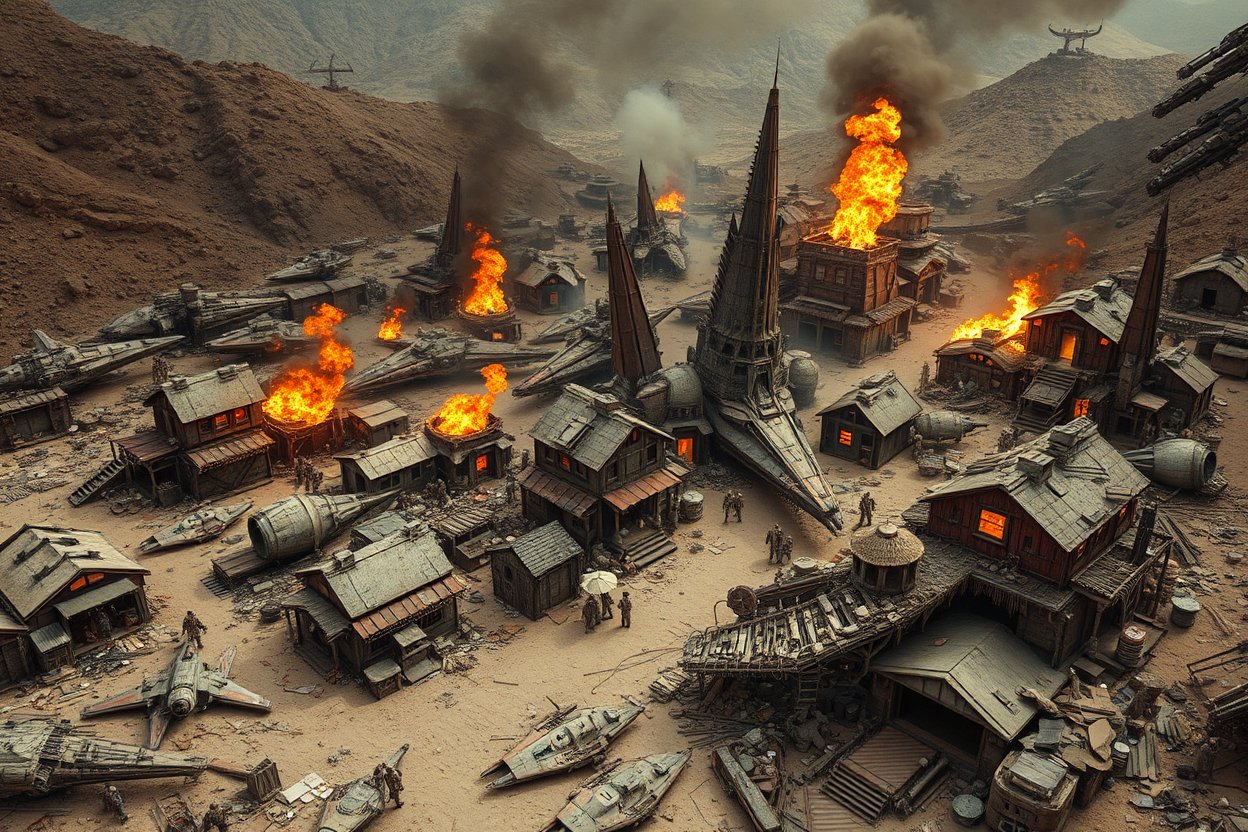
Smoke choked the narrow streets of the Ord Mantell township, curling between leaning scrap-built structures and half-collapsed durasteel hab-blocks. The settlement had been a maze of refitted wreckage and improvised architecture—old starship hulls turned into storefronts, stacked cargo containers converted into homes. Now much of it burned. Flames clawed up support struts and spilled through shattered windows, sending sparks drifting into a sky already stained black.
The ground told the story in brutal clarity. Dozens of bodies lay scattered from one end of the town to the other—some near market stalls, others in alleyways or slumped against doorframes as if they had almost made it inside. Blaster scoring traced clean, efficient lines across walls and pavement. There were no signs of a prolonged fight. Resistance, if it had existed at all, had been brief.
At the heart of the town, the central square had been cleared by force. A rusted fountain—long dry and filled with scrap—stood as a grim landmark beside a mass of kneeling civilians. They were packed shoulder to shoulder, hands bound or held behind their heads, surrounded on all sides by armored soldiers. Their dark, uniform armor was unmarred by the chaos around them, visors glowing faintly as they tracked movement with mechanical precision.
The formation was textbook. One half of the unit maintained a tight perimeter around the hostages, weapons angled inward just enough to make the threat unmistakable. The other half moved methodically through the surrounding streets and structures, breaching doorways, sweeping interiors, and covering elevated vantage points. Every rooftop, balcony, and window overlooking the square was watched. Every alley was claimed. Their movements were silent, coordinated, and utterly without hesitation.
Two ships anchored the occupation. The first, a heavy dropship, sat like a grounded beast near the edge of the square, its hull scarred and utilitarian, troop ramps still warm from deployment. The second rested farther back, sleeker and more predatory in design, its presence casting a long shadow across the ruined town. Its engines thrummed at idle, a constant reminder that this force had arrived swiftly—and could leave just as quickly.
Among the kneeling civilians moved a single figure.
She walked slowly, deliberately, armored from head to toe in blackened, intricately crafted plates that caught the firelight in sharp, crimson-edged reflections. The armor was not merely functional; it was ceremonial, imposing, and unmistakably designed to dominate both battlefield and mind. Her steps were measured as she circled the hostages, stopping now and then to linger behind an individual, tilting her head as if listening for something unseen.
Her attention shifted from face to face, from posture to breath, as though she were assessing more than fear alone. A subtle gesture here, a pause there—each movement suggested inspection rather than intimidation. The soldiers did not interfere. They adjusted their spacing instinctively as she passed, creating room without ever breaking formation.
The hostages could feel it. Some trembled uncontrollably. Others clenched their jaws and stared at the dirt. A few tried—and failed—to remain still as her shadow fell over them. Whatever she was searching for, it was clear she expected to find it among them.
The fires continued to burn. The ships continued to hum. And in the ruined heart of the town, under the unyielding watch of Imperial and inquisitorial force, judgment had not yet been delivered—but it was close.
Lumiya Dara
Rath Nihro
Zandra Ruus
Kole Silco
Location: Ord Mantell, Scrapyard Town
Smoke choked the narrow streets of the Ord Mantell township, curling between leaning scrap-built structures and half-collapsed durasteel hab-blocks. The settlement had been a maze of refitted wreckage and improvised architecture—old starship hulls turned into storefronts, stacked cargo containers converted into homes. Now much of it burned. Flames clawed up support struts and spilled through shattered windows, sending sparks drifting into a sky already stained black.
The ground told the story in brutal clarity. Dozens of bodies lay scattered from one end of the town to the other—some near market stalls, others in alleyways or slumped against doorframes as if they had almost made it inside. Blaster scoring traced clean, efficient lines across walls and pavement. There were no signs of a prolonged fight. Resistance, if it had existed at all, had been brief.
At the heart of the town, the central square had been cleared by force. A rusted fountain—long dry and filled with scrap—stood as a grim landmark beside a mass of kneeling civilians. They were packed shoulder to shoulder, hands bound or held behind their heads, surrounded on all sides by armored soldiers. Their dark, uniform armor was unmarred by the chaos around them, visors glowing faintly as they tracked movement with mechanical precision.
The formation was textbook. One half of the unit maintained a tight perimeter around the hostages, weapons angled inward just enough to make the threat unmistakable. The other half moved methodically through the surrounding streets and structures, breaching doorways, sweeping interiors, and covering elevated vantage points. Every rooftop, balcony, and window overlooking the square was watched. Every alley was claimed. Their movements were silent, coordinated, and utterly without hesitation.
Two ships anchored the occupation. The first, a heavy dropship, sat like a grounded beast near the edge of the square, its hull scarred and utilitarian, troop ramps still warm from deployment. The second rested farther back, sleeker and more predatory in design, its presence casting a long shadow across the ruined town. Its engines thrummed at idle, a constant reminder that this force had arrived swiftly—and could leave just as quickly.
Among the kneeling civilians moved a single figure.
She walked slowly, deliberately, armored from head to toe in blackened, intricately crafted plates that caught the firelight in sharp, crimson-edged reflections. The armor was not merely functional; it was ceremonial, imposing, and unmistakably designed to dominate both battlefield and mind. Her steps were measured as she circled the hostages, stopping now and then to linger behind an individual, tilting her head as if listening for something unseen.
Her attention shifted from face to face, from posture to breath, as though she were assessing more than fear alone. A subtle gesture here, a pause there—each movement suggested inspection rather than intimidation. The soldiers did not interfere. They adjusted their spacing instinctively as she passed, creating room without ever breaking formation.
The hostages could feel it. Some trembled uncontrollably. Others clenched their jaws and stared at the dirt. A few tried—and failed—to remain still as her shadow fell over them. Whatever she was searching for, it was clear she expected to find it among them.
The fires continued to burn. The ships continued to hum. And in the ruined heart of the town, under the unyielding watch of Imperial and inquisitorial force, judgment had not yet been delivered—but it was close.