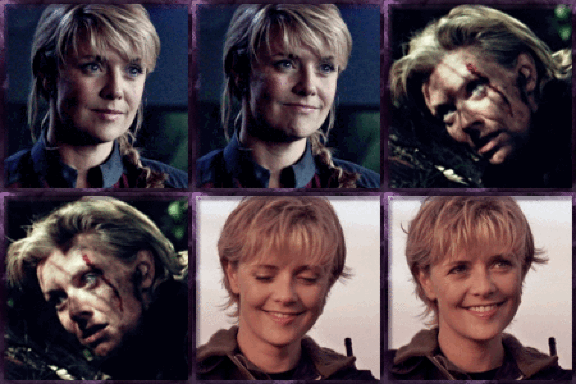
Alyssa Kydd
Starscream


The hangar smelled of hot oil and ozone — a clean, metallic sting that always calmed Alyssa the way the sea used to when the wind was right. Her hands were grease-dark beneath the sleeves of her flight-smock, fingers moving by muscle memory as she traced a faulty hydraulic line on a Peace Corps patrol skiff. Outside, the sky over her homeworld was a bright, uncomplicated blue; the kind of day that made people forget how small they were.
She had almost finished the line when the diagnostics pinged on her wrist-reader: three anomalous signatures in the north quadrant airspace, drifting slow and low over three separate grid substations. At first she assumed maintenance drones — contractors — but the IDs came back blank. No flight plan. No clearance. The readouts showed passive sensor sweeps tuned to electromagnetic emissions, not broadcasting, just listening.
Alyssa's jaw tightened. She double-tapped the data and pulled it onto the hangar wall — a map with pulsing dots where each object hung like a bruise. Whoever put them up had done it with restraint: minimal energy, minimal profile, but precise placement. Monitoring several power grids at once wasn't amateur work.
She wiped her hands on a rag and climbed onto the wing of the skiff to get a better angle, fingers tracing the riveted seam as if its rhythm could steady her thoughts. The Force — a word she had not even allowed herself in weeks — stirred at the edge of her awareness like a distant echo. It wasn't a voice or a vision, only a tightening in the back of her skull and a coldness in the palms she blamed on the oil. She breathed it down. Not yet. Not now.
Still, the pattern gnawed at her. Power hubs were lifelines — hospitals, comm relays, aerostat anchors. Monitoring them could be reconnaissance, testing, or the first step to something worse. Whoever had deployed those objects wanted to learn where people were vulnerable.
She pulled up the network logs. The objects were passively collecting: voltage fluctuations, load-balancing schedules, maintenance windows. Nothing alarming if viewed in isolation. Alarming as a whole.
Alyssa tapped open her contacts and found Kathryn Foster. Kathryn had a way of seeing things that made Alyssa both grateful and unsettled — the kind of friend who could read a map of numbers and find the hand that drew it. She hesitated only a beat before composing.
The holo-message projected a thin, blue rectangle above her wrist. Her fingers moved quickly, deliberately, not letting the tremor in her chest show.
A single press sent the message into the small, private relay between old friends. The holo winked out. Alyssa sat back on the skiff's wing and looked at the map one more time, the three pulsing dots waiting like questions in the open sky. Outside the hangar, a maintenance skiff glided past, its pilot laughing into a comm. The world went on. But somewhere above the power grids, silent watchers listened.
 Kathryn Foster
She had almost finished the line when the diagnostics pinged on her wrist-reader: three anomalous signatures in the north quadrant airspace, drifting slow and low over three separate grid substations. At first she assumed maintenance drones — contractors — but the IDs came back blank. No flight plan. No clearance. The readouts showed passive sensor sweeps tuned to electromagnetic emissions, not broadcasting, just listening.
Alyssa's jaw tightened. She double-tapped the data and pulled it onto the hangar wall — a map with pulsing dots where each object hung like a bruise. Whoever put them up had done it with restraint: minimal energy, minimal profile, but precise placement. Monitoring several power grids at once wasn't amateur work.
She wiped her hands on a rag and climbed onto the wing of the skiff to get a better angle, fingers tracing the riveted seam as if its rhythm could steady her thoughts. The Force — a word she had not even allowed herself in weeks — stirred at the edge of her awareness like a distant echo. It wasn't a voice or a vision, only a tightening in the back of her skull and a coldness in the palms she blamed on the oil. She breathed it down. Not yet. Not now.
Still, the pattern gnawed at her. Power hubs were lifelines — hospitals, comm relays, aerostat anchors. Monitoring them could be reconnaissance, testing, or the first step to something worse. Whoever had deployed those objects wanted to learn where people were vulnerable.
She pulled up the network logs. The objects were passively collecting: voltage fluctuations, load-balancing schedules, maintenance windows. Nothing alarming if viewed in isolation. Alarming as a whole.
Alyssa tapped open her contacts and found Kathryn Foster. Kathryn had a way of seeing things that made Alyssa both grateful and unsettled — the kind of friend who could read a map of numbers and find the hand that drew it. She hesitated only a beat before composing.
The holo-message projected a thin, blue rectangle above her wrist. Her fingers moved quickly, deliberately, not letting the tremor in her chest show.
She added one final line, then deleted it. No mention of the quiet sense that had pushed her to look — no hint of the Force under her skin. She wasn't ready for that to complicate anything. Kathryn didn't need that. Not yet.Kath —
Found three unmarked sensor platforms over the north substations. Passive EM sweeps, precision placement, no clearance. Looks like they're mapping load windows and relay timings. Not contractors. Not local.
Can you meet? I have logs and a thread that points to coordinated monitoring of multiple grids. If you can't come, I'll send the raw files. Keep this off the channel for now.
— Alyssa
A single press sent the message into the small, private relay between old friends. The holo winked out. Alyssa sat back on the skiff's wing and looked at the map one more time, the three pulsing dots waiting like questions in the open sky. Outside the hangar, a maintenance skiff glided past, its pilot laughing into a comm. The world went on. But somewhere above the power grids, silent watchers listened.
Kathryn Foster