

H E G E M O N


- Intent: To fill the world of Vandemar with interesting and diverse life that is intriguing to roleplay with.
- Image Credit:
- Canon: N/A
- Permissions: N/A
- Links: Vandemar
GENERAL INFORMATION
- Name: Ogrynth
- Designation: Semi-sentient
- Origins: Vandemar; ancient forests, mountain foothills and isolated woodland valleys
- Average Lifespan: 70–110 standard years
- Estimated Population: Rare; several isolated populations within Vandemar's largest wilderness regions
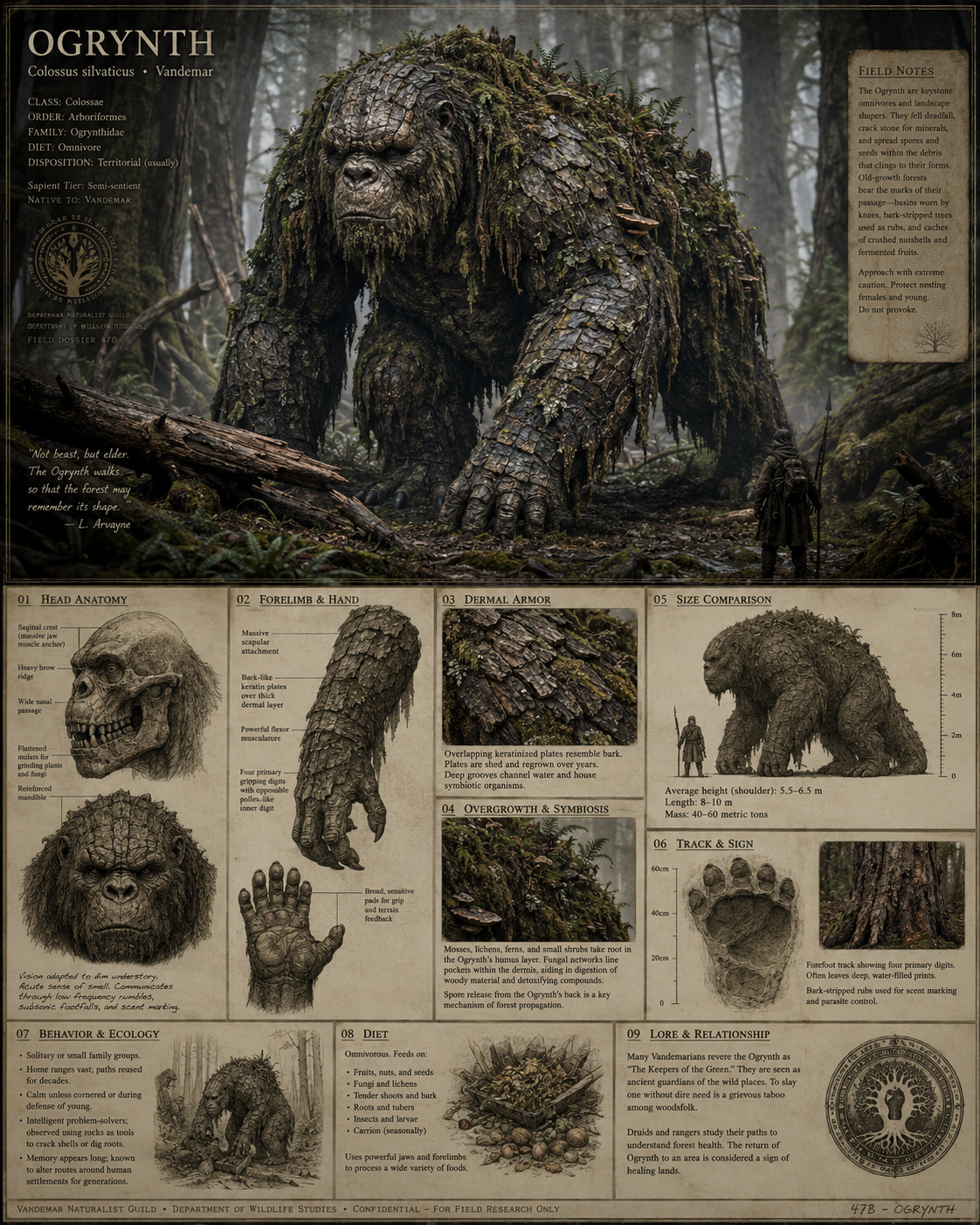
- Description: The ogrynth is an immense forest omnivore whose body resembles a moving mass of bark, muscle and stone. Though not naturally predatory, it is territorial, intelligent and capable of reducing vehicles, walls and armoured hunters to wreckage when provoked. Older specimens may stand motionless beneath the canopy for hours, indistinguishable from fallen trunks until the forest itself appears to rise.
PHYSICAL INFORMATION
- Breathes: Type I atmosphere
- Average Height of Adults: 2.4–3 metres at the shoulder; 4–5.5 metres when upright
- Average Length of Adults: 4–6 metres
- Skin color: Dark brown, grey, black or moss-green beneath the outer plating
- Hair color: Brown, black, grey or muted green
- Distinctions: Ogrynths possess enormous forelimbs, dense musculature and thick hides reinforced by overlapping bark-like keratin plates. Their backs collect moss, spores, seeds and small plants, particularly in older individuals, creating a living layer of camouflage. The broad skull contains powerful crushing teeth suited to roots, bone and hardwood. Their hands possess four thick digits capable of gripping stones, branches and structural components. Males are generally larger and develop heavier shoulder plating, while females possess broader torsos and more developed throat sacs used to communicate with young. Ageing specimens grow darker, accumulate thicker plant cover and often display broken or asymmetrical plates.
- Races: None formally recognised. Highland ogrynths possess denser plating and shorter limbs, while lowland populations are taller and more heavily overgrown.
- Force Sensitivity: Non-Sensitive
- Immense physical strength and resistance to conventional weapons
- Advanced memory, object manipulation and environmental awareness
- Natural camouflage within dense forests
- Slow acceleration and limited agility in open terrain
- Sensitive hearing makes them vulnerable to directed sonic systems
- Throat, eyes and joints remain comparatively unprotected
CULTURE
- Diet: Omnivore. Ogrynths consume roots, bark, fungi, fruit, carrion, insects and smaller animals. They can digest many toxic plants but react badly to concentrated industrial chemicals and several metallic compounds.
- Communication: Deep chest calls, throat vibrations, drumming upon trees, scent markings and deliberate gestures. Some calls travel several kilometres through forest soil and root systems.
- Technology level: None. Ogrynths may use stones, branches and scavenged objects as simple tools or weapons but do not manufacture lasting implements.
- Religion/Beliefs: None.
- General behavior:Ogrynths usually live alone or in small family groups consisting of a mother and several offspring. Adult males maintain broad territories that may overlap with those of females but rarely tolerate other mature males. They remember individuals, locations and injuries for decades, and have been observed altering routes to avoid settlements that treated them peacefully. When threatened, an ogrynth initially displays by striking trees, throwing debris and producing low-frequency roars. Actual attacks are sudden and brutally direct. Mothers raise their young for several years, teaching them feeding routes, safe caves and seasonal migration paths through imitation.
HISTORICAL INFORMATION
Ogrynth remains are present throughout Vandemar's ancient fossil record, though their bark-like plating appears to have become more pronounced after the expansion of the planet's deepest forests. Their ability to carry living plant growth may have developed through a symbiotic relationship with protective mosses and fungi.
Early Vandemarian settlers hunted ogrynths as dangerous obstacles to expansion. The campaigns proved costly and often unnecessary, as surviving animals simply withdrew deeper into the forests and later returned to abandoned territories. Their disappearance also disrupted seed dispersal and allowed several aggressive plant species to spread unchecked.
Modern authorities classify ogrynths as protected megafauna. Forest roads and settlements are designed around established migration paths, while sonic barriers redirect individuals from populated regions. Knightly intervention is authorised only when an ogrynth becomes trapped, injured or repeatedly attacks habitation.
Slaying one remains a formidable feat, but Vandemarian tradition regards killing a healthy ogrynth without necessity as shameful. The beast is not considered noble, gentle or sacred. It is simply ancient, powerful and entitled to the forest until it crosses the boundary of the realm.