

H E G E M O N



- Intent: To fill the world of Vandemar with interesting and diverse life that is intriguing to roleplay with.
- Image Credit:
- Canon: N/A
- Permissions: N/A
- Links: Vandemar
GENERAL INFORMATION
- Name: Mhyrrok
- Designation: Non-sentient
- Origins: Vandemar; forest floors, river valleys and temperate grasslands
- Average Lifespan: 22–34 standard years
- Estimated Population: Planetary; widespread beneath Vandemar's temperate regions
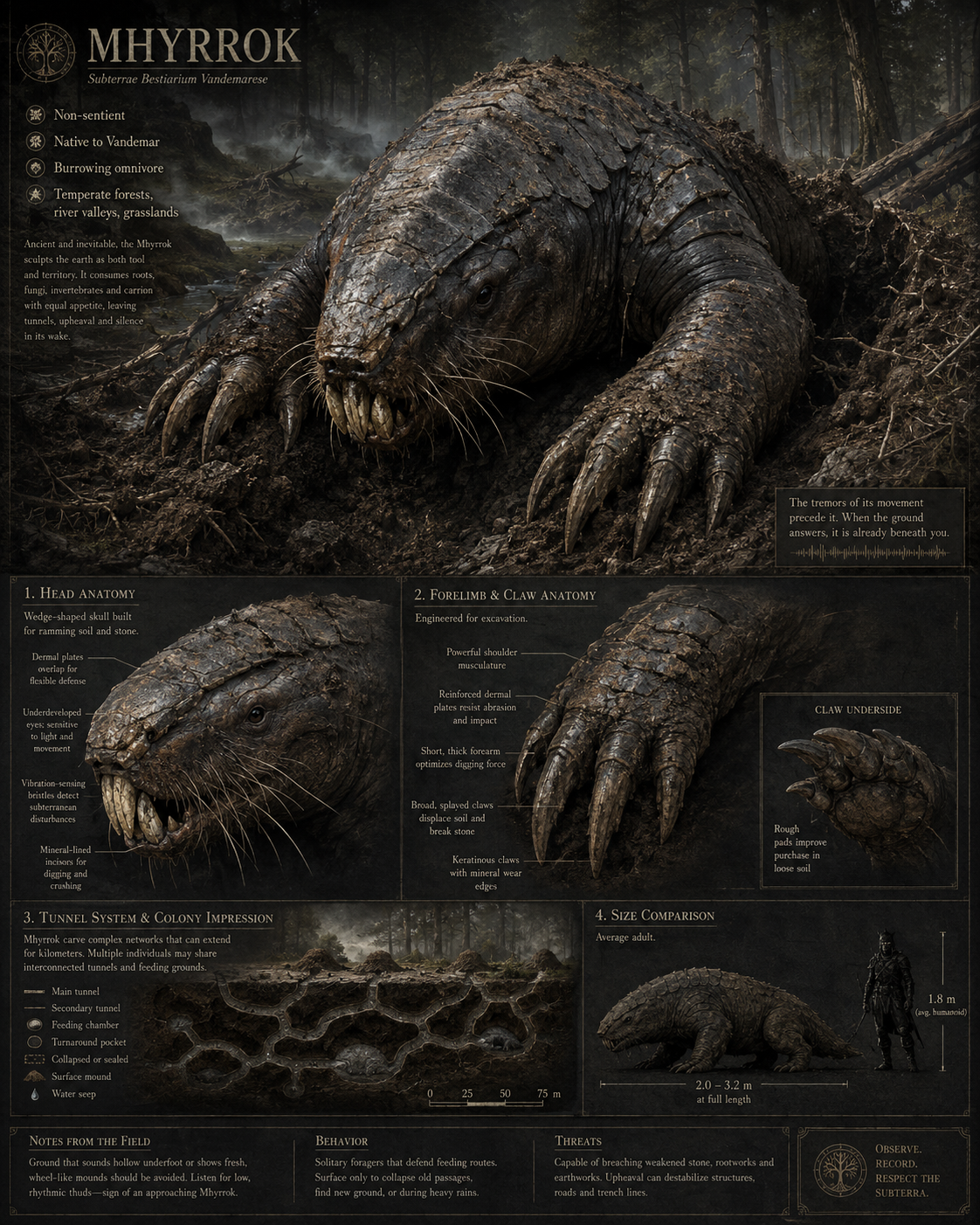
- Description: The mhyrrok is a massive burrowing omnivore built like a fusion of mole, boar and living excavation engine. Beneath Vandemar's forests, entire colonies carve through soil, roots and stone in sprawling subterranean warrens. Usually unseen, their presence is announced by trembling ground, collapsing paths and the wet rasp of mineral-lined teeth beneath the earth.
PHYSICAL INFORMATION
- Breathes: Type I atmosphere
- Average Height of Adults: 0.9–1.3 metres at the shoulder
- Average Length of Adults: 2–3.2 metres
- Skin color: Dark grey, clay-brown, black or muted ochre
- Hair color: Sparse black, brown or colourless sensory bristles
- Distinctions: Mhyrroks possess thick forelimbs ending in broad digging claws, a wedge-shaped skull and a heavy body protected by flexible dermal plates. Their eyes are small and poorly developed, while elongated whisker-like organs along the jaw detect vibration and airflow. Metallic compounds absorbed from the soil accumulate within their incisors, allowing older specimens to chew through roots, stone and light alloys. Females are generally broader and more heavily plated, while mature males develop pronounced ridges across the skull. Elderly mhyrroks often display cracked teeth, mineral growths around the jaws and pale patches across their armour.
- Races: None formally recognised. Mountain populations possess thicker claws and denser plating, while lowland mhyrroks are longer-bodied and more social.
- Force Sensitivity: Non-Sensitive
- Powerful claws and mineral-reinforced teeth
- Excellent vibration sensing beneath soil
- Thick hide and substantial physical strength
- Poor eyesight and limited awareness in open terrain
- Vulnerable throat and underbelly
- Easily disoriented by concentrated sonic pulses
CULTURE
- Diet: Omnivore. Mhyrroks consume roots, fungi, tubers, insects, carrion and smaller burrowing animals. They are attracted to mineral-rich soil and have been known to gnaw exposed cables, pipes and structural supports.
- Communication: Subsonic grunts, scraping patterns, scent markings and vibrations transmitted through tunnel walls.
- Technology level: None.
- Religion/Beliefs: None.
- General behavior: Mhyrroks live in extended colonies centred around several breeding females. Their tunnels contain sleeping chambers, food stores and fungal growths cultivated indirectly through accumulated waste and moisture. Colonies are fiercely territorial underground but usually avoid surface confrontation. When threatened, adults collapse passages behind them and attack through hidden side tunnels. Young remain with the colony until maturity, after which males often disperse to establish new warrens. During severe winters, entire groups may burrow beneath settlements, drawn by heat and stored food.
HISTORICAL INFORMATION
Mhyrroks are believed to be native descendants of smaller subterranean herbivores that adapted to Vandemar's mineral-rich soils. Over time, competition and predation favoured heavier bodies, reinforced teeth and increasingly complex colony structures.
Early settlers viewed them as vermin and attempted widespread extermination. The campaign ended after several regions suffered waterlogging, soil collapse and declining forest health. Mhyrrok tunnel systems were later recognised as vital to soil aeration and groundwater distribution.
Modern Vandemarian authorities map major colonies using orbital gravimetric scans and subterranean probes. Populations near cities are redirected through sonic barriers rather than destroyed. Even so, old roads sometimes vanish overnight, and isolated farmsteads have been swallowed whole when an ancient warren finally gives way beneath them.