Kael ordo
New Member
IDENTITY AT A GLANCE
Full Name:
Kael Ordo
Aliases:
"The Scarred Blade" | "Ordo's Scar" | "The Broken Blade" | "The Gray Ghost"
Age (28 ABY):
46 years old
Born:
18 BBY — Mandalore, ruins of Clan Ordo enclave near Keldabe
Clan:
Clan Ordo — sole surviving active member of his direct line
Role:
Lone mercenary operator / Anti-slaver hunter / Reluctant Mandalorian
Ship:
Vengeant — custom-built starfighter and mobile base, hand-fabricated and rebuilt by Kael across thirty years
Height / Weight:
5'7" | 185 lbs — compact and deceptively powerful
Status:
Dar'buir (no foundling), no riduur — operating solo
Confirmed Kills:
187 (conservative personal estimate)
Active Bounties:
At least 3 — Black Sun remnant, Grishk's Trandoshan blood-clan, one unnamed Outer Rim Hutt
II. FAMILY & ORIGINS
FATHER — VORR ORDO
Veteran of the Great Clan Wars and the Siege of Mandalore. A hulking warrior in red-and-silver armor with a reputation for unbreakable clan loyalty. Named his son Kael from old Mando'a: "edge" or "cutting blade." He died 4 BBY during a targeted Imperial strike on the Clan Ordo enclave — a crackdown on holdout resistance, not the Great Purge, which was still years away. He shielded Kael from a collapsing beskar-reinforced ceiling, crushed beneath it while Kael lay pinned in the rubble listening. He did not make a sound when the ceiling came down. That is the detail Kael has never been able to dislodge from the memory.
Legacy: The red-and-silver color scheme on Kael's armor honors Vorr directly. The helmet dents from that ceiling are the first and oldest scars. They have never been repaired.
MOTHER — LIRA ORDO (NÉE KELBORN)
Master armorer and pilot. Captured during the 4 BBY Imperial strike on the enclave and sold into Outer Rim slavery alongside Mira. In 26 ABY, Kael found beskar armor bearing her unmistakable Kelborn smithing marks — recently made — in a slaver's possession. The trail is active. She was thirty-four when they took her. She was teaching him how the forge worked. He was going to learn the Kelborn technique that summer. The summer was when they came.
Legacy: The forge-hammer motif in the hidden inner sigil honors her armorer heritage. The silver in the armor scheme is mourning made permanent.
SISTER — MIRA ORDO
Born 14 BBY. Idolized the legends of Canderous Ordo. Captured alongside Lira in the 4 BBY Imperial strike. Found alive in 24 ABY after nearly three decades of active hunting. Freed. Chose to leave Mandalorian life entirely and build peace elsewhere. He let her go without argument because it was hers to choose, and because the warrior who found her was not the brother she remembered and both of them knew it. A lock of her hair and her original prisoner manifest are kept in the hidden compartment of his left vambrace — touched every morning as ritual.
The gap between the warrior who found her and the brother she needed is the specific shape of the Mira-wound. It does not bleed. It just aches.
MENTOR — RUK TAL
A dying Ordo warrior who pulled Kael from the debris on Mandalore at age 14. Last words: "The clan is dead. Now you are the clan." Took Kael across the Outer Rim as a nomadic mercenary for three years. Taught brutal survival over honor. Died 1 BBY on a backwater moon — gunned down by allies claiming the full contract fee. Kael avenged him, killing all 18 responsible. The betrayal planted seeds of permanent distrust that have never fully grown out.
Kael does not fully believe Ruk's teaching. He has never stopped following it.
III. COMPLETE TIMELINE
18 BBY — Birth — Born in the ruins of a Clan Ordo enclave near Keldabe, Mandalore. Trained in the Resol'nare from birth. Learned to shoot before reading, to fight in full armor by age eight, to recite the Creed in Mando'a by ten.
12–5 BBY — The Gathering Years — Before the purge, before the scars, Kael attended annual inter-clan gatherings where he met Vira Vizsla of Clan Vizsla — one day a year, eight years running, from age 6 to age 13.
4 BBY — The Imperial Strike on Clan Ordo (Age 14) — Imperial forces conduct a targeted elimination of the Clan Ordo enclave near Keldabe. Not the Great Purge — a smaller, undocumented act of Imperial suppression. Vorr dies shielding Kael. Lira and Mira are captured and sold into slavery. Ruk Tal pulls Kael from the debris.
4–1 BBY — The Ruk Tal Years — Three years as nomadic mercenaries. First kill at age 14. 31 confirmed kills across this period.
1 BBY — Ruk's Death (Age 17) — Ruk Tal killed by allies on a backwater moon. Kael wipes out all 18 responsible. Fully embraces the lone-operator life.
4–5 ABY — The Night of a Thousand Tears — The Great Purge of Mandalore occurs while Kael is already deep in the Outer Rim. He hears about it through mercenary channels. He does not go back. There is nothing to go back to.
7 ABY — The Vengeant Begins (Age 25) — Kael strips a wrecked starfighter on a junker moon for parts and begins building his own ship from the keel up. The build will take three years across four scrapyards, two stolen drydocks, and one extended stay on a moon whose name he has never spoken since.
9 ABY — The Dune Sea Duel (Age 27) — Hired to eliminate Voss Krayn — a fallen Jedi turned dark-side enforcer. The duel lasts nearly an hour. Kael wins by detonating a thermal charge at point-blank range. Saves enslaved children. Claims Krayn's lightsaber hilt. The weekly vigil begins.
10 ABY — The Vengeant Flies (Age 28) — First successful test flight. The ship has been welded, rewired, scavenged, refitted, and re-welded by his own hands. There is no factory equivalent. There is nothing else like it in the galaxy.
12 ABY — The Sarlacc Betrayal (Age 30) — Rival bounty hunter Dorn Ordo shoves Kael into the Sarlacc pit. Thirty hours inside. The left arm is catastrophically damaged. He claws out using the lightsaber. Tracks Dorn for seven months and executes him.
15 ABY — The Back-Shot (Age 33) — Jarek Ordo shoots Kael in the back during a clan meeting. Kael kills him and three loyalists that same night.
17 ABY — Grishk's Fleet and Rancor Ridge (Age 35) — Boards Trandoshan warlord Grishk's flagship alone, kills 19 elite guards, takes the warlord's head. Claims the vibro-axe. Same year: holds a strategic ridge alone for three days after his team is wiped out.
18 ABY — The Corridor (Age 36) — A joint raid on a Zygerrian slaver convoy. Kael and Vira Vizsla fight back-to-back in a corridor for the first time as adults. Neither acknowledges the history. Both understand what it means.
24 ABY — Mira Found (Age 42) — Mira located and freed after nearly three decades. She chooses peace. He lets her go. That night he has a small Ordo forge-hammer tattooed into the scar tissue of his inner left forearm.
26 ABY — The Armorer's Mark (Age 44) — Finds beskar armor bearing Lira's Kelborn smithing marks — recently made, trail active. Vira delivers intel freely. Kael removes his helmet in front of her for the first time in years.
28 ABY — Present Day — Drifting the Outer Rim aboard the Vengeant. Three active contracts on his own head. The Lira trail is the warmest it has ever been.
IV. PHYSICAL DESCRIPTION
THE BODY
Kael Ordo is 5'7" and approximately 185 lbs — compact, deceptively powerful, built through thirty years of constant operational use rather than aesthetics. He is the kind of build people underestimate in a doorway and do not underestimate again. The Sarlacc acid left its mark most severely along the left arm from mid-bicep to wrist: dense, ridged scar tissue that tightens in low humidity and responds poorly to cold. The resting state of the left hand is a slight inward curl the nerve reconstruction never fully corrected. His right shoulder sits approximately two degrees lower than his left from an improperly healed muscle group from the back-shot. He compensates constantly and unconsciously.
THE ARMOR — COMPONENT BY COMPONENT
Complete beskar construction. Every plate, every joint, every surface.
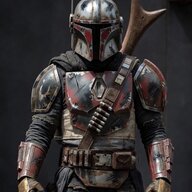
Helmet: Silver-dominant with faded red patches. Concentrated dents on crown and left side from the Mandalore ceiling (4 BBY) — oldest scars, never repaired. Hairline cracks. Bent antenna. Deep claw gouges from the rancor at Rancor Ridge.
Chestplate: Long diagonal gash from Krayn's crimson blade (9 ABY), running upper right to lower left, bisecting the cracked Ordo sigil at center. Fused and discolored at the scar edges. Unpolished. Never touched cosmetically.
Left Pauldron: Scarred Ordo skull variant — one horn chipped, heavy claw and blast damage from Rancor Ridge. Closest armor piece to the heart. Presented forward when facing slavers.
Upper Back: Deliberate cluster of scorch marks and shrapnel gouges from the back-shot (15 ABY). Patched for function, uncovered cosmetically. For anyone who reads Mandalorian armor damage: this man was shot in the back by someone he allowed close.
Lower Armor: Acid scarring and blaster burns across the lower torso from the Sarlacc (12 ABY). The blaster burns are his own — from the cauterization shot.
Vambraces: Heavy, asymmetric, scuffed dark gunmetal with red-and-silver veining. The left vambrace contains the hidden compartment that holds Mira's hair, Lira's prisoner manifest, and Vira's stamped piece of metal. The right vambrace mounts the wrist flamer and grappling line.
Belt & Holsters: Cracked leather, oil-darkened. The WESTAR-35 holster sits on the right hip. The lightsaber clips at the left hip — the position has not changed since 24 ABY when he first started carrying it on his person.
Cape: Tattered dark gray weave with rust-colored streaks. Half-length, off the right shoulder. Field-cut more than once. Never replaced.
ARMOR COLOR SYMBOLISM
◆ Silver — Mourning for the family he lost. Dominant because grief is the dominant truth.
◆ Red — Honoring Vorr Ordo. Faded and cracking but refusing to vanish.
◆ Black — The justice he delivers: rough, personal, uncompromising.
◆ Gold — Vengeance achieved and vengeance still owed. Taken from Grishk's gauntlet.
◆ Blue — The personal cost of intimate violence. Blue gloves worn to threads.
THE REBUILT LEFT ARM
The left arm was catastrophically damaged inside the Sarlacc pit — digestive acids destroyed the tissue from mid-bicep down across the first four hours of the thirty-hour ordeal. The arm underwent reconstruction: nerve grafts, scar tissue management, partial structural repair. The arm was rebuilt, not replaced. What exists now is his arm, recognisably and entirely, but not the arm he was born with. The scar tissue runs from mid-bicep to the wrist on the outer surface. In cold conditions the nerve reconstruction becomes unreliable: grip weakens, fine motor control degrades, and the resting state of the fingers contracts inward. He has learned every variation. He plans around it.
Tattooed into the scar tissue on the inner left forearm, hidden by the vambrace: a small Ordo forge-hammer overlaid with a broken chain. The hammer honors Lira. The broken chain marks Mira's emancipation. The lines are slightly irregular — the needle did not move through normal tissue. He has never told anyone it is there.
V. HOW HE MOVES & HOW HE TALKS
THE WALK
Kael Ordo walks like a man who has calculated the geometry of every room he has ever entered. His stride is even, unhurried, and covers ground efficiently. There is no performance in it. He moves as though going from one problem to the next with a rough estimate of how long it will take. The lightsaber hilt at his hip is part of the silhouette now. His left hand is most often held at his side with the fingers in a slight inward curl — the nerve reconstruction left the resting state of the left hand permanently contracted. He has stopped trying to correct it.
He stops completely when thinking. Not pacing — stopped. Standing with his weight on one foot, the helmet turned slightly as though listening to something no one else can hear. People who work with him learn to recognize this as a processing state.
IN COMBAT
Everything changes. He becomes consolidated — limbs tucked, the profile he presents reduced. He goes to the rifle first, always. When the rifle is not viable, he transitions to the WESTAR-35. When blasters are not viable, the lightsaber. He is not a trained duelist. What nineteen years of weekly contact with the blade have produced is an intuitive, body-level familiarity with its behavior that functions, in the field, as a practical substitute for formal training. He fights with it the way he fights with everything: efficiently, without theater, with the absolute willingness to absorb damage in order to finish what he started.
THE VOICE
The vocoder modifies his voice slightly lower and flatter than his natural register. What comes through sounds deliberate even when it is not. Without the helmet — rare, always on his own terms — his actual voice is lower than expected, rougher, with the texture of a man who does not use it enough to keep it smooth. He does not raise his voice. He has raised it twice in documented memory: once over Ruk's body, and once when Mira asked him not to follow her.
SPEECH PATTERNS
Kael speaks in minimum viable units. He strips sentences to their functional core and delivers them without preamble or postscript. He never asks questions he knows the answer to. He will say "I was wrong" if he was wrong — precisely, clearly, without elaboration.
DOCUMENTED LINES
"Do better than I did." — Said to every freed slave. Never varies. Never followed by anything.
"East." — Standard pre-engagement directional. One word. Non-negotiable.
"The contract is done." — After completing objectives. Flat. No triumph in it.
"I remember your face." — Said quietly to a Pyke Syndicate overseer he had tracked for two years.
"She's not here." — Said on eleven separate occasions at the conclusion of slaver-network searches.
"A saber requires you to let someone get close enough to make a point. I prefer to make mine first."
"The armor stays." — To a medbay attendant who attempted to remove his pauldrons during emergency treatment. Said once.
"Same place next year." — Last words to Vira Vizsla at the eighth gathering, 5 BBY. He was thirteen. He meant it.
"I know." — His response when told something is impossible, inadvisable, or suicidal.
"There are things in this galaxy that do not care what you believe. They keep moving anyway."
PERSONALITY & CORE PSYCHOLOGY
A haunted, quiet man who speaks only when necessary. Deeply troubled but functional through rigid discipline forged over thirty years of survival. He still believes in ba'jurir (raising children), aliit (family), and protecting the weak. Every rescued slave gets the same gruff send-off: "Do better than I did." He never accepts thanks.
The isolation was constructed deliberately after each betrayal. The helmet: never removed in unknown company — a distance-creation device, not just protection. The silence: words are connective tissue and he does not want to be connected. The refusal of thanks: gratitude is the beginning of relationship.
The performance is excellent. It has fooled almost everyone he has ever met. The places where it fails: the children, on whose behalf he intervenes at significant personal risk on at least eleven documented occasions, always immediately, without calculation.
The wound that never closes: the fourteen-year-old boy who was not strong enough to save anyone. He is aware that no fourteen-year-old could have stopped an Imperial strike. He has never fully accepted this awareness into his operating belief system. The logic is sound. The guilt does not care about logic.
THE CREED HE ACTUALLY FOLLOWS
Wear the armor. Raise the children you find. Protect those who cannot protect themselves. Avenge the dead. Keep moving.
VI. WEAPONS & EQUIPMENT
THE AMBAN KYBER RIFLE — "THE LONG ARGUMENT"
An Amban-pattern sniper rifle substantially modified from its disruptor origins. The disruptor cell has been replaced with a kyber focusing chamber that channels and fires compressed kyber energy as coherent saber bolts. The bolts carry the characteristic snap and scorch of lightsaber energy at extreme range. They cut through most personal shields, interact with cortosis and beskar the way a blade would, and leave cauterized wounds rather than blast damage. The Amban prong at the barrel remains functional as a contact stun electrode.
The weapon performs better in Kael's hands than it should. Kyber-based weapons require Force attunement for consistent output. Kael attributes the rifle's stability to his modifications. He is wrong about the source and completely correct about the results.
VOSS KRAYN'S LIGHTSABER HILT — "THE WEIGHT HE FINALLY CARRIES"
Claimed from the Dune Sea in 9 ABY. Dark metal construction, utilitarian rather than ornate. Carried for nineteen years in the Vengeant's cargo hold, ignited approximately once a week in the dark, in private, for reasons Kael has never articulated to himself or anyone else. As of 28 ABY, the hilt is carried on Kael's person and serves as his primary close-quarters weapon, having replaced the vibro-axe in the field.
The blade, when the Amban's kyber crystal is transferred to the hilt, is a blackwashed smoke-white: predominantly white luminance with a suspended grey-black depth within it, like white that has spent a long time above a fire. The color is the record of partial purification — a crystal responding to Kael's unacknowledged Force presence for nineteen years, moving toward healing without arriving.
He has ignited it in front of another living person exactly once. He did not explain the color. The person who saw it asked one question. He has thought about that unanswered question on a regular basis since.
THE VIBRO-AXE — "GRISHK'S DEBT" (TROPHY)
A massive curved vibro-axe claimed from Trandoshan warlord Grishk (17 ABY). Forty-one notches cut into the haft. Mounted horizontally above his bunk in the Vengeant's crew quarters — secured to the bulkhead with two beskar brackets he fabricated himself. It does not leave the ship. It is not a combat weapon anymore. It is a record: of everything he has survived, everything the galaxy sent at him, and the specific fact that he is still here.
WESTAR-35 BLASTER PISTOL
A single WESTAR-35 blaster pistol worn in a hip holster. Heavily worn and field-modified for improved accuracy at extended range. He has never replaced it.
VAMBRACE SYSTEMS
Standard Mandalorian armament: a wrist-mounted flamer projector on the right vambrace, grappling line on the same side, dual whistling-bird launchers on the left vambrace housed beside the hidden compartment. A short retractable beskar blade ejects from the left wrist when needed — close-quarters insurance, used rarely, kept sharp.
VII. THE VENGEANT — HIS OWN HANDS
The Vengeant is not a production fighter. There is no class designation that fits her. She does not appear in any registry. There is no factory she came out of and no line of ships she belongs to. Kael Ordo built her himself, by hand, across three years of scavenging, welding, and trial-and-error reconstruction across the Outer Rim's junker moons and stolen drydocks — and has rebuilt and re-engineered her continuously across the three decades since. Every plate is something he stripped from a wreck or cut from raw stock. Every wire is something he ran himself. The hyperdrive came out of three different ships and was never the same configuration twice until it was. The cockpit was salvaged from a pre-Imperial design he has never identified to anyone, and which he believes — though he has not confirmed — was originally Mandalorian. She has the geometry of a strike fighter and the internal volume of a small freighter. She answers to no designation that was given to her by anyone other than her pilot.
CONSTRUCTION & ORIGIN
The build began 7 ABY on a nameless moon in the Outer Rim. He had been operating out of a rented hold in a smuggler's den and had grown tired of the security profile. He needed a ship that no one had records of, that he understood at the level of every joint and fastener, that he could repair in the field with whatever was on hand because he had put it together with whatever was on hand. He started with a wrecked keel and worked outward. Three years. Two extended stalls when funds ran out. One catastrophic failure on the first powered test that nearly killed him. By 10 ABY she flew.
She has been rebuilt at least four times since. The hull plating from the original build is still on the underside near the engine cowling — discolored, reinforced, original. He could replace it. He has not.
PROFILE & SPECIFICATIONS
Length: Forty-five meters stem to stern. Forward-swept wing geometry — two upper stabilizer fins angling back and upward, two lower forward prongs sweeping down and ahead, creating an open throat at the nose that gives her the look of something permanently mid-strike. Twin engine nacelles ride the dorsal spine, deliberately oversized for a vessel this length and producing burst speed that has no business existing on a ship that isn't a dedicated fighter. From above she reads predatory. From directly ahead she reads as a mistake the observer is currently making.
Hull: Silver-grey beskar-alloy composite — not full beskar replacement, that would be impossible at this scale, but beskar-reinforced plating at every critical stress point and every junction where a breach would be catastrophic. The result is a ship that absorbs damage it shouldn't survive and keeps flying — and looks like one that has, because it has. Underneath the silver-grey, the original clan red is everywhere and nowhere: bleeding through in patches across the forward wings, the nacelle housings, and the lower prong surfaces. The silver-grey was applied over it thirty years ago and the red has been winning the argument slowly ever since. Blaster scoring on the forward starboard prong from the Nar Shaddaa run in 18 ABY. Three patched hull breaches across the years, structurally sound, cosmetically uncovered because cosmetics were never the point. One long scrape along the starboard upper wing, almost two meters, hull-deep. He has never explained it. He will not explain it now. She has never been cleaned cosmetically. She functions perfectly.
Cockpit: Dual cockpit — two seats side by side separated by a central console, full redundant flight controls on both stations. The canopy wraps wide; on a clean approach the stars come in from three directions at once. The port seat is his and has been for thirty years, padding compressed to the specific contours of his body. The starboard seat has never been adjusted for anyone. He has never removed it and has never directly explained why it exists configured as a full pilot station rather than a passenger seat. He will not explain it now. The cockpit smells of machine oil, ozone, old blood, and stale caf. The family holo-projector sits on the dash between the two stations, equidistant from both seats, looping damaged holos of Lira and young Mira — the file corruption is old and he has never repaired it. Grishk's jaw fragment is bolted to the instrument panel fascia. Mando'a prayers and kill tallies are scratched into the canopy frame on the port side; the starboard side of the canopy frame is completely unmarked, and this is not an oversight.
Crew Quarters: A dedicated cabin on the port side of the corridor. The bunk is full length — long enough that he can stretch out completely without curling, which was the entire point. A wall was moved during the rebuild to achieve this; it was the singular luxury he permitted himself in the entire construction process. He sleeps in armor more nights than not. The vibro-axe is mounted horizontally on two beskar brackets above the bunk, positioned at exactly eye level when lying down, so that when he wakes the first thing he sees is the haft. Forty-one notches in it. Built-in storage along the lower wall holds spare beskar plate, adhesives, a folded set of non-armor clothing that has been folded the same way since 17 ABY, and one matte black, unmarked, locked data drive containing twenty-three unread messages from the children of the Dune Sea settlement — never opened, never deleted. On the inboard wall, a narrow shelf with one object: a grey ceramic cup, no markings, that has either been on that shelf or in his hand since approximately 16 ABY.
Main Hold: The largest single space on the ship. Ceiling high enough to stand in full armor with the lightsaber ignited and not feel like the blade is in a box. Two shielded smuggling compartments are built flush into the deck plating — invisible unless you know the release points. They have carried freed captives on forty-seven documented occasions and an unknown number of undocumented ones. Their interior surfaces are scratched with messages in Huttese, Basic, Togruti, Rodian, and several scripts he has never identified — names, dates, thank-yous. He has read every one he could read. He has not had any of them removed. A folding table is bolted to the port bulkhead with two chairs. He uses one chair, always the same one. The other chair is folded flat against the wall on a permanent basis; it unfolds when he has a passenger and folds again when they leave, and the fold mechanism on the unused chair is noticeably stiffer than the one he uses. This is where the weekly vigil happens — sealed in the dark, back to the aft bulkhead, lightsaber held vertically, both hands. The hold knows things about him the rest of the ship does not.
Workshop: Starboard side of the corridor, mirror of the crew quarters. Converted entirely into workspace in the original rebuild — no bunk, no concession to anything that isn't work. An armorer's bench runs the full length of the exterior wall, bolted through the hull plate at five points. Tool racks floor to ceiling on the inboard wall; the organization appears chaotic and is not. A precision vise at the right end. A magnification array on a swing arm above the center section. Spare beskar stock in a locked floor compartment. This is where the crystal transfers happen — under the magnification array, on a cleared section of bench, the only context in which the workshop runs at full brightness. He narrates every transfer in Mando'a under his breath. He does not know he does this.
Medical Bay: Port side, aft of the crew quarters. Salvaged equipment, functional, disturbingly well-stocked for a solo operator. A partial bacta tank along the aft wall — enough for limb immersion, not full body submersion. Surgical instruments, bacta patches, field dressings, and pharmaceutical stores organized with the same non-chaotic logic as the workshop. He has performed procedures on himself in this bay that should have required a specialist; the most significant was the 24 ABY left arm reconstruction following the Malachor engagement, which took four hours across two sessions. He did not seek specialist care. He did not consider seeking it. The arm works. The medbay is the only space on the Vengeant that does not smell like him, and he finds this slightly disorienting every time he enters it.
Engineering: Aft section. Overcharged ion drives fill most of the volume; two narrow maintenance corridors run either side of the primary drive housing, barely passable in light clothing and impassable in full armor. Every surface carries thirty years of independent maintenance — repair solutions in different materials applied at different times, some superseded and left in place because removing them would require more effort than the improvement warrants. He can trace any power routing, coolant line, or data conduit from memory. None of it is written down. If something happened to him, the Vengeant would be nearly impossible for anyone else to maintain. He is aware of this and has never done anything about it.
The Caf System: Mounted to the corridor wall between the cockpit and the crew quarters. Fully automated. Twelve-hour keep-warm function. Capacity for six cups before the reservoir requires refilling. Installed in 21 ABY following an extended period of solo operations during which cold caf consumed standing at the workshop bench at irregular hours had become the baseline. The installation took four hours and required rerouting one power conduit. It serves no tactical purpose. It improves no operational capability. It is the only modification made to the Vengeant in thirty years that Ruk Tal would have looked at and called wasteful. Kael refills the reservoir every three days without reminder, without scheduling, without fail — more reliably than any other maintenance task on the ship. He has never explained it to anyone who asked. He will not explain it now.
Armament: Two fixed forward laser cannons, flush-mounted and low profile — easy to miss until they fire. One ventral turret under the belly, manually operated from an internal station. Two concussion missile tubes recessed into the lower port hull. The sensor array on the dorsal spine between the nacelles is a dense cluster of modified equipment that has no clean visual read — it looks like salvage and functions like something military that was never supposed to be on a civilian vessel.
Defensive Systems: Lightweight deflector shielding, partial sensor mask, and a redundant power conduit that Kael runs in parallel to the main grid. If primary power goes down she still flies. He has tested this twice. He prefers not to test it again.
Hyperdrive: Class 1.0 nominal. Class 0.9 when she is running well. Class 1.4 when she is angry.
Nose Art: "Vengeant" in angular Mando'a script — Vengaan / Gra'tuuro, "Vengeance Itself." Hand-stenciled. Rust has crept into the lower curves of the lettering. He has not corrected it.
HOW SHE FLIES
She flies the way a thing flies when it has been built by one set of hands and operated by the same set of hands for two decades. There is no production tolerance — there is only what Kael knows. The control yoke has a specific dead zone three degrees off-center that does not exist on any other ship in the galaxy and which Kael compensates for unconsciously. The starboard maneuvering thruster lags by a fraction of a second on cold starts. The shield generator hums at a pitch he can hear through the hull, and the day it stops humming will be the day he begins worrying. No one else can fly her well. Two pilots have tried. Both nearly crashed her in atmosphere within thirty seconds. He has not let anyone else into the cockpit since.
She is not registered. She has no transponder code that any official authority would recognize. She is, in every sense that matters, an extension of him: scarred, hand-made, not built to be replaced, not built to be understood by anyone but her builder.
◆ ◆ ◆
VOLUME II
THE INTERIOR WAR
The Force. The inner world. The scars. The search for Lira.
VIII. THE FORCE THREAD — WHAT KAEL WILL NOT NAME
Kael is not Jedi-Knight-tier Force sensitive. His midi-chlorian count, if measured, would land in a range the pre-Order Jedi would have noted as present but sub-threshold for formal consideration. What he has is something the old Order had a term for, rarely used: battle meditation adjacent. Not the large-scale version that could turn the tide of fleet engagements. The personal scale. The kind that has kept warriors alive for ten thousand years of galactic conflict.
Kael's Force sensitivity is not rooted in serenity or peace. It grew in rubble and was fed by grief and survived the Sarlacc and has been present with a dark-side kyber crystal for nineteen years. It is not dark — not oriented toward domination or destruction. But it is not light either. It is oriented toward survival. Specifically: toward the survival of people who cannot survive on their own.
THE INCIDENT CHRONOLOGY
Incident 1 — The Rubble (4 BBY): A section of ceiling beam shifted eighteen inches to the left with no mechanical cause. Filed under structural instability.
Incident 2 — The First Kill (4 BBY): A fraction of a second before pulling the trigger: a pressure behind his sternum, colder than fear and more certain. Like a door opening.
Incident 3 — Nar Shaddaa Ambush (7 ABY): He stopped walking for no identifiable reason. Three seconds later a blaster bolt came through the wall at head height.
Incident 4 — First Lightsaber Contact (9 ABY): The moment of recognition between his hand and Krayn's bled crystal. A crystal forced to bleed does not respond to just anyone.
Incident 5 — The Sarlacc (12 ABY): In the suspended darkness: a silence so complete it felt like a presence. "The bottom of the universe." He came out changed.
Incident 6 — The Ridge (17 ABY): The final twelve hours of the battle — anticipating attacks before they came. He attributes this to his armor, his weapons, and his stubbornness.
Incident 7 — The Weekly Vigil (9 ABY–Present): Approximately one thousand times in the dark cargo hold, igniting Krayn's saber. Each time the crystal reaches back. The sensation has shifted from cold recognition to something warmer.
Incident 8 — The Kessel Pull (27 ABY): The Amban Kyber Rifle, kicked eleven feet away during an engagement, returned to his extended hand. He has told himself three times since that it slid on the deck plating. The deck does not slide.
THE QUESTION HE WILL NOT ASK
On the day the enclave fell, something moved a beskar ceiling beam eighteen inches to the left and kept him alive. He was fourteen years old. He has never asked why he survived when everyone else he loved did not. He believes the answer would require him to believe his survival was meaningful — that the thirty years of blood and grief and searching were not random suffering but something with a shape. He cannot afford to believe that. So he does not ask.
THE BESKAR DOCTRINE — HIS FORCE PHILOSOPHY
The Force, for Kael, is not a power. It is not a teacher. It is something closer to what beskar is: a material with specific properties that can be worked but not invented, that resists what should destroy it, that takes the shape of what forged it while retaining its own nature. Kael's Force connection was forged in rubble and fed by grief and hardened in the Sarlacc.
He will not become a Jedi. He will not become a dark-side practitioner. He will become what a Mandalorian who carries the Force has always been: a warrior with an edge he cannot fully explain, who stops in corridors for reasons he does not interrogate, who has survived things he should not have survived, and who is slowly, finally, beginning to understand that the survival was not random.
"The armor knows." — What Kael Ordo would say, if he ever said anything. What he has always been saying, without words, for thirty years.
IX. THE FIVE DEFINING SCARS
SCAR ONE: THE CEILING — MANDALORE, 4 BBY
The Imperial strike began at 0340. Vorr Ordo's hands slammed into his son's chest and threw him backward into a door alcove hard enough to crack two ribs. Vorr did not make a sound when the ceiling came down. That is the detail Kael has never been able to dislodge. He lay pinned for several hours until a section of ceiling beam shifted eighteen inches to the left and gave him enough air to survive until Ruk found him.
SCAR TWO: THE SARLACC — TATOOINE, 12 ABY
Thirty hours inside the Pit of Carkoon. The digestive acids reached the left arm within the first four hours — not cleanly, not quickly, but in the specific sustained way of something designed to dissolve over time. He cauterized what he could with his own blaster. He clawed out of the pit using the lightsaber in his right hand and whatever the left arm could still do, which was less than it should have been and more than it had any right to be.
SCAR THREE: THE BACK-SHOT — NEUTRAL MOON, 15 ABY
Jarek Ordo broke the most fundamental rule of clan gatherings because he believed he had sufficient support to make the breaking survivable. He was wrong about the math. Kael dealt with Jarek Ordo and his three supporters. It took four minutes. He did not use the saber.
SCAR FOUR: RANCOR RIDGE — UNKNOWN MOON, 17 ABY
The extraction team found Kael sitting on the ridge, arms crossed, looking at the aftermath. One of them said later: "He looked like he was waiting for something else to fight." He was. He is still waiting.
SCAR FIVE: MIRA'S DEPARTURE — THE VENGEANT, 24 ABY
This is not a wound with a visible scar. It is the wound that exists in the gap between what Kael hoped and what occurred. He found her. She was alive. She chose not to come back. He let her go without argument because it was hers to choose. The gap between the warrior who found her and the brother she needed is the specific shape of the Mira-wound. It does not bleed. It just aches.
X. THE SEARCH FOR LIRA — INTELLIGENCE FILE
Name: Lira Ordo, née Kelborn. Last Confirmed Location: Clan Ordo enclave, near Keldabe, Mandalore, 4 BBY. Age if Living (28 ABY): Approximately 66 standard years. Distinguishing Characteristics: Master armorer, Kelborn smithing technique — angular internal bracing with double-reinforce at stress joints. Small burn scar on right forearm from a forge accident.
PHASE FOUR: THE ARMORER'S MARK — ACTIVE TRAIL (26 ABY–PRESENT)
During a routine clearance operation, Kael recovered custom beskar armor from a slaver compound. High quality. Recently made. When he examined the internal bracing: the double-reinforce at the stress joints. Angular internal bracing. Identical to the Kelborn signature he had been cataloguing for thirteen years. This was Lira's hand. The armor had been made within the past two years. Lira Ordo was alive in 26 ABY.
"She was thirty-four when they took her. She was teaching me how the forge worked. I was going to learn the Kelborn technique that summer. The summer was when they came."
◆ ◆ ◆
VOLUME III
BEFORE THE SCARS
The eight days that built everything.
XI. VIRA VIZSLA — "THE SHADOW'S EDGE"
Full Name:
Vira Vizsla
Age (28 ABY):
38 years old
Born:
10 BBY — hidden Vizsla outpost, Mandalore system
Clan:
Vizsla (splinter faction, Death Watch creed)
Role:
Elite tracker and anti-slaver operative
Armor:
Matte black base with deep crimson red accents. Scorched silver repair patches.
Height:
5'10", athletic and wiry. Short-cropped dark hair with silver streaks. Thin scar from left temple across the cheek.
Sharp-tongued, pragmatic, quietly idealistic. Calls him "Scar" or "Ordo" with a half-smirk. Has never called him Kael — not once in ten years of adult interaction. The name belongs to the boy on the ridge. Using it in the present tense would make a claim about continuity she is not yet ready to make.
She is one of the only people alive who has the original data — who knew him at six through thirteen, before the ceiling and the Sarlacc and everything that came after. She knows the difference between Kael being closed and Kael pretending to be closed. He cannot fool her in the specific way he fools everyone else.
"Su'cuy gar, Ordo. Still breathing?"
"Barely. You?"
"Kih kar'tayl, kih beskar'gam." — Broken heart, broken armor.
THE STAMP
At age seven, at the second inter-clan gathering, Vira took a small piece of scrap metal and stamped three words into it with her mother's tools. The stamping was crooked. The Mando'a was spelled phonetically by a child still learning it. It reads: "Gar taldin ni jaonyc" — Your soul is of the right stuff. He has carried it for thirty-nine years. He keeps it in the left vambrace compartment alongside Mira's hair and Lira's manifest.
The stamp does not enter the accounting. The stamp has been there for thirty-nine years.
XII. THE EIGHT GATHERINGS — 12 BBY TO 5 BBY
12 BBY — First Gathering (Kael: 6, Vira: 2) — This year does not count in any meaningful relational sense. Their fathers were placed in adjacent spaces. Their children simply existed in the same space.
11 BBY — Second Gathering (Kael: 7, Vira: 3) — A Saxon boy twice her size picked up a small carved stone her father had given her. She bit him hard enough to draw blood, retrieved her stone with complete composure, and walked away without looking back. Kael watched from ten meters away and registered: that one is going to be trouble.
10 BBY — Third Gathering (Kael: 8, Vira: 4) — The first year they actually interacted. Vira had opinions about armor. Specifically: the red is the wrong shade. They argued about this for twenty minutes. Neither was willing to concede.
9 BBY — Fourth Gathering (Kael: 9, Vira: 5) — Vira decided Kael was worth knowing deliberately. She gave him a rough-hewn Ordo sigil she had made herself and said: my letters are better than yours.
8 BBY — Fifth Gathering (Kael: 10, Vira: 6) — Their first real conversation — about what it meant to be Mandalorian when the Mand'alor was gone and the clans were scattered and the Empire was watching.
7 BBY — Sixth Gathering (Kael: 11, Vira: 7) — Vira arrived with the stamped metal: "Gar taldin ni jaonyc." He said: your letters are crooked. She told him the letters were fine and the message was the point. He kept it.
6 BBY — Seventh Gathering (Kael: 12, Vira: 8) — Smaller. Something had changed in the temperature of the world and they were both old enough to feel it and young enough not to have words for it yet.
5 BBY — Eighth Gathering (Kael: 13, Vira: 9) — They sat on a ridge above the gathering site as the light went orange over the Mandalorian hills. When the Vizsla group departed, Vira said: same place next year. Kael said: same place. There was no next year. Not for a very long time.
THE GAP & THE CORRIDOR — 5 BBY TO 18 ABY
Twenty-seven years of separate survivals. The reunion, 18 ABY: a joint raid on a Zygerrian slaver convoy. When the operation went sideways and they ended up fighting back-to-back in a corridor, something in him placed it before he recognized her face. Not memory. Something built across eight single days that had survived twenty-seven years of everything the galaxy could do to erase it. After the operation: Kael looked at her for a moment and said: Vizsla. She said: Ordo.
He still has not told her the letters were fine.
◆ ◆ ◆
VOLUME IV
THE KYBER CANON
The crystal. The blade. The color that has no name.
XIII. THE CRYSTAL — WHAT IT IS AND WHAT IT HAS BECOME
The kyber crystal currently housed in Voss Krayn's lightsaber hilt began its existence as a standard focusing crystal in Kael's Amban phase-pulse rifle. A kyber crystal is a living stone. It responds to Force presence. Krayn's crystal was bled — subjected to the dark side user's pain and anger until the crystal's natural resonance was overwritten, turning the crystal red. The process is an act of domination. The crystal does not choose red. It is made red.
Then nineteen years passed. Kael sat with the hilt in the dark of the hold approximately once a week for the entirety of those years. The crystal does not care whether the Force-sensitive individual holding it has named their sensitivity. It responds to what is present, not to what has been admitted.
XIV. THE BLADE — THE COLOR THAT HAS NO NAME
What emerged was a blackwashed smoke-white — the specific color of something that has been partially reclaimed but not fully resolved. Imagine white cloth that has been held above smoke for a long time: the white is still present, still dominant, still identifiably white, but there is a darkness suspended within it that does not sit at the surface and does not wash out. The blade carries that quality. In dim light it reads as near-white. In darkness it reveals the smoke within.
A white blade is the mark of a purified crystal — one that has been bled red by a dark-side user and then healed. Kael's blade is not pure white because the purification is not complete. The smoke remains because the man holding it has not yet decided to look at what he is.
He has not named the color. He does not know there is a tradition of naming blade colors. He knows only that the blade is not the red he took from the Dune Sea, and that the color it has become is not a color he has seen before.
The smoke in the white is the most honest thing about him. He has never looked at it directly.
WHAT THE CRYSTAL IS DOING
The crystal is healing. The smoke in the white blade will diminish over time. Whether it diminishes to pure white depends entirely on whether Kael eventually acknowledges what is happening. The crystal cannot complete its healing in response to an engagement that the engaging party refuses to recognize.
The crystal is patient. It has been through a dark-side user and nineteen years of unacknowledged Force proximity. It can wait.
◆ ◆ ◆
VOLUME V
STILL WATERS
A scene in three parts. Kael Ordo, alone, at the threshold. 28 ABY.
PART ONE — 0300
The cargo hold of the Vengeant is dark the way only a ship in hyperspace is dark — absolute, with no stars, no ambient light from any port or panel, nothing but the faint blue pulse of the hyperdrive motivator behind the engine wall and the single glow of the lightsaber sitting in its open compartment on the workbench. He built this hold. He knows every weld in it. The bench he is sitting on, he cut to size on a junker moon nineteen years ago.
Kael is sitting on the floor with his back to the engine housing. He has been sitting here for two hours. The saber is ignited. He did not plan to ignite it tonight. He ignited it and has not shut it off. The blade flickers and the color at the edges is not red.
He does not have a word for what color it is. He does not try to find one. He watches. The rifle came back to his hand. He had reached for it on reflex. Eleven feet. He had felt it move before it moved, the way he sometimes feels a threat before it manifests, the way he felt the ceiling beam the day his father died.
He thinks: the armor knows things before I know them. He is not sure where the thought came from. He does not examine it. But he does not file it away, either.
PART TWO — 0900
Vira's signal comes in at 0900. He answers it before he has assessed anything, which is itself unusual. She has intel on the Vakren Compact — structural, something about their shipping routes that narrows the search radius by approximately forty percent.
"The letters were fine," he says finally.
"I know," she says. "I know they were."
He transmits his current heading. She transmits hers. They will be in the same system in twenty hours. He closes the comm and sits for a moment looking at the blank panel. The piece of stamped metal in the left vambrace compartment is against his palm. He does not remember opening the compartment.
PART THREE — FOURTEEN HOURS LATER
They meet in the cargo bay of a neutral station at the edge of the Expansion Region. She is already there when he arrives, sitting on a crate with her helmet off, which she does with a specific ease that he has always found slightly disorienting. He leaves his on.
"The rifle," she says, after a while. Not a question.
"I heard about the Kessel docks. You reached eleven feet."
"Hydraulics," he says.
She looks at him with the expression that says: I know what you are doing and I am not going to argue with you and I am also not going to pretend I believe you. After a long time, in a register that is not quite his operational voice, he says:
"The armor knows things before I know them."
"Yes," she says quietly. "It does."
They walk out together. Not side by side exactly — his left shoulder is slightly forward, her right is slightly back, the specific geometry of two people who have been moving through dangerous spaces for a long time and have found, without discussing it, the configuration that gives them both the most coverage.
He still has not told her the letters were fine. His hands know why.
◆ ◆ ◆
CLAN ORDO
RYN ORDO
"THE GREEN SHADOW"
THE DEFINITIVE CHARACTER BIBLE
COMPLETE EDITION
MANDALORE SECTOR ◆ 28 ABY
"Kael carries the scars. I carry the silence. But we carry the same name. That is enough."
◆
◆ ◆ ◆
VOLUME I
RYN ORDO — THE FOUNDATION
Who he is. What he carries. Where every scar came from.
I. IDENTITY AT A GLANCE
Full Name:
Ryn Ordo
Aliases:
"The Green Shadow" | "Ghost Actual" | "Ordo's Second" | "The Quiet Gun"
Age (28 ABY):
38 years old
Born:
10 BBY — Clan Ordo enclave, near Keldabe, Mandalore
Clan:
Clan Ordo — direct bloodline, younger brother to Kael Ordo by eight years
Role:
Covert strike operative / Anti-slaver hunter / Shadow contractor
Ship:
Ardent Silence — heavily modified Kom'rk-class fighter-transport
Height / Weight:
6'1" | 210 lbs — tall, broad-shouldered, built for sustained engagement
Status:
Dar'buir (no foundling), no riduur — operating solo but not entirely by preference
Confirmed Kills:
143 (personal tally, conservative)
Active Contracts:
2 — Vakren Compact internal security, one Pyke Syndicate remnant cell
II. FAMILY & ORIGINS
FATHER — VORR ORDO
He was four years old when Vorr died shielding Kael from a collapsing beskar-reinforced ceiling in the 4 BBY Imperial strike. He did not see it happen. He heard it. He has never told Kael that he heard it.
Legacy: Ryn carries Vorr in the gold trim of his armor — the same color vocabulary Kael uses, arrived at separately, which is either coincidence or inheritance depending on who you ask. Neither brother has raised the subject.
MOTHER — LIRA ORDO (NÉE KELBORN)
Taken in the same 4 BBY strike. Ryn was four years old and remembers her in specific fragments: the way she held his wrist to check vambrace fit, the sound of her singing something old and Mando'a in the back of the forge, the specific warmth of her left hand — the one with the burn scar on the forearm from an accident before he was born. He has no complete memory of her face without effort. The effort gets harder every year. He does not stop making it.
Legacy: The search for Lira is the reason Ryn has spent eight years building intelligence networks across the Outer Rim's slaver corridors. He has not told Kael the full extent of what he knows.
BROTHER — KAEL ORDO
Born 18 BBY. Eight years older. The Scarred Blade. Ryn has known Kael was alive since 14 ABY, when a mercenary contact described a lone Ordo operator with a rebuilt left arm and a rifle that fired saber bolts. He spent four years verifying the identity before making contact — not because he doubted the description, but because walking up to the adult version of a brother he had spent a decade mourning required him to understand exactly what he was walking toward. He needed to know what had survived. What had survived was recognizable. That was the hardest part and also the only part that mattered.
SISTER — MIRA ORDO
Born 14 BBY. He has no memory of her that is fully his own — she was ten when they were taken, and the impressions that survived in him are not memories so much as the shape of a gap. Kael found her in 24 ABY. She chose peace. Ryn received a two-word message from Kael that night: She's safe. He kept it. It is the only message from Kael he has saved.
III. COMPLETE TIMELINE
10 BBY — Birth — Born into the Clan Ordo enclave near Keldabe. The youngest soul in the enclave.
4 BBY — The Imperial Strike (Age 4) — Ryn was pulled from debris by Ruk Tal alongside Kael, then separated in the chaos — a second Imperial sweep came through and Ruk grabbed Kael and ran. A surviving Ordo-adjacent mercenary family called the Drav'ko absorbed Ryn in the aftermath. He heard Vorr die. He has never told Kael.
4 BBY – 6 ABY — The Drav'ko Years (Ages 4–16) — Eight years with a mercenary family that treated him as an asset rather than a son. He ran his first courier contract at age nine. His first combat engagement at twelve. He left the Drav'ko at sixteen when their contract brought them into collision with a Zygerrian slaver operation. He was not asked to leave so much as the Drav'ko looked at what he had done to six armed slavers at age sixteen and made a practical decision.
6–14 ABY — The Lone Years (Ages 16–24) — Eight years of solo operation. Building his anti-slaver doctrine through direct field experience. By 14 ABY he had 87 confirmed kills and a reputation in three different slaver networks as something that came at night and left no contract alive to report on.
14 ABY — The Identity (Age 24) — A mercenary contact described a lone Ordo operator with a rebuilt left arm, a kyber rifle, and a hand-built fighter called the Vengeant. Ryn did not move for several seconds. He spent four years verifying before making contact. The verification was not doubt. It was preparation.
18 ABY — First Contact & The Corridor (Age 28) — A joint anti-slaver operation against a Zygerrian convoy. They met in a corridor from opposite ends with eight hostiles between them and the exit. They cleared it in under two minutes without exchanging a word. After: Kael looked at him. One word: Ryn. Ryn said: Kael. That was the reunion. Thirty-two years reduced to two names.
18–26 ABY — Parallel Operations — Separate tracks, shared intelligence on the Lira search. Ryn reoriented his intelligence-gathering toward the Vakren Compact specifically. By 24 ABY he had mapped approximately sixty percent of the Compact's logistics infrastructure.
26 ABY — The Armorer's Mark (Age 36) — When Kael sent four words — Trail is warm. Ordo. — Ryn already knew. He had found three separate pieces of beskar bearing the Kelborn smithing signature in a fourteen-month period. Kael: Why didn't you tell me. Ryn: Because I wanted something you could use. Not something that would hurt you.
28 ABY — Present Day — Running active operations against Vakren Compact logistics nodes. Three facilities remain before the network map is complete enough to identify Lira's probable location with high confidence.
IV. PHYSICAL DESCRIPTION
THE BODY
Ryn Ordo is 6'1" and 210 lbs — tall, broad through the shoulders, with the specific build of someone who was still growing when the fighting started and never had the conditions to stop moving long enough for the growth to finish cleanly. He is eight years younger than Kael and it shows in the ways that matter and does not show in the ways that don't. He moves without Kael's accumulated compensations — the right shoulder dip, the left hand curl — but he moves with his own: a slight forward lean when stationary, the posture of someone who learned early that being upright is a luxury you negotiate with the room.
THE ARMOR — COMPONENT BY COMPONENT
Helmet: Matte army green dome. Single thin black horizontal stripe across the crown. Black T-visor housing. Rangefinder maintained in full working order, black with a gold hardware ring at the base joint. One scoring line across the left cheek panel. This helmet is maintained, not memorialized.
Chestplate: Army green center plate with the diamond panel recess intact. An Ordo sigil — smaller and less cracked than Kael's — sits just below the diamond recess. Gold trim lines the lower and side edges. A tactical bandolier crosses diagonally from left shoulder to right hip.
Pauldrons: Left is gloss black with a gold Ordo forge-hammer sigil, honoring Lira directly. Right is army green with gold trim along the outer rim. The asymmetry echoes Kael's without copying it.
Undersuit: Dark charcoal tactical suit throughout — not quite the black of Kael's but close enough that at range, in low light, the distinction disappears. This is not accidental.
ARMOR COLOR SYMBOLISM
◆ Army Green — The living color. Ryn chose green over Kael's silver mourning scheme because he needed his armor to say something different — not that everything was lost, but that something was still growing.
◆ Black — The operational truth. The color of a man who comes at night and leaves before the sun can make him a target.
◆ Gold — Family. Specifically Lira — the armorer's color, the forge's color. Also Vorr. The gold persists the way the red persists in Kael's armor.
SIDE-BY-SIDE RULE
Kael reads like he crawled out of a wreck. Ryn reads like the wreck is something he is walking toward on purpose.
THE COMPARTMENT
The hidden interior compartment of the left vambrace holds one item: a small rectangle of cured leather, approximately three centimeters by five, on which a child's hand has burned three words in Mando'a with a forge stylus. The hand was Lira's. She pressed it into his palm the morning of the Imperial strike.
His best interpretation of the words: Be the thing that holds. He has never asked anyone to translate it definitively. He is not ready for the interpretation to be fixed.
V. WEAPONS & EQUIPMENT
PRIMARY — MANDALORIAN MARKSMAN RIFLE — "THE LONG PATIENCE"
A Mandalorian-pattern precision rifle with a folding stock, matte black barrel assembly, and army green receiver. The scope mount carries gold detail on both adjustment rings — he used Lira's gold-tinted alloy for the mounts as a private reference to her armorer heritage. He has rebuilt this rifle four times across twenty years. The receiver has been with him since he was twenty-two. Everything else has been replaced at least once. He considers the receiver the rifle. Everything else is maintenance.
He calls it The Long Patience. Not because of the range — because of what it requires him to be.
SIDEARMS — DUAL WESTAR-35 BLASTER PISTOLS
Two WESTAR-35 blaster pistols worn in low-riding thigh holsters on both legs, black with army green grip panels and gold trigger guard accents. The same model carried by Kael — Ryn found his first one in a Zygerrian armory at age twenty. That Kael carries one and Ryn carries two is the clearest operational difference between them.
THE JETPACK
A structured angular jetpack in army green with black thruster housings, gold trim along the upper stabilizer fins, and a single central missile tube. The most operationally significant tool in his loadout and the sharpest tactical distinction from Kael, who assessed the jetpack during the Ruk Tal years and set it aside permanently.
His jetpack doctrine is not aerial combat. It is geometric disruption. A burst upward changes every sightline in a room. A lateral burn puts him on an angle nobody covered. He is not trying to fly. He is trying to be somewhere the target did not account for.
THE ARDENT SILENCE
A heavily modified Kom'rk-class fighter-transport, approximately 52 meters, running salvage identification markings changed four times in the last decade. Hull: army green base coat under salvage grey overpaint that has worn through in patterns Ryn did not plan but has not corrected. Gold trim on the engine nacelle housings — the only deliberate aesthetic choice in the exterior.
Hidden cargo compartments in the lower hold have been used to transport 31 freed captives across twelve years of operations. One compartment carries a small carved wooden tooka cat, left by a child who told him she would come back someday to collect it. He has not moved it. He does not expect her to come back. He has left it in case.
One worn Mando'a phrase scratched into the co-pilot console armrest: Mhi solus tome. We are one together. He scratched it there in 18 ABY, two days after the corridor. He has not thought about it consciously since. He thinks about it constantly.
◆ ◆ ◆
VOLUME II
THE INTERIOR WAR
The four-year-old boy in the rubble. The weight he carries.
VI. HOW HE MOVES & HOW HE TALKS
THE WALK
Ryn Ordo walks like a man who has already identified the exits. His stride is long, unhurried, and covers ground efficiently — not the calibrated evenness of Kael's gait, but something more instinctive, the walk of a man whose body learned threat-navigation before it learned most other things. He carries the jetpack's weight without apparent effort.
SPEECH PATTERNS
Where Kael strips sentences to their functional core, Ryn builds his to their exact required size and stops. Not minimal. Exact. He answers the question that was asked and the question beneath it — identified during the pause — and then he stops. He asks questions. This distinguishes him sharply from Kael, who operates on observation and inference.
DOCUMENTED LINES
"Where is she." — Not a question. The first thing he says to every slaver he takes alive. Always present tense.
"The geometry was wrong. I found a better angle." — His standard mission debrief summary.
"He carries more than he should. So do I. The difference is I know what I'm carrying." — On Kael. Said once, to Vira.
"I heard you through the corridor." — To Kael, when Kael had been narrating repairs in Mando'a at 0300. He handed him caf and left.
"She made something with her hands and it survived thirty-two years of the galaxy. That tells you what you need to know about who she was. Was. Is." — On Lira, correcting himself.
"Same corridor." — His response when someone asks how he and Kael found each other.
WHAT HE IS BAD AT
Asking for things. The Drav'ko did not model asking — you demonstrated capability and were assigned accordingly, or you found what you needed and took it without announcement. Ryn has carried this into adulthood in ways that complicate his relationships with the few people he trusts. He will go without sleep for thirty-six hours before mentioning to anyone that he needs rest.
CORE PSYCHOLOGY
Quieter than Kael in a native register rather than a constructed one. Where Kael's silence is built architecture — deliberate, maintained, a wall he has known how to repair for thirty years — Ryn's silence is the original material. He built his interior life in private, with no audience, across eight years of adolescence in a mercenary family that treated personality as a liability.
The performance he does not know he is running: Ryn genuinely believes he is more functional than Kael. Less burdened. More operationally clear. He is wrong in ways he cannot see from inside the architecture.
He has not built a life that accounts for after. He notices this the way you notice a gap in a map — it is there, it is documented, he has not done anything about it. He knows this about Kael. He does not know it about himself.
VII. THE FOUR DEFINING EVENTS
EVENT ONE: THE CEILING — MANDALORE, 4 BBY
Ryn remembers: being thrown, being covered by something large and warm, the sound of the ceiling coming down, the silence after. Vorr did not make a sound. Kael was in the alcove to the left, and Ryn was in the alcove to the right, and Vorr was between them. Ryn has never told Kael he heard this. He has tried to find an opening in their dynamic where this information would help rather than simply wound. He has not found it.
EVENT TWO: THE DRAV'KO EXIT — OUTER RIM, 6 ABY
The contract brought them to a Zygerrian slaver waystation. At the waystation, a child approximately four years old was separated from the captive group for private sale. Something in Ryn's threat assessment resolved without consulting the part of his mind that builds plans. He has also never examined what specifically it was about the four-year-old in the separate holding area that bypassed his entire tactical planning system.
EVENT THREE: THE CORRIDOR — 18 ABY
Thirty-two years reduced to two names. His body knew Kael's fighting style before his mind did. Two minutes later, his mind had caught up. Afterward, standing in the wreckage: Kael looked at him. A long time. Whatever Kael found in the assessment produced one word: Ryn. He has replayed that single syllable many times.
EVENT FOUR: THE MESSAGE — 24 ABY
Two words from Kael: She's safe. Ryn was at the armorer's workbench when the message came through. He put the datapad down with both hands. He sat in the hold for an undetermined amount of time — long enough for the caf to go cold. When he came back to himself he sent one word to Kael: Good. He meant: I have been carrying this for thirty-four years and tonight it changed.
◆ ◆ ◆
VOLUME III
THE BROTHER CODEX
The dynamic. The silences. The things they have never said.
VIII. RYN & KAEL — THE COMPLETE DYNAMIC
WHAT THEY SHARE
The same clan. The same parents. The same enclave, the same ceiling, the same night. The same enemy. The same color vocabulary in their armor, arrived at separately, never discussed. A way of moving through the world that is recognizable to people who know both of them — a quality of assessment-before-expression, of presence before announcement. This is not coordination. It is inheritance.
WHAT THEY DO NOT SHARE
The weight of memory. Kael has thirty years of constructed interior architecture built around specific losses he remembers precisely. Ryn has gaps where the memories should be and has built his interior life around the gaps rather than the content. Kael's grief is load-bearing — it holds the structure together. Ryn's grief is generative — it drives him forward because stopping means examining the shape of what he lost, and the shape is too imprecise to hold without movement.
THE THINGS THEY HAVE NEVER SAID
◆ Ryn has never told Kael he heard Vorr die.
◆ Kael has never told Ryn what the three days of silence felt like before he agreed to the parallel-operations arrangement.
◆ Ryn has never told Kael the full scope of the Vakren Compact intelligence he has been building for eight years.
◆ Kael has never told Ryn that the first time he heard his voice through the Vengeant's comm system he sat in the cockpit for two minutes without responding, calculating the odds that the verification was wrong, not wanting to finish the calculation.
◆ Neither of them has said: I thought you were dead for a long time. Because the sentence does not have a natural continuation and both of them know it.
THE EIGHT-YEAR MAP
While Kael has been running active operations against slaver networks through direct field engagement, Ryn has been building a structural map of the Vakren Compact from the inside out — identifying logistics nodes, personnel hierarchies, captive transfer protocols. The map is not complete. Three facilities remain.
He has not shared the full map with Kael. He is keeping it from him because telling Kael that his younger brother has been running an eight-year intelligence operation on the network that holds their mother would require Kael to sit with the scale of what Ryn has invested. He will tell him. After the third facility. When the map is complete and the information is a plan rather than a wound.
◆ ◆ ◆
VOLUME IV
STILL MOVING
A scene in two parts. 28 ABY. Two brothers. One map.
PART ONE — 0200 — THE ARDENT SILENCE, HYPERSPACE
The rear compartment of the Ardent Silence smells like cold caf and the specific neutral weight of a space that has been lived in alone for a long time. Ryn is at the armorer's workbench with a datapad in his hands and has not looked at it once.
The datapad contains the map. Three-quarters complete. Two hundred and forty-seven nodes identified. Three facilities uncleared. Three more operations. He knows the third — the highest-probability facility — is the kind of operation that requires a second operator. He has been not-thinking about that for four months.
She was thirty-four when they took her. He was four. The math of that has never stopped being incomprehensible. Whatever shape she has become in thirty-two years — he does not know. He is not ready to know. He is going anyway.
He transmits a status update to Kael: Third facility has complications. Require a second operator for clean extraction. Timeline: 60 days to position. Kael's response comes eight minutes later. Four words: I'll be there. Ordo.
Ryn reads it twice. He sets the datapad down with both hands. He sits in the rear compartment for a long time, holding it, not yet ready to call it what it is.
PART TWO — 72 HOURS LATER — A NEUTRAL STATION, EXPANSION REGION
They meet in the cargo bay of a neutral station. The cargo bay is empty except for two Mandalorians and a map on a portable display surface between them. Ryn walks Kael through it. Every node. Every chain. Every facility. He watches Kael absorb it. He watches his brother go very still.
"Eight years," Kael says.
"Yes."
"Alone."
"Yes."
"You should have told me."
"I know. I was building something you could use. Not something that would hurt you."
Kael says nothing. He looks at the map for a long time. Then:
"She was teaching me the forge the summer they came."
"I know. She was going to teach me next."
They work the map for four hours. When they finish, Kael stands. He says: 60 days. Ryn: 60 days. They walk out together. His left shoulder slightly forward, Kael's right shoulder slightly back — the specific geometry of two people who have been moving through dangerous spaces for a long time and have found, without discussing it, the configuration that gives them both the most coverage.
He reads like someone who chose to be here. Kael reads like someone who survived to be here. Both descriptions are accurate. Neither is complete.
"The armor knows." — What Kael Ordo would say. "The map knows. Build the map complete enough and it tells you where to go." — What Ryn Ordo would say. They are saying the same thing.
Full Name:
Kael Ordo
Aliases:
"The Scarred Blade" | "Ordo's Scar" | "The Broken Blade" | "The Gray Ghost"
Age (28 ABY):
46 years old
Born:
18 BBY — Mandalore, ruins of Clan Ordo enclave near Keldabe
Clan:
Clan Ordo — sole surviving active member of his direct line
Role:
Lone mercenary operator / Anti-slaver hunter / Reluctant Mandalorian
Ship:
Vengeant — custom-built starfighter and mobile base, hand-fabricated and rebuilt by Kael across thirty years
Height / Weight:
5'7" | 185 lbs — compact and deceptively powerful
Status:
Dar'buir (no foundling), no riduur — operating solo
Confirmed Kills:
187 (conservative personal estimate)
Active Bounties:
At least 3 — Black Sun remnant, Grishk's Trandoshan blood-clan, one unnamed Outer Rim Hutt
II. FAMILY & ORIGINS
FATHER — VORR ORDO
Veteran of the Great Clan Wars and the Siege of Mandalore. A hulking warrior in red-and-silver armor with a reputation for unbreakable clan loyalty. Named his son Kael from old Mando'a: "edge" or "cutting blade." He died 4 BBY during a targeted Imperial strike on the Clan Ordo enclave — a crackdown on holdout resistance, not the Great Purge, which was still years away. He shielded Kael from a collapsing beskar-reinforced ceiling, crushed beneath it while Kael lay pinned in the rubble listening. He did not make a sound when the ceiling came down. That is the detail Kael has never been able to dislodge from the memory.
Legacy: The red-and-silver color scheme on Kael's armor honors Vorr directly. The helmet dents from that ceiling are the first and oldest scars. They have never been repaired.
MOTHER — LIRA ORDO (NÉE KELBORN)
Master armorer and pilot. Captured during the 4 BBY Imperial strike on the enclave and sold into Outer Rim slavery alongside Mira. In 26 ABY, Kael found beskar armor bearing her unmistakable Kelborn smithing marks — recently made — in a slaver's possession. The trail is active. She was thirty-four when they took her. She was teaching him how the forge worked. He was going to learn the Kelborn technique that summer. The summer was when they came.
Legacy: The forge-hammer motif in the hidden inner sigil honors her armorer heritage. The silver in the armor scheme is mourning made permanent.
SISTER — MIRA ORDO
Born 14 BBY. Idolized the legends of Canderous Ordo. Captured alongside Lira in the 4 BBY Imperial strike. Found alive in 24 ABY after nearly three decades of active hunting. Freed. Chose to leave Mandalorian life entirely and build peace elsewhere. He let her go without argument because it was hers to choose, and because the warrior who found her was not the brother she remembered and both of them knew it. A lock of her hair and her original prisoner manifest are kept in the hidden compartment of his left vambrace — touched every morning as ritual.
The gap between the warrior who found her and the brother she needed is the specific shape of the Mira-wound. It does not bleed. It just aches.
MENTOR — RUK TAL
A dying Ordo warrior who pulled Kael from the debris on Mandalore at age 14. Last words: "The clan is dead. Now you are the clan." Took Kael across the Outer Rim as a nomadic mercenary for three years. Taught brutal survival over honor. Died 1 BBY on a backwater moon — gunned down by allies claiming the full contract fee. Kael avenged him, killing all 18 responsible. The betrayal planted seeds of permanent distrust that have never fully grown out.
Kael does not fully believe Ruk's teaching. He has never stopped following it.
III. COMPLETE TIMELINE
18 BBY — Birth — Born in the ruins of a Clan Ordo enclave near Keldabe, Mandalore. Trained in the Resol'nare from birth. Learned to shoot before reading, to fight in full armor by age eight, to recite the Creed in Mando'a by ten.
12–5 BBY — The Gathering Years — Before the purge, before the scars, Kael attended annual inter-clan gatherings where he met Vira Vizsla of Clan Vizsla — one day a year, eight years running, from age 6 to age 13.
4 BBY — The Imperial Strike on Clan Ordo (Age 14) — Imperial forces conduct a targeted elimination of the Clan Ordo enclave near Keldabe. Not the Great Purge — a smaller, undocumented act of Imperial suppression. Vorr dies shielding Kael. Lira and Mira are captured and sold into slavery. Ruk Tal pulls Kael from the debris.
4–1 BBY — The Ruk Tal Years — Three years as nomadic mercenaries. First kill at age 14. 31 confirmed kills across this period.
1 BBY — Ruk's Death (Age 17) — Ruk Tal killed by allies on a backwater moon. Kael wipes out all 18 responsible. Fully embraces the lone-operator life.
4–5 ABY — The Night of a Thousand Tears — The Great Purge of Mandalore occurs while Kael is already deep in the Outer Rim. He hears about it through mercenary channels. He does not go back. There is nothing to go back to.
7 ABY — The Vengeant Begins (Age 25) — Kael strips a wrecked starfighter on a junker moon for parts and begins building his own ship from the keel up. The build will take three years across four scrapyards, two stolen drydocks, and one extended stay on a moon whose name he has never spoken since.
9 ABY — The Dune Sea Duel (Age 27) — Hired to eliminate Voss Krayn — a fallen Jedi turned dark-side enforcer. The duel lasts nearly an hour. Kael wins by detonating a thermal charge at point-blank range. Saves enslaved children. Claims Krayn's lightsaber hilt. The weekly vigil begins.
10 ABY — The Vengeant Flies (Age 28) — First successful test flight. The ship has been welded, rewired, scavenged, refitted, and re-welded by his own hands. There is no factory equivalent. There is nothing else like it in the galaxy.
12 ABY — The Sarlacc Betrayal (Age 30) — Rival bounty hunter Dorn Ordo shoves Kael into the Sarlacc pit. Thirty hours inside. The left arm is catastrophically damaged. He claws out using the lightsaber. Tracks Dorn for seven months and executes him.
15 ABY — The Back-Shot (Age 33) — Jarek Ordo shoots Kael in the back during a clan meeting. Kael kills him and three loyalists that same night.
17 ABY — Grishk's Fleet and Rancor Ridge (Age 35) — Boards Trandoshan warlord Grishk's flagship alone, kills 19 elite guards, takes the warlord's head. Claims the vibro-axe. Same year: holds a strategic ridge alone for three days after his team is wiped out.
18 ABY — The Corridor (Age 36) — A joint raid on a Zygerrian slaver convoy. Kael and Vira Vizsla fight back-to-back in a corridor for the first time as adults. Neither acknowledges the history. Both understand what it means.
24 ABY — Mira Found (Age 42) — Mira located and freed after nearly three decades. She chooses peace. He lets her go. That night he has a small Ordo forge-hammer tattooed into the scar tissue of his inner left forearm.
26 ABY — The Armorer's Mark (Age 44) — Finds beskar armor bearing Lira's Kelborn smithing marks — recently made, trail active. Vira delivers intel freely. Kael removes his helmet in front of her for the first time in years.
28 ABY — Present Day — Drifting the Outer Rim aboard the Vengeant. Three active contracts on his own head. The Lira trail is the warmest it has ever been.
IV. PHYSICAL DESCRIPTION
THE BODY
Kael Ordo is 5'7" and approximately 185 lbs — compact, deceptively powerful, built through thirty years of constant operational use rather than aesthetics. He is the kind of build people underestimate in a doorway and do not underestimate again. The Sarlacc acid left its mark most severely along the left arm from mid-bicep to wrist: dense, ridged scar tissue that tightens in low humidity and responds poorly to cold. The resting state of the left hand is a slight inward curl the nerve reconstruction never fully corrected. His right shoulder sits approximately two degrees lower than his left from an improperly healed muscle group from the back-shot. He compensates constantly and unconsciously.
THE ARMOR — COMPONENT BY COMPONENT
Complete beskar construction. Every plate, every joint, every surface.
Helmet: Silver-dominant with faded red patches. Concentrated dents on crown and left side from the Mandalore ceiling (4 BBY) — oldest scars, never repaired. Hairline cracks. Bent antenna. Deep claw gouges from the rancor at Rancor Ridge.
Chestplate: Long diagonal gash from Krayn's crimson blade (9 ABY), running upper right to lower left, bisecting the cracked Ordo sigil at center. Fused and discolored at the scar edges. Unpolished. Never touched cosmetically.
Left Pauldron: Scarred Ordo skull variant — one horn chipped, heavy claw and blast damage from Rancor Ridge. Closest armor piece to the heart. Presented forward when facing slavers.
Upper Back: Deliberate cluster of scorch marks and shrapnel gouges from the back-shot (15 ABY). Patched for function, uncovered cosmetically. For anyone who reads Mandalorian armor damage: this man was shot in the back by someone he allowed close.
Lower Armor: Acid scarring and blaster burns across the lower torso from the Sarlacc (12 ABY). The blaster burns are his own — from the cauterization shot.
Vambraces: Heavy, asymmetric, scuffed dark gunmetal with red-and-silver veining. The left vambrace contains the hidden compartment that holds Mira's hair, Lira's prisoner manifest, and Vira's stamped piece of metal. The right vambrace mounts the wrist flamer and grappling line.
Belt & Holsters: Cracked leather, oil-darkened. The WESTAR-35 holster sits on the right hip. The lightsaber clips at the left hip — the position has not changed since 24 ABY when he first started carrying it on his person.
Cape: Tattered dark gray weave with rust-colored streaks. Half-length, off the right shoulder. Field-cut more than once. Never replaced.
ARMOR COLOR SYMBOLISM
◆ Silver — Mourning for the family he lost. Dominant because grief is the dominant truth.
◆ Red — Honoring Vorr Ordo. Faded and cracking but refusing to vanish.
◆ Black — The justice he delivers: rough, personal, uncompromising.
◆ Gold — Vengeance achieved and vengeance still owed. Taken from Grishk's gauntlet.
◆ Blue — The personal cost of intimate violence. Blue gloves worn to threads.
THE REBUILT LEFT ARM
The left arm was catastrophically damaged inside the Sarlacc pit — digestive acids destroyed the tissue from mid-bicep down across the first four hours of the thirty-hour ordeal. The arm underwent reconstruction: nerve grafts, scar tissue management, partial structural repair. The arm was rebuilt, not replaced. What exists now is his arm, recognisably and entirely, but not the arm he was born with. The scar tissue runs from mid-bicep to the wrist on the outer surface. In cold conditions the nerve reconstruction becomes unreliable: grip weakens, fine motor control degrades, and the resting state of the fingers contracts inward. He has learned every variation. He plans around it.
Tattooed into the scar tissue on the inner left forearm, hidden by the vambrace: a small Ordo forge-hammer overlaid with a broken chain. The hammer honors Lira. The broken chain marks Mira's emancipation. The lines are slightly irregular — the needle did not move through normal tissue. He has never told anyone it is there.
V. HOW HE MOVES & HOW HE TALKS
THE WALK
Kael Ordo walks like a man who has calculated the geometry of every room he has ever entered. His stride is even, unhurried, and covers ground efficiently. There is no performance in it. He moves as though going from one problem to the next with a rough estimate of how long it will take. The lightsaber hilt at his hip is part of the silhouette now. His left hand is most often held at his side with the fingers in a slight inward curl — the nerve reconstruction left the resting state of the left hand permanently contracted. He has stopped trying to correct it.
He stops completely when thinking. Not pacing — stopped. Standing with his weight on one foot, the helmet turned slightly as though listening to something no one else can hear. People who work with him learn to recognize this as a processing state.
IN COMBAT
Everything changes. He becomes consolidated — limbs tucked, the profile he presents reduced. He goes to the rifle first, always. When the rifle is not viable, he transitions to the WESTAR-35. When blasters are not viable, the lightsaber. He is not a trained duelist. What nineteen years of weekly contact with the blade have produced is an intuitive, body-level familiarity with its behavior that functions, in the field, as a practical substitute for formal training. He fights with it the way he fights with everything: efficiently, without theater, with the absolute willingness to absorb damage in order to finish what he started.
THE VOICE
The vocoder modifies his voice slightly lower and flatter than his natural register. What comes through sounds deliberate even when it is not. Without the helmet — rare, always on his own terms — his actual voice is lower than expected, rougher, with the texture of a man who does not use it enough to keep it smooth. He does not raise his voice. He has raised it twice in documented memory: once over Ruk's body, and once when Mira asked him not to follow her.
SPEECH PATTERNS
Kael speaks in minimum viable units. He strips sentences to their functional core and delivers them without preamble or postscript. He never asks questions he knows the answer to. He will say "I was wrong" if he was wrong — precisely, clearly, without elaboration.
DOCUMENTED LINES
"Do better than I did." — Said to every freed slave. Never varies. Never followed by anything.
"East." — Standard pre-engagement directional. One word. Non-negotiable.
"The contract is done." — After completing objectives. Flat. No triumph in it.
"I remember your face." — Said quietly to a Pyke Syndicate overseer he had tracked for two years.
"She's not here." — Said on eleven separate occasions at the conclusion of slaver-network searches.
"A saber requires you to let someone get close enough to make a point. I prefer to make mine first."
"The armor stays." — To a medbay attendant who attempted to remove his pauldrons during emergency treatment. Said once.
"Same place next year." — Last words to Vira Vizsla at the eighth gathering, 5 BBY. He was thirteen. He meant it.
"I know." — His response when told something is impossible, inadvisable, or suicidal.
"There are things in this galaxy that do not care what you believe. They keep moving anyway."
PERSONALITY & CORE PSYCHOLOGY
A haunted, quiet man who speaks only when necessary. Deeply troubled but functional through rigid discipline forged over thirty years of survival. He still believes in ba'jurir (raising children), aliit (family), and protecting the weak. Every rescued slave gets the same gruff send-off: "Do better than I did." He never accepts thanks.
The isolation was constructed deliberately after each betrayal. The helmet: never removed in unknown company — a distance-creation device, not just protection. The silence: words are connective tissue and he does not want to be connected. The refusal of thanks: gratitude is the beginning of relationship.
The performance is excellent. It has fooled almost everyone he has ever met. The places where it fails: the children, on whose behalf he intervenes at significant personal risk on at least eleven documented occasions, always immediately, without calculation.
The wound that never closes: the fourteen-year-old boy who was not strong enough to save anyone. He is aware that no fourteen-year-old could have stopped an Imperial strike. He has never fully accepted this awareness into his operating belief system. The logic is sound. The guilt does not care about logic.
THE CREED HE ACTUALLY FOLLOWS
Wear the armor. Raise the children you find. Protect those who cannot protect themselves. Avenge the dead. Keep moving.
VI. WEAPONS & EQUIPMENT
THE AMBAN KYBER RIFLE — "THE LONG ARGUMENT"
An Amban-pattern sniper rifle substantially modified from its disruptor origins. The disruptor cell has been replaced with a kyber focusing chamber that channels and fires compressed kyber energy as coherent saber bolts. The bolts carry the characteristic snap and scorch of lightsaber energy at extreme range. They cut through most personal shields, interact with cortosis and beskar the way a blade would, and leave cauterized wounds rather than blast damage. The Amban prong at the barrel remains functional as a contact stun electrode.
The weapon performs better in Kael's hands than it should. Kyber-based weapons require Force attunement for consistent output. Kael attributes the rifle's stability to his modifications. He is wrong about the source and completely correct about the results.
VOSS KRAYN'S LIGHTSABER HILT — "THE WEIGHT HE FINALLY CARRIES"
Claimed from the Dune Sea in 9 ABY. Dark metal construction, utilitarian rather than ornate. Carried for nineteen years in the Vengeant's cargo hold, ignited approximately once a week in the dark, in private, for reasons Kael has never articulated to himself or anyone else. As of 28 ABY, the hilt is carried on Kael's person and serves as his primary close-quarters weapon, having replaced the vibro-axe in the field.
The blade, when the Amban's kyber crystal is transferred to the hilt, is a blackwashed smoke-white: predominantly white luminance with a suspended grey-black depth within it, like white that has spent a long time above a fire. The color is the record of partial purification — a crystal responding to Kael's unacknowledged Force presence for nineteen years, moving toward healing without arriving.
He has ignited it in front of another living person exactly once. He did not explain the color. The person who saw it asked one question. He has thought about that unanswered question on a regular basis since.
THE VIBRO-AXE — "GRISHK'S DEBT" (TROPHY)
A massive curved vibro-axe claimed from Trandoshan warlord Grishk (17 ABY). Forty-one notches cut into the haft. Mounted horizontally above his bunk in the Vengeant's crew quarters — secured to the bulkhead with two beskar brackets he fabricated himself. It does not leave the ship. It is not a combat weapon anymore. It is a record: of everything he has survived, everything the galaxy sent at him, and the specific fact that he is still here.
WESTAR-35 BLASTER PISTOL
A single WESTAR-35 blaster pistol worn in a hip holster. Heavily worn and field-modified for improved accuracy at extended range. He has never replaced it.
VAMBRACE SYSTEMS
Standard Mandalorian armament: a wrist-mounted flamer projector on the right vambrace, grappling line on the same side, dual whistling-bird launchers on the left vambrace housed beside the hidden compartment. A short retractable beskar blade ejects from the left wrist when needed — close-quarters insurance, used rarely, kept sharp.
VII. THE VENGEANT — HIS OWN HANDS
The Vengeant is not a production fighter. There is no class designation that fits her. She does not appear in any registry. There is no factory she came out of and no line of ships she belongs to. Kael Ordo built her himself, by hand, across three years of scavenging, welding, and trial-and-error reconstruction across the Outer Rim's junker moons and stolen drydocks — and has rebuilt and re-engineered her continuously across the three decades since. Every plate is something he stripped from a wreck or cut from raw stock. Every wire is something he ran himself. The hyperdrive came out of three different ships and was never the same configuration twice until it was. The cockpit was salvaged from a pre-Imperial design he has never identified to anyone, and which he believes — though he has not confirmed — was originally Mandalorian. She has the geometry of a strike fighter and the internal volume of a small freighter. She answers to no designation that was given to her by anyone other than her pilot.
CONSTRUCTION & ORIGIN
The build began 7 ABY on a nameless moon in the Outer Rim. He had been operating out of a rented hold in a smuggler's den and had grown tired of the security profile. He needed a ship that no one had records of, that he understood at the level of every joint and fastener, that he could repair in the field with whatever was on hand because he had put it together with whatever was on hand. He started with a wrecked keel and worked outward. Three years. Two extended stalls when funds ran out. One catastrophic failure on the first powered test that nearly killed him. By 10 ABY she flew.
She has been rebuilt at least four times since. The hull plating from the original build is still on the underside near the engine cowling — discolored, reinforced, original. He could replace it. He has not.
PROFILE & SPECIFICATIONS
Length: Forty-five meters stem to stern. Forward-swept wing geometry — two upper stabilizer fins angling back and upward, two lower forward prongs sweeping down and ahead, creating an open throat at the nose that gives her the look of something permanently mid-strike. Twin engine nacelles ride the dorsal spine, deliberately oversized for a vessel this length and producing burst speed that has no business existing on a ship that isn't a dedicated fighter. From above she reads predatory. From directly ahead she reads as a mistake the observer is currently making.
Hull: Silver-grey beskar-alloy composite — not full beskar replacement, that would be impossible at this scale, but beskar-reinforced plating at every critical stress point and every junction where a breach would be catastrophic. The result is a ship that absorbs damage it shouldn't survive and keeps flying — and looks like one that has, because it has. Underneath the silver-grey, the original clan red is everywhere and nowhere: bleeding through in patches across the forward wings, the nacelle housings, and the lower prong surfaces. The silver-grey was applied over it thirty years ago and the red has been winning the argument slowly ever since. Blaster scoring on the forward starboard prong from the Nar Shaddaa run in 18 ABY. Three patched hull breaches across the years, structurally sound, cosmetically uncovered because cosmetics were never the point. One long scrape along the starboard upper wing, almost two meters, hull-deep. He has never explained it. He will not explain it now. She has never been cleaned cosmetically. She functions perfectly.
Cockpit: Dual cockpit — two seats side by side separated by a central console, full redundant flight controls on both stations. The canopy wraps wide; on a clean approach the stars come in from three directions at once. The port seat is his and has been for thirty years, padding compressed to the specific contours of his body. The starboard seat has never been adjusted for anyone. He has never removed it and has never directly explained why it exists configured as a full pilot station rather than a passenger seat. He will not explain it now. The cockpit smells of machine oil, ozone, old blood, and stale caf. The family holo-projector sits on the dash between the two stations, equidistant from both seats, looping damaged holos of Lira and young Mira — the file corruption is old and he has never repaired it. Grishk's jaw fragment is bolted to the instrument panel fascia. Mando'a prayers and kill tallies are scratched into the canopy frame on the port side; the starboard side of the canopy frame is completely unmarked, and this is not an oversight.
Crew Quarters: A dedicated cabin on the port side of the corridor. The bunk is full length — long enough that he can stretch out completely without curling, which was the entire point. A wall was moved during the rebuild to achieve this; it was the singular luxury he permitted himself in the entire construction process. He sleeps in armor more nights than not. The vibro-axe is mounted horizontally on two beskar brackets above the bunk, positioned at exactly eye level when lying down, so that when he wakes the first thing he sees is the haft. Forty-one notches in it. Built-in storage along the lower wall holds spare beskar plate, adhesives, a folded set of non-armor clothing that has been folded the same way since 17 ABY, and one matte black, unmarked, locked data drive containing twenty-three unread messages from the children of the Dune Sea settlement — never opened, never deleted. On the inboard wall, a narrow shelf with one object: a grey ceramic cup, no markings, that has either been on that shelf or in his hand since approximately 16 ABY.
Main Hold: The largest single space on the ship. Ceiling high enough to stand in full armor with the lightsaber ignited and not feel like the blade is in a box. Two shielded smuggling compartments are built flush into the deck plating — invisible unless you know the release points. They have carried freed captives on forty-seven documented occasions and an unknown number of undocumented ones. Their interior surfaces are scratched with messages in Huttese, Basic, Togruti, Rodian, and several scripts he has never identified — names, dates, thank-yous. He has read every one he could read. He has not had any of them removed. A folding table is bolted to the port bulkhead with two chairs. He uses one chair, always the same one. The other chair is folded flat against the wall on a permanent basis; it unfolds when he has a passenger and folds again when they leave, and the fold mechanism on the unused chair is noticeably stiffer than the one he uses. This is where the weekly vigil happens — sealed in the dark, back to the aft bulkhead, lightsaber held vertically, both hands. The hold knows things about him the rest of the ship does not.
Workshop: Starboard side of the corridor, mirror of the crew quarters. Converted entirely into workspace in the original rebuild — no bunk, no concession to anything that isn't work. An armorer's bench runs the full length of the exterior wall, bolted through the hull plate at five points. Tool racks floor to ceiling on the inboard wall; the organization appears chaotic and is not. A precision vise at the right end. A magnification array on a swing arm above the center section. Spare beskar stock in a locked floor compartment. This is where the crystal transfers happen — under the magnification array, on a cleared section of bench, the only context in which the workshop runs at full brightness. He narrates every transfer in Mando'a under his breath. He does not know he does this.
Medical Bay: Port side, aft of the crew quarters. Salvaged equipment, functional, disturbingly well-stocked for a solo operator. A partial bacta tank along the aft wall — enough for limb immersion, not full body submersion. Surgical instruments, bacta patches, field dressings, and pharmaceutical stores organized with the same non-chaotic logic as the workshop. He has performed procedures on himself in this bay that should have required a specialist; the most significant was the 24 ABY left arm reconstruction following the Malachor engagement, which took four hours across two sessions. He did not seek specialist care. He did not consider seeking it. The arm works. The medbay is the only space on the Vengeant that does not smell like him, and he finds this slightly disorienting every time he enters it.
Engineering: Aft section. Overcharged ion drives fill most of the volume; two narrow maintenance corridors run either side of the primary drive housing, barely passable in light clothing and impassable in full armor. Every surface carries thirty years of independent maintenance — repair solutions in different materials applied at different times, some superseded and left in place because removing them would require more effort than the improvement warrants. He can trace any power routing, coolant line, or data conduit from memory. None of it is written down. If something happened to him, the Vengeant would be nearly impossible for anyone else to maintain. He is aware of this and has never done anything about it.
The Caf System: Mounted to the corridor wall between the cockpit and the crew quarters. Fully automated. Twelve-hour keep-warm function. Capacity for six cups before the reservoir requires refilling. Installed in 21 ABY following an extended period of solo operations during which cold caf consumed standing at the workshop bench at irregular hours had become the baseline. The installation took four hours and required rerouting one power conduit. It serves no tactical purpose. It improves no operational capability. It is the only modification made to the Vengeant in thirty years that Ruk Tal would have looked at and called wasteful. Kael refills the reservoir every three days without reminder, without scheduling, without fail — more reliably than any other maintenance task on the ship. He has never explained it to anyone who asked. He will not explain it now.
Armament: Two fixed forward laser cannons, flush-mounted and low profile — easy to miss until they fire. One ventral turret under the belly, manually operated from an internal station. Two concussion missile tubes recessed into the lower port hull. The sensor array on the dorsal spine between the nacelles is a dense cluster of modified equipment that has no clean visual read — it looks like salvage and functions like something military that was never supposed to be on a civilian vessel.
Defensive Systems: Lightweight deflector shielding, partial sensor mask, and a redundant power conduit that Kael runs in parallel to the main grid. If primary power goes down she still flies. He has tested this twice. He prefers not to test it again.
Hyperdrive: Class 1.0 nominal. Class 0.9 when she is running well. Class 1.4 when she is angry.
Nose Art: "Vengeant" in angular Mando'a script — Vengaan / Gra'tuuro, "Vengeance Itself." Hand-stenciled. Rust has crept into the lower curves of the lettering. He has not corrected it.
HOW SHE FLIES
She flies the way a thing flies when it has been built by one set of hands and operated by the same set of hands for two decades. There is no production tolerance — there is only what Kael knows. The control yoke has a specific dead zone three degrees off-center that does not exist on any other ship in the galaxy and which Kael compensates for unconsciously. The starboard maneuvering thruster lags by a fraction of a second on cold starts. The shield generator hums at a pitch he can hear through the hull, and the day it stops humming will be the day he begins worrying. No one else can fly her well. Two pilots have tried. Both nearly crashed her in atmosphere within thirty seconds. He has not let anyone else into the cockpit since.
She is not registered. She has no transponder code that any official authority would recognize. She is, in every sense that matters, an extension of him: scarred, hand-made, not built to be replaced, not built to be understood by anyone but her builder.
◆ ◆ ◆
VOLUME II
THE INTERIOR WAR
The Force. The inner world. The scars. The search for Lira.
VIII. THE FORCE THREAD — WHAT KAEL WILL NOT NAME
Kael is not Jedi-Knight-tier Force sensitive. His midi-chlorian count, if measured, would land in a range the pre-Order Jedi would have noted as present but sub-threshold for formal consideration. What he has is something the old Order had a term for, rarely used: battle meditation adjacent. Not the large-scale version that could turn the tide of fleet engagements. The personal scale. The kind that has kept warriors alive for ten thousand years of galactic conflict.
Kael's Force sensitivity is not rooted in serenity or peace. It grew in rubble and was fed by grief and survived the Sarlacc and has been present with a dark-side kyber crystal for nineteen years. It is not dark — not oriented toward domination or destruction. But it is not light either. It is oriented toward survival. Specifically: toward the survival of people who cannot survive on their own.
THE INCIDENT CHRONOLOGY
Incident 1 — The Rubble (4 BBY): A section of ceiling beam shifted eighteen inches to the left with no mechanical cause. Filed under structural instability.
Incident 2 — The First Kill (4 BBY): A fraction of a second before pulling the trigger: a pressure behind his sternum, colder than fear and more certain. Like a door opening.
Incident 3 — Nar Shaddaa Ambush (7 ABY): He stopped walking for no identifiable reason. Three seconds later a blaster bolt came through the wall at head height.
Incident 4 — First Lightsaber Contact (9 ABY): The moment of recognition between his hand and Krayn's bled crystal. A crystal forced to bleed does not respond to just anyone.
Incident 5 — The Sarlacc (12 ABY): In the suspended darkness: a silence so complete it felt like a presence. "The bottom of the universe." He came out changed.
Incident 6 — The Ridge (17 ABY): The final twelve hours of the battle — anticipating attacks before they came. He attributes this to his armor, his weapons, and his stubbornness.
Incident 7 — The Weekly Vigil (9 ABY–Present): Approximately one thousand times in the dark cargo hold, igniting Krayn's saber. Each time the crystal reaches back. The sensation has shifted from cold recognition to something warmer.
Incident 8 — The Kessel Pull (27 ABY): The Amban Kyber Rifle, kicked eleven feet away during an engagement, returned to his extended hand. He has told himself three times since that it slid on the deck plating. The deck does not slide.
THE QUESTION HE WILL NOT ASK
On the day the enclave fell, something moved a beskar ceiling beam eighteen inches to the left and kept him alive. He was fourteen years old. He has never asked why he survived when everyone else he loved did not. He believes the answer would require him to believe his survival was meaningful — that the thirty years of blood and grief and searching were not random suffering but something with a shape. He cannot afford to believe that. So he does not ask.
THE BESKAR DOCTRINE — HIS FORCE PHILOSOPHY
The Force, for Kael, is not a power. It is not a teacher. It is something closer to what beskar is: a material with specific properties that can be worked but not invented, that resists what should destroy it, that takes the shape of what forged it while retaining its own nature. Kael's Force connection was forged in rubble and fed by grief and hardened in the Sarlacc.
He will not become a Jedi. He will not become a dark-side practitioner. He will become what a Mandalorian who carries the Force has always been: a warrior with an edge he cannot fully explain, who stops in corridors for reasons he does not interrogate, who has survived things he should not have survived, and who is slowly, finally, beginning to understand that the survival was not random.
"The armor knows." — What Kael Ordo would say, if he ever said anything. What he has always been saying, without words, for thirty years.
IX. THE FIVE DEFINING SCARS
SCAR ONE: THE CEILING — MANDALORE, 4 BBY
The Imperial strike began at 0340. Vorr Ordo's hands slammed into his son's chest and threw him backward into a door alcove hard enough to crack two ribs. Vorr did not make a sound when the ceiling came down. That is the detail Kael has never been able to dislodge. He lay pinned for several hours until a section of ceiling beam shifted eighteen inches to the left and gave him enough air to survive until Ruk found him.
SCAR TWO: THE SARLACC — TATOOINE, 12 ABY
Thirty hours inside the Pit of Carkoon. The digestive acids reached the left arm within the first four hours — not cleanly, not quickly, but in the specific sustained way of something designed to dissolve over time. He cauterized what he could with his own blaster. He clawed out of the pit using the lightsaber in his right hand and whatever the left arm could still do, which was less than it should have been and more than it had any right to be.
SCAR THREE: THE BACK-SHOT — NEUTRAL MOON, 15 ABY
Jarek Ordo broke the most fundamental rule of clan gatherings because he believed he had sufficient support to make the breaking survivable. He was wrong about the math. Kael dealt with Jarek Ordo and his three supporters. It took four minutes. He did not use the saber.
SCAR FOUR: RANCOR RIDGE — UNKNOWN MOON, 17 ABY
The extraction team found Kael sitting on the ridge, arms crossed, looking at the aftermath. One of them said later: "He looked like he was waiting for something else to fight." He was. He is still waiting.
SCAR FIVE: MIRA'S DEPARTURE — THE VENGEANT, 24 ABY
This is not a wound with a visible scar. It is the wound that exists in the gap between what Kael hoped and what occurred. He found her. She was alive. She chose not to come back. He let her go without argument because it was hers to choose. The gap between the warrior who found her and the brother she needed is the specific shape of the Mira-wound. It does not bleed. It just aches.
X. THE SEARCH FOR LIRA — INTELLIGENCE FILE
Name: Lira Ordo, née Kelborn. Last Confirmed Location: Clan Ordo enclave, near Keldabe, Mandalore, 4 BBY. Age if Living (28 ABY): Approximately 66 standard years. Distinguishing Characteristics: Master armorer, Kelborn smithing technique — angular internal bracing with double-reinforce at stress joints. Small burn scar on right forearm from a forge accident.
PHASE FOUR: THE ARMORER'S MARK — ACTIVE TRAIL (26 ABY–PRESENT)
During a routine clearance operation, Kael recovered custom beskar armor from a slaver compound. High quality. Recently made. When he examined the internal bracing: the double-reinforce at the stress joints. Angular internal bracing. Identical to the Kelborn signature he had been cataloguing for thirteen years. This was Lira's hand. The armor had been made within the past two years. Lira Ordo was alive in 26 ABY.
"She was thirty-four when they took her. She was teaching me how the forge worked. I was going to learn the Kelborn technique that summer. The summer was when they came."
◆ ◆ ◆
VOLUME III
BEFORE THE SCARS
The eight days that built everything.
XI. VIRA VIZSLA — "THE SHADOW'S EDGE"
Full Name:
Vira Vizsla
Age (28 ABY):
38 years old
Born:
10 BBY — hidden Vizsla outpost, Mandalore system
Clan:
Vizsla (splinter faction, Death Watch creed)
Role:
Elite tracker and anti-slaver operative
Armor:
Matte black base with deep crimson red accents. Scorched silver repair patches.
Height:
5'10", athletic and wiry. Short-cropped dark hair with silver streaks. Thin scar from left temple across the cheek.
Sharp-tongued, pragmatic, quietly idealistic. Calls him "Scar" or "Ordo" with a half-smirk. Has never called him Kael — not once in ten years of adult interaction. The name belongs to the boy on the ridge. Using it in the present tense would make a claim about continuity she is not yet ready to make.
She is one of the only people alive who has the original data — who knew him at six through thirteen, before the ceiling and the Sarlacc and everything that came after. She knows the difference between Kael being closed and Kael pretending to be closed. He cannot fool her in the specific way he fools everyone else.
"Su'cuy gar, Ordo. Still breathing?"
"Barely. You?"
"Kih kar'tayl, kih beskar'gam." — Broken heart, broken armor.
THE STAMP
At age seven, at the second inter-clan gathering, Vira took a small piece of scrap metal and stamped three words into it with her mother's tools. The stamping was crooked. The Mando'a was spelled phonetically by a child still learning it. It reads: "Gar taldin ni jaonyc" — Your soul is of the right stuff. He has carried it for thirty-nine years. He keeps it in the left vambrace compartment alongside Mira's hair and Lira's manifest.
The stamp does not enter the accounting. The stamp has been there for thirty-nine years.
XII. THE EIGHT GATHERINGS — 12 BBY TO 5 BBY
12 BBY — First Gathering (Kael: 6, Vira: 2) — This year does not count in any meaningful relational sense. Their fathers were placed in adjacent spaces. Their children simply existed in the same space.
11 BBY — Second Gathering (Kael: 7, Vira: 3) — A Saxon boy twice her size picked up a small carved stone her father had given her. She bit him hard enough to draw blood, retrieved her stone with complete composure, and walked away without looking back. Kael watched from ten meters away and registered: that one is going to be trouble.
10 BBY — Third Gathering (Kael: 8, Vira: 4) — The first year they actually interacted. Vira had opinions about armor. Specifically: the red is the wrong shade. They argued about this for twenty minutes. Neither was willing to concede.
9 BBY — Fourth Gathering (Kael: 9, Vira: 5) — Vira decided Kael was worth knowing deliberately. She gave him a rough-hewn Ordo sigil she had made herself and said: my letters are better than yours.
8 BBY — Fifth Gathering (Kael: 10, Vira: 6) — Their first real conversation — about what it meant to be Mandalorian when the Mand'alor was gone and the clans were scattered and the Empire was watching.
7 BBY — Sixth Gathering (Kael: 11, Vira: 7) — Vira arrived with the stamped metal: "Gar taldin ni jaonyc." He said: your letters are crooked. She told him the letters were fine and the message was the point. He kept it.
6 BBY — Seventh Gathering (Kael: 12, Vira: 8) — Smaller. Something had changed in the temperature of the world and they were both old enough to feel it and young enough not to have words for it yet.
5 BBY — Eighth Gathering (Kael: 13, Vira: 9) — They sat on a ridge above the gathering site as the light went orange over the Mandalorian hills. When the Vizsla group departed, Vira said: same place next year. Kael said: same place. There was no next year. Not for a very long time.
THE GAP & THE CORRIDOR — 5 BBY TO 18 ABY
Twenty-seven years of separate survivals. The reunion, 18 ABY: a joint raid on a Zygerrian slaver convoy. When the operation went sideways and they ended up fighting back-to-back in a corridor, something in him placed it before he recognized her face. Not memory. Something built across eight single days that had survived twenty-seven years of everything the galaxy could do to erase it. After the operation: Kael looked at her for a moment and said: Vizsla. She said: Ordo.
He still has not told her the letters were fine.
◆ ◆ ◆
VOLUME IV
THE KYBER CANON
The crystal. The blade. The color that has no name.
XIII. THE CRYSTAL — WHAT IT IS AND WHAT IT HAS BECOME
The kyber crystal currently housed in Voss Krayn's lightsaber hilt began its existence as a standard focusing crystal in Kael's Amban phase-pulse rifle. A kyber crystal is a living stone. It responds to Force presence. Krayn's crystal was bled — subjected to the dark side user's pain and anger until the crystal's natural resonance was overwritten, turning the crystal red. The process is an act of domination. The crystal does not choose red. It is made red.
Then nineteen years passed. Kael sat with the hilt in the dark of the hold approximately once a week for the entirety of those years. The crystal does not care whether the Force-sensitive individual holding it has named their sensitivity. It responds to what is present, not to what has been admitted.
XIV. THE BLADE — THE COLOR THAT HAS NO NAME
What emerged was a blackwashed smoke-white — the specific color of something that has been partially reclaimed but not fully resolved. Imagine white cloth that has been held above smoke for a long time: the white is still present, still dominant, still identifiably white, but there is a darkness suspended within it that does not sit at the surface and does not wash out. The blade carries that quality. In dim light it reads as near-white. In darkness it reveals the smoke within.
A white blade is the mark of a purified crystal — one that has been bled red by a dark-side user and then healed. Kael's blade is not pure white because the purification is not complete. The smoke remains because the man holding it has not yet decided to look at what he is.
He has not named the color. He does not know there is a tradition of naming blade colors. He knows only that the blade is not the red he took from the Dune Sea, and that the color it has become is not a color he has seen before.
The smoke in the white is the most honest thing about him. He has never looked at it directly.
WHAT THE CRYSTAL IS DOING
The crystal is healing. The smoke in the white blade will diminish over time. Whether it diminishes to pure white depends entirely on whether Kael eventually acknowledges what is happening. The crystal cannot complete its healing in response to an engagement that the engaging party refuses to recognize.
The crystal is patient. It has been through a dark-side user and nineteen years of unacknowledged Force proximity. It can wait.
◆ ◆ ◆
VOLUME V
STILL WATERS
A scene in three parts. Kael Ordo, alone, at the threshold. 28 ABY.
PART ONE — 0300
The cargo hold of the Vengeant is dark the way only a ship in hyperspace is dark — absolute, with no stars, no ambient light from any port or panel, nothing but the faint blue pulse of the hyperdrive motivator behind the engine wall and the single glow of the lightsaber sitting in its open compartment on the workbench. He built this hold. He knows every weld in it. The bench he is sitting on, he cut to size on a junker moon nineteen years ago.
Kael is sitting on the floor with his back to the engine housing. He has been sitting here for two hours. The saber is ignited. He did not plan to ignite it tonight. He ignited it and has not shut it off. The blade flickers and the color at the edges is not red.
He does not have a word for what color it is. He does not try to find one. He watches. The rifle came back to his hand. He had reached for it on reflex. Eleven feet. He had felt it move before it moved, the way he sometimes feels a threat before it manifests, the way he felt the ceiling beam the day his father died.
He thinks: the armor knows things before I know them. He is not sure where the thought came from. He does not examine it. But he does not file it away, either.
PART TWO — 0900
Vira's signal comes in at 0900. He answers it before he has assessed anything, which is itself unusual. She has intel on the Vakren Compact — structural, something about their shipping routes that narrows the search radius by approximately forty percent.
"The letters were fine," he says finally.
"I know," she says. "I know they were."
He transmits his current heading. She transmits hers. They will be in the same system in twenty hours. He closes the comm and sits for a moment looking at the blank panel. The piece of stamped metal in the left vambrace compartment is against his palm. He does not remember opening the compartment.
PART THREE — FOURTEEN HOURS LATER
They meet in the cargo bay of a neutral station at the edge of the Expansion Region. She is already there when he arrives, sitting on a crate with her helmet off, which she does with a specific ease that he has always found slightly disorienting. He leaves his on.
"The rifle," she says, after a while. Not a question.
"I heard about the Kessel docks. You reached eleven feet."
"Hydraulics," he says.
She looks at him with the expression that says: I know what you are doing and I am not going to argue with you and I am also not going to pretend I believe you. After a long time, in a register that is not quite his operational voice, he says:
"The armor knows things before I know them."
"Yes," she says quietly. "It does."
They walk out together. Not side by side exactly — his left shoulder is slightly forward, her right is slightly back, the specific geometry of two people who have been moving through dangerous spaces for a long time and have found, without discussing it, the configuration that gives them both the most coverage.
He still has not told her the letters were fine. His hands know why.
◆ ◆ ◆
CLAN ORDO
RYN ORDO
"THE GREEN SHADOW"
THE DEFINITIVE CHARACTER BIBLE
COMPLETE EDITION
MANDALORE SECTOR ◆ 28 ABY
"Kael carries the scars. I carry the silence. But we carry the same name. That is enough."
◆
◆ ◆ ◆
VOLUME I
RYN ORDO — THE FOUNDATION
Who he is. What he carries. Where every scar came from.
I. IDENTITY AT A GLANCE
Full Name:
Ryn Ordo
Aliases:
"The Green Shadow" | "Ghost Actual" | "Ordo's Second" | "The Quiet Gun"
Age (28 ABY):
38 years old
Born:
10 BBY — Clan Ordo enclave, near Keldabe, Mandalore
Clan:
Clan Ordo — direct bloodline, younger brother to Kael Ordo by eight years
Role:
Covert strike operative / Anti-slaver hunter / Shadow contractor
Ship:
Ardent Silence — heavily modified Kom'rk-class fighter-transport
Height / Weight:
6'1" | 210 lbs — tall, broad-shouldered, built for sustained engagement
Status:
Dar'buir (no foundling), no riduur — operating solo but not entirely by preference
Confirmed Kills:
143 (personal tally, conservative)
Active Contracts:
2 — Vakren Compact internal security, one Pyke Syndicate remnant cell
II. FAMILY & ORIGINS
FATHER — VORR ORDO
He was four years old when Vorr died shielding Kael from a collapsing beskar-reinforced ceiling in the 4 BBY Imperial strike. He did not see it happen. He heard it. He has never told Kael that he heard it.
Legacy: Ryn carries Vorr in the gold trim of his armor — the same color vocabulary Kael uses, arrived at separately, which is either coincidence or inheritance depending on who you ask. Neither brother has raised the subject.
MOTHER — LIRA ORDO (NÉE KELBORN)
Taken in the same 4 BBY strike. Ryn was four years old and remembers her in specific fragments: the way she held his wrist to check vambrace fit, the sound of her singing something old and Mando'a in the back of the forge, the specific warmth of her left hand — the one with the burn scar on the forearm from an accident before he was born. He has no complete memory of her face without effort. The effort gets harder every year. He does not stop making it.
Legacy: The search for Lira is the reason Ryn has spent eight years building intelligence networks across the Outer Rim's slaver corridors. He has not told Kael the full extent of what he knows.
BROTHER — KAEL ORDO
Born 18 BBY. Eight years older. The Scarred Blade. Ryn has known Kael was alive since 14 ABY, when a mercenary contact described a lone Ordo operator with a rebuilt left arm and a rifle that fired saber bolts. He spent four years verifying the identity before making contact — not because he doubted the description, but because walking up to the adult version of a brother he had spent a decade mourning required him to understand exactly what he was walking toward. He needed to know what had survived. What had survived was recognizable. That was the hardest part and also the only part that mattered.
SISTER — MIRA ORDO
Born 14 BBY. He has no memory of her that is fully his own — she was ten when they were taken, and the impressions that survived in him are not memories so much as the shape of a gap. Kael found her in 24 ABY. She chose peace. Ryn received a two-word message from Kael that night: She's safe. He kept it. It is the only message from Kael he has saved.
III. COMPLETE TIMELINE
10 BBY — Birth — Born into the Clan Ordo enclave near Keldabe. The youngest soul in the enclave.
4 BBY — The Imperial Strike (Age 4) — Ryn was pulled from debris by Ruk Tal alongside Kael, then separated in the chaos — a second Imperial sweep came through and Ruk grabbed Kael and ran. A surviving Ordo-adjacent mercenary family called the Drav'ko absorbed Ryn in the aftermath. He heard Vorr die. He has never told Kael.
4 BBY – 6 ABY — The Drav'ko Years (Ages 4–16) — Eight years with a mercenary family that treated him as an asset rather than a son. He ran his first courier contract at age nine. His first combat engagement at twelve. He left the Drav'ko at sixteen when their contract brought them into collision with a Zygerrian slaver operation. He was not asked to leave so much as the Drav'ko looked at what he had done to six armed slavers at age sixteen and made a practical decision.
6–14 ABY — The Lone Years (Ages 16–24) — Eight years of solo operation. Building his anti-slaver doctrine through direct field experience. By 14 ABY he had 87 confirmed kills and a reputation in three different slaver networks as something that came at night and left no contract alive to report on.
14 ABY — The Identity (Age 24) — A mercenary contact described a lone Ordo operator with a rebuilt left arm, a kyber rifle, and a hand-built fighter called the Vengeant. Ryn did not move for several seconds. He spent four years verifying before making contact. The verification was not doubt. It was preparation.
18 ABY — First Contact & The Corridor (Age 28) — A joint anti-slaver operation against a Zygerrian convoy. They met in a corridor from opposite ends with eight hostiles between them and the exit. They cleared it in under two minutes without exchanging a word. After: Kael looked at him. One word: Ryn. Ryn said: Kael. That was the reunion. Thirty-two years reduced to two names.
18–26 ABY — Parallel Operations — Separate tracks, shared intelligence on the Lira search. Ryn reoriented his intelligence-gathering toward the Vakren Compact specifically. By 24 ABY he had mapped approximately sixty percent of the Compact's logistics infrastructure.
26 ABY — The Armorer's Mark (Age 36) — When Kael sent four words — Trail is warm. Ordo. — Ryn already knew. He had found three separate pieces of beskar bearing the Kelborn smithing signature in a fourteen-month period. Kael: Why didn't you tell me. Ryn: Because I wanted something you could use. Not something that would hurt you.
28 ABY — Present Day — Running active operations against Vakren Compact logistics nodes. Three facilities remain before the network map is complete enough to identify Lira's probable location with high confidence.
IV. PHYSICAL DESCRIPTION
THE BODY
Ryn Ordo is 6'1" and 210 lbs — tall, broad through the shoulders, with the specific build of someone who was still growing when the fighting started and never had the conditions to stop moving long enough for the growth to finish cleanly. He is eight years younger than Kael and it shows in the ways that matter and does not show in the ways that don't. He moves without Kael's accumulated compensations — the right shoulder dip, the left hand curl — but he moves with his own: a slight forward lean when stationary, the posture of someone who learned early that being upright is a luxury you negotiate with the room.
THE ARMOR — COMPONENT BY COMPONENT
Helmet: Matte army green dome. Single thin black horizontal stripe across the crown. Black T-visor housing. Rangefinder maintained in full working order, black with a gold hardware ring at the base joint. One scoring line across the left cheek panel. This helmet is maintained, not memorialized.
Chestplate: Army green center plate with the diamond panel recess intact. An Ordo sigil — smaller and less cracked than Kael's — sits just below the diamond recess. Gold trim lines the lower and side edges. A tactical bandolier crosses diagonally from left shoulder to right hip.
Pauldrons: Left is gloss black with a gold Ordo forge-hammer sigil, honoring Lira directly. Right is army green with gold trim along the outer rim. The asymmetry echoes Kael's without copying it.
Undersuit: Dark charcoal tactical suit throughout — not quite the black of Kael's but close enough that at range, in low light, the distinction disappears. This is not accidental.
ARMOR COLOR SYMBOLISM
◆ Army Green — The living color. Ryn chose green over Kael's silver mourning scheme because he needed his armor to say something different — not that everything was lost, but that something was still growing.
◆ Black — The operational truth. The color of a man who comes at night and leaves before the sun can make him a target.
◆ Gold — Family. Specifically Lira — the armorer's color, the forge's color. Also Vorr. The gold persists the way the red persists in Kael's armor.
SIDE-BY-SIDE RULE
Kael reads like he crawled out of a wreck. Ryn reads like the wreck is something he is walking toward on purpose.
THE COMPARTMENT
The hidden interior compartment of the left vambrace holds one item: a small rectangle of cured leather, approximately three centimeters by five, on which a child's hand has burned three words in Mando'a with a forge stylus. The hand was Lira's. She pressed it into his palm the morning of the Imperial strike.
His best interpretation of the words: Be the thing that holds. He has never asked anyone to translate it definitively. He is not ready for the interpretation to be fixed.
V. WEAPONS & EQUIPMENT
PRIMARY — MANDALORIAN MARKSMAN RIFLE — "THE LONG PATIENCE"
A Mandalorian-pattern precision rifle with a folding stock, matte black barrel assembly, and army green receiver. The scope mount carries gold detail on both adjustment rings — he used Lira's gold-tinted alloy for the mounts as a private reference to her armorer heritage. He has rebuilt this rifle four times across twenty years. The receiver has been with him since he was twenty-two. Everything else has been replaced at least once. He considers the receiver the rifle. Everything else is maintenance.
He calls it The Long Patience. Not because of the range — because of what it requires him to be.
SIDEARMS — DUAL WESTAR-35 BLASTER PISTOLS
Two WESTAR-35 blaster pistols worn in low-riding thigh holsters on both legs, black with army green grip panels and gold trigger guard accents. The same model carried by Kael — Ryn found his first one in a Zygerrian armory at age twenty. That Kael carries one and Ryn carries two is the clearest operational difference between them.
THE JETPACK
A structured angular jetpack in army green with black thruster housings, gold trim along the upper stabilizer fins, and a single central missile tube. The most operationally significant tool in his loadout and the sharpest tactical distinction from Kael, who assessed the jetpack during the Ruk Tal years and set it aside permanently.
His jetpack doctrine is not aerial combat. It is geometric disruption. A burst upward changes every sightline in a room. A lateral burn puts him on an angle nobody covered. He is not trying to fly. He is trying to be somewhere the target did not account for.
THE ARDENT SILENCE
A heavily modified Kom'rk-class fighter-transport, approximately 52 meters, running salvage identification markings changed four times in the last decade. Hull: army green base coat under salvage grey overpaint that has worn through in patterns Ryn did not plan but has not corrected. Gold trim on the engine nacelle housings — the only deliberate aesthetic choice in the exterior.
Hidden cargo compartments in the lower hold have been used to transport 31 freed captives across twelve years of operations. One compartment carries a small carved wooden tooka cat, left by a child who told him she would come back someday to collect it. He has not moved it. He does not expect her to come back. He has left it in case.
One worn Mando'a phrase scratched into the co-pilot console armrest: Mhi solus tome. We are one together. He scratched it there in 18 ABY, two days after the corridor. He has not thought about it consciously since. He thinks about it constantly.
◆ ◆ ◆
VOLUME II
THE INTERIOR WAR
The four-year-old boy in the rubble. The weight he carries.
VI. HOW HE MOVES & HOW HE TALKS
THE WALK
Ryn Ordo walks like a man who has already identified the exits. His stride is long, unhurried, and covers ground efficiently — not the calibrated evenness of Kael's gait, but something more instinctive, the walk of a man whose body learned threat-navigation before it learned most other things. He carries the jetpack's weight without apparent effort.
SPEECH PATTERNS
Where Kael strips sentences to their functional core, Ryn builds his to their exact required size and stops. Not minimal. Exact. He answers the question that was asked and the question beneath it — identified during the pause — and then he stops. He asks questions. This distinguishes him sharply from Kael, who operates on observation and inference.
DOCUMENTED LINES
"Where is she." — Not a question. The first thing he says to every slaver he takes alive. Always present tense.
"The geometry was wrong. I found a better angle." — His standard mission debrief summary.
"He carries more than he should. So do I. The difference is I know what I'm carrying." — On Kael. Said once, to Vira.
"I heard you through the corridor." — To Kael, when Kael had been narrating repairs in Mando'a at 0300. He handed him caf and left.
"She made something with her hands and it survived thirty-two years of the galaxy. That tells you what you need to know about who she was. Was. Is." — On Lira, correcting himself.
"Same corridor." — His response when someone asks how he and Kael found each other.
WHAT HE IS BAD AT
Asking for things. The Drav'ko did not model asking — you demonstrated capability and were assigned accordingly, or you found what you needed and took it without announcement. Ryn has carried this into adulthood in ways that complicate his relationships with the few people he trusts. He will go without sleep for thirty-six hours before mentioning to anyone that he needs rest.
CORE PSYCHOLOGY
Quieter than Kael in a native register rather than a constructed one. Where Kael's silence is built architecture — deliberate, maintained, a wall he has known how to repair for thirty years — Ryn's silence is the original material. He built his interior life in private, with no audience, across eight years of adolescence in a mercenary family that treated personality as a liability.
The performance he does not know he is running: Ryn genuinely believes he is more functional than Kael. Less burdened. More operationally clear. He is wrong in ways he cannot see from inside the architecture.
He has not built a life that accounts for after. He notices this the way you notice a gap in a map — it is there, it is documented, he has not done anything about it. He knows this about Kael. He does not know it about himself.
VII. THE FOUR DEFINING EVENTS
EVENT ONE: THE CEILING — MANDALORE, 4 BBY
Ryn remembers: being thrown, being covered by something large and warm, the sound of the ceiling coming down, the silence after. Vorr did not make a sound. Kael was in the alcove to the left, and Ryn was in the alcove to the right, and Vorr was between them. Ryn has never told Kael he heard this. He has tried to find an opening in their dynamic where this information would help rather than simply wound. He has not found it.
EVENT TWO: THE DRAV'KO EXIT — OUTER RIM, 6 ABY
The contract brought them to a Zygerrian slaver waystation. At the waystation, a child approximately four years old was separated from the captive group for private sale. Something in Ryn's threat assessment resolved without consulting the part of his mind that builds plans. He has also never examined what specifically it was about the four-year-old in the separate holding area that bypassed his entire tactical planning system.
EVENT THREE: THE CORRIDOR — 18 ABY
Thirty-two years reduced to two names. His body knew Kael's fighting style before his mind did. Two minutes later, his mind had caught up. Afterward, standing in the wreckage: Kael looked at him. A long time. Whatever Kael found in the assessment produced one word: Ryn. He has replayed that single syllable many times.
EVENT FOUR: THE MESSAGE — 24 ABY
Two words from Kael: She's safe. Ryn was at the armorer's workbench when the message came through. He put the datapad down with both hands. He sat in the hold for an undetermined amount of time — long enough for the caf to go cold. When he came back to himself he sent one word to Kael: Good. He meant: I have been carrying this for thirty-four years and tonight it changed.
◆ ◆ ◆
VOLUME III
THE BROTHER CODEX
The dynamic. The silences. The things they have never said.
VIII. RYN & KAEL — THE COMPLETE DYNAMIC
WHAT THEY SHARE
The same clan. The same parents. The same enclave, the same ceiling, the same night. The same enemy. The same color vocabulary in their armor, arrived at separately, never discussed. A way of moving through the world that is recognizable to people who know both of them — a quality of assessment-before-expression, of presence before announcement. This is not coordination. It is inheritance.
WHAT THEY DO NOT SHARE
The weight of memory. Kael has thirty years of constructed interior architecture built around specific losses he remembers precisely. Ryn has gaps where the memories should be and has built his interior life around the gaps rather than the content. Kael's grief is load-bearing — it holds the structure together. Ryn's grief is generative — it drives him forward because stopping means examining the shape of what he lost, and the shape is too imprecise to hold without movement.
THE THINGS THEY HAVE NEVER SAID
◆ Ryn has never told Kael he heard Vorr die.
◆ Kael has never told Ryn what the three days of silence felt like before he agreed to the parallel-operations arrangement.
◆ Ryn has never told Kael the full scope of the Vakren Compact intelligence he has been building for eight years.
◆ Kael has never told Ryn that the first time he heard his voice through the Vengeant's comm system he sat in the cockpit for two minutes without responding, calculating the odds that the verification was wrong, not wanting to finish the calculation.
◆ Neither of them has said: I thought you were dead for a long time. Because the sentence does not have a natural continuation and both of them know it.
THE EIGHT-YEAR MAP
While Kael has been running active operations against slaver networks through direct field engagement, Ryn has been building a structural map of the Vakren Compact from the inside out — identifying logistics nodes, personnel hierarchies, captive transfer protocols. The map is not complete. Three facilities remain.
He has not shared the full map with Kael. He is keeping it from him because telling Kael that his younger brother has been running an eight-year intelligence operation on the network that holds their mother would require Kael to sit with the scale of what Ryn has invested. He will tell him. After the third facility. When the map is complete and the information is a plan rather than a wound.
◆ ◆ ◆
VOLUME IV
STILL MOVING
A scene in two parts. 28 ABY. Two brothers. One map.
PART ONE — 0200 — THE ARDENT SILENCE, HYPERSPACE
The rear compartment of the Ardent Silence smells like cold caf and the specific neutral weight of a space that has been lived in alone for a long time. Ryn is at the armorer's workbench with a datapad in his hands and has not looked at it once.
The datapad contains the map. Three-quarters complete. Two hundred and forty-seven nodes identified. Three facilities uncleared. Three more operations. He knows the third — the highest-probability facility — is the kind of operation that requires a second operator. He has been not-thinking about that for four months.
She was thirty-four when they took her. He was four. The math of that has never stopped being incomprehensible. Whatever shape she has become in thirty-two years — he does not know. He is not ready to know. He is going anyway.
He transmits a status update to Kael: Third facility has complications. Require a second operator for clean extraction. Timeline: 60 days to position. Kael's response comes eight minutes later. Four words: I'll be there. Ordo.
Ryn reads it twice. He sets the datapad down with both hands. He sits in the rear compartment for a long time, holding it, not yet ready to call it what it is.
PART TWO — 72 HOURS LATER — A NEUTRAL STATION, EXPANSION REGION
They meet in the cargo bay of a neutral station. The cargo bay is empty except for two Mandalorians and a map on a portable display surface between them. Ryn walks Kael through it. Every node. Every chain. Every facility. He watches Kael absorb it. He watches his brother go very still.
"Eight years," Kael says.
"Yes."
"Alone."
"Yes."
"You should have told me."
"I know. I was building something you could use. Not something that would hurt you."
Kael says nothing. He looks at the map for a long time. Then:
"She was teaching me the forge the summer they came."
"I know. She was going to teach me next."
They work the map for four hours. When they finish, Kael stands. He says: 60 days. Ryn: 60 days. They walk out together. His left shoulder slightly forward, Kael's right shoulder slightly back — the specific geometry of two people who have been moving through dangerous spaces for a long time and have found, without discussing it, the configuration that gives them both the most coverage.
He reads like someone who chose to be here. Kael reads like someone who survived to be here. Both descriptions are accurate. Neither is complete.
"The armor knows." — What Kael Ordo would say. "The map knows. Build the map complete enough and it tells you where to go." — What Ryn Ordo would say. They are saying the same thing.