

Imperial Admiral




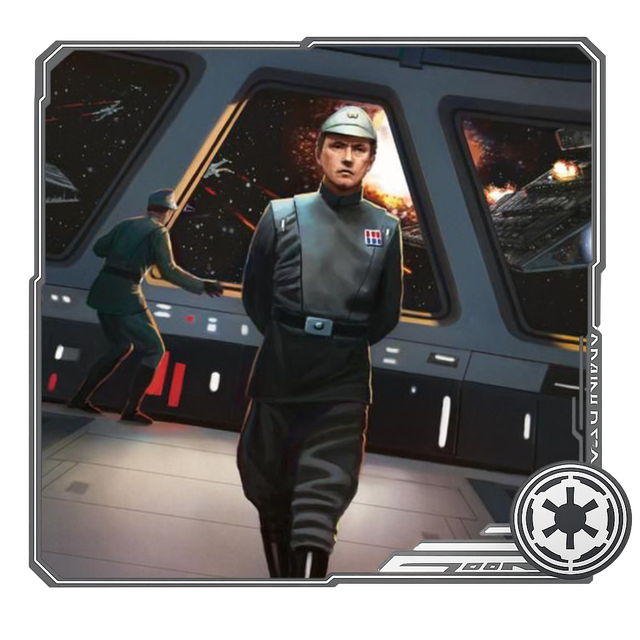
James Raddock
| Age | 35 |
| Species | Human |
| Gender | Male |
| Height | 6.1 ft |
| Weight | 73 kg |
| Force Sensitive | No. |
PHYSICAL DESCRIPTION
James Raddock stood at just over six feet tall, his lean frame giving him the appearance of a man who had spent far more time aboard starships than planets. At seventy-three kilograms, he lacked the broad, imposing build often associated with military heroes, but compensated for it with an unmistakable air of authority. His features were sharp and weathered by years of service, carrying the subtle signs of exhaustion that seemed common among officers who had survived the Empire's collapse. Short brown hair sat neatly beneath a grey naval officer's cap, while stern eyes constantly appeared to be studying something just beyond the immediate moment. Even at rest, he looked as though he were calculating risks, assessing situations, and preparing for the next crisis.
Raddock carried himself with the quiet confidence of a professional officer. His dark grey Imperial uniform was immaculately maintained despite the hardships of recent campaigns, the rank plaque upon his chest standing out against an otherwise austere appearance. He moved with measured precision, rarely wasting effort or motion, and often clasped his hands behind his back while observing those around him. There was little theatricality about him; he projected competence—the sort of presence that caused subordinates to straighten their posture and continue their duties without needing to be told.
INVENTORY
Please list all relevant possessions, factory submissions, and codex submissions here.
PERSONALITY AND BELIEFS
James Raddock is a professional first and foremost. Calm, disciplined, and intensely pragmatic, he possesses the sort of temperament that military institutions spend decades trying to cultivate in their officers. He rarely raises his voice, avoids unnecessary displays of emotion, and approaches most problems with methodical patience. While many officers inspire through charisma or force of personality, Raddock earns loyalty through competence. His crews trust him because he consistently demonstrates sound judgment, remains composed under pressure, and accepts responsibility when things go wrong.
Years of service have made him deeply skeptical of grand promises and ideological zeal. He has seen too many ambitious politicians, admirals, and warlords confidently march entire fleets into disaster while proclaiming victory was inevitable. As a result, he values realism over optimism and planning over passion. This often makes him appear cynical, though those who know him well understand that his caution comes from experience rather than pessimism. He still believes in the future; he simply believes that survival requires acknowledging reality before trying to improve it.
Despite his reserved nature, Raddock is not cold. He genuinely cares about the people under his command and takes casualties personally, though he rarely allows himself to show it openly. Every ship lost, every officer killed, and every failed operation becomes another weight he quietly carries. He maintains a professional distance from most relationships, believing that familiarity can cloud judgment, but there is a paternal quality to his leadership. He expects high standards because he understands the consequences of failure.
The collapse of the Galactic Empire only reinforced Raddock's conviction that civilizations are held together by institutions, not individuals. While many of his peers became obsessed with finding new strongmen, avenging old defeats, or restoring lost glory, Raddock came to a different conclusion. The Empire failed because too much depended upon a handful of extraordinary people. When those people disappeared, the structure beneath them collapsed. Since then, he has become a firm believer in building organizations that can survive the loss of any one leader, including himself.
He also views warfare as a necessary but deeply unpleasant reality. Unlike officers who romanticize battle, Raddock sees war as a failure of circumstance rather than a source of glory. Victories are valuable because they secure objectives, not because they produce heroes. He has little patience for reckless bravery, theatrical last stands, or officers who gamble lives for personal prestige. The purpose of a military, in his view, is to create stability, protect civilization, and win conflicts as efficiently as possible.
Perhaps most importantly, Raddock believes that the Empire's future lies not in reclaiming what was lost, but in building something better than what came before. He does not dream of restoring the old Galactic Empire exactly as it existed. Too much blood has been spilled for that illusion. Instead, he supports the idea behind the Imperial Reclamation Authority: a smaller, more competent, more disciplined state built upon professionalism rather than arrogance. If the Empire is to rise again, it must earn its place through competence rather than entitlement.
He also views warfare as a necessary but deeply unpleasant reality. Unlike officers who romanticize battle, Raddock sees war as a failure of circumstance rather than a source of glory. Victories are valuable because they secure objectives, not because they produce heroes. He has little patience for reckless bravery, theatrical last stands, or officers who gamble lives for personal prestige. The purpose of a military, in his view, is to create stability, protect civilization, and win conflicts as efficiently as possible.
Perhaps most importantly, Raddock believes that the Empire's future lies not in reclaiming what was lost, but in building something better than what came before. He does not dream of restoring the old Galactic Empire exactly as it existed. Too much blood has been spilled for that illusion. Instead, he supports the idea behind the Imperial Reclamation Authority: a smaller, more competent, more disciplined state built upon professionalism rather than arrogance. If the Empire is to rise again, it must earn its place through competence rather than entitlement.
STRENGTHS
Professional Naval Officer
James is an exceptionally competent fleet officer with a strong grasp of strategy, logistics, operational planning, and command. He understands that wars are won by supply lines, maintenance schedules, fuel reserves, and disciplined execution just as much as by battles themselves. His ability to remain focused on practical realities allows him to avoid many of the mistakes that plague more ambitious commanders.
Calm Under Pressure
Very little rattles Raddock. Fleet disasters, unexpected attacks, political crises, and battlefield setbacks rarely cause him to lose composure. He is capable of making difficult decisions under immense pressure and provides a stabilizing influence on those around him. When others panic, he becomes more focused.
Institution Builder
Unlike many Imperial officers who pursue personal glory, James is concerned with creating systems and organizations that will survive beyond his own career. He excels at administration, delegation, mentorship, and building competent command structures. He is often at his best when helping transform struggling units into effective ones.
Respected Leadership
Raddock inspires confidence through reliability rather than charisma. Subordinates trust him because he is consistent, fair, and willing to share hardships with those under his command. While he may not be beloved, he is deeply respected.
WEAKNESSES
Overly Cautious
Years of watching reckless commanders destroy ships and lives have made James extremely risk-averse. He often prefers the safer option, even when a more aggressive course of action might produce greater rewards. This caution can occasionally cause him to miss opportunities that bolder leaders would seize.
Carries Every Loss
Raddock takes casualties personally. While he understands that losses are inevitable in war, he never truly becomes numb to them. Failed operations, destroyed ships, and dead personnel weigh heavily on his conscience, sometimes leading him to become overly protective of his forces or hesitant to commit them to dangerous operations.
Poor Political Instincts
James understands organizations far better than politics. He is often uncomfortable with manipulation, intrigue, and personal ambition, preferring straightforward solutions to complicated political problems. This leaves him vulnerable to more cunning administrators, intelligence officers, and political operators who understand how to navigate systems of influence.
Lacks Charisma
While respected, James is not particularly inspiring. He struggles to rally people through speeches, personal magnetism, or grand vision. In an age where powerful personalities often dominate the political landscape, his quiet professionalism can make him seem unremarkable beside more dynamic leaders.
Difficulty Letting Go
Raddock has a tendency to cling to responsibility long after it becomes healthy. He often believes that if he works harder, plans more carefully, or personally oversees every detail, he can prevent disaster. This can lead to exhaustion, stress, and an unwillingness to delegate critical tasks to others, even when they are fully capable of handling them themselves.
HISTORY
James Raddock was born into a galaxy that increasingly relied upon institutions to survive. Unlike many of his contemporaries, he never dreamed of becoming a hero, a politician, or a great military conqueror. The Navy attracted him because it was practical. Ships moved supplies. Fleets protected worlds. Logistics kept civilization functioning. While others were drawn to glory, James found himself fascinated by the machinery that held entire governments together.
He entered military service during the final years of the Galactic Alliance, a period marked by growing instability and an increasingly desperate war against the Sith. His early career was unremarkable by design. He served aboard patrol vessels, escorts, and logistics ships, gradually earning promotions through reliability rather than brilliance. While other officers distinguished themselves through daring actions and battlefield heroics, Raddock built a reputation as the man who could be trusted to keep operations functioning. He learned how fleets lived and died, not through dramatic battles, but through shortages, maintenance failures, poor planning, and political interference.
When the Galactic Alliance finally collapsed and the Galactic Empire rose in its place, Raddock adapted quickly. Like many military professionals, his loyalty was not to a specific government but to the continuation of order itself. The galaxy was losing the war. Whatever one thought of the Empire politically, it appeared to offer the decisiveness and unity the Alliance had lacked during its final years. Raddock accepted a commission within the new Imperial Navy and continued serving, focusing on fleet operations and strategic logistics rather than ideological concerns.
The Empire's rise, however, would prove far shorter than many expected.
As the galaxy united against the new regime, Imperial forces found themselves stretched across multiple fronts. Fleet after fleet was committed to increasingly desperate operations as enemies closed in from every direction. During this period, James was assigned to what would become the 3rd Naval Task Force, a formation tasked with preserving Imperial naval strength wherever possible. The unit participated in numerous withdrawals, evacuations, convoy escorts, and rearguard actions as Imperial territory steadily collapsed around them.
By the time the Galactic Empire finally broke apart, the 3rd Naval Task Force had become less of a fleet and more of a collection of survivors.
Communications with high command vanished. Entire sectors fell silent. Supply networks collapsed. Captains became admirals overnight simply because nobody outranked them anymore. Yet somehow the Task Force endured. Under a collection of experienced officers unwilling to surrender, the fleet continued operating along the fringes of known space, scavenging resources, preserving personnel, and avoiding battles it could not win.
It was during this long period of isolation that James rose into a senior command role.
The experience fundamentally changed him. He watched ambitious officers destroy themselves chasing impossible victories. He witnessed warlords emerge from the ruins of the Empire. He saw entire crews sacrifice themselves so that others might escape. Most importantly, he learned that survival was not achieved through grand speeches or heroic charges. Survival came from discipline, cooperation, and the willingness to make difficult decisions before circumstances made them for you.
Years later, the 3rd Naval Task Force intercepted a signal that changed everything. Another Imperial remnant had survived.
The 9th Mechanized Corps, battered but intact, had endured its own journey through the collapse of Imperial authority. Contact was established, identities verified, and a rendezvous arranged on the world of Lothal. For the first time since the Empire's fall, James found himself standing on the edge of something larger than mere survival.