

Architect


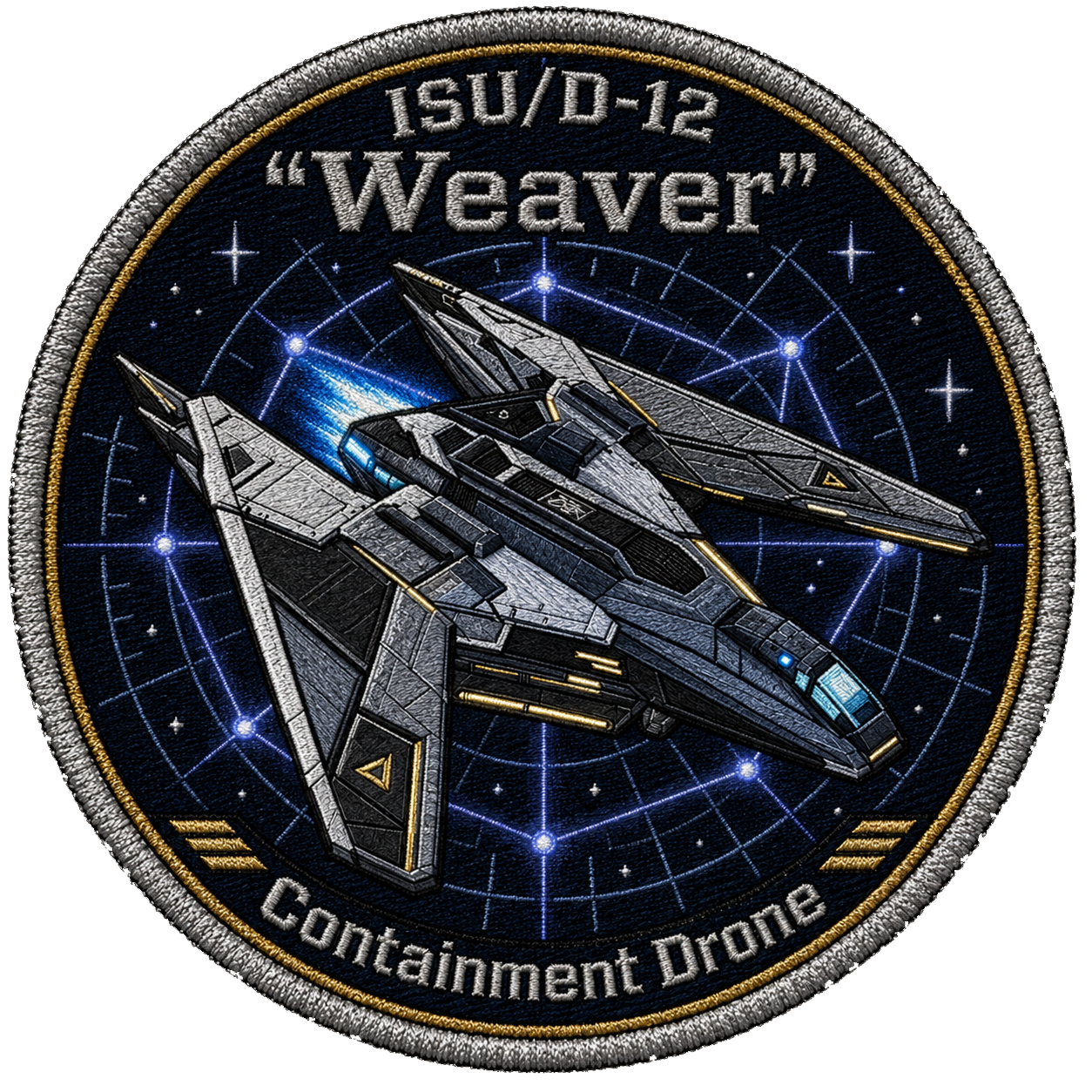
ISU/D-12 "WEAVER"
CONTAINMENT DRONE
CONTAINMENT DRONE
OUT OF CHARACTER INFORMATION
- Intent: To create containment drones that utilize the new Arachne Distributed Containment System
- Image Source: Midjourney / ChatGPT
- Canon Link: N/A
- Permissions: N/A
- Primary Source: Arachne Distributed Containment System
- Manufacturer: Imperial Commonwealth of Dosuun
- Affiliation: Imperial Commonwealth of Dosuun
- Market Status: Closed-Market
- Model: ISU/D-12 "Weaver" Containment Drone
- Modularity: No
- Production: Limited
- Material:
- Durasteel-Reinforced Crystalamnium Hull
- Crystaplast Micro-Liner
- Alusteel-Reinforced Durasteel Internal Frame
- Reactive Polyfoam Internal Shock Buffer
- Agrinium Shielding around reactor, datacore, and synchronization hardware
- Dallorian Alloy thermal reinforcement around projector assemblies and radiator surfaces
- Reinforced ceramic and superconductive components within the lattice projector assemblies
TECHNICAL SPECIFICATIONS
- Classification: Utility / Support Craft (Autonomous Containment Drone)
- Length: 9.4 meters
- Width: 9.1 meters
- Height: 2.8 meters
- Armament: Very Low
- 2 × Compact Defensive Laser Cannons
- Intended for emergency defense against light drones, missiles, and exposed ordnance.
- Not intended for fighter combat.
- Arachne Polarized Proton-Ion Projector Assemblies
- Classified as containment equipment rather than conventional destructive armament.
- 2 × Compact Defensive Laser Cannons
- Defenses: Average
- Compact Deflector Shield
- Reinforced Crystalamnium Hull
- Crystaplast Micro-Liner
- Agrinium-protected electronic and power systems
- Redundant internal compartmentalization around projector controls
- Squadron Count: Average, 12
- Maneuverability Rating: High
- Speed Rating: High
- Hyperdrive: None
STANDARD FEATURES
- Fully autonomous navigation and flight controls
- Encrypted Commonwealth IFF transponder
- Short and medium-range communications package
- Intra-squadron encrypted datalink
- Parent-vessel command uplink
- Standard sensor and navigational suite
- Repulsorlift system for atmospheric launch, recovery, and landing
- Compact deflector shield generator
- Automated docking and recovery systems
- Emergency locator and retrieval beacon
- No life-support system
- No crew compartment
- No passenger capacity
- No conventional cargo capacity
- Armored forward sensor blister in place of a cockpit
ADVANCED SYSTEMS
- Arachne Distributed Containment System: The Weaver serves as the mobile projection node for the larger Arachne containment architecture. Multiple drones position themselves around a designated target and establish synchronized polarized proton-ion filaments between neighboring units. The resulting network can be developed from individual barriers into a fully enclosed containment lattice.
- Independent Reactor Architecture: Each Weaver contains its own compact high-output reactor. The host vessel is responsible for deployment, targeting information, and command coordination, but does not continuously power the containment lattice.
- High-Density Capacitor Banks: Reactor output is accumulated within oversized capacitor assemblies. These provide the enormous short-duration energy discharge necessary to establish new proton-ion filaments and reinforce an existing lattice.
- Multi-Axis Projector Assemblies: Vectorable lattice emitters distributed through the Weaver's wing and hull structures allow the craft to maintain simultaneous filament connections with several neighboring drones.
- Anchor Mode: Once in its assigned lattice position, the Weaver reallocates propulsion, reactor output, thermal management, and computing resources toward containment. Fine maneuvering thrusters continuously compensate for target movement while the primary projector assemblies maintain the lattice.
- Formation Mode: Prior to enclosure, Weavers retain their full speed and maneuverability in order to disperse around a target, evade fire, and establish the required containment geometry.
- Distributed Mesh Coordination: Each Weaver exchanges positional, sensor, power-state, and projector information with the rest of its formation. Loss of one drone causes neighboring units to automatically calculate whether the lattice can be reshaped around the missing node.
- Autonomous Local Control: Loss of direct communication with the parent vessel does not immediately collapse an established Web. Surviving drones continue carrying out their last valid containment instructions using local mesh coordination.
- Adaptive Lattice Geometry: A Weaver formation can alter spacing and relative position while maintaining containment, allowing the cage to follow limited target movement or gradually reduce the volume available to the enclosed vessel.
- Thermal Regulation Network: Extensive heat sinks, radiators, coolant loops, and emergency power-shedding systems protect the projector equipment during sustained containment operations.
- Automatic Recovery Programming: Surviving drones disengage, retract active projector systems, and return to their assigned carrier when recalled or when operating reserves reach predetermined limits.
STRENGTHS
- Spin the Web: The Weaver transforms empty space into temporary battlefield geometry. Several drones can establish barriers, restrict maneuvering lanes, divide formations, or completely surround a target using the Arachne lattice.
- Independent Power: Every Weaver powers its own projector array. Deploying a squadron does not require the carrying vessel to continuously divert reactor output into maintaining the Web.
- Distributed Containment: There is no single central emitter whose destruction automatically terminates the entire network. Surviving drones can reshape a damaged lattice if sufficient nodes remain.
- Twelve Little Problems: A standard twelve-drone squadron provides considerable tactical flexibility. Six drones can form a conventional containment group while the remainder act as reserves, reinforce the existing lattice, or establish a second formation against smaller targets.
- Adaptive Formation: High speed and maneuverability allow Weavers to rapidly move into position before transitioning into the much more stationary Anchor Mode.
- Take Them Alive: The system is designed around movement denial and containment rather than destruction. This makes it particularly valuable against vessels intended for boarding, interrogation, seizure, or recovery.
- No Crew at Risk: The entire craft is autonomous. Commanders can expose Weaver formations to hazardous positioning maneuvers without risking pilots.
- Reusable Asset: Unlike a missile or disposable mine, a surviving Weaver can be recovered, serviced, recharged, and redeployed.
WEAKNESSES
- One Drone Does Not Make a Web: A single Weaver cannot produce a meaningful containment cage. Multiple drones must successfully reach their assigned positions before the system reaches its intended effectiveness.
- The Web Must Be Woven: Deployment is not instantaneous. Weavers must launch, disperse around the target, establish geometry, synchronize, and activate their projector links. A sufficiently fast vessel may escape before enclosure is complete.
- Anchor Mode: A Weaver maintaining a high-strength lattice is much easier to engage than one maneuvering freely. A significant portion of available propulsion authority is committed to precise station keeping, while reactor output is diverted toward the projectors.
- Cut the Thread: Destroying or disabling a Weaver removes the filaments dependent upon that node. Enough losses can create an escape corridor or cause the entire lattice to collapse.
- Heat Before Fuel: Reactor endurance is not usually the limiting factor. Projector heat and capacitor throughput are. Sustained high-output containment eventually forces individual drones to reduce lattice strength or disengage for cooling.
- Very Little Bite: The Weaver is not a fighter. Its defensive lasers can discourage missiles or very light drones, but dedicated interceptors can overwhelm it quickly.
- No Hyperdrive: Weaver squadrons are entirely dependent upon carriers or other equipped vessels for strategic transportation.
- Electronic Warfare: Heavy jamming can disrupt parent-vessel control and degrade formation coordination. Local mesh networking allows the drones to continue operating, but the lattice becomes slower to adapt and less efficient.
- Finite Geometry: A twelve-drone squadron cannot contain arbitrarily large vessels. Increasing target dimensions, engine power, defensive shielding, and mass require wider spacing and greater lattice output. Very large targets may require multiple Weaver squadrons.
- Not an Absolute Barrier: The Arachne lattice produces powerful resistance and disruptive interaction, not an indestructible wall. Sufficient shield output, concentrated weapons fire, specialized countermeasures, or brute propulsion may break an individual filament.
- Friendly Traffic Included: The Web does not politely distinguish between hostile and friendly craft crossing an active filament. Fighters, boarding shuttles, missiles, and allied vessels must use designated openings or remain clear until containment is deliberately altered.
DESCRIPTION
The ISU/D-12 "Weaver" represents the first purpose-built utility drone of the Commonwealth's modern /D autonomous craft lineage. The designation follows the precedent established by the ISF/D-11 "Laren" Drone Interceptor, but the change from ISF to ISU reflects an important doctrinal distinction. The Weaver is not a starfighter. Its purpose is not interception, strike warfare, reconnaissance, or conventional ship-to-ship combat. It is a mobile piece of battlefield infrastructure. The approved Laren already establishes the Commonwealth's modern slash-D designation and autonomous swarm architecture; the Weaver takes that philosophy into a very different mission set.
At slightly under ten meters in length, the Weaver is considerably larger than the compact Laren. Much of that additional internal volume is consumed by its power-generation and containment equipment. The apparent forward cockpit is actually an armored sensor blister containing optical, electromagnetic, ranging, and navigational instrumentation. There is no seat behind it, no life support system, and no accommodation for an organic pilot.
The Weaver is built around a compact reactor coupled to oversized capacitor banks. This arrangement is fundamental to the craft's mission. Rather than forcing an equipped cruiser or carrier to divert enormous quantities of power into a remotely projected containment field, the parent vessel launches the energy source along with the emitter. Each Weaver therefore arrives at its assigned position with the power required to establish and maintain its own portion of the Web.
During Formation Mode, the drones behave much like unusually large autonomous support fighters. They spread away from their carrier at high speed and maneuver around a designated target according to geometry calculated jointly by the parent vessel and the formation itself. A single drone is of little consequence. Two can establish a filament between them. Three or more begin creating useful barriers and funneling structures. A conventional closed containment operation typically employs six Weavers, while additional drones reinforce the enclosure or remain available to replace damaged nodes.
Once properly positioned, the drones transition into Anchor Mode.
Power is redirected from normal maneuvering reserves into the Arachne projector assemblies. High-density capacitors discharge, polarized proton-ion filaments snap into existence between neighboring drones, and the individual emitters synchronize into a larger lattice. Each Weaver continually adjusts its position with maneuvering thrusters, compensating for drift and limited movement by the vessel inside.
The completed structure is colloquially known throughout Commonwealth service as the Web.
The Web is not intended to slice through a vessel or crush it. Instead, the interaction between its energized filaments and a ship's shields, propulsion emissions, charged hull surfaces, and maneuvering systems makes crossing an active boundary progressively more difficult. A vessel pushing against a filament may experience shield distortion, localized ionization, engine feedback, and severe electrical stress. Force can overcome the lattice, but doing so becomes a contest between the escaping ship's available power and the participating Weavers' ability to maintain field cohesion.
The system is consequently at its most useful when the Commonwealth does not wish to destroy its opponent. Intelligence vessels can be prevented from fleeing while boarding teams approach. Damaged capital ships can be held away from hyperspace escape long enough for conventional forces to disable them. Hostile formations can be divided, avenues of approach temporarily denied, and pursuing vessels forced to choose between slowing down or challenging the lattice directly.
None of this makes the Weaver invulnerable.
Anchor Mode is inherently dangerous. A drone that had been darting freely through space moments before must now maintain very precise relative positioning while dumping immense amounts of energy through its projectors. Its movements become predictable, its thermal signature increases sharply, and an enemy that understands the system knows exactly what to shoot.
Destroying one drone can break several connecting filaments simultaneously.
A properly deployed formation attempts to compensate by shifting neighboring Weavers and bringing reserve drones forward, creating a constant struggle between the trapped vessel attempting to open the cage and the drone network attempting to close it again. This makes containment an ongoing tactical contest rather than an automatic status effect.
A standard flight consists of twelve Weavers. Commonwealth commanders can employ the entire flight against a large or particularly powerful opponent, divide it into two six-drone containment groups, or hold part of the formation in reserve. Multiple flights may cooperate when confronting capital ships too large or powerful for a single Web.
The ISU/D-12 is therefore neither fighter nor mine nor conventional weapons platform.
It is, quite literally, the thing that spins the Web.
Out Of Character Info
Intent:
To create containment drones that utilize the new Arachne Distributed Containment System
Image Source(s):
https://chatgpt.com
Canon Link:
N/A
Permissions:
N/A
Primary Source(s):
https://www.starwarsrp.net/threads/arachne-distributed-containment-system.208962/
Technical Information
Affiliation:
Imperial Commonwealth of Dosuun
Model:
ISU/D-12 "Weaver" Containment Drone
Starship Class:
Small Craft (1-50m)
Starship Role:
Drone
Modular:
No
Material:
Durasteel-Reinforced Crystalamnium Hull Crystaplast Micro-Liner Alusteel-Reinforced Durasteel Internal Frame Reactive Polyfoam Internal Shock Buffer Agrinium Shielding around reactor, datacore, and synchronization hardware Dallorian Alloy thermal reinforcement around projector assemblies and radiator surfaces Reinforced ceramic and superconductive components within the lattice projector assemblies
Armaments:
2 × Compact Defensive Laser Cannons
Intended for emergency defense against light drones, missiles, and exposed ordnance.
Not intended for fighter combat.
Arachne Polarized Proton-Ion Projector Assemblies
Classified as containment equipment rather than conventional destructive armament.
Intended for emergency defense against light drones, missiles, and exposed ordnance.
Not intended for fighter combat.
Arachne Polarized Proton-Ion Projector Assemblies
Classified as containment equipment rather than conventional destructive armament.
Defense Rating:
Average
Speed Rating:
High
Maneuverability Rating::
High
Energy Resist:
Low
Kinetic Resist:
Low
Radiation Resist:
Average
Other Resistance(s):
- EMP/ION: Average
- Sonic: Average
- Force Disruption/Harmonics: Low
- Elemental (Fire/Cold/Corrosive): Low
Minimum Crew:
0
Optimal Crew:
0
Passenger Capacity:
0
Cargo Capacity:
None