

Architect




ISF/D-11 "LAREN" DRONE INTERCEPTOR
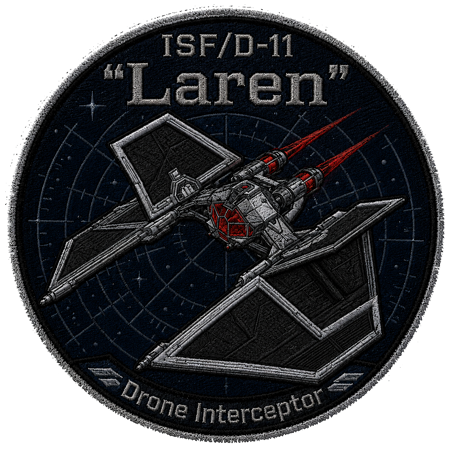
OUT OF CHARACTER INFORMATION
- Intent: To modernize the Primo Victorian Shipwright Laren-type Droid Interceptor (2018) into the Imperial Commonwealth of Dosuun's contemporary starfighter doctrine — a Minor-production, fully autonomous anti-missile point-defense drone deployed in coordinated swarms to picket fleets against incoming ordnance, fielded in numbers sufficient to commit aggressively at Commonwealth scale. Establishes the slash-D drone designation as a legacy-modernization category within the existing ISF/ISE/ISB/ISR lineage.
- Image Source: Pinterest / Bioware (original 2018 sub); ChatGPT
- Canon Link: N/A
- Permissions: N/A
- Primary Source:
- Laren-type, Droid Interceptor — Fiolette Fortan, 2018 (Primo Victorian Shipwright)
- Tasha-type Plasma Cannon — fighter-scale ancestor of the Laren's Tasha-pattern armament
- Tasha III-type Plasma Disruptor Cannon — modern doctrinal evolution of the Tasha line; doctrinal parent of the Laren's compact-scale armament
- ISF/74A Aegis Heavy Defender, ISF/88A Marauder Medium Strike Fighter
PRODUCTION INFORMATION
- Manufacturer: Imperial Commonwealth of Dosuun
- Affiliation: Imperial Commonwealth of Dosuun
- Market Status: Closed-Market
- Model: ISF/D-11 "Laren" Drone Interceptor
- Production: Minor
- Material:
- Durasteel-Reinforced Crystalamnium Hull (Compact)
- Crystaplast Micro-Liner
- Alusteel-Reinforced Durasteel Frame [Internal]
- Reactive Polyfoam Buffer [Internal Shock Absorption]
- Agrinium [Critical Components —Eralam/NATASI Core, Power Cell]
- Classification: Interceptor (Drone, Anti-Ordnance)
- Length: 3.25 meters
- Width: 2.0 meters
- Height: 2.5 meters
- Armament: Low
- 4 × Tasha-Pattern Compact Plasma Disruptors [Drone Variant] — Drone-scale plasma disruptor emitters inheriting the doctrinal characteristics of the modern Tasha III-type Plasma Disruptor Cannon at compact form-factor: rapid-tracking, AI-coordinated, multi-projectile engagement against missiles and drones, with limited light-shield disruption against soft targets in extended bursts. Effective against ordnance, drones, and small unshielded craft; explicitly not a fighter-versus-fighter armament.
- Defenses: Low
- Compact Deflector Shield: Light shielding sufficient to deflect glancing fire or shrapnel from intercepted ordnance; will not survive concentrated attention.
- Ion Shielding Layer (Compact): Protects the Eralam/NATASI core and swarm-coordination relays against ion, EMP, and ECM-heavy environments.
- Crystaplast Micro-Hull: Minor radiant dispersion and kinetic fragmentation resistance.
- Reactive Polyfoam Buffer: Internal shock absorption for the data core during near-miss detonations and atmospheric maneuvers.
- Squadron Count: Very High — 20
- Maneuverability Rating: High
- Speed Rating: Very High
- Hyperdrive: None
STANDARD FEATURES
- Compact encrypted Commonwealth IFF transponder
- Compact comms relay (intra-swarm and parent-vessel datalink only)
- Compact navigation and short-range astrogation
- Standard repulsorlift system
- No life-support; no crew compartment; no ejection system (fully autonomous platform)
ADVANCED SYSTEMS
- Power & Propulsion Systems:
- 4× Howlback-XC Compact Ion Engines [Drone Variant] — Microburst-tuned ion thrusters at compact scale, optimized for the sharp tracking maneuvers anti-ordnance work demands. The Howlback's native agility profile is the engine's ideal application at this hull size: rapid pivots, fine directional thrust, and short-duration overdrive to close the gap on an incoming missile track.
- 2× Icarus-S Compact Maneuvering Array [Drone Variant] — Vector-thrust microjets providing the lateral burst authority required to intercept ordnance arriving on unpredictable terminal vectors. Inertial-dampener override permits high-G repositioning that would be punishing on a crewed craft and is doctrinally irrelevant on an unmanned one.
- Trinity Core: Sakerstrike Compact [Drone Variant] — Scaled-down strike-grade reactor providing reliable power for sustained PD operations across the swarm's engagement window. No redundancy and no survivability margin — the Laren is built to be committed, not preserved, but it is a committed Commonwealth asset rather than a purely disposable hull.
- Fries-IV Compact Suite [Drone Variant] — Thermal regulation and emergency power-rerouting at drone scale, preserving the data core under sustained engagement heat.
- Crystal-Integrated Harmonic Regulator (Compact) [Drone Variant] — Energy stabilization preventing cascading power fluctuations across propulsion, tracking, and weapons during rapid PD engagement cycles.
- Autonomous Intelligence Architecture:
- Full Eralam/NATASI Integration — The original platform's heuristic processor is superseded by complete Eralam/NATASI architecture, providing autonomous threat detection, missile-track prediction, terminal-engagement geometry, and — critically — swarm coordination across the full 20-drone flight: target hand-off between drones, distributed PD coverage of approach vectors, dynamic re-tasking as missiles are intercepted or new threats appear. The swarm operates as a single coordinated intelligence rather than 20 individual processors, with each Laren receiving and contributing to a shared engagement picture.
- Datalink-First Doctrine: The Laren's operational value depends on the swarm link to the parent vessel and to peer drones; an isolated Laren is degraded but functional, while a fully linked swarm is the platform at full capability.
- Sensors & Datacore Systems:
- TCSX-Strikeveil Compact Tracking Suite [Drone Variant] — Short-range threat detection and missile-track classification tuned for the PD role. Identifies incoming ordnance by signature, predicts terminal vectors, and feeds engagement solutions to the Eralam/NATASI core for swarm-distributed response. Local-theater only and significantly shorter-ranged than the starfighter variant carried by the Marauder and Dauntless — sufficient for the Laren's mission and no more.
- ECMX-Ghostspike Validation Suite (Compact) [Drone Variant] — Validates swarm-coordination data and parent-vessel targeting against spoofing, protecting the integrity of the engagement picture across the flight.
- Compact Comms Relay — Intra-swarm and parent-vessel datalink; no long-range communication capability.
STRENGTHS
- Anti-missile saturation: A full 20-drone flight provides dense, distributed point-defense coverage against incoming ordnance, protecting capital ships, carriers, and strike packages from missile and torpedo saturation in a way no crewed fighter can match at this density.
- Swarm intelligence: Full Eralam/NATASI integration is the platform's defining capability — the swarm coordinates target hand-off, distributes PD coverage across multiple vectors, and dynamically re-tasks as threats appear and are intercepted. Twenty drones operate as one coordinated intelligence.
- Agility at scale: Quadruple Howlback engines, dual Icarus arrays, and a 3.25m hull give the Laren the maneuver authority to track and intercept ordnance arriving on unpredictable terminal vectors.
- Committed at Commonwealth scale: Minor production at the scale of a Major Faction allows the Laren to be fielded in numbers sufficient to commit aggressively against ordnance threats — not a throwaway hull, but a specialized PD asset produced in enough quantity that losses are absorbable rather than catastrophic. The Commonwealth treats Larens as committable, not precious.
- No crew at risk: Fully autonomous operation means a Laren engagement carries no personnel cost, freeing fleet commanders to commit them aggressively against ordnance threats that would otherwise force harder defensive choices.
WEAKNESSES
- Anti-ordnance only: The Tasha-pattern armament is explicitly tuned to disrupt missiles and small unshielded targets — the Laren is helpless against fighters, gunships, or anything with meaningful shields and armor. A Laren swarm engaged by interceptors dies very quickly, and a Laren is not a fighter-versus-fighter combatant at any scale.
- Glass cannon at the individual level: Low defenses on a 3.25m hull mean any solid hit kills a Laren. Survivability is a swarm property, not an individual one.
- No hyperdrive: Carrier-launched only. Lurens cannot self-deploy and depend wholly on parent-vessel transit and recovery cycles, tying the platform to fleet operations.
- Swarm degrades under ECM: Heavy electronic warfare that severs intra-swarm datalink degrades the Laren from a coordinated swarm intelligence to 20 individual short-range PD drones — still functional, but at a fraction of designed capability. Ghostspike validation mitigates spoofing but not jamming.
- Sensor reach is minimal: The Compact Strikeveil suite is local-theater only and significantly shorter-ranged than the starfighter variant. The Laren sees what is close enough to shoot and little else; long-range threat warning depends on the parent vessel's sensor picture.
- Compact-scale hull: Materials and systems are scaled-down compact variants, not the full starfighter-grade backbone of the Marauder/Harrier/Dauntless. Durability tolerances are accordingly reduced — the Laren is a drone, not a small fighter.
DESCRIPTION
The Laren is older than most of the craft beside which it now flies. Its original lineage traces to the late First Order era under Primo Victorian Shipwright, where the VDF-OSI Laren was developed as a dedicated anti-missile droid interceptor for the Charger II prototype and the Raskova III escort line — a small, fast, autonomous platform meant to swat incoming ordnance from the sky before it reached the hulls of larger vessels. The design was pulled from Sith Empire archives and miniaturized; its heuristic processor was the state of the art for the time, and its Tasha-type plasma cannons established the anti-missile armament profile that has never since left the platform.
The modern ISF/D-11 is that same craft, evolved across the decade of Commonwealth doctrinal development that separates it from its origins. The compact crystal-hull lineage that defines every contemporary Commonwealth fighter has replaced the original quadanium reinforcement; the Howlback-XC and Icarus systems that anchor the modern starfighter corps now drive the Laren at drone scale, finally finding their ideal home in a hull whose entire mission is to pivot, track, and intercept. The Tasha-pattern armament has been brought forward through the Tasha III-type plasma disruptor's modern doctrinal evolution — rapid-tracking, AI-coordinated, multi-projectile engagement at compact drone scale rather than the capital-grade form-factor in which the Tasha III is normally fielded. Most significantly, the original heuristic processor has been wholly superseded by full Eralam/NATASI integration — the same autonomous intelligence architecture that flies the Marauder's strike sequencing and the Harrier's sensor triage, now coordinating 20 Larens as a single distributed swarm rather than 20 individual drones.
That swarm intelligence is the platform's reason to exist in its modern form. A Laren flight does not engage missiles as 20 separate interceptors; it engages as one coordinated picket, with target hand-off, distributed coverage, and dynamic re-tasking handled across the flight in real time. Where the previous Laren made its own decisions and engaged its own targets, a modern Laren operates within a shared engagement picture: each drone sees what every other drone sees, contributes to the swarm's threat classification, and is dispatched against the ordnance it is geometrically best positioned to intercept. The whole flight, working through the Eralam/NATASI architecture, behaves more like a single distributed weapon system than a squadron — and is the answer the Commonwealth has developed to the missile-saturation tactics that crewed point-defense fighters cannot economically counter.
What it cannot do is fight. The Tasha-pattern disruptors that make it lethal against incoming ordnance are useless against fighters, gunships, or anything with real armor and shields; a Laren swarm engaged by interceptors dies without a meaningful return blow. Individual survivability is minimal — any solid hit kills a Laren — and the platform depends on its carrier for hyperspace transit, recovery, and re-arming. The Minor production tier reflects the Laren's current status honestly: not a throwaway hull, but a specialized Commonwealth asset produced in sufficient numbers that the swarm doctrine remains viable and losses are absorbable rather than catastrophic. In Commonwealth service it flies ahead of and beside the fleet's ordnance-vulnerable assets — the Cataclysm during its escort phase, the carriers themselves, the high-value capital hulls — picketing the approach vectors against the missile and torpedo saturation that has come to define modern fleet engagement.
It is the oldest platform in the new corps, and the one that has changed the most.
Out Of Character Info
Intent:
To modernize the Primo Victorian Shipwright Laren-type Droid Interceptor (2018) into the Imperial Commonwealth of Dosuun's contemporary starfighter doctrine — a Minor-production, fully autonomous anti-missile point-defense drone deployed in coordinated swarms to picket fleets against incoming ordnance, fielded in numbers sufficient to commit aggressively at Commonwealth scale. Establishes the slash-D drone designation as a legacy-modernization category within the existing ISF/ISE/ISB/ISR lineage.
Canon Link:
N/A
Permissions:
N/A
Primary Source(s):
Laren-type, Droid Interceptor — Fiolette Fortan, 2018 (Primo Victorian Shipwright)
Technical Information
Affiliation:
Imperial Commonwealth of Dosuun
Model:
ISF/D-11 "Laren" Drone Interceptor
Starship Class:
Small Craft (1-50m)
Starship Role:
Drone
Modular:
No
Material:
Durasteel-Reinforced Crystalamnium Hull (Compact) Crystaplast Micro-Liner Alusteel-Reinforced Durasteel Frame [Internal] Reactive Polyfoam Buffer [Internal Shock Absorption] Agrinium [Critical Components —Eralam/NATASI Core, Power Cell]
Armaments:
4 × Tasha-Pattern Compact Plasma Disruptors [Drone Variant] — Drone-scale plasma disruptor emitters inheriting the doctrinal characteristics of the modern Tasha III-type Plasma Disruptor Cannon at compact form-factor: rapid-tracking, AI-coordinated, multi-projectile engagement against missiles and drones, with limited light-shield disruption against soft targets in extended bursts. Effective against ordnance, drones, and small unshielded craft; explicitly not a fighter-versus-fighter armament.
Defense Rating:
Low
Speed Rating:
Very High
Maneuverability Rating::
High
Energy Resist:
Low
Kinetic Resist:
Low
Radiation Resist:
Average
Other Resistance(s):
- EMP/ION: Average
- Sonic: Average
- Force Disruption/Harmonics: Low
- Elemental (Fire/Cold/Corrosive): Low
Minimum Crew:
0
Optimal Crew:
0
Passenger Capacity:
0
Cargo Capacity:
None