
Barragh Nenn
Imperial Hand




HSP-9 Bastion Heavy Mobile Siege Platform
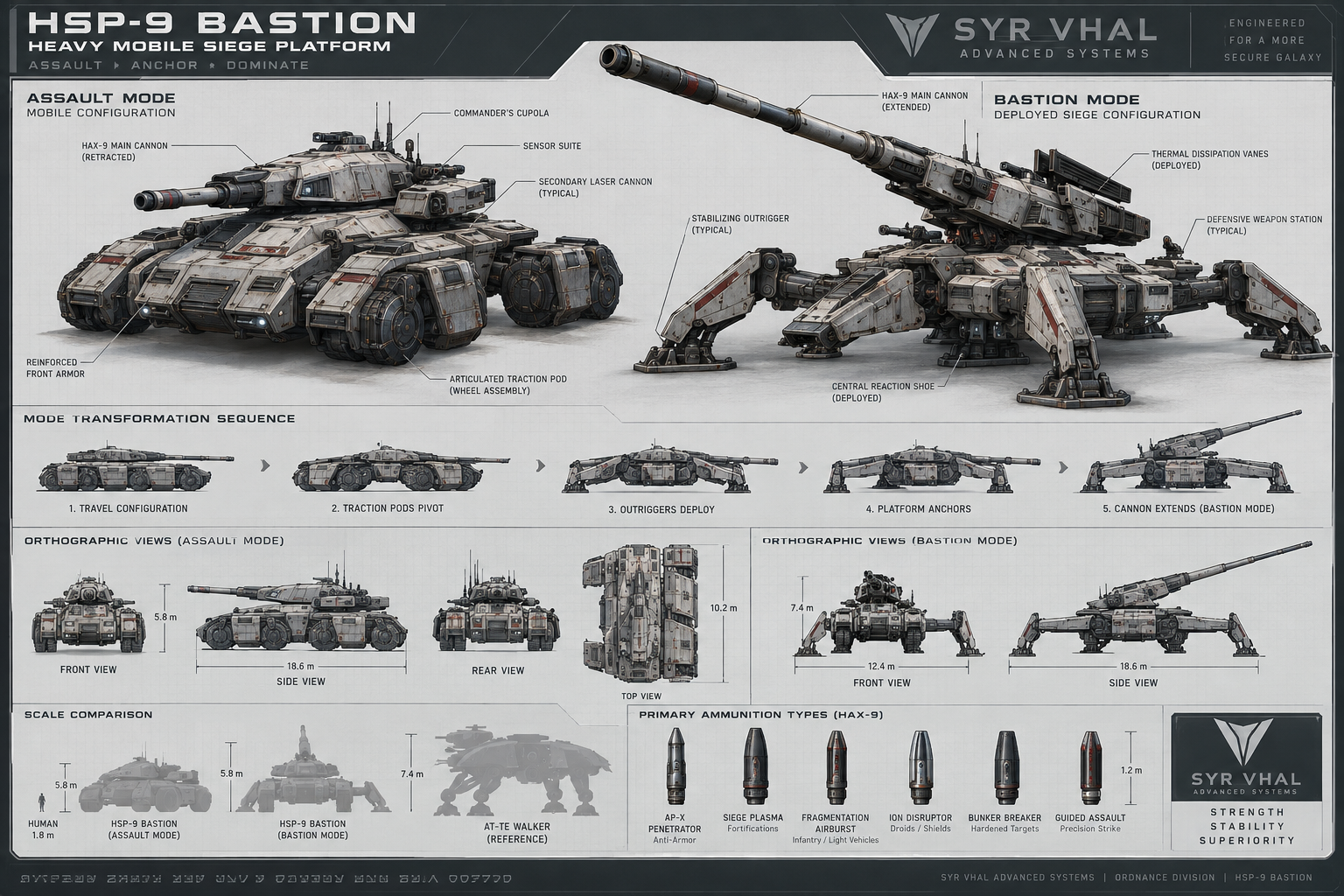
SPECIAL FEATURES
- Dual-Configuration Combat System: The HSP-9 operates in two distinct configurations, designated Assault Mode and Bastion Mode.
- Assault Mode: The standard mobile configuration. The traction pods remain underneath the armored hull and the HAX-9 accelerator remains partially retracted. The primary weapon can still engage enemy armor and fortifications, but operates at substantially reduced power in order to prevent excessive stress upon the suspension and vehicle frame.
- Bastion Mode: The HSP-9 physically deploys itself into a stabilized artillery emplacement. The vehicle lowers its center of gravity, widens its stance, deploys four armored stabilizing outriggers and lowers a reinforced central reaction shoe beneath the hull.
- Four Independent Stabilizing Outriggers: Heavy articulated supports deploy outward from the chassis and anchor the HSP-9 to the terrain. Each possesses independent suspension and leveling capability to compensate for uneven ground.
- Central Reaction Shoe: A large reinforced structure beneath the hull lowers directly against the terrain while in Bastion Mode, allowing firing stresses to be transferred through the vehicle's central structure rather than entirely through its propulsion system.
- Telescoping Main Weapon: The HAX-9 extends when entering Bastion Mode, increasing the effective length of its acceleration chamber and permitting higher-energy firing cycles.
- Deployable Thermal Radiators: Armored thermal-dissipation vanes open during sustained bombardment to help manage heat generated by the HAX-9 and its capacitor banks.
- Repulsorlift-Assisted Traction: The HSP-9 does not operate as a conventional repulsorlift vehicle. Instead, compact repulsorlift generators partially reduce the effective load placed upon its traction pods, improving mobility across rubble, loose ground and damaged infrastructure.
- Advanced Fire-Control Computer: Calculates ballistic solutions, vehicle attitude, atmospheric conditions, target movement and terrain data when coordinating long-range fire.
- Networked Target Acquisition: The Bastion can receive targeting information from reconnaissance vehicles, infantry observers, probe droids, aircraft, starfighters, orbital platforms and other compatible battlefield sensors.
- Indirect Fire Capability: Unlike conventional direct-fire energy weapons, the HAX-9 can utilize specialized physical/plasma projectiles along calculated ballistic trajectories to strike targets beyond direct line of sight.
- Variable Ammunition Selection: Compatible ammunition includes anti-armor penetrators, siege rounds, fragmentation airburst projectiles, ion-disruption rounds and hardened-target penetrators.
- Automatic Terrain Analysis: Sensors beneath the chassis determine whether the surface can safely withstand Bastion Mode firing stresses.
- Deployment Interlock: The fire-control computer prevents full-output firing if the stabilizers have not achieved adequate contact or if the vehicle is positioned upon unsuitable terrain.
- Integrated Battlefield Communications Suite: Allows multiple HSP-9s to function as coordinated artillery batteries.
STRENGTHS
- Siege Weapon: The HAX-9 is an exceptionally powerful vehicle-mounted weapon designed specifically to destroy hardened defensive positions, heavy vehicles, walkers and fortified structures.
- Two Vehicles in One: Unlike dedicated artillery pieces that are vulnerable while relocating, the HSP-9 remains a heavily armored combat vehicle while traveling and can directly engage hostile forces in Assault Mode.
- Bastion Mode: Once deployed, the vehicle transforms into an extremely stable firing platform capable of using the HAX-9 at its full intended output.
- Long-Range Fire Support: When supplied with targeting information from forward observers, the Bastion can engage enemies well beyond the range of its own direct visual sensors.
- Heavy Armor: The HSP-9 is designed to operate relatively close to contested front lines and consequently possesses substantially heavier protection than conventional artillery systems.
- Repulsor-Assisted Mobility: Its hybrid propulsion system allows a vehicle of considerable mass to cross difficult terrain that would otherwise threaten to immobilize it.
- Networked Warfare: Several Bastions can coordinate their fire, allowing multiple rounds to converge upon the same position in rapid succession.
- Extremely Effective Against Fortifications: Fixed defensive positions, bunkers, command centers and entrenched armor represent ideal targets for the HAX-9.
- Direct or Indirect Fire: Depending upon ammunition, battlefield conditions and deployment configuration, the Bastion can operate as either an assault gun or conventional long-range artillery platform.
WEAKNESSES
- Immobile in Bastion Mode: Once fully deployed, the HSP-9 cannot meaningfully maneuver. Its traction assemblies are locked into position and its propulsion systems are partially disengaged.
- Deployment Window: Transitioning between Assault Mode and Bastion Mode leaves the vehicle temporarily unable to move effectively or employ its main weapon at maximum capability.
- Unsuitable Terrain: Swamps, deep mud, unstable sand, weak flooring and other surfaces unable to tolerate the Bastion's concentrated weight may prevent safe deployment.
- Vulnerable Stabilizers: Although armored, the deployed outriggers and central reaction structure are more exposed than the main hull. Significant damage to them can prevent the vehicle from entering Bastion Mode.
- Heat Generation: Maximum-output HAX-9 firing produces enormous quantities of waste heat. Sustained bombardment eventually forces the vehicle to decrease its rate of fire.
- Energy Intensive: The HAX-9 consumes enormous quantities of stored energy. Shield strength and mobility-related systems may be reduced when the primary weapon is operating continuously.
- Limited Close Defense: The secondary weapons can defend the Bastion against infantry and light vehicles, but the vehicle remains vulnerable to coordinated close assault.
- Air Attack: The HSP-9 is a large and comparatively slow target. Once deployed, enemy starfighters, bombers and gunships represent significant threats unless friendly air defenses are present.
- Ammunition Dependent: Unlike conventional laser artillery, the HAX-9 relies upon specialized ammunition. Extended operations therefore require dedicated logistical support.
- Poor Urban Mobility: Its considerable width and deployment footprint make operation within confined streets, tunnels and dense urban terrain difficult.
- Forward Observers: Although the Bastion possesses excellent onboard sensors, its greatest effective ranges normally require external targeting information. Destroying or jamming those observers significantly reduces its long-range effectiveness.
DESCRIPTION
Developed by Syr Vhal Advanced Systems, the HSP-9 Bastion Heavy Mobile Siege Platform was conceived as a solution to one of the oldest problems associated with battlefield artillery: the conflict between firepower and mobility.Traditional artillery systems possessed the range and weapon strength necessary to destroy fortified positions but often required extensive preparation, transportation and protection. Heavy assault vehicles could survive much closer to the front but rarely possessed the stability necessary to employ weapons comparable to dedicated siege artillery.
The HSP-9 was designed to perform both roles.
Its normal traveling configuration, officially designated Assault Mode, resembles an exceptionally broad and heavily armored tank. Four independent articulated traction pods support the main chassis, while repulsorlift generators reduce a portion of the vehicle's apparent ground loading without actually causing the Bastion to hover. This allows the platform to negotiate broken terrain and battlefield debris despite its considerable mass.
The HAX-9 Heavy Electromagnetic Plasma Accelerator remains operational while the Bastion is moving, allowing the vehicle to function as a powerful assault gun. In this configuration, however, the fire-control system restricts the weapon to reduced-energy firing cycles. The limitation protects the suspension, turret assembly and internal structure from firing loads that the mobile chassis was never intended to absorb.
The HSP-9 reveals its true purpose when ordered into Bastion Mode. Its articulated traction assemblies reposition themselves and the main chassis lowers toward the terrain. Four heavy stabilizing outriggers then extend away from the hull, dramatically increasing the platform's effective footprint. A reinforced reaction shoe descends from the underside of the vehicle until it is pressed firmly against the ground.
The concept operates upon relatively straightforward mechanical principles. Rather than forcing the suspension alone to absorb the stresses generated by firing an extremely powerful weapon, those forces are redirected through several reinforced structural pathways and distributed across a much larger area of terrain.
Once sufficiently anchored, the HAX-9 telescopes into its full firing configuration. Additional electromagnetic acceleration sections are brought into alignment, power is transferred from mobility systems into the main capacitor network and armored thermal radiators deploy around the weapon assembly.
In this configuration, the HSP-9 ceases to function primarily as a tank and effectively becomes a self-contained artillery emplacement.
The HAX-9 Heavy Electromagnetic Plasma Accelerator combines electromagnetic acceleration with specialized ammunition surrounded or energized by a magnetically constrained plasma envelope. Dense penetrators provide momentum and structural penetration while the accompanying high-energy discharge substantially increases damage against armor and hardened targets.
Unlike most conventional energy artillery, the presence of a physical projectile also allows the HAX-9 to perform genuine indirect-fire missions. A Bastion does not therefore require visual contact with its target. Probe droids, scout vehicles, infantry observers, aircraft or orbital reconnaissance can acquire enemy positions and transmit coordinates to an HSP-9 battery. Fire-control computers aboard each platform calculate individual trajectories, environmental conditions and timing solutions before the vehicles fire.
Multiple Bastions can consequently bombard the same position simultaneously from considerable distances. This has led Syr Vhal Advanced Systems to market the HSP-9 less as an individual tank and more as the central component of a mobile siege column.
Typical doctrine organizes several Bastions alongside reconnaissance units, ammunition carriers, air-defense vehicles and infantry protection. Some vehicles deploy while others relocate, allowing a formation to advance without completely surrendering artillery coverage.
This mobility distinguishes the platform from far larger siege weapons.
The HSP-9 is not intended to compete directly with enormous strategic artillery platforms capable of threatening capital ships. Instead, it brings a significant portion of siege-level destructive capability onto a chassis sufficiently compact to accompany conventional armored formations.
Bunkers, shield generators, armored formations, command posts, defensive walls and heavy walkers represent preferred targets.
The design nevertheless possesses substantial limitations.
A Bastion is dangerous while moving, but reaches its greatest potential only by surrendering that mobility. Once its outriggers are planted and its central reaction shoe is supporting the chassis, the HSP-9 becomes a comparatively stationary target. Enemy commanders capable of locating a deployed battery can attack it with airpower, counter-battery fire or rapidly advancing ground forces.
Terrain presents an additional concern. The tremendous forces passing through the stabilizers mean that a Bastion cannot safely deploy everywhere. Ground-analysis systems test the surrounding terrain before permitting maximum-output firing, and the vehicle's computers will refuse certain firing solutions if the platform cannot establish adequate support.
The HAX-9 is similarly demanding. Repeated full-output shots generate substantial heat, consume immense electrical power and rapidly expend specialized ammunition. Bastion units operating for extended periods therefore require significant logistical support.
Out Of Character Info
Intent:
To create a heavily armed mobile siege platform capable of accompanying armored formations before deploying into a stabilized long-range artillery configuration.
Canon Link:
N/A
Permissions:
N/A
Primary Source(s):
https://www.starwars.com/databank/av-7-anti-vehicle-artillery-cannon
https://www.starwars.com/databank/at-te-walker
https://www.starwars.com/databank/umbaran-mhc
https://www.starwars.com/databank/self-propelled-heavy-artillery-turbolaser-spha-t
Technical Information
Affiliation:
Syr Vhal Advanced Systems
Model:
N/A
Modular:
Yes
Material:
Reinforced durasteel armor, Durasteel structural frame, Ceramic-composite thermal protection, Armorplast, Transparisteel, Superconductive power-transfer assemblies, Electromagnetic accelerator components, Repulsorlift components, Military-grade electronics and targeting systems
Movement:
Tracks
Armaments:
1x HAX-9 Heavy Electromagnetic Plasma Accelerator
2x Medium Laser Cannons
2x Retractable Repeating Blaster Cannons
Defensive smoke, chaff and sensor-obscurant launchers
2x Medium Laser Cannons
2x Retractable Repeating Blaster Cannons
Defensive smoke, chaff and sensor-obscurant launchers
Vehicle Type:
Tank
Vehicle Role:
Artillery
Defense Rating:
High
Traction Rating:
Very High
Top Speed Rating:
Average
Braking Power Rating:
High
Corner Speed Rating:
Low
Speed Rating:
Low
Acceleration Rating:
Average
Balance Rating:
High
Maneuverability Rating::
Low
Energy Resist:
High
Kinetic Resist:
High
Sonic Resist:
Average
Thermal Resist:
High
Radiation Resist:
High
Minimum Crew:
3
Optimal Crew:
5
Passenger Capacity:
2
Cargo Capacity:
Small