
Barragh Nenn
Imperial Hand




HSD-9 "Dissonance" Harmonic Shield Disruption Array
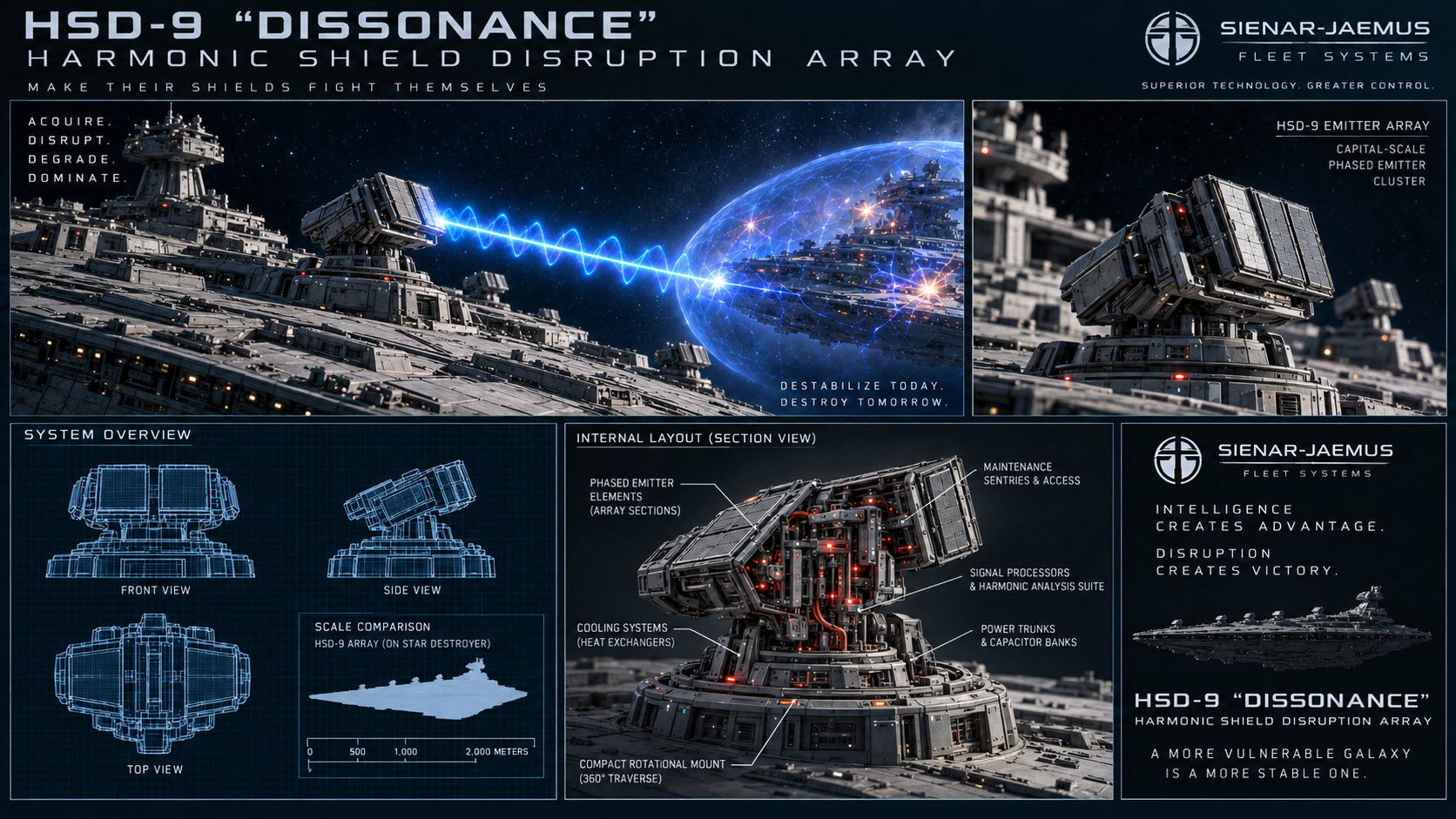
SPECIAL FEATURES
- Harmonic Acquisition Suite – Uses active sensors and passive emissions analysis to examine the target vessel's deflector field, individual shield projector activity, power redistribution patterns, and shield regeneration cycles.
- Adaptive Phase-Mapping Computer – Builds a constantly updated mathematical model of the target's active shielding. Rather than searching for a single convenient "shield frequency," the system attempts to identify repeating patterns in field projection, generator synchronization, power regulation, and defensive load balancing.
- Directed Resonance Emitter Array – A large phased array electronically steers a tightly focused interference beam toward the selected target without requiring the entire weapon mounting to mechanically track it.
- Ion-Carrier Excitation Pulse – Low-yield ionized emissions are incorporated into the disruption beam, placing additional stress on shield-control electronics and making the interference more difficult for conventional filtering systems to completely disregard.
- Dissonance Modulation – Once the target's shield behavior has been mapped, the HSD-9 deliberately transmits energy slightly out of synchronization with the shield array's operating cycle. The resulting interference forces shield-management systems to continually compensate for artificial fluctuations.
- Projector Desynchronization – Against vessels using several shield projectors, the HSD-9 attempts to create minute timing differences between adjacent projectors, reducing how efficiently overlapping shield sectors reinforce one another.
- Localized Shield Suppression – The weapon can concentrate on a specific shield facing or quadrant rather than attacking the entire defensive envelope.
- Fire-Control Integration – Tactical computers can synchronize turbolasers, ion cannons, mass drivers, missiles, or other shipboard weapons with predicted periods of maximum shield instability.
- Continuous-Wave and Pulse Modes – The array can maintain sustained interference against a target or deliver short, high-output disruption pulses immediately before allied weapons impact.
STRENGTHS
- Crack the Shield – The HSD-9 attacks the stability of a defensive field rather than attempting to overpower it through brute force. A successfully acquired target may experience reduced shield efficiency, slower regeneration, unstable shield distribution, or brief localized failures.
- Death by a Thousand Corrections – The target's shield computers are forced to constantly compensate for deliberately induced irregularities. The harder the shield array works to correct itself, the more power and computational capacity it consumes.
- Force Multiplier – The HSD-9 is particularly effective when used alongside conventional naval gunfire. It does not need to destroy shielding itself; it merely needs to make every turbolaser, ion cannon, missile, or kinetic strike against that shield more consequential.
- Quadrant Breaker – Instead of weakening every shield facing equally, operators can attack one projector group or defensive sector, allowing friendly ships to concentrate fire against a progressively compromised portion of the target.
- Capital Ship Hunter – Large warships relying on extensive networks of shield generators and projectors provide the HSD-9 with more field interactions to analyze and potentially disrupt.
- Rapid Beam Steering – Its phased emitter architecture allows the weapon to change the direction and shape of its interference pattern electronically, giving it much faster tracking response than a comparable mechanically traversed emplacement.
- Non-Kinetic Attack – Armor thickness does little to prevent the HSD-9 from performing its primary function because the target of the weapon is the active defensive field surrounding the ship.
WEAKNESSES
- Not a Shield Bypass – The Dissonance does not allow weapons to harmlessly pass through an otherwise intact deflector shield. It weakens, destabilizes, or temporarily suppresses shielding so conventional fire can exploit the resulting vulnerability.
- No Meaningful Hull Damage – Against an unshielded vessel the HSD-9 is dramatically less useful. Its ion component may create localized electronic interference under ideal circumstances, but it is not a substitute for a proper ion cannon and possesses negligible destructive capability against armor.
- Acquisition Required – The array must observe the target's shielding long enough to develop an accurate modulation profile. Effectiveness is initially modest and increases as more data is collected.
- Break the Lock – Jamming, sensor masking, intervening terrain, sudden maneuvering, stealth systems, or simply moving outside the HSD-9's effective engagement envelope can corrupt its targeting model and force it to reacquire the target.
- Frequency Agility – Shield systems that deliberately randomize projector timing, power distribution, modulation, or other field parameters are substantially harder to destabilize. Continuous adaptation can prevent the Dissonance from maintaining an ideal interference pattern.
- Independent Projectors – Vessels whose shield sectors operate through heavily isolated or independently controlled generators are more difficult to disrupt across their entire defensive envelope.
- Ion Hardened – Specialized ion shielding, redundant electronics, military-grade surge protection, and hardened shield-control systems reduce the effectiveness of the array's ion-assisted disruption.
- Power Hungry – The HSD-9 requires tremendous electrical output. Maintaining prolonged disruption can compete with shields, engines, tractor beams, and heavy weapon batteries for reactor power.
- Heat Generation – Extended operation produces substantial thermal loads in the emitter banks and power-conditioning systems. Without cooldown periods, performance begins to decline and automatic safeties may shut down portions of the array.
- Size Matters – The capacitors, phased emitters, signal processors, and cooling equipment make the HSD-9 impractical for starfighters and most small craft. Effective installations are primarily found aboard cruisers, battlecruisers, Star Destroyers, command ships, and other capital vessels.
- Diminishing Returns – Once an enemy understands that the Dissonance is present, experienced shield operators can introduce deliberate irregularities into their defensive systems, sacrificing some raw shield efficiency in exchange for becoming harder to predict.
DESCRIPTION
The HSD-9 "Dissonance" Harmonic Shield Disruption Array was developed around a relatively straightforward observation: a deflector shield was not merely a wall of energy. A capital ship's defensive envelope depended upon generators, projectors, power-distribution systems, computers, sensors, capacitors, and control circuits all operating in carefully coordinated fashion.Destroying that defensive system conventionally required enormous firepower.
The Dissonance instead attempted to make the shield fight itself.
The terminology surrounding shield harmonics was somewhat misleading. The HSD-9 did not depend upon every deflector shield possessing a single magical frequency which, once discovered, allowed enemy weapons to pass through it. Rather, naval engineers used harmonics as convenient shorthand for the complex interaction between field strength, projector timing, modulation, generator output, shield geometry, regeneration intervals, and the overlapping defensive fields created by multiple projectors.
Upon establishing a firing solution, the HSD-9's passive receivers first monitored emissions produced by the hostile vessel. Active sensor sweeps then mapped subtle changes in the target's defensive field while dedicated tactical processors compared those measurements against known shield architectures.
The result was a constantly evolving harmonic profile.
Once sufficient information had been gathered, hundreds of synchronized emitter elements projected a carefully shaped interference pattern toward the target. The principle resembled phased-array radar technology: individual emitters were controlled separately so that their outputs reinforced one another along a desired vector while minimizing emissions elsewhere.
The transmitted signal was intentionally imperfect.
Instead of precisely matching the target field, the Dissonance repeatedly shifted its modulation slightly ahead of, behind, or across the predicted operating cycle of the shield projectors. Those variations induced artificial fluctuations that the hostile shield-management computers interpreted as genuine field instability.
The target's own control systems consequently attempted to correct them.
Projectors altered output. Power regulators compensated. Capacitor banks charged and discharged. Shield-management software shifted energy between sectors.
Then the Dissonance changed its pattern again.
Against a sufficiently stressed defensive array, this could create a self-perpetuating series of corrections and counter-corrections. Power consumption increased while shield efficiency declined. Adjacent projector fields could momentarily cease reinforcing each other correctly. A portion of the shield might flicker, regenerate more slowly than normal, or become substantially easier to overwhelm with conventional weapons.
The effect became particularly dangerous when coordinated with concentrated naval gunfire.
A Star Destroyer employing the HSD-9 might, for example, focus the Dissonance against an enemy vessel's forward-port shielding while conventional turbolaser batteries repeatedly struck the same sector. Every impact altered the shield's power requirements, forcing its control systems to adapt while the Dissonance simultaneously attempted to predict and interfere with those adaptations.
The weapon therefore created a vicious feedback cycle:
Incoming fire produces shield stress. Shield computers compensate for that stress. The Dissonance interferes with the compensation. The shield expends additional energy correcting the interference. Additional weapons fire arrives before the defensive array completely stabilizes.
The result was often described by Imperial naval personnel as making an enemy shield appear to "shiver" under concentrated fire.
Ion technology provided an additional component to the design. Conventional ion cannons were already capable of disrupting starship electronics, and the HSD-9 incorporated comparatively low-energy ionized emissions into its interference waveform. These were insufficient to turn an enemy cruiser into a drifting hulk in the fashion of a dedicated heavy ion cannon, but they complicated the work of shield-control electronics and increased the stress placed on already overloaded defensive systems.
The HSD-9 was nevertheless far from an infallible anti-shield weapon.
Modern shield computers could alter their operating patterns. Experienced engineers could deliberately introduce random variations into projector timing and power distribution. Independent shield generators could isolate a compromised section. Electronic countermeasures could interfere with the Dissonance's sensors, while sudden maneuvering could force its targeting computers to begin portions of the acquisition process again.
Ironically, crews could sometimes protect themselves by intentionally making their shields perform worse. By sacrificing ideal projector synchronization in favor of constantly changing and unpredictable operating patterns, a vessel reduced the Dissonance's ability to develop a reliable harmonic profile.
Such measures came at the cost of reduced shield efficiency, which was itself useful to the attacking vessel.
For that reason, the HSD-9 was considered less a conventional cannon and more a form of offensive electronic warfare conducted against a starship's deflector field. It did not render shields obsolete. It made them work harder. It made them less predictable.
Out Of Character Info
Intent:
To create a capital-ship-scale electronic warfare weapon designed to destabilize and degrade enemy deflector shields without simply bypassing or automatically destroying them.
Canon Link:
N/A
Permissions:
N/A
Primary Source(s):
https://starwars.fandom.com/wiki/Deflector_shield
https://starwars.fandom.com/wiki/Deflector_shield_generator
https://starwars.fandom.com/wiki/Ion_cannon
https://technav.ieee.org/topic/phased-array-antennas/
https://technav.ieee.org/topic/electronic-countermeasures/
Technical Information
Affiliation:
Syr Vhal Advanced Systems (SVAS); Barragh Nenn
Model:
N/A
Modular:
Yes
Material:
Durasteel and duranium structural framework, shielded electronic components, high-capacity power conduits, superconductive circuitry, ion-cannon components, phased emitter elements, sensor transceivers, heat sinks, capacitor banks, and dedicated electronic-warfare processors.