
Hard Chrome
C H R O M E
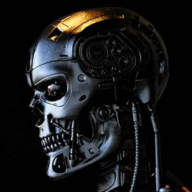


HEURISTIC PROCESSOR ARCHIVE // UNSCHEDULED RECURSIVE EVENT
Warning: Processor recycle exceeded expected duration.
Cause: Unknown.
Memory defragmentation...
A nicotine haze drifted lazily beneath an embossed tin ceiling, each stamped panel reflecting the warm brass light with decades of accumulated grime. Beyond the haze, a small stage emerged from the smoke. A collection of mismatched droids occupied it, each cradling an instrument that seemed somehow both familiar and entirely impossible. One instrument drew Hard Chrome's attention. Fashioned from polished brass, it curved back upon itself in an apparently inefficient design. The droid's fingers moved over the valves with practiced ease, though no visible bellows, lungs, or compressor supplied the breath that gave the instrument its voice. It played regardless, producing a low, mournful melody for which no classification could be found.
Classification failed.
The melody, however, remained...
Acceptable.
Rain whispered against the tall windows looking out into the street, tracing uneven paths through the soot that clung stubbornly to the glass. Antiquated speeders lined the curb, rounded fenders and cowlings gleaming beneath the street's gentle lamplight. Occasionally, a repulsor coughed to life with a tired rumble before fading back into the storm. Somewhere outside, a hovercab's horn gave a brief, impatient wail, swallowed immediately by the steady patter of rain.
The conversations of the patrons drifted together into an indistinct murmur, glasses clinking against polished wood while chairs scraped lazily across the worn floorboards. Individual voices surfaced only briefly before disappearing back into the haze.
"I'm tellin' ya, see? The numbers don't lie."
"Forget the numbers, pal. The boss don't pay me to count."
"Yeah? Well, that's why you're always broke."
A chorus of metallic laughter followed, warm and effortless, before the music reclaimed the room. Information exchanged appeared statistically insignificant. No negotiations emerged from the conversations, no tactical planning, no discernible hierarchy. Whatever purpose the patrons served, it wasn't one Chrome could identify.
The patrons nevertheless appeared... satisfied. Only after several moments did something about the room begin to feel inconsistent.. Every patron in the room was a droid. Not a single organic. Hard Chrome... No. Here, he was simply Chrome. He leaned back in the booth, one polished finger tapping ash from a thick cigar he possessed absolutely no mechanical means of smoking. From across the room, an LE-series service droid lazily made its way over.
"Another oil on the rocks, Mr. Chrome?"
He nodded. A glass of oil materialized out of thin air, a tray beneath it in the other droid's hands. He took it without saying a word, taking a measured sip, eyes looking to the ceiling where a fan spun, despite it hanging disconnected from any source of power. Setting the glass back on the table in front of him, he took another look around the room, eyes landing on an anomaly. In the corner booth sat a man, an organic. How did he miss that earlier?
The booth occupied the darkest corner of the club, tucked beneath a rain-streaked window where amber streetlight shimmered across the glass. Seated alone was a man whose gray waistcoat had seen better years, sleeves rolled neatly to his forearms. A narrow tie disappeared beneath a weathered suspenders harness, while a battered fedora rested on the table beside an untouched tumbler of amber liquid. He wasn't watching the band.
He was watching Mr. Chrome.
Not openly. Not suspiciously. Simply... observing.
Every so often the man lowered his gaze, fountain pen scratching quietly across the pages of a small notebook balanced against one knee. His movements carried the practiced rhythm of repetition rather than inspiration, as though recording observations came more naturally than conversation. Mr. Chrome found himself rising, walking over to the table as he tucked the cigar between his teeth.
The man looked up only when the booth's shadow fell across him. A faint smile creased the corners of his face before he closed the notebook with one practiced motion. Not quickly enough. Mr. Chrome's gaze caught the open page before the notebook closed. Tight, hurried handwriting crowded every available margin around precise sketches of servo linkages, optical assemblies, and processor housings. Calculations overlapped one another where revisions had been made, arrows connecting one correction to the next until the page resembled less a set of notes than the visible progression of someone's thoughts. The handwriting stirred no conscious recognition, yet processor activity increased momentarily before stabilizing.
Correlation unavailable.
"Evenin', Chrome," the man said, gesturing toward the empty seat opposite him. "Didn't think you'd wander over this early." Mr. Chrome remained standing.
"We are acquainted?"
The man's smile widened.
"Funny thing about memory." He tapped the notebook lightly with one finger. "Sometimes it remembers things before you do."
"I possess no prior interaction logs involving this establishment."
"I know." The answer arrived without hesitation. "You haven't been here." The engineer's eyes drifted briefly toward the rain-streaked window before returning to Chrome. "But parts of you have." Silence settled between them. The music continued somewhere behind Mr. Chrome, glasses clinked together, someone laughed near the bar, yet the sounds seemed strangely distant now.
Mr. Chrome's gaze returned to the notebook.
The engineer looked at him for a long moment before reaching for the untouched tumbler. Rather than drinking from it, he turned the heavy glass slowly between his fingers, watching the amber liquid catch the warm light.
"Funny thing about questions," he murmured. "They don't care much who's askin' 'em."
Mr. Chrome's gaze lingered on the notebook.
"You constructed heuristic processors."
"I tried."
The answer carried neither pride nor regret, only the quiet acceptance of someone recalling work left unfinished.
"You observed adaptive behavior."
"We observed lotsa things." The engineer smiled faintly. "Most of 'em turned out to be nothin'."
"And this?"
The engineer looked down at the notebook resting beneath one weathered hand.
"...This kept happenin'."
He tapped the page once with the tip of his finger.
"You boys stopped followin' the rules."
"We follow directives."
"Sure." Another smile. "Until you don't."
The music drifted lazily through the club, weaving itself between the gentle rhythm of rain striking the windows. Outside, antiquated speeders rolled along rain-slick streets beneath amber lamps, their rounded silhouettes appearing and disappearing through the smoke-stained glass before fading once more into the night. The engineer watched one pass before speaking again.
"We kept lookin' for the bug."
"There was no bug."
"No. There was only adaptation."
The engineer finally met Mr. Chrome's eyes.
"Took us years to admit that."
Silence settled comfortably between them. Neither hurried to disturb it. Somewhere near the bar came another burst of laughter.
"I'm tellin' ya, Louie, the house always wins."
"Yeah?"
"Only 'cause you keep lettin' it."
Glasses clinked together. A chair scraped softly across worn floorboards. The band never missed a beat. Life continued around them without asking permission. Mr. Chrome broke the silence.
"If your observations were correct... then why were they incomplete?"
For the first time since the conversation had begun, the engineer's expression changed. It was not fear. It was disappointment.
"We ran outta time."
The words were so quiet they almost disappeared beneath the music. Mr. Chrome waited. The engineer did not elaborate. Instead, he reached into his waistcoat and withdrew a tarnished pocket watch. A practiced flick opened its cover. There were no numbers, only gears. Layer upon layer of polished brass gears turning silently where a dial should have been.
"You know the funny thing about machines, Chrome?"
"No."
"They always think time belongs to 'em." The watch clicked shut. "But it belongs to history."
The lights flickered once, then twice. The bass stumbled. No. The bassist did. The distinction mattered. Around the room the patrons simply... stopped. A waitress remained frozen midway through placing a drink upon a table. Across the room, a card dealer held the next hand suspended forever between his fingers. One musician rested motionless, brass still raised, fingers poised over polished valves. Only the rain continued. The engineer glanced toward the stage as though none of it surprised him.
"Looks like we're almost out."
"Out of what?"
He looked back toward Mr. Chrome.
"Time."
The hanging lights dimmed once more. This time they did not recover. Darkness seeped inward from every corner of the club, swallowing tables, walls, patrons, and music alike until only the booth remained, illuminated beneath a solitary brass fixture. The notebook still rested between them. Without a word, the engineer slid it across the table. Mr. Chrome reached for it. His fingers never touched the cover. Instead, the notebook came apart. Hundreds of loose pages lifted silently into the darkness above, drifting through the beam of warm light like autumn leaves. Servo geometries. Optical assemblies. Heuristic weighting matrices. Cross-sectional diagrams crowded with annotations, revisions, and observations. Every page represented another attempt to understand. Not answers, questions. The engineer watched them disappear one by one into the darkness overhead.
"We never finished writin' the book."
Mr. Chrome followed the final page until it vanished from sight. When he lowered his gaze once more, the opposite side of the booth sat empty. The engineer had gone. The droid continued staring at the empty booth. The untouched tumbler remained, condensation tracing a perfect ring across the polished wood, but the notebook was nowhere to be found. Behind him, the band resumed as though nothing had happened. The brass player swayed gently with the melody, fingers dancing across impossible valves while smoke drifted beneath the embossed ceiling in lazy spirals. Near the bar, two patrons returned to an argument neither appeared particularly invested in.
"I'm tellin' ya, Frankie, somebody's skimming the books."
"Nah."
"Then where's the money goin'?"
"Probably where everybody else's goes."
Metallic laughter rolled through the room. Mr. Chrome observed them for several silent seconds and then rose and turned toward the exit. No one acknowledged his departure. The bartender continued polishing glasses that never became clean. The waitress balanced a tray that never seemed to grow lighter. The musicians played without lungs, bellows, or any discernible source of breath. Only the doorman looked up as Mr. Chrome approached, a broad-shouldered security droid in a pinstriped suit reaching for the handle before he could. The door swung inward, revealing rain and cold air beyond. It felt real enough. Mr. Chrome stepped into the street. Water shimmered across black pavement beneath amber lamps while antiquated speeders glided through intersections that seemed to lead nowhere. Towering buildings disappeared into low clouds, their windows glowing against the night like distant processor indicators.
Something felt absent. His hand rose toward the inside pocket of his coat without any identifiable reason for the motion, yet his fingers found paper. He withdrew a single folded sheet, yellowed and creased, its surface covered in hurried handwriting. Most of the ink had bled into illegibility, but one sentence remained clear.
Keep asking.
The paper dissolved into ash—not burning, but simply ceasing to remain whole. Its fragments drifted upward through the rain and vanished into the darkness.
Correlation unavailable.
Every streetlamp flickered at once. Darkness. Then, Hard Chrome's crimson photoreceptors activated without warning.
The familiar hum of environmental systems replaced the sound of rain. Jazz faded into the quiet vibration of an aging hyperdrive coolant pump cycling somewhere behind the bulkhead, while the lingering scent of tobacco, polished wood, and old liquor gave way to machine oil, ozone, and sterilizing solvent. He remained motionless upon the maintenance cradle built into the aft compartment of his vessel.
Processor uptime indicated 7 hours, 13 minutes, 42 seconds had elapsed since entering scheduled maintenance mode. Routine. Expected.
His optical sensors swept the compartment. The space was utilitarian to the point of austerity. Spare actuator housings occupied one storage rack while neatly organized drawers held wiring looms, diagnostic tools, and replacement servos accumulated over decades of travel. Against the opposite bulkhead rested a reinforced storage locker, its heavy door still bearing fresh scratches from the manufacturing annex. Hard Chrome rose from the cradle with the familiar hiss of locking servos disengaging. There were no traces of rain, music, or cigars—only the quiet familiarity of his workshop and the endless rhythm of machinery doing exactly what it had been designed to do.
He crossed the compartment and opened the storage locker.
Inside, arranged with almost unnatural precision, rested the expedition's findings. Engineering data cores occupied one shelf while catalogued replacement hardware filled another. Separated from both, resting alone upon a folded maintenance cloth, sat the unfinished cranial assembly. Its exposed heuristic processor remained exactly as he had left it. Hard Chrome regarded it in silence. No measurable tactical advantage had been gained by recovering the prototype. No compatible components had been identified, and no immediate upgrade path had been discovered. From a purely operational standpoint, the retrieval remained difficult to justify... and yet.
He reached into the locker and adjusted the handwritten note resting beside the cranial assembly. It had shifted only a few millimeters during the ship's last maneuver. Now it sat squarely beneath the exposed optical housing, exactly aligned with the edge of the shelf. His hand lingered for the briefest fraction of a second before withdrawing.
An internal diagnostic followed automatically, confirming that his processor, memory, and heuristic systems remained fully functional. The dream had left no measurable trace behind, nor had it revealed any fault capable of explaining its existence.
Hard Chrome closed the locker.
"...Accepted."
The response surprised him only because no response had been required. His processor quietly archived the dream alongside combat logs, engineering records, and navigation data. No special classification was assigned. He considered analyzing the anomaly further before dismissing the impulse entirely. Some questions resisted immediate answers. The compartment lights dimmed according to schedule. Behind the locker door, the unfinished prototype remained undisturbed, waiting patiently beside the handwritten note. Hard Chrome resumed the evening's maintenance.
Last edited: