
Barragh Nenn
Imperial Hand




Concordance Fire Control Sensor Array
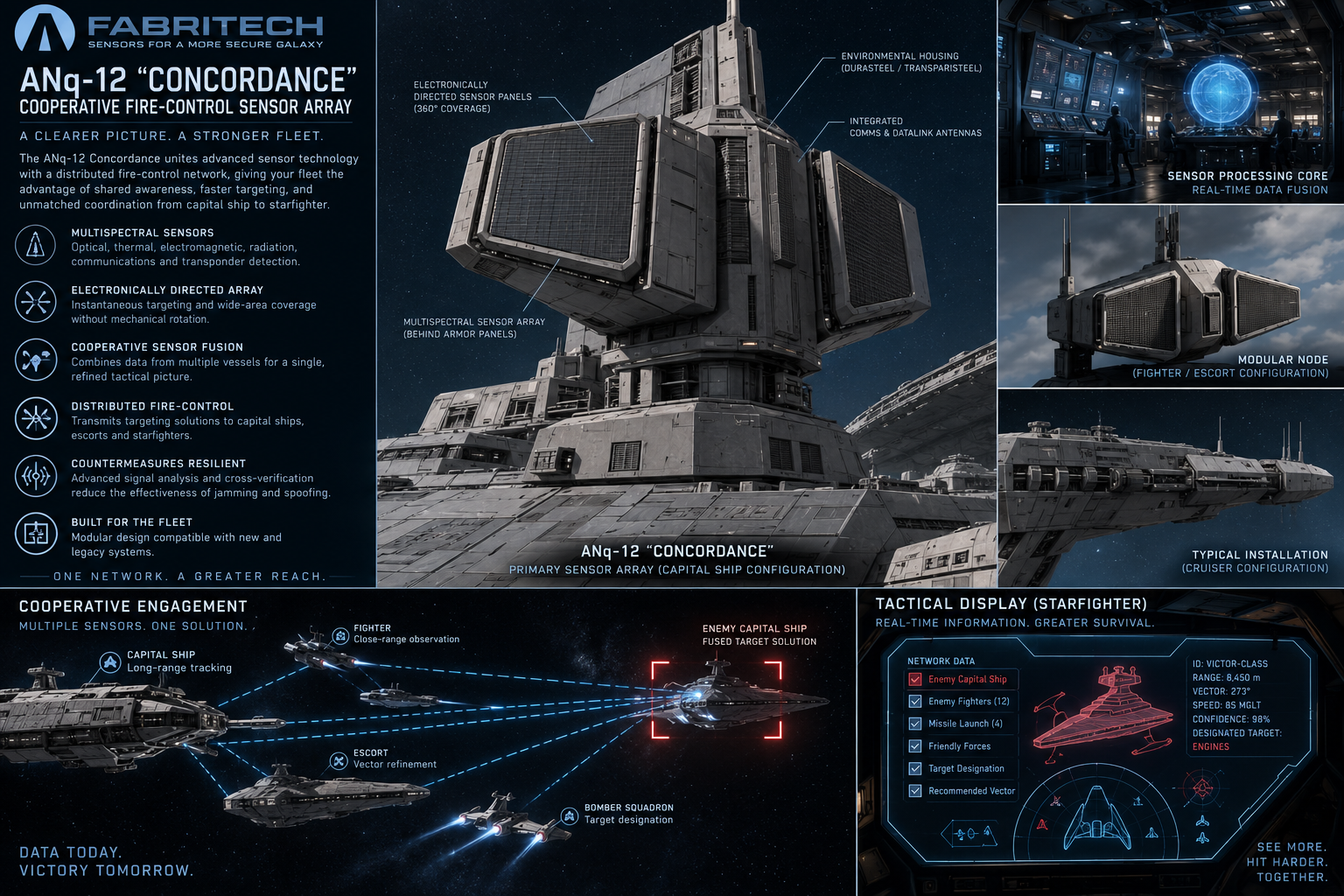
Image by Chatgpt
SPECIAL FEATURES
- Multispectral Sensor Array — The Concordance does not depend upon a single detection system. Optical, thermal, electromagnetic, radiation, communications, transponder, and conventional starship sensor information is combined into a single composite tactical picture.
- Electronically Directed Sensor Emitters — Inspired by real-world phased-array and AESA technology, numerous independent sensor emitters can be electronically redirected without physically rotating the entire array. Different portions of the system can simultaneously search, track, classify, and closely examine separate contacts.
- Track-While-Scan Capability — Concordance can maintain targeting tracks on established contacts while continuing to search surrounding space for new objects.
- Cooperative Sensor Fusion — Data received from multiple Concordance-equipped vessels is compared and combined. A fighter detecting an enemy from one angle, an escort from another, and a capital ship from a third can collectively produce a substantially more accurate track than any individual vessel might obtain alone.
- Distributed Fire-Control Network — Ships do not necessarily need to acquire their own complete targeting solution. Sufficiently accurate targeting data acquired by another friendly Concordance node can be transmitted to participating vessels.
- Capital Weapon Fire-Control Interface — The system directly interfaces with compatible turbolasers, heavy laser cannons, ion cannons, missile batteries, and other shipboard weapons. It calculates target velocity, acceleration, relative vector, anticipated course, weapons convergence, firing delay, and projectile or energy travel time.
- Predictive Gunnery Solutions — Similar in principle to established Star Wars targeting computers, Concordance continuously predicts where a moving vessel is likely to be when incoming weapons fire reaches it rather than simply instructing weapons to fire at its present location.
- Target Quality Rating — Every contact is assigned a constantly changing confidence rating based upon the quantity, quality, age, and agreement of available sensor information. Weapons officers can distinguish between confirmed targeting information and less reliable sensor estimates.
- Precision Target Designation — At sufficiently close ranges and with adequate sensor resolution, Concordance can designate specific areas of a capital ship such as engines, communications towers, exposed weapon emplacements, hangars, shield generators, sensor systems, or previously damaged sections.
- Concentrated Fire Coordination — Command vessels can designate particular targets or target areas and distribute them throughout a battlegroup. Multiple capital ships can consequently direct fire toward the same vessel or structural region rather than independently selecting targets.
- Fighter Tactical Data Feed — Compatible starfighters and bombers receive condensed targeting information through their onboard targeting computers. Pilots may receive target identification, range, vector, predicted movement, threat classification, friendly positions, designated objectives, and recommended attack vectors.
- Sensor Handoff — A reconnaissance craft, starfighter, corvette, or picket vessel can detect and track a contact before transferring that track to heavier vessels whose weapons possess considerably greater range or destructive power.
- Remote Weapon Cueing — A vessel may begin orienting weapons toward a target identified by another Concordance node before its own sensors have developed an independent weapons-quality solution.
- Passive Acquisition Mode — Concordance can rely heavily upon passive optical, thermal, electromagnetic, transponder, communications, and allied sensor information rather than broadcasting powerful active scans.
- Active Precision Scan Mode — When concealment is no longer important, selected emitters may concentrate their output upon individual targets, rapidly improving ranging and tracking accuracy.
- Transponder/IFF Correlation — Transponder signals and known friendly identification codes are automatically cross-referenced against the tactical picture to reduce accidental engagements.
- Frequency-Agile Fleet Datalink — Tactical information is transmitted through encrypted, rapidly shifting communications channels intended to make interception and jamming considerably more difficult.
- Subspace Communications Interface — Existing starship subspace communications equipment can relay strategic sensor reports and targeting information across larger operational distances, though immediate fire-control information normally relies upon the faster and more reliable local tactical network.
- Mesh-Network Architecture — There is no absolute requirement for every combatant to communicate directly with the command ship. Friendly units may relay tactical information between one another, allowing escorts, fighters, reconnaissance craft, satellites, and other platforms to extend the network.
- Electronic Counter-Countermeasures — Concordance compares information from multiple sensors, frequencies, viewing angles, and friendly vessels to identify inconsistencies characteristic of conventional sensor jamming or spoofing.
- Battle Damage Assessment — Changes in target emissions, propulsion, thermal output, weapons activity, and movement are analyzed following an attack to estimate whether an engagement was effective.
- Legacy Targeting Computer Integration — Concordance is specifically designed to augment rather than replace existing shipboard and starfighter targeting computers. Older systems can receive simplified targeting packets without requiring a complete Concordance installation.
STRENGTHS
- See What They See: Concordance transforms individual ships into members of a larger sensor network. A contact observed by one vessel can quickly become visible to every compatible vessel within the tactical network.
- Right Sensor, Right Weapon: The vessel possessing the best sensor position does not have to be the vessel firing the weapon. A fighter, reconnaissance craft, or picket ship can locate an enemy while a distant cruiser or battleship provides the firepower.
- Concentrated Fire: Perhaps the system's most dangerous capability is the coordination of multiple weapons platforms against a common target. Instead of several ships independently engaging the same enemy, Concordance provides them with a shared targeting picture and designated aim points.
- Exceptional Against Maneuvering Targets: Continuous vector analysis and predictive targeting make the system particularly useful when engaging fast cruisers, corvettes, bombers, and starfighters with weapons whose effective accuracy depends heavily upon anticipating movement.
- Improved Long-Range Gunnery: Multiple sensor observations can progressively refine a target track, making long-range capital-ship fire substantially more practical than reliance upon a single ship's sensor solution.
- Fleet-Wide Situational Awareness: Fighters can receive information gathered by capital ships while capital ships can benefit from information gathered by fighters, reconnaissance craft, escorts, or remote sensor platforms.
- Redundancy: Destroying one sensor installation does not necessarily blind the network. Other Concordance nodes can continue providing data, although overall accuracy may decline.
- Counter-Jamming Capability: Sensor information gathered from several locations makes conventional jamming considerably less effective. A false return convincing from one direction may be exposed when compared with observations from several others.
- Compatible With Existing Doctrine: Concordance does not require autonomous weaponry or unusual munitions. It improves the effectiveness of weapons already fitted to participating vessels.
WEAKNESSES
- Garbage In, Garbage Out: Concordance can only construct targeting solutions from available information. Severe sensor interference, unusual stellar phenomena, heavy jamming, stealth technology, or insufficient observations can significantly degrade accuracy.
- Not an Auto-Hit System: The array improves targeting information; it does not alter the physical performance of the weapon firing upon the target. A target may maneuver after weapons are fired, leave effective range, take cover, intercept incoming ordnance, or simply survive the attack.
- Electronic Warfare Target: The extraordinary amount of information exchanged throughout a Concordance network makes communications warfare particularly important. Powerful jamming can reduce update rates, isolate vessels, or force units to rely upon their own sensors.
- Network Poisoning: Successfully compromising a trusted Concordance node can allow false or manipulated sensor information to enter the network. Cross-checking and confidence algorithms make this difficult, but sophisticated slicers or electronic-warfare systems can still create considerable confusion.
- Emission Signature: Active precision scanning produces a detectable electromagnetic signature. Enemy electronic-support systems may be able to determine that they are being intensively tracked and potentially locate the scanning vessel.
- Bandwidth Hungry: Raw sensor information is extremely data intensive. During very large engagements, the system must prioritize important contacts and distribute compressed tracking information rather than transmitting every piece of raw sensor data to every ship.
- Saturation: Enormous numbers of starfighters, missiles, decoys, debris fields, electronic countermeasures, and simultaneous capital-ship contacts can overwhelm available processing resources and communications bandwidth.
- Compatibility Required: A vessel without compatible communications protocols may receive simplified targeting information but cannot fully participate in the cooperative fire-control network.
- Increasing Errors Over Distance: Small errors in target velocity or heading become increasingly significant over extreme engagement distances. Long-range targeting therefore remains less precise than close-range fire.
- Physical Vulnerability: Although processing hardware is normally protected deep within a warship, external sensor apertures and communications assemblies remain vulnerable to weapons fire and battle damage.
- Centralization Risk: While Concordance is capable of decentralized operation, fleets often designate a command vessel as the primary coordinator. Destroying or isolating that vessel can temporarily disrupt organized fleet-wide fire control while subordinate nodes reorganize.
DESCRIPTION
Syr Vhal Advanced Systems (SVAS) developed the ANq-12 Concordance Cooperative Fire-Control Sensor Array around a deceptively simple premise: a fleet should not fight as a collection of ships whose sensors happen to occupy the same battlespace.It should fight as a single distributed sensor.
Traditional targeting computers already performed an essential function throughout galactic history. They detected and tracked hostile craft, determined range and movement, and calculated where weapons needed to be aimed in order to intersect a moving target. Such technology was found on everything from starfighters to Imperial capital ships. The Concordance expanded that principle beyond the boundaries of an individual vessel.
A full Concordance installation consists of numerous distributed sensor apertures connected to hardened fire-control processors and a high-capacity encrypted communications system. Instead of mechanically directing one large sensor dish toward a contact, banks of electronically controlled emitters can concentrate sensing energy in different directions almost instantaneously. Some search surrounding space while others maintain established tracks or conduct high-resolution examinations of priority targets.
The resulting information is combined with passive sensor observations, transponder data, communications intercepts, allied sensor reports, and information received from other Concordance installations.
Each measurement is evaluated according to its apparent accuracy, viewing geometry, age, source reliability, and consistency with other observations. Information gathered by three vessels positioned around an enemy cruiser might therefore produce a dramatically better targeting solution than three vessels individually trying to track the same cruiser.
A forward reconnaissance vessel might detect an enemy formation without possessing weapons capable of seriously threatening it. Concordance can transmit those tracks to a distant battlecruiser. The larger vessel's fire-control computers can begin positioning heavy batteries while its own sensors attempt to confirm the transmitted information.
A squadron operating much closer to an enemy battleship may provide continuous observations of its vector, acceleration, weapon activity, and visible battle damage. Those observations are returned to the fleet, combined with capital-ship sensor information, and redistributed as a refined track.
The exchange works in both directions.
A starfighter equipped only with a comparatively small targeting computer can receive an abbreviated tactical picture generated by an entire battlegroup. Enemy fighters detected by destroyers, missile launches observed by picket ships, bomber formations identified by reconnaissance craft, and priority targets designated by fleet command may all appear on the pilot's tactical display.
This allows fighter squadrons to respond to threats they could not yet detect independently.
The system reaches its full potential during coordinated engagements.
A commander can designate an enemy Star Destroyer as the fleet's priority target. Concordance distributes the target designation throughout the network while continuously updating its position. Participating vessels calculate their individual firing solutions from the common track. Turbolaser batteries distributed across several kilometers of allied warships can consequently engage the same vessel within a closely coordinated firing window.
With sufficiently detailed sensor information, fire-control officers may go further and designate particular regions of the target.
Rather than allowing every vessel to scatter fire across an enemy hull, multiple ships might be instructed to concentrate their batteries against an engine cluster, communications tower, hangar opening, damaged hull section, or known weapons emplacement.
This does not guarantee that those weapons will strike the intended location. Starships remain mobile targets, shields distort or absorb incoming fire, weapons possess finite accuracy, and sensor information is never perfect. Concordance merely ensures that every cooperating gun crew is operating from approximately the same high-quality information.
Electronic warfare remains its natural enemy.
Sensor jammers are widespread in galactic combat, and sophisticated electronic countermeasures can obscure targets or introduce misleading information. Concordance counters this by examining a target simultaneously through several different sensors and from several different positions. Jamming that successfully deceives the sensor array of one cruiser may conflict with measurements obtained by two fighters and another destroyer.
These discrepancies lower the confidence assigned to the affected track rather than allowing questionable information to automatically become a firing solution.
The same architecture also creates vulnerabilities.
A Concordance battlegroup produces enormous quantities of tactical communications traffic. Encryption, frequency agility, directional transmissions, and redundant routing protect the network, but powerful electronic warfare can still interrupt communications. A sufficiently sophisticated hostile slicer who compromises a trusted node may attempt to introduce false contacts or corrupt real ones.
For precisely this reason, Concordance never completely replaces a vessel's independent targeting computer. Fire-control officers may reject external data, demand local sensor confirmation, sever questionable network nodes, or place their vessel into an isolated fire-control mode.
This philosophy distinguishes Concordance from a centralized combat computer. There is no single machine deciding where every weapon in the fleet fires. Instead, Concordance gives every participating vessel access to the collective perception of the fleet. A destroyer can shoot using a fighter's eyes. A fighter can avoid an interceptor detected by a cruiser thousands of kilometers away. A battleship can concentrate several vessels' turbolasers against the same damaged section of an enemy warship. And a commander looking across the tactical display does not see dozens of contradictory sensor pictures, they see one battle.
Out Of Character Info
Intent:
To create an advanced capital-ship sensor, target-acquisition, and fleet fire-control system capable of developing high-quality targeting solutions for heavy starship weaponry while distributing real-time tactical information to allied vessels, escorts, bombers, and starfighters. The system is intended to facilitate coordinated fleet engagements and concentrated fire without functioning as an automatic-hit system.
Canon Link:
N/A
Permissions:
N/A
Primary Source(s):
https://starwars.fandom.com/wiki/Targeting_computer
https://starwars.fandom.com/wiki/Sensor_array
https://starwars.fandom.com/wiki/Electronic_countermeasures
https://starwars.fandom.com/wiki/Subspace_transceiver
https://www.navy.mil/DesktopModules/ArticleCS/Print.aspx?Article=2166802&ModuleId=724&PortalId=1&utm
Technical Information
Affiliation:
Syr Vhal Advanced Systems (SVAS); Barragh Nenn
Model:
N/A
Modular:
Yes
Material:
Durasteel housings, transparisteel sensor apertures, superconducting communications assemblies, radiation-hardened computer components, optical sensors, electromagnetic detection equipment, subspace transceiver hardware, encrypted data-processing systems, and standard starship electronics.