
Akhenaton
Sith Hunter
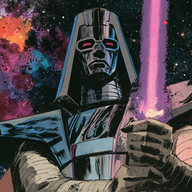



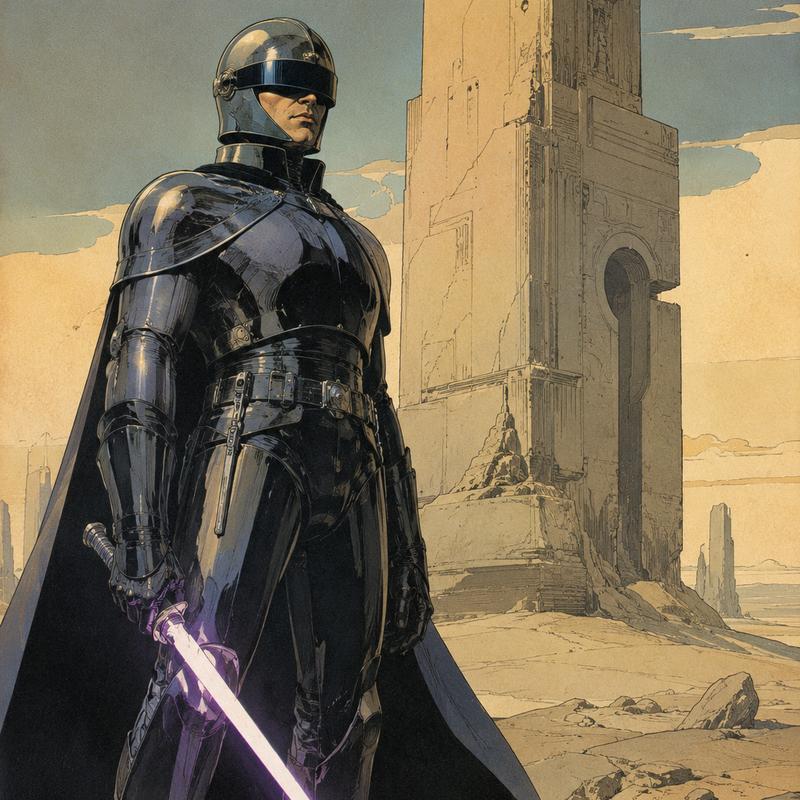
Akhenaton
| Age | 35 |
| Species | Human |
| Gender | Male |
| Height | 6'3" |
| 190 | Weight |
| Force Sensitive | Yes |
PHYSICAL DESCRIPTION
Standing over six feet tall, he possesses the lean, athletic build of a seasoned warrior forged through years of relentless training rather than simple physical strength. His broad shoulders and balanced frame are encased in a suit of polished black armor that reflects light like dark chrome, its smooth plates seamlessly layered for protection without sacrificing agility. Unlike cumbersome military armor, every piece is streamlined, giving him an elegant yet intimidating silhouette. A highly armored gorget rises around his neck, flowing into a chrome helmet with a narrow black visor that conceals his eyes while leaving the lower half of his face exposed. Strong features, a square jaw, and a calm, unreadable expression rarely betray emotion, lending him an almost statuesque appearance. A long, midnight cloak falls from his shoulders to his boots, adding the unmistakable presence of an ancient knight wandering a forgotten age.
INVENTORY
Chrome Armor
Violet Lightsaber
PERSONALITY AND BELIEFS
Akhenaton is a stoic man who relentlessly seeks forbidden knowledge. He is a man of restraint, not only in his words but in his actions as well. Calm, patient, and composed, he rarely allows emotion to cloud his judgment. He believes that knowledge is neither inherently good nor evil, for it carries no morality of its own. The Light and the Dark are both aspects of a greater truth, and only by understanding them together can one truly comprehend the Force and the galaxy. He views the Jedi as willfully ignorant, their censorship and fear of dark side teachings having allowed the Sith to rise time and again throughout history. Likewise, he believes the Sith are nothing more than slaves to their passions and lust for power. Though they claim mastery over the Force, they are merely zealots consumed by greed, hatred, and ambition, forever bound by the very darkness they believe they command.
STRENGTHS
Master Bladesman – An exceptional swordsman whose precision, timing, and technique allow him to overwhelm even experienced duelists.
Unbreakable Discipline – Maintains absolute composure under pressure, resisting fear, pain, and emotional manipulation.
Strategic Mind – Excels at reading opponents, exploiting weaknesses, and adapting his tactics as a battle unfolds.
WEAKNESSES
Relentless Hatred – His obsession with hunting Sith can cloud his judgment. Faced with a chance to destroy one, he may ignore larger threats, abandon allies, or walk into carefully prepared traps.
Scorn for Mercy – Years in the gladiator pits and disappointment with the Jedi left him viewing compassion as a dangerous weakness. He often dismisses diplomacy or redemption, making it difficult to form lasting alliances or see alternatives to violence.
Bound by Ancient Doctrine – He follows forgotten dark side philosophies with unwavering conviction. His rigid code leaves him predictable to those who understand it, and he refuses to compromise even when doing so would offer a tactical advantage.
HISTORY
No one remembers who he really was. The only name he still claims is Exoryn, though even that feels more like a gravestone than an identity.
As a child, he was stolen from the Outer Rim during a Sith raid. His memories of his mother survive only as fragments, a warm hand, a voice singing in a long-forgotten language, the scent of rain on stone. His father was never more than a question without an answer. Whatever life he might have lived died the day he was shackled.
Sold from master to master, Exoryn spent his youth breaking stone in the mines of Nal Hutta. Years beneath the earth forged his body into iron, but they also tempered something darker within him. Every lash, every chain, every nameless corpse left in the tunnels became another weight upon his soul. He learned that mercy belonged only to the powerful, and justice belonged to no one.
One day, a guard began beating an elderly slave for no reason beyond amusement. Exoryn endured countless cruelties in silence, but something inside him finally broke. He seized a loose stone from the ground and crushed the guard's skull with savage fury. Even after the man was dead, Exoryn continued striking until several guards dragged him away in chains.
His Hutt master saw profit where others saw rebellion.
Rather than execute him, the Hutt cast him into the gladiator pits.
There, Exoryn was stripped even of his own name. Before roaring crowds, he became Akhenaton, the undefeated champion whose victories filled the coffers of his masters. He slew beast after beast, warrior after warrior, until the arena itself became a mausoleum built upon his survival. Every cheer from the spectators was another reminder that they celebrated not a man, but a weapon. Each victory buried Exoryn a little deeper beneath the legend of Akhenaton.
Yet chains of gold remain chains.
When the opportunity finally arose, he united gladiators, laborers, and slaves alike in a bloody revolt. The uprising drowned the arena in fire and left its masters dead beneath the stones that had once imprisoned them. Against impossible odds, Exoryn escaped Nal Hutta, leading hundreds into Alliance territory. He asked for no reward beyond their freedom.
Among the refugees walked Jedi.
They sensed what the gladiators never understood, that Exoryn had unconsciously wielded the Force throughout his life. His impossible reflexes, his instinctive awareness, and his unmatched prowess had never been born from talent alone. Though some Masters questioned whether a man raised by violence could ever know peace, they chose to offer him what no one else ever had.
A choice.
Exoryn embraced the Jedi with the same relentless devotion that had once made him a champion of the pits. He mastered lightsaber combat with extraordinary speed, his brutal efficiency refined into disciplined precision. He immersed himself in ancient martial traditions, studying Teräs Käsi alongside forgotten forms of blade work so that no enemy could easily exploit him. To many, he became proof that even the most broken soul could be reforged.
But beneath the robes, the scars remained.
As war spread across the galaxy, Exoryn watched the Jedi deliberate while worlds burned. He saw councils debate where action was needed, mercy offered to monsters who would never repent, and victories surrendered in the hope that compassion alone could overcome evil. To him, the Order had mistaken restraint for virtue and hesitation for wisdom.
Fearing that history was preparing to repeat itself, he withdrew from the Order. He journeyed to Tython, Lettow, and forgotten sanctuaries hidden beyond the Core, seeking truths older than both Jedi and Sith. There he studied the writings of the First and Second Great Schisms, the philosophies abandoned before the Sith Order had ever existed. He also delved into Sith teachings, not to embrace them, but to understand the darkness that had stolen his childhood. What he found only deepened his hatred. The Sith were not masters of the dark side, but its slaves, forever shackled by ambition, fear, and endless betrayal.
From those forgotten doctrines, Exoryn decided to forge a new path.
He accepted that darkness was a weapon, but rejected the Sith belief that it should become one's master. Compassion without strength invited ruin. Power without restraint birthed tyranny. Between those extremes lay a harsher road, one walked by exiles, executioners, and guardians willing to stain their own souls so others would not have to.
When Coruscant fell and the Jedi Order shattered beneath the weight of war, Exoryn did not mourn the death of the Order. He mourned the death of those who could not protect and defend themselves, those who would be enslaved by this ancient cult from the outer rim. Casting aside the title of Jedi, he swore an oath to himself that he would hunt down the Sith and free those whom they enslaved.
A hunter.
A crusader.
This was a dark journey he was taking, and he would renounce the Light and leave the better half of him behind. Watching the Jedi fall, almost prophetically, He took his old name given to him by his masters. Akhenaton.
Last edited: