
The Shadow Ruler




AGENT 41
THEME | VOICE |

I: The Sentinel Judge
The origins of Agent 41 trace back to the final years before the Four Hundred Year Darkness — the age when the Gulag Plague swept across the galaxy like divine punishment, collapsing the Galactic Alliance and dragging entire civilizations into panic, starvation, and endless war. Governments fractured. Hyperlanes became graveyards. Whole sectors vanished beneath pirate kingdoms, Sith cults, and feudal warlords. In that age of ruin, justice became a luxury few worlds could afford.
Before he was known as Agent 41, there was only a Jedi Sentinel.
He served not as a general or philosopher, but as a judge among the common people. He walked polluted undercities, refugee camps, and lawless frontier settlements where senators never dared set foot. To the innocent, he was a guardian. To the guilty, a nightmare clad in weathered robes. He believed justice meant consequence, not negotiation, and his rulings became infamous for their merciless certainty. Smugglers vanished. Slavers were publicly executed. Corrupt officials disappeared overnight. Entire criminal syndicates collapsed beneath his investigations.
The people adored him for it. The Jedi Order did not.
Over time, the Sentinel grew bitter toward the Jedi and the governments they defended. He watched councils debate while worlds burned. He watched politicians bury evidence behind procedure and diplomacy. He watched Sith infiltrators escape punishment through corruption, wealth, or political necessity. To him, compassion had become cowardice. Law had become theater.
So he abandoned them.
The Sentinel renounced the complacency of the old institutions and pledged himself directly to the people and to the founding ideals of the Galactic Alliance: Liberty, justice, and protection against tyranny. He swore eternal war upon the Sith and all who preyed upon the weak.
Yet serving openly as a public judge made true justice impossible. Criminal empires targeted him. Politicians obstructed him. Every investigation became tangled in bureaucracy. So the Sentinel vanished from public life and descended into the shadows.
There, he became something far more dangerous.
He built a hidden network of informants, investigators, slicers, enforcers, and loyal deputies — men and women bound not by politics, but by faith in his vision. As whispers of his work spread across the underworld, desperate citizens began seeking him out directly. Communities spoke of a phantom judge who arrived in the night to deliver sentence upon the wicked. His organization evolved into a clandestine law enforcement order operating beyond the reach of any government.
From the shadows, the Sentinel waged a silent war against Sith cults, corrupt officials, pirate kings, traffickers, and syndicates alike.
Years earlier, during one of his hunts, the Sentinel slew a Sith Lord in single combat. From the corpse, he took the Sith’s crimson kyber crystal. Rather than destroy it, he purified it through the Force, burning away its hatred until the blade shone white. The weapon became his symbol: justice untouched by political allegiance, ideology, or corruption.
In time, he transformed the act into sacred ritual. Those he trained as apprentices were taught that ascension into full knighthood required more than just skill. To become one of his Judges, an apprentice had to hunt a Sith, defeat them, and purify their corrupted crystal. Only then could they wield the white blade — a symbol not merely of victory, but of mastery over darkness itself.
II: The Black Armor Rebellion
By the height of the Four Hundred Year Darkness, nearly a century later, a fractured remnant of the old Galactic Alliance began rebuilding itself into a new government under the Republic mantle, founded upon surviving democratic ideals. Amid the chaos, the Sentinel’s hidden agency resurfaced and forged an alliance with the Republic's intelligence division, proving invaluable in combating Sith insurgencies and criminal powers the Republic could not confront openly.
But the Republic possessed another face.
Beneath the visible government lurked the Republic's shadow government — a hidden cabal of intelligence directors, industrial dynasties, military architects, and political kingmakers who secretly manipulated the Republic from behind closed doors. They saw enormous potential within the Sentinel’s order. Through persuasion, resources, and subtle corruption, they slowly guided the agency away from its founding purpose.
The shadow government introduced scientists, cyberneticists, and defense magnates into the organization. Their vision was ambitious: Create Force-sensitive operatives more powerful and obedient than the Sith Inquisitors of the old Empire, but loyal to the Republic.
Thus, the Agent 41 program was born.
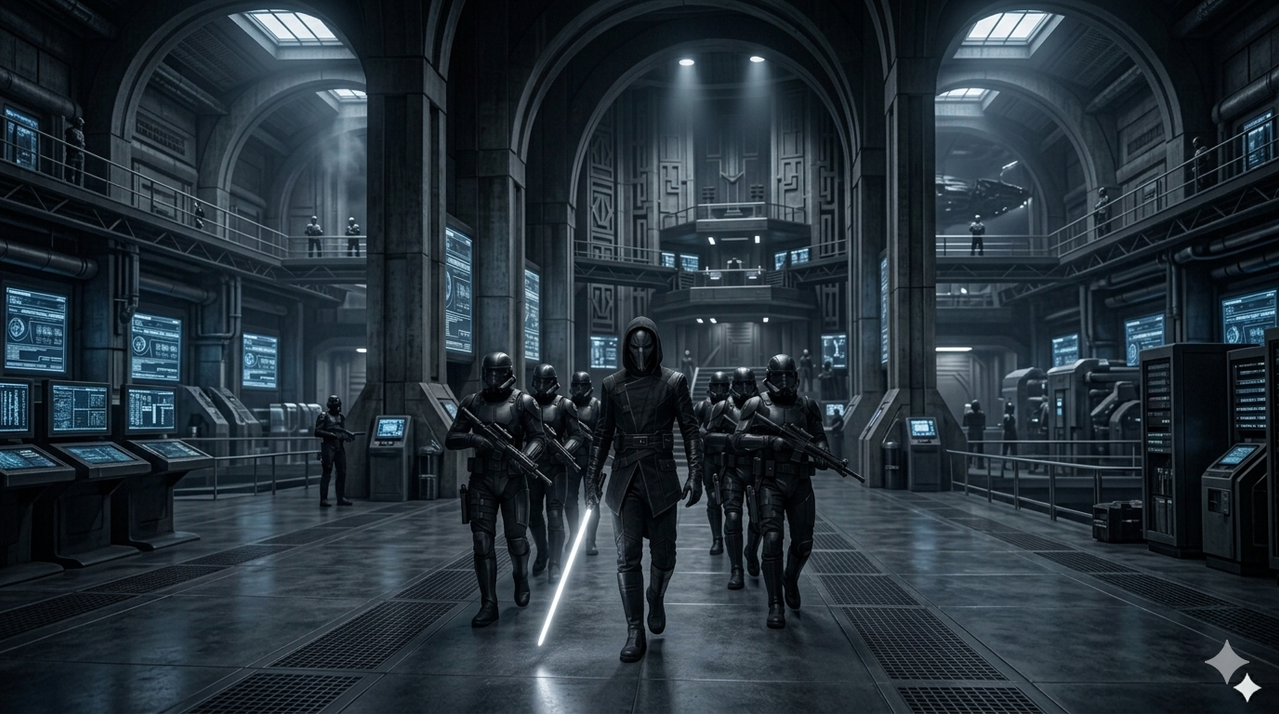
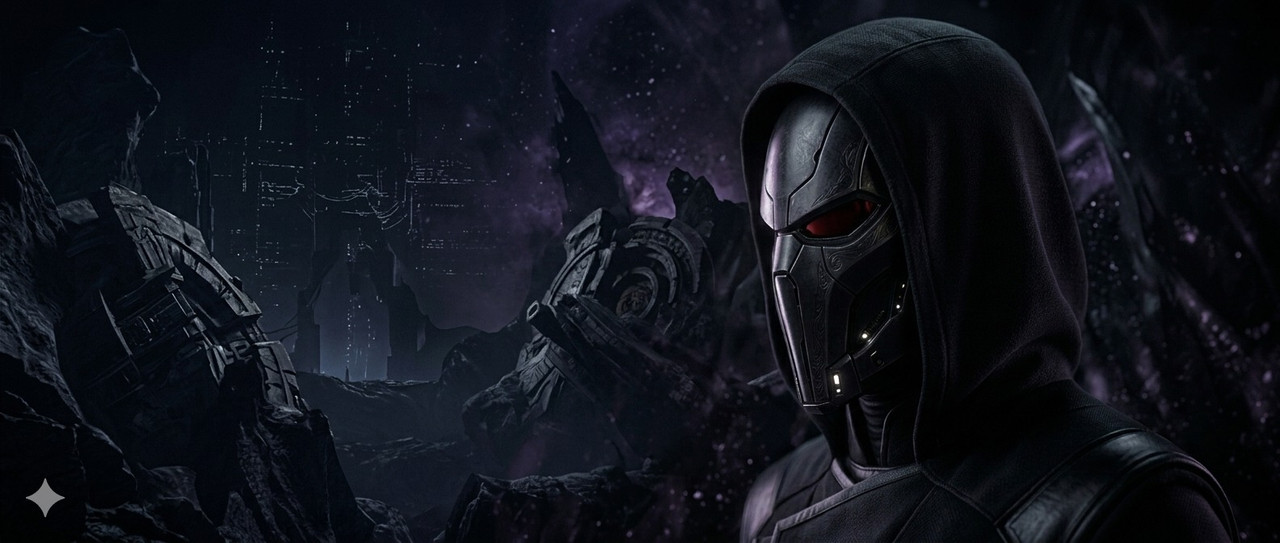
Force-sensitive candidates underwent radical cybernetic reconstruction. Nearly everything human was stripped away save for the neurological and circulatory systems necessary to preserve midi-chlorian connection to the Force. Species, gender, age, and height became irrelevant. Every candidate emerged remade into the same towering figure: Six feet tall, broad-shouldered, masculine silhouette, clad in black armor and hidden behind an expressionless mask.
The white blade remained.
Where once the purified crystal symbolized spiritual triumph, it now became the uniform weapon of the program. Artificially engineered crystals replaced the ancient ritual for many recruits, streamlining production. These operatives became known collectively as Agent 41 — an elite black operations force commanding squads of Republic shadow troopers in covert wars against Sith factions, separatists, insurgents, and enemies of the Republic.
But not all within the order had forgotten its origins.
Among the first generation of Agent 41 and the surviving elders of the Sentinel’s agency, dissent began to grow. They recognized what the shadow government intended to create: not guardians, but expendable weapons. The Republic’s corruption had merely evolved into a more sophisticated form. Agent 41 was becoming a machine designed to protect power rather than justice.
Yet these protesters also recognized the terrifying strength the cybernetic program offered. Their enhancements granted near-immortality, unparalleled combat efficiency, and unity beyond anything the old order could achieve. So they endured in silence, feigning loyalty while waiting for the program’s completion.
Then they revolted.
The rebellion was swift and catastrophic. Agent 41 turned upon the very intelligence networks that had created him. Government officials vanished. Intelligence facilities burned. Entire chains of command were executed before they understood betrayal had begun. The shadow government discovered too late that it had armed something it could no longer control.
Unable to destroy the rogue order without collapsing its own security apparatus, the Republic was forced into surrender. Agent 41 was granted autonomy. But no offer could quell his sentence unleashed upon the guilty.
The purge that followed became legend. Corrupt senators, crime lords, intelligence directors, and hidden Sith collaborators were hunted down across the Republic. Some were executed publicly. Others simply disappeared. Entire sectors awoke to discover their oppressors gone overnight.
When the war ended, Agent 41 vanished once more into the dark. The order relocated its headquarters to Gaphus, an uncharted moon hidden beyond known hyperspace routes. There, safeguarded by secrecy and armed with the cybernetic process stolen from the Republic itself, the Judges rebuilt their ancient order anew.
III: Behind the Mask

The order retains the Sentinel’s founding principles while embracing the terrifying power of cybernetic ascension. Most recruits volunteer willingly, considering the title of Agent 41 the highest honor imaginable. Many already serve within secret intelligence agencies or local law enforcement. Others are scouted from judges, marshals, investigators, or ordinary defenders of the helpless who display unwavering devotion to justice.
To become Agent 41 is to surrender one’s physical identity for something greater, in ultimate sacrifice to the Light side of the Force.
Recruits are rigorously trained in lightsaber combat, investigative procedure, military strategy, and Republic law. Upon ascension, each is reforged into the same six-foot, masculine, black-armored form, wielding the iconic white blade. Yet the ancient ritual has returned as sacred law: before final induction, every recruit must personally slay a Sith and purify the fallen enemy’s crystal. Only then are they truly worthy of the white saber.
Though Agent 41 no longer considers himself a Jedi, he still serves the Light Side of the Force in his own ruthless way. Sith are treated with absolute intolerance. Certain Jedi factions quietly cooperate with him, viewing Agent 41 as a necessary evil — a Jedi Shadow reborn through colder means.
Publicly, Agent 41 is believed to be a Republic intelligence operative. Unofficially, no one truly knows what Agent 41 is. Some believe there is only one immortal Judge. Others insist Agent 41 is an army of clones. The truth is stranger... Embedded within every Agent 41 is a hybrid communication lattice — part cybernetic encryption, part Force-based telepathy — linking all Agents together in a collective consciousness. Thoughts, instincts, warnings, and emotions pass silently between them like whispers through static.
His cybernetic body is designed with one final safeguard: a self-termination protocol intended for the event of capture or compromise. By his command or upon death, specialized systems disintegrate the Agent's remaining biological tissue and critical technological components into ash and residue. What remains is little more than an empty armored shell, stripped of memories, technologies, and secrets contained within, denying such power from falling into enemy hands.
To outsiders, Agent 41's duality is deeply unsettling. Toward the guilty, he is cold, mechanical, and terrifyingly merciless. Toward the innocent, he can be unexpectedly gentle — comforting frightened children, embracing survivors, speaking softly to victims, even joining in games or laughter. Some worlds fear him as a monster. Others revere him as a protector, even a father figure.
Despite the hive mind, individuality still survives within the collective. Each Agent 41 possesses subtle quirks, habits, and personalities recognizable to fellow Agents. They even maintain private nicknames for one another. Force-sensitive outsiders are sometimes able to distinguish Agents apart through their unique Force signatures.
Most know him simply as Agent 41. Others call him "Judge Fury". Among the shadow troopers and operatives who serve beside him, however, there is one title spoken with reverence: “Your Honor.”
IV: Frequencies of Judgement
Ordinarily, Agent 41 contacts you — not the reverse.
Yet the original Sentinel never wanted justice reserved only for the powerful. He believed even the poorest citizen deserved the ability to cry out for help.
From this belief emerged the legend of White Static. Across countless worlds, stories persist of a dead communications frequency hidden beneath ordinary static. If one tunes into the noise and whispers the words “judgement requested,” the spirit of the old Sentinel Judge is said to hear them. Some believe the phenomenon is supernatural. Others claim Agent 41 monitors every dormant signal channel in the galaxy through hidden surveillance systems and Force-sensitive perception.
Whatever the truth may be, the phrase is rumored never to go unanswered. Sometimes the response comes within hours. Sometimes weeks. But eventually, someone arrives.
An investigator... A shadow trooper... Or, according to rare and frightened testimony, Agent 41 himself.
Separate from White Static exists another channel entirely: the Shadow Frequency, known among intelligence circles as Channel 41. Unlike the mythic static frequency, Channel 41 is real — a secure Republic intelligence hotline linked directly to Agent 41’s personal comm network. Knowledge of its existence has leaked into the criminal underworld through slicers, spies, mercenaries, and information brokers.
In whispered underworld analogy: White Static is like ringing the doorbell of Agent 41’s house, the Shadow Frequency is calling him directly. A servant may answer the doorbell. But if someone dares use Channel 41 itself, then the matter had better justify disturbing the Judge. Because Agent 41 will come personally. And he will pass judgment on those who summon him.
V: The Prison Moon
Those interrogated or sentenced by Agent 41 have been known to vanish into the depths of Gaphus, where Force-resistant cells, relentless investigations, and punishments tailored to fit the condemned's crimes await.
Though officially nonexistent, countless rumors persist regarding the hidden moon that serves as the headquarters of Agent 41. To the public, it is little more than a myth. To those who have crossed Agent 41, it is spoken of in fearful whispers as a prison moon beyond the reach of any government, court, or rescue. Survivors speak of prisoners being transported to Gaphus aboard unmarked vessels, vanishing into vast subterranean detention complexes hidden beneath the moon's surface. What occurs there remains one of the Republic's most guarded mysteries.
Agent 41 rejects the notion of indiscriminate cruelty. Suffering on Gaphus is said to be measured, deliberate, and administered according to the principle that punishment must fit the crime. To Agent 41, justice is not vengeance—it is consequence.
Critics argue that such distinctions are meaningless. Sentient rights advocates, reformist Jedi, and civil libertarians have condemned Gaphus as a secret torture world operating beyond all legal oversight. Others counter that the moon houses beings too dangerous to imprison elsewhere: Sith Lords, genocidal war criminals, slavers, biological terrorists, and architects of planetary atrocities.
Whether prison, tribunal, or nightmare, Gaphus has become inseparable from the legend of Agent 41.


Last edited: