

W I L D C A R D




ISLEY THE YOUNGER
"Power decides who may breathe freely."

"Born to Court. Built for War."
BASIC INFO |
|---|
| Age | 55 |
| Species | Human |
| Culture(s) | Mandalorian Naboo |
| Gender | Male |
| Height | 6'2" |
| Build | Cruiserweight |
| Force User | Confirmed |
FACTION INFO |
|---|
| Faction(s) | Mandalorian Empire High Republic |
| Clan | House Verd of Naboo House Cardé of Naboo |
| Division | Death Watch Great Houses of Naboo |
PHYSICAL DESCRIPTION
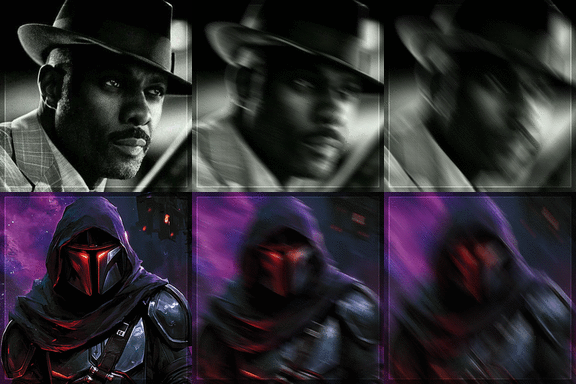
Isley the Younger cuts an imposing figure at six foot two, cruiserweight and powerfully built, with a presence shaped by discipline rather than excess. His features are strong and deliberate, a defined jaw framed by a neatly kept beard, and eyes that scan a room with quiet calculation before ever speaking. In the courts of Naboo he favors immaculate tailoring, dark suits cut close and clean, often finished with a brimmed hat worn with practiced confidence, presenting the image of a statesman who understands that perception carries its own authority. When diplomacy gives way to action, that refinement hardens into jet black beskar’gam, polished to drink in the light, a deep crimson cloak falling from his shoulders as a restrained but unmistakable declaration that he is as willing to lead from the front as he is from a throne.
PERSONALITY AND BELIEFS
Isley the Younger moves with controlled intensity; his calm exterior masking a relentless moral drive shaped by betrayal and hard memory. Of all his kin, he harbors the deepest hatred for the Sith and the Dark Side. His conviction is bordering on zealotry and was forged by watching his father serve as a puppet Mand’alor that allowed the Sith to occupy Mandalore itself.
Isley the Younger clings fiercely to the Naboo heritage of his mother and grandmother, cultivating a cadet branch of House Carde’ as both anchor and defiance, grounded in law, dignity, and restraint. Though he believes in the Mandalorians of his grandfather’s era and respects the path his uncle Aether now walks, he maintains a wary distrust of Mandalorians as a whole; for he has seen how swiftly they turned on Force sensitives under Ra Vizsla’s regime. His focus is singular and deliberate, to build something enduring with House Verd of Naboo that honors the women who shaped him and the world that sheltered them when the galaxy turned away.
Isley the Younger clings fiercely to the Naboo heritage of his mother and grandmother, cultivating a cadet branch of House Carde’ as both anchor and defiance, grounded in law, dignity, and restraint. Though he believes in the Mandalorians of his grandfather’s era and respects the path his uncle Aether now walks, he maintains a wary distrust of Mandalorians as a whole; for he has seen how swiftly they turned on Force sensitives under Ra Vizsla’s regime. His focus is singular and deliberate, to build something enduring with House Verd of Naboo that honors the women who shaped him and the world that sheltered them when the galaxy turned away.
STRENGTHS & WEAKNESSES
▲ POLITICAL PRECISION: Isley the Younger is an exceptional political operator, able to read motives, alliances, and pressure points with surgical clarity. His Naboo education and long presence in courtly spaces have given him mastery over rhetoric, negotiation, and image, allowing him to advance his aims without overplaying his hand or revealing his full intent.
▲ WARRIOR-STATESMAN: Trained in Mandalorian combat doctrine by his grandfather’s hand, Isley the Younger is more than ceremonial in armor. He is decisive, efficient, and comfortable leading from the front when required, blending tactical awareness with personal capability in a way that commands respect from soldiers and nobles alike.
▼ IDEOLOGICAL RIGIDITY: Isley the Younger's hatred of the Sith and the Dark Side borders on zealotry, leaving little room for nuance once that line is crossed. While this conviction fuels his resolve, it can narrow his strategic options, making compromise or indirect engagement difficult when Sith involvement is even suspected.
▼ GUARDED TRUST: Years of betrayal have left Isley the Younger slow to place faith in institutions or people beyond a tightly controlled circle. This caution protects him from manipulation but can hinder coalition-building, particularly among Mandalorians, where his reluctance to fully commit can be mistaken for aloofness or quiet judgment.
▲ WARRIOR-STATESMAN: Trained in Mandalorian combat doctrine by his grandfather’s hand, Isley the Younger is more than ceremonial in armor. He is decisive, efficient, and comfortable leading from the front when required, blending tactical awareness with personal capability in a way that commands respect from soldiers and nobles alike.
▼ IDEOLOGICAL RIGIDITY: Isley the Younger's hatred of the Sith and the Dark Side borders on zealotry, leaving little room for nuance once that line is crossed. While this conviction fuels his resolve, it can narrow his strategic options, making compromise or indirect engagement difficult when Sith involvement is even suspected.
▼ GUARDED TRUST: Years of betrayal have left Isley the Younger slow to place faith in institutions or people beyond a tightly controlled circle. This caution protects him from manipulation but can hinder coalition-building, particularly among Mandalorians, where his reluctance to fully commit can be mistaken for aloofness or quiet judgment.
HISTORY
Isley the Younger was born in the shadow of betrayal, the son of Amaya Cardei and a Mand’alor whose name he refuses to speak, a man elevated by Darth Carnifex to steward Mandalore during the Sith occupation. When the truth of that arrangement became impossible to outrun, Amaya fled with her son, cutting a hard line away from Mandalorian space and seeking sanctuary on Naboo. There, Isley was raised beneath the protection of his grandmother’s house, House Carde’, educated as Naboo nobility and taught that survival could be an act of quiet defiance rather than open war.
His childhood was shaped by women of formidable resolve. House Carde’ did not merely shelter him, they claimed him, instilling discipline, civic duty, and a reverence for law that stood in stark contrast to the chaos that had driven them into exile. Gratitude was not taught as sentiment but as obligation, and Isley learned early that legacy was something to be earned through conduct rather than blood alone. Naboo became his home not because it erased his past, but because it gave him the tools to endure it.
Even so, the pull of House Verd never loosened its grip. His mother filled his youth with stories of his grandfather’s rise and fall, of Vicelordship, empire, and hard choices made in impossible times. Isley the Elder, for his part, ensured those stories were matched with instruction, insisting that Mandalorian values be passed down alongside Naboo refinement. As the first grandchild of House Verd, Isley the Younger was openly favored, shaped as a bridge between worlds rather than a rejection of either.
As he came of age, House Carde’ formally sanctioned the creation of a cadet branch, granting Isley the authority to carry their name forward while binding him to their expectations. The arrangement was practical and deliberate, a way to preserve inheritance lines while extending influence beyond Naboo’s immediate courts. Through this branch, Isley established himself as a constant presence in Naboo’s political sphere, a familiar figure in its halls and councils, respected for restraint as much as resolve.
Though Naboo remains his anchor, Isley has never fully turned his back on Mandalore. In measured intervals, he lends support to his uncle Aether’s empire, most often through service with Death Watch as a mercenary rather than a courtier. The choice is intentional, allowing him to honor his grandfather’s Mandalorians while keeping a critical distance from the failures that scarred his youth. Everything he builds is dedicated to the women who saved him, to House Carde’ that raised him, and to the world that offered refuge when the galaxy proved unworthy of trust.
His childhood was shaped by women of formidable resolve. House Carde’ did not merely shelter him, they claimed him, instilling discipline, civic duty, and a reverence for law that stood in stark contrast to the chaos that had driven them into exile. Gratitude was not taught as sentiment but as obligation, and Isley learned early that legacy was something to be earned through conduct rather than blood alone. Naboo became his home not because it erased his past, but because it gave him the tools to endure it.
Even so, the pull of House Verd never loosened its grip. His mother filled his youth with stories of his grandfather’s rise and fall, of Vicelordship, empire, and hard choices made in impossible times. Isley the Elder, for his part, ensured those stories were matched with instruction, insisting that Mandalorian values be passed down alongside Naboo refinement. As the first grandchild of House Verd, Isley the Younger was openly favored, shaped as a bridge between worlds rather than a rejection of either.
As he came of age, House Carde’ formally sanctioned the creation of a cadet branch, granting Isley the authority to carry their name forward while binding him to their expectations. The arrangement was practical and deliberate, a way to preserve inheritance lines while extending influence beyond Naboo’s immediate courts. Through this branch, Isley established himself as a constant presence in Naboo’s political sphere, a familiar figure in its halls and councils, respected for restraint as much as resolve.
Though Naboo remains his anchor, Isley has never fully turned his back on Mandalore. In measured intervals, he lends support to his uncle Aether’s empire, most often through service with Death Watch as a mercenary rather than a courtier. The choice is intentional, allowing him to honor his grandfather’s Mandalorians while keeping a critical distance from the failures that scarred his youth. Everything he builds is dedicated to the women who saved him, to House Carde’ that raised him, and to the world that offered refuge when the galaxy proved unworthy of trust.
